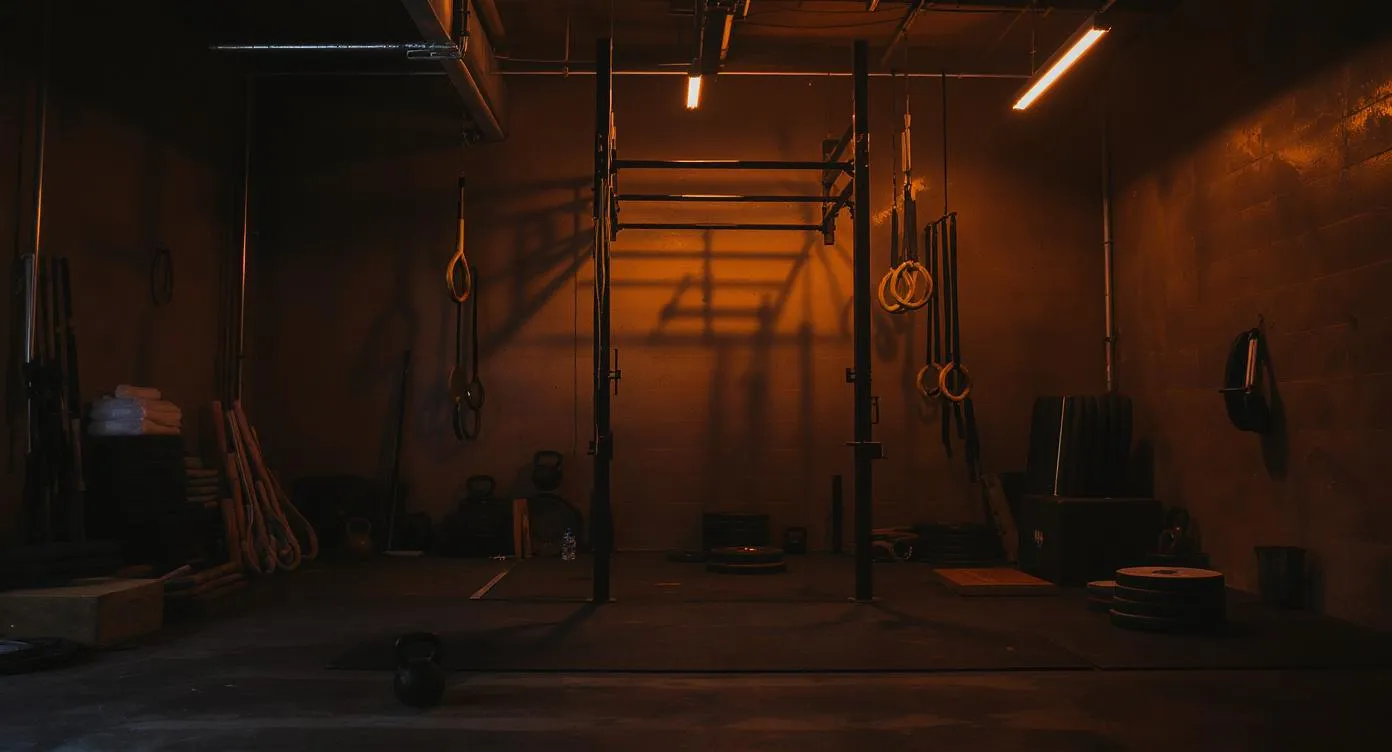
CrossFit Home Gym Build: $2,000 Complete Box (2026)
Build a complete CrossFit home gym for under $2,000. Power rack, barbell, plates, gymnastic rings, jump rope, kettlebells, and conditioning tools.
CrossFit demands more equipment variety than any other training methodology. A powerlifter needs a rack, bar, bench, and plates. A bodybuilder adds cables and dumbbells. But a CrossFit athlete needs all of that plus gymnastic rings, kettlebells, plyo boxes, slam balls, jump ropes, and ideally a conditioning machine. The constantly varied, functional movement philosophy means your garage gym has to cover barbell cycling, gymnastics, monostructural cardio, and odd-object work — all in one space.
The good news: you do not need to spend $10,000 replicating a CrossFit affiliate. This guide breaks down a complete CrossFit home gym build for under $2,000 using equipment verified on Amazon as of early 2026. Every piece was selected for CrossFit-specific performance — needle-bearing barbells for Olympic lifts, drop-safe flooring for cleans, and gymnastic rings rated for muscle-ups. If you have followed our how to build a garage gym guide, you already know the foundation. This build is the CrossFit-specific layer on top.
Why CrossFit Demands a Different Equipment Strategy
Most home gym builds start with a rack and barbell and call it done. CrossFit athletes cannot do that. The programming rotates through nine foundational movements (air squat, front squat, overhead squat, press, push press, push jerk, deadlift, sumo deadlift high pull, and medicine ball clean) plus dozens of skill movements like muscle-ups, toes-to-bar, double-unders, handstand push-ups, and pistol squats. A single workout might combine a 1RM snatch with ring muscle-ups and a 400-meter run.
That variety is what makes CrossFit effective — and what makes the equipment list longer than any other training style. The key is prioritizing intelligently. Here is the hierarchy this build follows:
- Power rack with pull-up bar — squats, bench press, overhead press, kipping pull-ups, toes-to-bar
- Olympic barbell with needle bearings — cleans, snatches, jerks, thrusters
- Weight plates — cast iron starter set, with bumper plate upgrade path
- Kettlebells — swings, snatches, Turkish get-ups, goblet squats
- Gymnastic rings — muscle-ups, ring dips, ring rows, false grip work
- Speed jump rope — double-unders, conditioning
- Plyo box — box jumps, step-ups, box jump-overs
- Slam ball — wall balls, slams, ground-to-overhead
- Adjustable bench — press variations, step-ups, accessory work
- Trap bar — farmers walks, trap bar deadlifts, conditioning carries
- Light dumbbells — dumbbell snatches, thrusters, devil's press
- Rubber flooring — drop protection, joint health, noise reduction
Every item on this list serves multiple CrossFit movements. Nothing is single-purpose. That is how you keep the budget under $2,000 while covering 90% of benchmark WODs.
The Complete CrossFit Home Gym Build ($1,879)
The total lands at $1,879, leaving $121 of headroom in the $2,000 budget for bumper plates, a weight vest, or the start of a conditioning machine fund. Every price was verified on Amazon in Q1 2026.
1. Power Rack — ULTRA FUEGO Power Cage ($389.99)

ULTRA FUEGO Power Cage, Multi-Functional Power Rack
Capacity
800 lbs
Steel
2x2" 14-Gauge Steel
Footprint
50.5" L x 46.5" W x 83.5" H
Price
$389.98
- 4.5+ star rating on Amazon with 5,000+ reviews
- Excellent value under $350
- 800 lb weight capacity
- Includes multi-grip pull-up bar
- Standard 2x2 hole spacing for attachments
- Optional lat pulldown attachment available
- 14-gauge steel is thinner than premium racks
- Plastic J-cup liners can wear over time
- Not ideal for lifters squatting 600+ lbs
Price and availability may change
The ULTRA FUEGO Power Cage is the foundation of this build. It handles 800 lbs, includes adjustable safety bars for bailing heavy squats and failed bench presses, and has a multi-grip pull-up bar that supports kipping pull-ups — a CrossFit essential. The 2x2 inch steel uprights with standard hole spacing accept aftermarket J-hooks and attachments if you want to add a dip station or landmine later.
Critical for CrossFit athletes: you must anchor this rack. Kipping pull-ups and butterfly pull-ups generate lateral and dynamic loads that will rock an unanchored rack. Bolt it to a concrete floor or a plywood platform with lag bolts. Our how to anchor a power rack guide walks through the process step by step, including the hardware you need and common mistakes to avoid.
The pull-up bar also serves as the anchor point for gymnastic rings (item 5 below), giving you ring muscle-ups, ring dips, and ring rows without any additional mounting hardware.
- 800 lb weight capacity handles any CrossFit barbell movement
- Multi-grip pull-up bar supports kipping and butterfly pull-ups
- Standard 2x2 hole spacing accepts aftermarket attachments
- Adjustable safety bars for solo training on squats and bench
- Pull-up bar doubles as gymnastic ring mounting point
- Must be anchored for kipping movements — not optional
- Footprint is 50.5 x 46.5 inches which limits floor space for WODs
- No integrated plate storage — need wall-mounted pegs or floor storage
2. Olympic Barbell — Synergee Games 20kg ($200)

Synergee Games 15kg and 20kg Colored Ceramic Coated Barbells
Capacity
1,500 lbs rated capacity
Steel
Ceramic Coated Steel / Needle Bearings
Footprint
28.5mm Shaft, 7ft Olympic Bar
Price
$149.95
- 4.7+ star rating on Amazon
- 1,000 lb capacity at mid-range price
- Needle bearings provide smooth spin for Olympic lifts
- 190K PSI tensile strength
- Dual knurling marks for powerlifting and Olympic lifts
- Best Amazon-available upgrade from budget bars
- Black phosphate finish requires regular oiling
- Not made in the USA
- Knurling is slightly less aggressive than premium bars
Price and availability may change
CrossFit demands a barbell that can handle both Olympic lifting and high-rep barbell cycling. The Synergee Games 20kg delivers both. Needle bearings provide smooth spin for cleans, snatches, and jerks — essential for catching the bar in the rack position without wrist strain. The dual knurling marks (Olympic and powerlifting spacing) mean you can grip correctly for any lift CrossFit throws at you.
The 1,000 lb static rating handles anything in a home gym context. The 28.5mm shaft diameter matches competition barbells, so your grip and feel translate directly to affiliate workouts or competition. Chrome finish resists rust in humid garage environments, though you should still wipe it down after sweaty barbell cycling sessions. Our how to choose a barbell guide explains why needle bearings matter so much for Olympic lifts.
For high-rep touch-and-go deadlifts and squat cleans — the bread and butter of CrossFit metcons — this bar tracks straight and spins consistently. At $200, it is the best value Olympic-capable barbell on the market. Read our full review.
3. Olympic Weight Set — CAP Barbell 300 lb Set ($340)

CAP Barbell 300-Pound Olympic Set (Includes 7 Feet Bar)
Capacity
300 lbs total (255 lbs plates + 45 lb bar)
Steel
Cast Iron Plates / Chrome Bar
Footprint
7ft Olympic Bar (28mm shaft)
Price
$499.99
- 4.5+ star rating with 8,000+ reviews
- Complete barbell + plate set in one purchase
- Standard Olympic 2" sleeves fit all racks
- Includes: 2x45, 2x35, 2x25, 2x10, 4x5, 2x2.5 lb plates
- Cast iron plates are durable and accurate
- Best value starter weight set available
- Bar is entry-level (bushing sleeves, mild knurling)
- Plates are not calibrated for competition use
- No bumper plates — not safe to drop on concrete
- Chrome plating on bar chips over time
Price and availability may change
The CAP Barbell 300 lb set ships with 255 lbs of cast iron plates in standard increments: two 45s, two 35s, two 25s, two 10s, two 5s, and two 2.5s plus an Olympic bar (which you can set aside since you have the superior Synergee bar above) and spring collars. That plate selection covers every prescribed CrossFit weight from 65 lb thrusters to 225 lb deadlifts.
Cast iron plates are not ideal for dropping from overhead — that is the one trade-off at this price point. For cleans where you guide the bar down, cast iron works fine. For heavy snatches where a missed lift means an overhead drop, you will want bumper plates eventually. The budget leaves room for a pair of 45 lb bumper plates ($150) as your first upgrade, and our how to choose weight plates guide covers when bumpers become essential versus nice-to-have.
The included spring collars work but will loosen during aggressive barbell cycling. Budget $15 for a pair of OSO Barbell Collars or similar lockjaw-style clips — they stay put during high-rep cleans and snatches. Read our full review.
4. Kettlebell Set — Yes4All Cast Iron Set ($150)

Yes4All Cast Iron Kettlebell 5-80 Lb for Full Body Workout
Capacity
5-80 lbs options
Steel
Solid Cast Iron
Footprint
Varies by weight
Price
$79.97
- 4.7+ star rating on Amazon with 12,000+ reviews
- Solid cast iron construction
- Durable painted finish
- Standard grip width for most users
- Available individually or in sets
- Best budget kettlebell option
- Cheaper competition-grade bells exist
- Paint can chip with heavy use
- Not ideal for kettlebell sport (uniform size)
- Handle texture varies between batches
Price and availability may change
Kettlebells are non-negotiable for CrossFit. The Yes4All Cast Iron Kettlebell Set covers 10, 15, 20, 25, and 30 lbs — enough for swings, goblet squats, Turkish get-ups, single-arm snatches, and overhead carries. The flat base means they sit stable on the floor between sets, and the wide handle accommodates two-handed swings without pinching.
For reference, CrossFit prescribes kettlebell swings at 1.5 pood (53 lb) for men and 1 pood (35 lb) for women in benchmark WODs like Helen and kettlebell Fran. The 30 lb bell in this set works for skill development and lighter metcons. Add a 35 lb and 53 lb bell individually ($40-60 each) as your swing strength develops. Most athletes spend 3-6 months at lighter weights before needing the heavier bells, so there is no rush.
The cast iron construction is virtually indestructible. These bells will outlast every other piece of equipment in your gym. Read our full review.
5. Gymnastic Rings — Double Circle Wood Rings ($49.97)

Double Circle Wood Gymnastics Rings with Quick Adjust Numbered Straps
Capacity
880 lbs
Steel
Wood / Nylon Webbing
Footprint
Multi-size wood rings with numbered straps
Price
$49.97
- 4.7+ star rating on Amazon with 8,000+ reviews
- 880 lb weight capacity handles any user
- Solid birch wood (not plastic)
- 15 ft adjustable nylon straps with metal buckles
- Easy on the hands compared to plastic rings
- Best budget gymnastic rings on Amazon
- No carry bag included
- Wood needs occasional sanding to prevent splinters
- Buckles can slip slightly under heavy load (re-adjust)
Price and availability may change
Gymnastic rings unlock three movements you cannot replicate with any other equipment: ring muscle-ups, ring dips, and false grip ring rows. These are staple CrossFit movements that appear in benchmark WODs (like the CrossFit Games Open) and daily programming. The Double Circle Wood Gymnastics Rings use solid birch wood — the same material as competition-grade Rogue rings — with an 880 lb weight rating and numbered straps for quick height adjustment.
Wood rings provide superior grip compared to plastic or metal alternatives, especially when your hands are chalked or sweaty. The texture improves as the wood absorbs chalk over time, developing a grippy patina that plastic rings never achieve. The 1.25-inch diameter matches FIG (Federation Internationale de Gymnastique) competition standards.
Hang them from the power rack pull-up bar at different heights: high for muscle-ups and ring dips, low for ring rows and ring push-ups, medium for support holds and L-sits. Adjust strap length between movements — it takes about 15 seconds once you know the numbered markings for each position. Read our full review.
6. Speed Jump Rope — WOD Nation ($15)

WOD Nation Adjustable Speed Jump Rope
Capacity
Adjustable up to 11 ft
Steel
Alloy Steel Cable / Aluminum Handles
Footprint
Pocket-sized
Price
$17.99
- 4.5+ star rating on Amazon with 14,000+ reviews
- Blazing-fast alloy steel speed cable
- Tool-free adjustable length up to 11 ft (wire cutter included)
- Smooth 360° ball-bearing rotation for double-unders
- Lightweight aluminum handles
- Great for boxing, MMA, and CrossFit conditioning
- Steel cable can fray on rough concrete over time
- Not weighted — pure speed rope (no strength training)
- Handles are slim — bigger hands may want grip tape
Price and availability may change
Double-unders appear in roughly 30% of CrossFit benchmark WODs. You need a speed rope, not a heavy boxing rope or a beaded rope. The WOD Nation Speed Jump Rope uses ball-bearing handles for frictionless rotation and a thin steel cable that cuts through the air fast enough for consistent double-unders and even triple-unders if your skill develops.
The adjustable cable length lets you dial in the exact rope length for your height — the standard recommendation is to stand on the center of the rope and adjust until the handles reach your armpits. Too long and the rope drags; too short and you catch your feet. Spend 5 minutes getting this right before your first session.
At $15, this is the highest-return piece of equipment in the entire build. Double-unders are a skill that takes weeks of dedicated practice to master, and having your own rope (rather than grabbing a random one at a box) accelerates that learning curve dramatically. Read our full review.
7. Wooden Plyo Box — Yes4All 3-in-1 ($100.47)

Yes4All Plyo Box, 3-in-1 Wooden Box Jumps with Smooth Edges & Wide Handles
Capacity
450 lbs
Steel
Wood
Footprint
20" x 24" x 30" (3-sided)
Price
$100.46
- 4.7+ star rating on Amazon with 3,500+ reviews
- Three heights in one box (20/24/30 inches)
- Sturdy 13-ply birch construction
- 550 lb static weight capacity
- Pre-cut interlocking pieces — easy assembly
- Best value plyo box on Amazon
- Edges are sharp until sanded by user
- Assembly requires a drill (screws included)
- Heavier than steel boxes once assembled
Price and availability may change
The Yes4All 3-in-1 Wooden Plyo Box provides 20-inch, 24-inch, and 30-inch jump heights by rotating the box to different faces. CrossFit prescribes 24 inches for men and 20 inches for women on standard box jumps, but the 30-inch face is there for advanced athletes and step-up variations.
Wooden plyo boxes are the CrossFit standard for a reason: they are stable, they do not bounce or shift under impact, and they handle thousands of jumps without degrading. The flat top surface is large enough for two-foot landings without worrying about missing the edge. The one downside is shin scrapes on missed jumps — some athletes wrap the front edge with a strip of pipe insulation foam as cheap shin protection.
This box also serves as an elevated surface for deficit handstand push-ups, box pistol squats (sit-to-stand on the box to develop pistol strength), and tricep dips. It is a more versatile tool than most athletes realize. Read our full review.
8. Slam Ball — Yes4All ($23.84)

Yes4All Slam Balls, 10-40lb Weighted PVC Sand Filled Workout Ball
Capacity
10-40 lbs options
Steel
Durable PVC / Sand Fill
Footprint
9-13 inch diameter
Price
$35.99
- 4.7+ star rating on Amazon with 15,000+ reviews
- Heavy-duty PVC outer shell resists tears
- Sand fill prevents bouncing
- Available from 10-50 lbs
- Great for HIIT and conditioning
- Best value slam ball on Amazon
- Stitching can wear over years of heavy use
- Surface can crack on rough concrete
- No grip texture (gets slippery with sweat)
Price and availability may change
The Yes4All Slam Ball serves double duty as both a slam ball and a wall ball target substitute. CrossFit prescribes wall ball shots at 20 lbs for men and 14 lbs for women — get the 20 lb version to start. The dead-bounce rubber shell absorbs impact without bouncing back unpredictably, making it safe for overhead slams in a garage environment.
For wall balls, mark a 10-foot and 9-foot target line on your garage wall with painter's tape. Hit that line on every rep. The slam ball is slightly smaller and denser than a traditional Dynamax-style wall ball, which means you need to adjust your catch slightly, but the movement pattern is identical. Many home gym CrossFitters prefer slam balls because they are cheaper, more durable, and take up less storage space than soft-shell wall balls.
Slam balls also work for ground-to-overhead, Russian twists, and partner med ball tosses if you train with someone. Read our full review.
9. Adjustable Bench — FLYBIRD ($110)

FLYBIRD WB2 Weight Bench, Utility Adjustable Weight Bench
Capacity
800 lbs (ASTM Certified)
Steel
Commercial-Grade Steel Frame
Footprint
48.4" L x 16.5" W x 17" H (folded)
Price
$109.99
- 4.6+ star rating on Amazon with 25,000+ reviews
- Unbeatable value under $120
- ASTM-certified 800 lb weight capacity
- 8 backrest angles (90° to -30° FID)
- Folds flat for easy storage in small spaces
- Quick 10-minute assembly
- Gap between seat and backrest at steep inclines
- No decline position on some variants
- Pad is narrower (10.2") than premium benches (12")
- Feet can slide on smooth concrete without rubber mats
Price and availability may change
The FLYBIRD adjustable bench adds flat and incline pressing, dumbbell rows, step-ups, and box jumps (for lower heights). The 800 lb weight capacity handles any pressing movement in a CrossFit context, and the 8-position backrest means you can hit flat bench, low incline, steep incline, and everything in between for accessory work.
CrossFit programming includes bench press less frequently than overhead work, but it still appears in strength cycles and accessory programming. The bench also serves as a platform for Bulgarian split squats, hip thrusts, and single-arm rows — all valuable accessory movements for addressing the imbalances that high-volume CrossFit can create.
The FLYBIRD folds flat for storage, which matters in a garage gym where floor space doubles as your WOD area. Slide it against the wall during metcons and pull it out for strength work. Read our full review.
10. Trap Bar — Bells of Steel Open Trap Bar ($299.99)

Bells of Steel Trap Bar, Open Ended Hex Bar with Rotating Sleeves & Built-in Jack
Capacity
700 lbs
Steel
Heavy-Duty Steel / Rotating Sleeves
Footprint
Open-ended design, Olympic sleeves
Price
$299.99
- Open-ended design allows easier plate loading
- Rotating Olympic sleeves for smoother lifts
- Built-in barbell jack saves your back
- Dual handle heights for high or low pulls
- 700 lb weight capacity
- Great for deadlifts, shrugs, and farmer walks
- Pricier than basic hex bars
- Open ends require more space awareness
- Heavy unit at ~55 lbs unloaded
Price and availability may change
The Bells of Steel Open Trap Bar is not a traditional CrossFit tool, but it solves two problems home gym athletes face: farmers walk loading and back-friendly deadlift variation. Farmers walks are prescribed in CrossFit programming and nearly impossible to load heavy with dumbbells alone. The trap bar handles up to 750 lbs and has dual handle heights (high handles for beginners, low handles for full range of motion). The open-ended design makes stepping into position quicker during fast-paced WODs.
Trap bar deadlifts also serve as an excellent deload variation when your lower back is fatigued from high-volume conventional deadlifts and cleans. The more upright torso position reduces spinal loading by roughly 10-15% compared to a straight bar, making it a smart tool for training around minor tweaks without losing pulling volume.
Use it for loaded carries in conditioning workouts: farmers walks, suitcase carries, and trap bar marches build grip strength and trunk stability that transfer directly to barbell cycling endurance.
11. Hex Dumbbells — CAP Light Pairs ($120)

CAP Barbell Cast Iron Hex Dumbbell, Multiple Options
Capacity
Multiple weight options
Steel
Cast Iron
Footprint
Hex shape prevents rolling
Price
$18.16
- 4.7+ star rating on Amazon with 30,000+ reviews
- Solid cast iron — virtually indestructible
- Hex shape prevents rolling
- Available in pairs from 5 to 50 lbs
- Cheapest fixed dumbbells per pound on Amazon
- Standard ergonomic handles
- Painted finish chips with heavy use
- Need multiple pairs to build a full set
- Requires significant storage space vs adjustable dumbbells
- No quick weight changes between exercises
Price and availability may change
A few pairs of light hex dumbbells (15 lb and 25 lb) cover dumbbell-specific CrossFit movements: single-arm dumbbell snatches, dumbbell thrusters, devil's press, and dumbbell clean-and-jerks. These movements appear frequently in CrossFit Open workouts and daily programming, and they cannot be replicated with a barbell.
CrossFit prescribes 50 lb dumbbells for men and 35 lb for women on most workouts. The 25 lb pair works for skill development and lighter metcons. Add heavier individual dumbbells as needed — the beauty of hex dumbbells is that you can buy single weights without committing to a full set.
The rubber hex heads prevent rolling and protect your garage floor. They stack neatly against a wall and take up minimal space. Read our full review.
12. Rubber Flooring ($80)
Horse stall mats from Tractor Supply remain the gold standard for garage gym flooring. At $50 per 4x6 foot mat (3/4 inch thick), two mats cover the rack area and provide enough drop protection for guided barbell returns from cleans and front squats. These mats weigh about 100 lbs each, so they stay in place without adhesive.
For Olympic lifting with overhead drops, you will eventually want a dedicated lifting platform. Our how to build a lifting platform guide covers a DIY platform build for under $200 that provides proper drop protection for snatches and jerks with bumper plates. But for the initial build, stall mats are sufficient for everything except aggressive overhead drops of loaded barbells.
Cut mats to fit your space with a utility knife and a straight edge. Score the rubber side, flip, score the smooth side, then snap along the score line. Wear gloves — the edges are sharp.
Running Total: $1,879 — that leaves $121 under the $2,000 budget for upgrades.
Space Requirements and Gym Layout
A CrossFit home gym needs more floor space than a powerlifting setup because WODs require room to move. Here are the minimum dimensions:
- Power rack footprint: 50.5 x 46.5 inches plus 24 inches of clearance on each side for loading plates
- WOD floor space: At least 8 x 8 feet of open floor for burpees, box jumps, kettlebell swings, and jump rope
- Ceiling height: 9 feet minimum for overhead pressing inside the rack and ring work; 10 feet preferred for box jumps and jump rope
- Total recommended area: 12 x 20 feet (240 square feet) — a standard two-car garage works perfectly
Position the rack against the back wall with the bench stored beside it. Keep the center of the garage clear for WODs. Wall-mount a plate tree or pegboard for kettlebells and plates along one side wall. The plyo box stores upright in a corner. Rings hang from the rack pull-up bar and can be coiled up when not in use.
If you are working with a smaller space, check our home gym small spaces guide for layout strategies that maximize training area in tight garages and basements.
Build Order: What to Buy First
If you cannot purchase everything at once, follow this priority sequence:
Month 1 — The Foundation ($930)
- Power rack ($389.99)
- Olympic barbell ($200)
- Weight plates ($340)
With these three items, you can do every barbell movement in CrossFit: squats, deadlifts, presses, cleans, snatches, jerks, and thrusters. Add bodyweight movements (pull-ups on the rack, push-ups, air squats, burpees) and you have enough for meaningful WODs.
Month 2 — Gymnastics and Conditioning ($165)
- Gymnastic rings ($49.97)
- Speed jump rope ($15)
- Plyo box ($100.47)
These three pieces add the gymnastics and monostructural elements that make CrossFit distinct from general strength training. Ring muscle-ups, double-unders, and box jumps appear in a huge percentage of programmed WODs.
Month 3 — Variety and Accessories ($784)
- Kettlebells ($150)
- Slam ball ($23.84)
- Adjustable bench ($110)
- Trap bar ($299.99)
- Hex dumbbells ($120)
- Rubber flooring ($80)
This final batch rounds out the gym with odd-object work, accessory tools, and floor protection. By month three, you have a complete CrossFit home gym that handles 90% of benchmark WODs as written.
Sample CrossFit WODs You Can Do With This Setup
This build covers the equipment requirements for the majority of CrossFit benchmark workouts. Here are seven classics you can program immediately:
Fran (21-15-9, for time)
- Thrusters at 95 lb / 65 lb — barbell from the rack
- Pull-ups — rack pull-up bar
Fran is the most famous CrossFit workout. Elite time is sub-2 minutes. Beginners should aim for sub-8. Scale the weight and substitute ring rows for pull-ups if needed.
Cindy (20-minute AMRAP)
- 5 pull-ups
- 10 push-ups
- 15 air squats
Pure bodyweight. No equipment except the pull-up bar. Target 20+ rounds for intermediate fitness.
Helen (3 rounds, for time)
- 400m run (use the road or driveway)
- 21 kettlebell swings at 53 lb / 35 lb
- 12 pull-ups
Substitute the 30 lb kettlebell until you build up to the prescribed weight.
Diane (21-15-9, for time)
- Deadlift at 225 lb / 155 lb
- Handstand push-ups (against the wall)
Heavy barbell plus gymnastics — the classic CrossFit combination.
Grace (30 reps for time)
- Clean and jerk at 135 lb / 95 lb
A pure barbell cycling test. This is where the Synergee's needle bearings pay for themselves — smooth spin in the rack position saves your wrists over 30 reps.
Karen (150 reps for time)
- Wall ball shots at 20 lb / 14 lb
Use the slam ball and a wall target at 10 feet (men) or 9 feet (women). This is a lung-burner that tests mental fortitude as much as physical capacity.
Murph (for time)
- 1-mile run
- 100 pull-ups
- 200 push-ups
- 300 air squats
- 1-mile run
- (With a 20 lb vest for the hero version)
Murph requires no equipment beyond a pull-up bar and a road to run on. Add a weight vest ($55.99) for the prescribed version. Partition the middle work into 20 rounds of 5-10-15 for faster completion.
What This Build Does Not Include (and When to Add It)
The $2,000 budget covers barbell, gymnastics, kettlebell, plyo, and bodyweight work. Here is what is missing and when each upgrade makes sense:
Bumper Plates — $150 for a pair of 45 lb plates Add these as your first upgrade. They allow safe overhead drops on snatches and jerks. The cast iron plates in the starter set work for cleans (guided descent) but not for missed snatches (uncontrolled drop). Priority: high.
Concept2 RowErg — $990 The gold standard rower for CrossFit. Approximately 35-40% of programmed WODs include rowing. Until you have one, substitute rowing calories with equivalent running distance (500m row = 400m run) or jump rope (500m row = 75 double-unders). Priority: medium-high, but expensive.
Sunny Health SF-B223018 or Schwinn Airdyne — $400-750 Air bikes appear in hero WODs and conditioning pieces. The Schwinn Airdyne Bike Series ($750) is the competition standard; the Sunny Health SF-B223018 ($400 refurbished) is the budget alternative. Substitute with burpees or running until you add one. Priority: medium.
Weight Vest — $55.99 Required for the prescribed version of Murph and other hero WODs. A 20 lb plate carrier style vest works. Priority: low initially, but essential for hero WOD enthusiasts.
Olympic Weightlifting Shoes — $100-150 Elevated heel improves squat depth and upright torso position for cleans, snatches, and thrusters. Nike Romaleos and Reebok Legacy Lifters are the CrossFit standards. Priority: low — useful once your Olympic lifting numbers warrant the investment.
Maintenance Schedule for CrossFit Equipment
CrossFit equipment takes more abuse than standard gym gear because of the high-rep, high-intensity nature of the training. Follow this maintenance schedule to protect your investment:
After every session:
- Wipe down the barbell knurling with a dry rag to remove chalk and sweat
- Coil gymnastic ring straps neatly to prevent fraying
- Store the jump rope hanging (never coiled tightly, which kinks the cable)
Weekly:
- Brush the barbell knurling with a nylon bristle brush to clear embedded chalk
- Wipe kettlebell handles with a damp cloth to prevent rust in humid environments
- Inspect gymnastic ring straps for wear at the buckle attachment points
Monthly:
- Apply a light coat of 3-in-1 oil to the barbell sleeves (the spinning portion) — one drop per side, spin to distribute
- Check all rack bolts and tighten any that have loosened from kipping movements
- Inspect the plyo box for splinters or delamination and sand any rough spots
- Check jump rope cable for kinks or fraying near the handles
Quarterly:
- Deep clean rubber flooring with a solution of warm water and mild dish soap
- Inspect rack anchor bolts and retighten
- Check slam ball for cracks or air leaks (slam balls degrade faster than other equipment)
For a comprehensive equipment care guide, see our barbell maintenance guide which covers cleaning, lubrication, and long-term storage.
Programming Your CrossFit Home Gym
Having the equipment is half the battle. Programming is the other half. Here are three approaches that work well for home gym CrossFit athletes:
Option 1: CrossFit.com WOD — Free daily workouts posted at crossfit.com. Scale movements and loads as needed. This is the simplest approach and what CrossFit HQ recommends for beginners.
Option 2: CrossFit Linchpin — Pat Sherwood's free programming designed specifically for home gym athletes with limited equipment. Movements are selected with garage gym constraints in mind.
Option 3: Self-Programming — Follow a 3-on-1-off or 5-on-2-off cycle with this daily structure:
- Strength (15-20 min): One barbell lift, working to a heavy single, double, or triple
- Metcon (10-20 min): An AMRAP, for-time, or EMOM workout combining 2-3 movements
- Skill (10 min): Practice one gymnastics skill — muscle-ups, handstand walks, double-unders, pistol squats
Rotate through squat, press, deadlift, clean, and snatch for the strength portion. Vary the metcon movements daily. Dedicate skill work to your weakest gymnastics movement until it becomes a strength.
Upgrade Path: From $2,000 to $5,000
Once the base build is complete and your budget allows, here is the recommended upgrade sequence:
- Bumper plates ($150) — first priority for safe Olympic lifting
- Extra kettlebells (35 lb and 53 lb, $100 total) — hit prescribed CrossFit weights
- Weight vest ($55.99) — unlock hero WODs as prescribed
- Heavier dumbbells (35 lb and 50 lb pairs, $200 total) — match Open workout weights
- Concept2 RowErg ($990) — eliminate the biggest equipment gap
- DIY lifting platform ($200) — proper drop protection for Olympic lifts
- Sunny Health SF-B223018 or Schwinn Airdyne ($400-750) — complete conditioning toolkit
- Ab mat and GHD pad ($30-50) — sit-ups and hip extension accessories
That progression takes the gym from $1,879 to approximately $3,600-3,900, covering every movement that appears in CrossFit programming including competition-level Open workouts. For a complete high-end build, see our dream gym under $5,000 guide.
Common Questions
Can I do real CrossFit in a $2,000 home gym?
Do I need bumper plates for CrossFit?
Can I really do muscle-ups on the Double Circle rings?
What about a rower? Most WODs include rowing.
How much space do I need for a CrossFit home gym?
Should I anchor the power rack for CrossFit?
What is the best free CrossFit programming for home gyms?
How does this compare to a CrossFit affiliate membership?
Additional Resources
- NSCA Home Gym Design Principles
- CPSC Home Gym Equipment Safety Guide
- ACE Strength Training Fundamentals
The Bottom Line
A complete CrossFit home gym for well under $2,000 is not a compromise build — it is a fully functional training facility that covers barbell cycling, gymnastics, kettlebell work, plyometrics, and conditioning. The 12-piece equipment list in this guide handles 90% of CrossFit benchmark workouts as written, with clear upgrade paths for the remaining 10%.
Start with the rack, barbell, and plates in month one. Add gymnastics and conditioning tools in month two. Round out with variety pieces in month three. Within 90 days, you will have a garage gym that rivals many CrossFit affiliates in equipment variety — and you will never wait for a rack, share a barbell, or pay $200 per month for a membership again.
The PRs, the improved conditioning, and the 5 AM WODs in your own garage are waiting. Build this and start training.
Derek Walsh
Strongman competitor and former commercial gym equipment salesman. Knows what survives heavy daily use.
Read full bioMore in Budget Builds
Women's Home Gym Build: Complete Equipment Guide (2026)
Build the perfect home gym for women. Glute-focused equipment, strength training essentials, and space-efficient picks for every budget.
Olympic Weightlifting Home Gym Build (2026)
Build a home gym for Olympic weightlifting. Platform specs, bar selection, bumper plates, and everything you need to snatch and clean at home.
The Best Home Gym Build for Seniors (2026)
Build a safe, effective home gym for seniors. Joint-friendly equipment picks, fall-prevention features, and age-appropriate training programs.