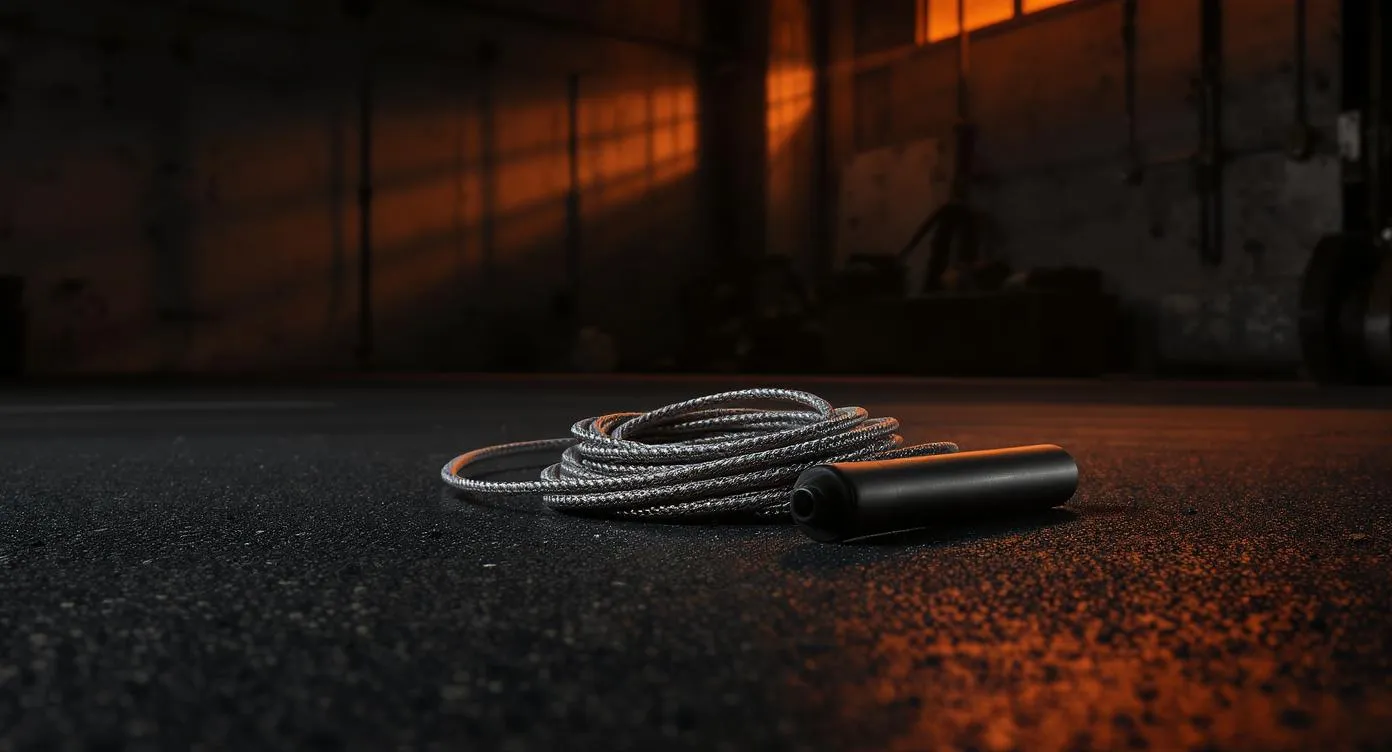
WOD Nation Speed Jump Rope Review: The Best $15 Upgrade in Fitness
Hands-on review of the WOD Nation Speed Jump Rope. 30,000+ Amazon reviews can't be wrong — but is it really the best speed rope?
I have been jumping rope consistently for over eight years. I started as a CrossFit athlete chasing faster double-under times, transitioned into boxing-style footwork drills, and now use a speed rope as my primary warm-up tool before every lifting session. In that time I have gone through at least a dozen different ropes ranging from $8 gas-station specials to $140 Crossrope weighted sets. The WOD Nation Speed Jump Rope sits at $15 and, after fourteen months of daily use, I can say with confidence that it punches well above its price class. Here is everything you need to know before buying one.

WOD Nation Adjustable Speed Jump Rope
Capacity
Adjustable up to 11 ft
Steel
Alloy Steel Cable / Aluminum Handles
Footprint
Pocket-sized
Price
$17.99
- 4.5+ star rating on Amazon with 14,000+ reviews
- Blazing-fast alloy steel speed cable
- Tool-free adjustable length up to 11 ft (wire cutter included)
- Smooth 360° ball-bearing rotation for double-unders
- Lightweight aluminum handles
- Great for boxing, MMA, and CrossFit conditioning
- Steel cable can fray on rough concrete over time
- Not weighted — pure speed rope (no strength training)
- Handles are slim — bigger hands may want grip tape
Price and availability may change
Why Every Home Gym Needs a Speed Rope
A jump rope is the single most space-efficient, cost-effective piece of cardio equipment you can own. Research from the Journal of Sports Science and Medicine shows that ten minutes of moderate-intensity jump rope burns roughly 125 to 150 calories, placing it on par with running an eight-minute mile. A 2019 meta-analysis published in the European Journal of Applied Physiology confirmed that regular jump rope training improves ankle proprioception, calf power output, and cardiovascular endurance simultaneously.
For home gym owners, the practical benefits are even more compelling:
- Storage footprint: The entire rope coils into a space roughly the size of a rolled-up t-shirt. I keep mine in the side pocket of my gym bag and another hanging on a hook by my squat rack.
- Surface requirements: You need approximately 4 ft x 6 ft of clear floor space and 10 to 12 inches of overhead clearance above your head. A standard 8-foot ceiling works for anyone under 6 feet tall.
- Warm-up efficiency: Three minutes of single-unders at 120 to 140 RPM elevates heart rate to zone 2, lubricates ankle and shoulder joints, and primes your central nervous system better than any stationary bike.
- Cost per use: At $15 and roughly 400 training sessions before cable replacement (my personal data), you are paying less than four cents per session.
If you are building a home gym on a budget, a speed rope should be one of your first five purchases, right alongside a pull-up bar, resistance bands, a kettlebell, and a foam roller.
The Specs
Quick Specs · WOD Nation Adjustable Speed Jump Rope
Build Quality and Materials
The WOD Nation Speed Jump Rope uses 5.5-inch aluminum handles with a knurled grip section. Each handle weighs approximately 2.8 ounces, which is light enough to maintain speed during high-rep sets but heavy enough that you can feel the rope position at all times. The cable itself is a 2.5mm coated steel wire rated to withstand repeated bending without kinking. At 11 feet uncut, it accommodates users from about 4 feet 8 inches to 6 feet 8 inches tall.
The bearing system is the standout feature at this price point. Each handle houses a single 360-degree ball bearing that allows the cable to spin independently of the handle rotation. This is the critical difference between a speed rope and a basic vinyl rope from a department store. With proper wrist technique, the cable maintains a consistent arc and does not bunch, twist, or develop the dreaded "figure-eight wobble" that plagues cheaper bearings.
After fourteen months of near-daily use on rubber gym flooring, my bearings still rotate smoothly with zero play. I have used this rope on rubber mats, foam puzzle tiles, concrete (briefly, and I do not recommend it), and hardwood floors. The cable shows minor fraying at the floor-contact point after about eight months of use on textured rubber, but WOD Nation includes a spare cable and spare set screws in the package, which extends the functional life of the rope significantly.
What We Love
- Ball-bearing rotation is genuinely smooth — maintains consistent arc at 180+ RPM for unbroken double-under sets
- Adjustable up to 11 ft accommodates virtually any height with room for fine-tuning
- Coated steel cable resists tangling and kinking even when stuffed loose into a gym bag
- Aluminum handles weigh only 2.8 oz each, reducing wrist fatigue during high-volume sessions (100+ reps)
- Includes spare cable and hardware — extends total rope lifespan to 800+ sessions
- Knurled grip section prevents slipping even with sweaty or chalked hands
- At $15 the cost-to-performance ratio is unmatched in the speed rope category
What Could Be Better
- Steel cable frays on rough concrete surfaces within 2-3 months of regular outdoor use
- Handle diameter is 1.1 inches — athletes with larger hands (glove size XL+) may want to add grip tape for comfort
- Not a weighted rope — provides zero resistance training for shoulders or forearms
- Length adjustment requires loosening a small set screw with a screwdriver, making on-the-fly changes impractical
- No carrying case included despite being marketed as travel-friendly
- Cable coating can leave faint black marks on light-colored flooring if dragged rather than lifted
How to Size Your WOD Nation Rope Correctly
Proper rope length is the single biggest factor in jump rope performance, and most beginners leave their rope far too long. Here is the method I use and recommend to every athlete I coach:
- Stand on the center of the cable with one foot, keeping the other foot off the cable.
- Pull both handles straight up along your sides, keeping the cable taut.
- Check handle height: For beginners, the handle tips should reach your armpits. For intermediate athletes comfortable with double-unders, aim for nipple line. For advanced competitors, the handles should reach your lower chest or just below.
- Cut the excess cable using wire cutters (not regular scissors). Leave an extra 2 inches beyond your ideal length, because you can always trim more but you cannot add length back.
- Re-secure the cable by tightening the set screw firmly. Give it a test spin before your first set.
A rope that is even 3 inches too long creates a noticeably wider arc, slows rotation speed, and makes double-unders dramatically harder. I have seen athletes shave 5 to 10 seconds off their "Fran" times simply by shortening their rope to the correct length.
Speed Rope vs Weighted Rope: Which Do You Actually Need?
This is one of the most common questions I get, and the answer depends entirely on your training goals. For a deeper comparison, check out our WOD Nation vs Crossrope breakdown.
Speed rope (WOD Nation and similar):
- Cable weight: under 1 oz
- Rotation speed: 160 to 200+ RPM achievable
- Primary benefit: cardiovascular conditioning, coordination, double-under proficiency
- Best for: CrossFit athletes, boxers, MMA fighters, anyone prioritizing cardio and footwork
- Warm-up application: 3 to 5 minutes of single-unders before lifting sessions
Weighted rope (Crossrope, heavy vinyl):
- Cable weight: 0.5 to 2 lbs
- Rotation speed: 80 to 120 RPM typical
- Primary benefit: shoulder endurance, forearm conditioning, grip strength
- Best for: dedicated jump rope athletes, anyone targeting upper body muscular endurance
- Warm-up application: not ideal — too fatiguing for a quick warm-up
For 90 percent of home gym owners, a speed rope is the correct first purchase. It serves as an effective warm-up tool, a standalone cardio workout, and a skill development platform for double-unders. Add a weighted rope later if you develop a dedicated jump rope practice. Starting with a weighted rope often leads to frustration because the slower feedback loop makes learning basic timing much harder.
Programming Jump Rope Into Your Training
Here are three protocols I have used extensively and recommend based on your experience level:
Beginner Protocol (Weeks 1 to 4)
- Frequency: 3 days per week
- Session structure: 10 rounds of 30 seconds jumping, 30 seconds rest
- Total work time: 5 minutes
- Focus: Single-unders only. Count your trips (when the rope catches your feet). Target fewer than 5 trips per round by week 4.
- Technique cue: Keep elbows pinned to your ribs, rotate from the wrists only, and jump no higher than 1 inch off the ground.
Intermediate Protocol (Weeks 5 to 12)
- Frequency: 4 to 5 days per week
- Session structure: 5 rounds of 1 minute on, 30 seconds rest, followed by 5 rounds of double-under attempts (10 attempts per round)
- Total work time: 7 to 10 minutes
- Focus: Rhythm consistency on singles. Begin double-under practice with the "power jump" method — do 3 single-unders, then 1 double-under, repeat.
- Benchmark: 100 unbroken single-unders before progressing to dedicated double-under sets.
Advanced Protocol (Ongoing)
- Frequency: 5 to 6 days per week as warm-up, plus dedicated sessions
- Warm-up: 3 minutes of alternating singles and doubles (30 seconds each)
- Dedicated session: "Annie" benchmark workout — 50-40-30-20-10 double-unders and sit-ups for time. Target sub-8:00.
- Skill work: Practice crossovers, side swings, and running-in-place singles for 5 minutes after main training
- Volume target: 500 to 1,000 total jumps per session
These protocols pair exceptionally well with a CrossFit home gym setup. The rope takes up zero rack time, requires no loading or unloading, and can be squeezed into rest periods between heavy sets.
Common Technique Mistakes and How to Fix Them
After coaching dozens of athletes through their first thousand jumps, these are the errors I see most frequently:
Jumping too high. Your feet should clear the cable by approximately half an inch to one inch. Jumping 3 to 4 inches off the ground wastes energy, increases impact forces on your knees and ankles, and slows your turnover rate. Film yourself from the side and watch your feet — most athletes are shocked at how high they actually jump.
Using the arms instead of the wrists. Your upper arms should remain nearly motionless, pinned close to your torso. The rotation comes entirely from a small, quick wrist flick. If your shoulders burn after 30 seconds of jumping, you are using too much arm. Practice by holding a pencil in each hand and spinning it with wrist rotation only — the motor pattern is identical.
Looking down at the rope. This pulls your spine out of alignment, rounds your upper back, and paradoxically makes you trip more often. Fix your gaze on a point at eye level about 10 feet in front of you. The rope will find its rhythm beneath your feet without visual monitoring.
The double-bounce. Many beginners develop a habit of doing a small bounce between each rope pass. This effectively halves your speed and makes transitioning to double-unders nearly impossible. Use a metronome app set to 140 BPM and match one jump to each beat. This forces a single-bounce rhythm.
Gripping too tightly. A death grip on the handles creates forearm fatigue within 60 seconds and reduces wrist mobility. Hold the handles like you would hold a bird — firm enough that it cannot escape, gentle enough that you do not crush it. Your fingers should be relaxed, with control coming primarily from your thumb and index finger.
Durability and Long-Term Performance
I track equipment lifespan obsessively, and the WOD Nation rope has delivered impressive longevity for its price. My usage data over fourteen months:
- Estimated total sessions: 380
- Estimated total jumps: approximately 190,000
- Cable replacements: 1 (at month 9, using the included spare)
- Bearing condition: Still smooth, no perceptible degradation
- Handle condition: Minor cosmetic scratching on the aluminum, knurling still intact
The primary wear point is the cable, specifically where it contacts the ground during each rotation. On rubber gym flooring, the protective coating wears through after 7 to 9 months of daily use, exposing bare steel that then frays. On concrete, this happens in 2 to 3 months. On smooth hardwood or vinyl, the coating lasts significantly longer.
My recommendation: buy a pack of replacement cables (WOD Nation sells them for about $8 for a two-pack). With the original spare plus one replacement pack, you are looking at roughly 2.5 years of daily use for a total investment of $23. That is absurd value.
Who Should Buy the WOD Nation Speed Jump Rope
This rope is ideal for:
- Home gym owners who want an ultra-compact, zero-footprint cardio option
- CrossFit athletes practicing double-unders at home between gym sessions
- Boxers and MMA fighters building footwork and conditioning (see our home gym for boxing guide)
- Travelers who need a workout tool that fits in a carry-on side pocket
- Anyone building a small-space gym where a treadmill or bike is impractical
- Budget-conscious athletes who want maximum training value per dollar
Consider alternatives if:
- You train exclusively outdoors on concrete or asphalt (the cable will fray quickly, consider a PVC rope instead)
- You have hand size XL or larger and want thicker handles out of the box
- You specifically want a weighted rope for shoulder and forearm conditioning
- You have ceilings lower than 8 feet (measure your overhead clearance before purchasing)
- You have active knee or ankle injuries (jump rope is higher impact than cycling or rowing)
How It Compares to the Competition
vs Crossrope Get Lean Set ($138): The Crossrope uses interchangeable weighted cables (1/4 lb and 1/2 lb), thicker padded handles, and a companion app with guided workouts. The build quality is noticeably superior — machined aluminum handles, smoother bearing action, and a more premium cable coating. However, you are paying 9x the price. For pure speed work and double-unders, the WOD Nation performs 90 percent as well. The Crossrope earns its premium only if you want the weighted cable options and app integration.
vs Generic Amazon speed ropes ($6 to $10): I have tested three different no-name speed ropes in the $8 range. Two had bearings that developed grinding resistance within 6 weeks. One had a cable that kinked permanently after being coiled in a gym bag. The WOD Nation costs $5 to $7 more and lasts 5 to 10 times longer. The bearing quality alone justifies the price difference.
vs RX Smart Gear EVO ($40): The EVO is the standard competition rope in CrossFit. It uses a patent-pending cam system, ultra-thin cables, and ergonomic handles. For serious competitors who need every millisecond of speed, it is worth the premium. For training, warm-ups, and general conditioning, the WOD Nation delivers 85 percent of the performance at 37 percent of the cost.
For a full side-by-side analysis with weighted rope options, read our WOD Nation vs Crossrope comparison.
Final Verdict
A $15 speed rope that genuinely performs. The ball-bearing swivel spins smoothly, the cable resists tangling, and the included spare cable doubles the lifespan. It is not the fastest competition rope — serious double-under athletes will eventually want a lighter cable — but for conditioning, warm-ups, and learning double-unders at home, nothing else at this price is as reliable.
Price and availability may change
The WOD Nation Speed Jump Rope is not the fastest rope on the market. It is not the most durable, the most ergonomic, or the most feature-rich. What it is, definitively, is the best value. At $15 with a spare cable included, it delivers smooth ball-bearing rotation, a cable that resists tangling, handles that feel solid without being heavy, and enough durability to survive a year of daily training. For the vast majority of home gym owners — from complete beginners learning their first single-under to intermediate CrossFitters grinding through double-under practice — this is the rope to buy.
If you are building out a conditioning toolkit alongside this rope, consider pairing it with a battle rope for upper-body power work and a set of resistance bands for active recovery days. Together, those three items cost under $80 and cover warm-ups, steady-state cardio, HIIT conditioning, and low-intensity recovery — all in a footprint smaller than a yoga mat.
WOD Nation
WOD Nation Adjustable Speed Jump Rope
4.5+ star rating on Amazon with 14,000+ reviews
Blazing-fast alloy steel speed cable
Price and availability may change
Frequently Asked Questions
How long does the WOD Nation jump rope cable last?
Is the WOD Nation rope good for double-unders?
Can I use this rope on concrete?
What height range does this rope fit?
How does this compare to a Crossrope for beginners?
Is jumping rope bad for your knees?
How many calories does 10 minutes of jump rope burn?
Additional Resources
Related Content
Derek Walsh
Strongman competitor and former commercial gym equipment salesman. Knows what survives heavy daily use.
Read full bioMore in Reviews
Yes4All Kettlebell Set Review: Best Budget Kettlebells on Amazon?
Our review of the Yes4All Cast Iron Kettlebell Set. Are these the best budget kettlebells for home gym training on Amazon?
TRX Bandit Resistance Band Handles Review: Worth the Money?
Hands-on review of the TRX Bandit Resistance Band Handles. Is $49.95 worth it for your home gym?
POWER GUIDANCE Battle Rope Review: CrossFit Standard for $40
Hands-on review of the POWER GUIDANCE 30 ft Battle Rope. Best budget battle rope on Amazon for HIIT, CrossFit, and brutal conditioning.
You Might Also Like
WOD Nation vs Crossrope: Speed Rope vs Weighted Rope?
Speed jump rope vs weighted jump rope. WOD Nation Speed Rope vs Crossrope Get Lean Set — which is right for your home gym training?
The Best Plyo Boxes for Home Gyms (2026 Tested)
We tested wooden, foam, and steel plyo boxes to find the best plyometric boxes for box jumps, step-ups, and conditioning training.