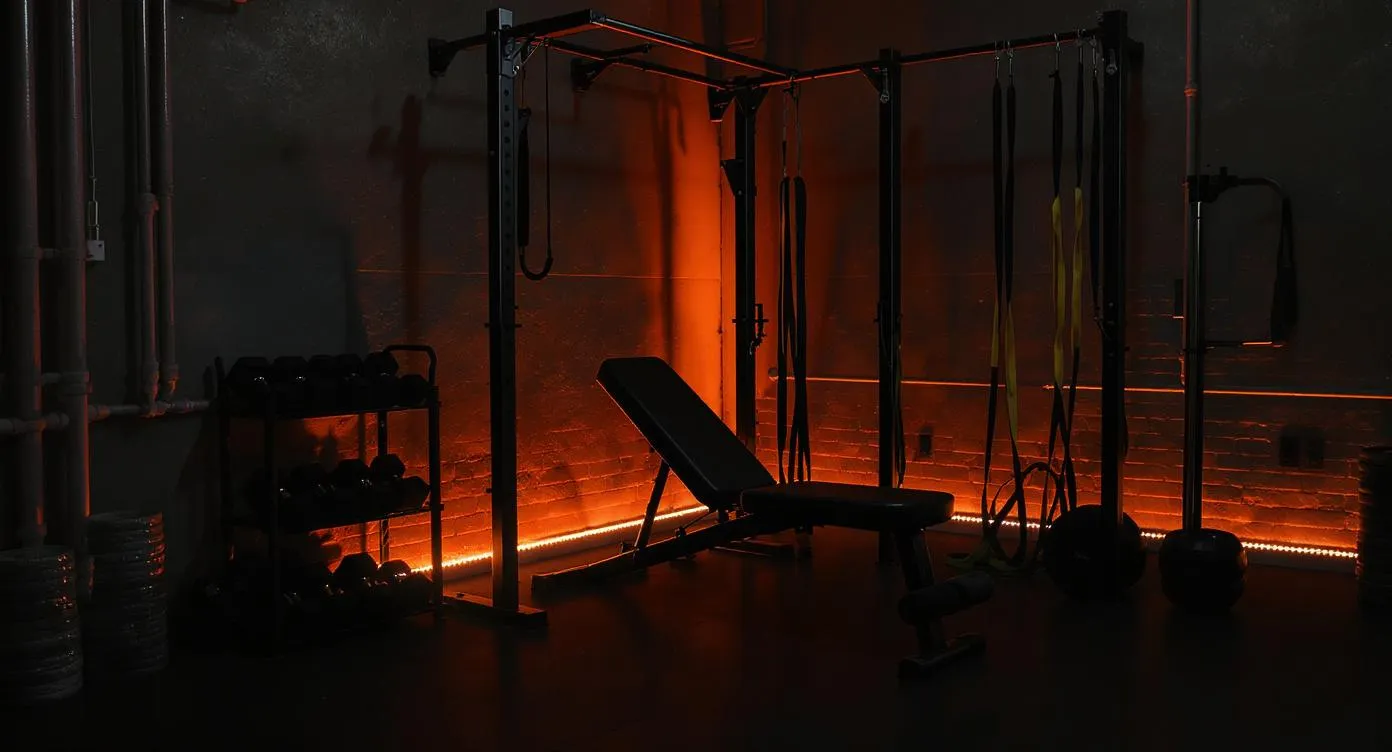
Home Gym in Small Spaces: Building in Under 100 Sq Ft
How to build a complete home gym in a small space (bedroom, corner, closet). Space-efficient equipment and creative layout tips.
With just 50-80 sq ft (an 8x10 corner), you can fit adjustable dumbbells, a foldable bench, and a wall-mounted pull-up bar for a complete training setup. Prioritize adjustable and foldable equipment that stores vertically.
You do not need a two-car garage, a spare bedroom, or a commercial lease to build a serious training space. Some of the strongest people I know train in converted closets, apartment corners, and single-car garages packed with lawn equipment. The constraint is not space — it is planning. With deliberate equipment selection, wall-mounted storage solutions, and a layout strategy that treats every square foot as real estate, you can build a home gym in under 100 square feet that handles everything from heavy compound lifts to conditioning work.
This guide covers exact space requirements by training style, the equipment that earns its footprint in a small gym, four proven layout strategies with dimensions, noise management for shared-wall living, flooring considerations, sample programming, maintenance in tight quarters, and the mistakes that waste both money and space. Whether you are squeezing a gym into a studio apartment spare corner or carving out a training zone in a crowded garage, everything you need is here.
Understanding Your Space Requirements
Before buying a single piece of equipment, measure your available area accurately. Grab a tape measure, not a rough estimate. Account for ceiling height (critical for overhead pressing and pull-ups), door swing clearance, and any permanent obstructions like water heaters, electrical panels, or load-bearing columns. Then match your space to these training tier benchmarks.
Tier 1: Ultra-Compact (35-49 sq ft / 7' x 7')
This is the absolute minimum for meaningful resistance training. You have enough room for a set of adjustable dumbbells on a small stand, a doorway-mounted pull-up bar, resistance bands anchored to a door or wall bracket, and a yoga mat for floor work. Barbell training is not practical at this size. Focus on dumbbell complexes, bodyweight progressions, and band-resisted movements.
Ceiling requirement: 7.5 feet minimum for standing dumbbell presses. Below that, seated pressing only.
Tier 2: Functional Small Space (50-80 sq ft / 8' x 10')
The sweet spot for apartment and spare-room gyms. This footprint accommodates a foldable weight bench, adjustable dumbbells, a wall-mounted or doorway pull-up bar, kettlebells, and possibly a compact squat stand pair. You can perform every major movement pattern — squat, hinge, press, pull, carry — with appropriate loading.
Ceiling requirement: 8 feet minimum. 9 feet preferred for overhead barbell work if using squat stands.
Tier 3: Complete Small Gym (80-120 sq ft / 10' x 12')
Full power rack territory. At this size you can fit a compact cage (the ULTRA FUEGO Power Cage footprint is 50.5 inches by 46.5 inches), an adjustable bench that slides in and out of the rack, a plate tree stored against the wall, adjustable dumbbells, and enough working space to move freely. This is a legitimate strength training facility that rivals a commercial gym for individual use.
Ceiling requirement: 8.5 feet minimum for racking a barbell overhead in a cage. Measure your standing height with arms extended and add 6 inches.
Space-Efficient Equipment: The Priority Buy Order
In a small gym, every piece of equipment must justify its footprint with training versatility. The following priority order maximizes training options per square foot, from highest value to lowest.
Priority 1: Adjustable Dumbbells — The Non-Negotiable Foundation

BowFlex Results Series SelectTech Dumbbells
Capacity
5-52.5 lbs each
Steel
Steel Plates / Nylon Dial Mechanism
Footprint
16.9" L x 8.3" W x 9" H each
Price
$429.00
- 4.7+ star rating on Amazon with 15,000+ reviews
- Replaces 15 sets of dumbbells (5-52.5 lbs)
- Fastest weight change system on the market (2 seconds)
- 2.5 lb increments up to 25 lbs
- Compact cradle storage footprint
- Sold as a pair
- Cannot be dropped — internal mechanism is fragile
- Length at 52.5 lbs feels awkward on some exercises
- Price has increased from original $349 MSRP
- 5 lb increments above 25 lbs
Price and availability may change
The Bowflex SelectTech 552 replaces 15 pairs of fixed dumbbells spanning 5 to 52.5 lbs — equipment that would occupy an entire wall of a commercial gym — with a single pair sitting in a cradle that measures roughly 17 inches by 9 inches per dumbbell. That is approximately 2 square feet of total floor space for 30 incremental weight options. No other single purchase delivers this kind of space-to-versatility ratio.
The 2.5 lb increments from 5 to 25 lbs matter for shoulder isolation work and progressive overload on smaller muscle groups. Above 25 lbs, the increments jump to 5 lbs, which is standard. The dial mechanism changes weight in under two seconds — critical for supersets and drop sets where rest periods are short. Read our detailed Bowflex 552 review for long-term durability testing and comparison against the PowerBlock Elite.
Small-space tip: Store the Bowflex cradle against a wall or under a bench when not in use. The cradle itself is the only footprint — no separate rack required.
Priority 2: Foldable Adjustable Bench

FLYBIRD WB2 Weight Bench, Utility Adjustable Weight Bench
Capacity
800 lbs (ASTM Certified)
Steel
Commercial-Grade Steel Frame
Footprint
48.4" L x 16.5" W x 17" H (folded)
Price
$109.99
- 4.6+ star rating on Amazon with 25,000+ reviews
- Unbeatable value under $120
- ASTM-certified 800 lb weight capacity
- 8 backrest angles (90° to -30° FID)
- Folds flat for easy storage in small spaces
- Quick 10-minute assembly
- Gap between seat and backrest at steep inclines
- No decline position on some variants
- Pad is narrower (10.2") than premium benches (12")
- Feet can slide on smooth concrete without rubber mats
Price and availability may change
A bench transforms dumbbell training from a limited exercise list into a comprehensive program. Incline pressing, decline pressing, seated shoulder press, chest-supported rows, Bulgarian split squats, step-ups, hip thrusts — the bench unlocks all of these. But in a small space, the bench must fold.
The FLYBIRD adjustable bench folds to 17 inches deep and stands upright against a wall, occupying less than 1.5 square feet when stored. When deployed, it offers seven back positions and three seat positions with a 700 lb weight capacity. That capacity matters — your body weight plus the load of two 52.5 lb dumbbells on a heavy bench press easily exceeds 300 lbs. Read our FLYBIRD bench review for adjustment mechanism durability details.
Critical check: Before buying any bench, measure your available floor space with the bench fully flat and add 12 inches on each side for arm clearance during pressing movements. A bench that is 44 inches long needs roughly 68 inches (5.5 feet) of clear length for pressing.
Priority 3: Doorway or Wall-Mounted Pull-Up Bar

Iron Gym Pull-Up Bar, Total Upper Body Workout Bar for Doorway
Capacity
300 lbs user weight
Steel
Steel / Foam Grips
Footprint
Fits doorways 24-32 inches wide
Price
$26.00
- 4.5+ star rating on Amazon with 60,000+ reviews
- No screws or installation required
- Multiple grip positions (wide, narrow, neutral)
- Removable for door access
- Best-selling doorway pull-up bar on Amazon
- Cheapest entry into upper body training
- Limited to 300 lb user weight
- Cannot be used for kipping or muscle-ups
- Can damage doorframe trim with heavy use
- Width restricted to standard doorways
Price and availability may change
The pull-up bar takes zero floor space and unlocks the entire vertical pulling plane that dumbbells cannot replicate. Wide-grip pull-ups, chin-ups, neutral-grip pulls, hanging leg raises, hanging knee raises, and dead hangs for grip and shoulder health — all from a single bar that mounts in a doorway or bolts to a wall.
The Iron Gym Total Upper Body Workout Bar supports up to 300 lbs and installs in seconds without hardware using leverage against the door frame. For a permanent setup, wall-mounted pull-up bars rated for 500+ lbs handle dynamic movements like kipping and weighted pull-ups far more safely than doorway models.
Expansion path: Hang a TRX GO Suspension Trainer or a pair of gymnastic rings from the pull-up bar to add rows, dips, push-up variations, face pulls, and dozens of core movements — all with zero additional floor space.

TRX GO Suspension Trainer, Portable Gym for Full Body Exercise
Capacity
350 lbs user weight
Steel
Mil-Spec Nylon Webbing / Reinforced Hardware
Footprint
Fits in a small bag
Price
$139.95
- 4.6+ star rating on Amazon with 5,000+ reviews
- Original TRX brand quality
- Fits in a backpack (best for travel)
- 300+ exercises possible
- Includes door anchor and carry bag
- Lifetime warranty on hardware
- Pricier than knockoff suspension trainers
- Requires a sturdy anchor point overhead
- Door anchor only works on inward-opening doors
- Not ideal for explosive movements
Price and availability may change
The TRX GO weighs 1.56 lbs, packs into a mesh bag smaller than a water bottle, and provides over 80 exercises from a single anchor point. For small-space gyms, this is arguably the highest value-per-square-foot accessory available. See our guide to essential home gym accessories for more compact training tools.
Priority 4: Kettlebells

Yes4All Cast Iron Kettlebell 5-80 Lb for Full Body Workout
Capacity
5-80 lbs options
Steel
Solid Cast Iron
Footprint
Varies by weight
Price
$79.97
- 4.7+ star rating on Amazon with 12,000+ reviews
- Solid cast iron construction
- Durable painted finish
- Standard grip width for most users
- Available individually or in sets
- Best budget kettlebell option
- Cheaper competition-grade bells exist
- Paint can chip with heavy use
- Not ideal for kettlebell sport (uniform size)
- Handle texture varies between batches
Price and availability may change
Kettlebells occupy 1 to 2 square feet of floor space but unlock an entire training methodology — swings, cleans, snatches, Turkish get-ups, goblet squats, farmer carries, halos, windmills. Unlike dumbbells, the offset center of mass trains grip strength, core stabilization, and hip explosiveness simultaneously. A single 35 lb kettlebell provides a complete conditioning workout.
The Yes4All cast iron kettlebell set provides three weights for progressive loading. Start with a 25 lb bell for pressing and get-ups, a 35 lb bell for swings and cleans, and work toward a 53 lb bell for heavy two-hand swings and goblet squats. Stack kettlebells in a corner or on a small shelf — they nest vertically and take almost no room. Read our Yes4All kettlebell review for handle finish and coating durability details, or our kettlebell selection guide for sizing recommendations.
Priority 5: Resistance Bands

Bodylastics PRO Series Resistance Band Set (6 Bands, 280 lbs)
Capacity
6 bands stackable to 280 lbs
Steel
Anti-Snap Natural Latex Tubing
Footprint
Handles, ankle straps, door anchor + carry bag
Price
$61.97
- 4.6 star rating on Amazon with 2,600+ reviews
- Patented anti-snap inner cord for safety
- 6 bands stackable up to 280 lbs total resistance
- Includes handles, ankle straps, and door anchor
- Lifetime replacement on bands
- Travel-friendly storage bag
- Resistance feels different than free weights
- Door anchor requires an inward-opening door
- Handles wear faster than the bands
Price and availability may change
Resistance bands store in a drawer and provide up to 280 lbs of stackable resistance. They replicate cable machine exercises — face pulls, tricep pushdowns, lat pulldowns, woodchops, banded squats — without any permanent footprint. Anchor them to a door bracket, a pull-up bar, or a heavy piece of furniture.
The Bodylastics PRO set includes six bands from 10 to 90 lbs, handles, ankle straps, and a door anchor. Loop bands (not tube bands) are also worth owning for banded hip thrusts, glute bridges, and warming up before heavy work.
Priority 6: Compact Power Rack (If Space Allows)

ULTRA FUEGO Power Cage, Multi-Functional Power Rack
Capacity
800 lbs
Steel
2x2" 14-Gauge Steel
Footprint
50.5" L x 46.5" W x 83.5" H
Price
$389.98
- 4.5+ star rating on Amazon with 5,000+ reviews
- Excellent value under $350
- 800 lb weight capacity
- Includes multi-grip pull-up bar
- Standard 2x2 hole spacing for attachments
- Optional lat pulldown attachment available
- 14-gauge steel is thinner than premium racks
- Plastic J-cup liners can wear over time
- Not ideal for lifters squatting 600+ lbs
Price and availability may change
If your available area reaches 64+ square feet with 8.5 feet of ceiling clearance, a compact power rack transforms your gym from good to complete. The ULTRA FUEGO Power Cage footprint measures 50.5 by 46.5 inches — roughly 16 square feet — and provides a 800 lb weight capacity with safety bars for solo barbell squats, bench press, overhead press, and rack pulls. The included multi-grip pull-up bar eliminates the need for a separate doorway bar.
This is a meaningful upgrade over squat stands because the safety bars allow you to train to failure alone — a critical safety factor when there is no training partner available. Read our ULTRA FUEGO Power Cage review for assembly details, or browse our power rack selection guide for alternatives with different footprints.
If the ULTRA FUEGO is too large: Wall-mounted fold-down squat racks exist that fold flat against the wall when not in use, freeing 100% of floor space between sessions. These cost more ($400-800) but solve the footprint problem entirely.
Pros and Cons of Training in a Small Space
- Lower total equipment cost — focused purchases eliminate unnecessary spending
- Faster setup and teardown — everything is within arm's reach
- Forces exercise selection discipline which often improves training outcomes
- No commute time or gym membership fees ($40-80/month saved)
- Train any time without scheduling around gym hours or waiting for equipment
- Equipment resale value retains 60-70% if your space situation changes
- Privacy for training — no audience, no judgment, full focus
- Limited exercise variety compared to a full-size gym or commercial facility
- Barbell training requires minimum 64+ sq ft which eliminates the smallest setups
- Noise management is critical in apartments and shared-wall housing
- Ceiling height restrictions may prevent overhead pressing and pull-ups
- Ventilation can be poor in closets, basements, and interior rooms without windows
- No spotter available — safety bars or self-limiting exercises are mandatory
- Storage between sessions requires disciplined organization
Four Proven Small-Space Layout Strategies
Strategy 1: The Wall Workout (32 sq ft)
Mount everything on a single 8-foot wall section and use 4 feet of floor depth for training.
Wall setup (top to bottom):
- Pull-up bar at 7-7.5 feet (with TRX or rings hanging from it)
- Wall-mounted barbell holder at 5 feet (horizontal storage for one barbell)
- Pegboard or shelf at 3 feet (kettlebell storage, bands, collars)
- Floor level: adjustable dumbbells in cradle, foldable bench stored vertically
Active training zone: 8 feet wide by 4 feet deep (32 sq ft). Foldable bench deploys into this zone during pressing work and stores vertically against the wall between sets if needed.
Best for: Apartment spare walls, garage side walls, basement walls with studs for mounting.
Strategy 2: The Corner Gym (48 sq ft)
Use a room corner where two walls meet to anchor storage and mount equipment, with a 6-by-8-foot training zone extending from the corner.
Corner anchor: Adjustable dumbbells on a small stand tucked into the corner. Pull-up bar spans the shorter wall. Kettlebells line the base of the longer wall. Bench leans vertically against the longer wall when stored.
Active zone: 6 feet by 8 feet (48 sq ft) of clear floor with interlocking foam tiles or a single horse stall mat underneath.
Best for: Spare bedrooms, large walk-in closets, garage corners next to parked vehicles.
Strategy 3: The Dedicated Room (80-100 sq ft)
Convert a spare bedroom, den, or enclosed porch into a permanent training room.
Layout: Compact power rack against the back wall. Bench slides into the rack for pressing and stores alongside it. Plate tree to the rack's left. Adjustable dumbbells on the rack's right. Pull-up bar is built into the rack — no separate mount needed. Mirror on the opposite wall for form checking.
Active zone: 10 feet by 10 feet (100 sq ft) with rubber flooring covering the full area.
Best for: Anyone with a spare room they can commit permanently to training.
Strategy 4: The Invisible Gym (0 dedicated sq ft)
For studio apartments and shared spaces where no permanent gym footprint is acceptable.
Equipment: Doorway pull-up bar (installs and removes in 5 seconds). Adjustable dumbbells stored under the bed or in a closet. Resistance bands in a drawer. Yoga mat rolled up behind furniture. Kettlebell in a closet corner.
Training method: Deploy equipment into any open floor space (living room, bedroom), train, return everything to storage. Total active footprint during training: approximately 6 by 6 feet (36 sq ft). Total storage footprint: effectively zero visible space.
Best for: Studio apartments, shared living situations, renters who cannot mount anything to walls.
Flooring for Small Spaces
Flooring protects your subfloor from dropped weights, reduces noise transmission to lower floors, and provides a stable non-slip surface for lifting. In a small space, you do not need to cover an entire room — just the active training zone.

BalanceFrom Puzzle Exercise Mat 1/2' Thick, EVA Interlocking Foam Floor Tiles for Home Gym, Mat for Home Workout Equipment, Floor Padding for Kids, Black, 24 in x 24 in x 1/2 in, 24 Sq Ft - 6 Tiles
Capacity
N/A — flooring
Steel
High-Density EVA Foam (1/2" thick)
Footprint
24 sq ft (6 tiles)
Price
$25.99
- 4.5+ star rating on Amazon with 40,000+ reviews
- 24 sq ft covers a full lifting platform area
- 1/2 inch thick EVA foam absorbs impact and noise
- Interlocking design — no adhesive needed
- Easy to cut for custom fit around racks
- Best budget gym flooring on Amazon
- Puzzle seams can separate under heavy racks
- Not as durable as horse stall mats for deadlifts
- Slight chemical smell for first few days
Price and availability may change
For dumbbell-only setups (Tier 1-2): Interlocking foam puzzle mats like the BalanceFrom set provide adequate protection at $1 per square foot. They compress under heavy loads but handle dumbbell training, bodyweight work, and kettlebell swings without issue. Cover your active zone — typically 24 to 48 square feet.
For rack-based setups (Tier 3): Horse stall mats (3/4-inch rubber, $45 per 4x6 mat from Tractor Supply) are the gold standard. One or two mats cover the rack footprint and lifting zone. They do not shift, compress minimally under heavy loads, and last decades. Cut them to fit your exact space with a utility knife and a straight edge. See our complete gym flooring guide for detailed comparison of materials.
Apartment consideration: If you train above another occupied unit, double-layer your flooring — puzzle mat underneath for vibration absorption, rubber mat on top for impact protection. This combination reduces noise transmission by roughly 60-70% compared to bare floor.
Noise and Neighbor Management
Small-space gyms almost always share walls, floors, or ceilings with other people. Noise management is not optional — it determines whether your gym survives long-term or gets shut down by complaints. This applies to apartments, townhouses, condos, and any home where family members sleep while you train.
The five rules of quiet training:
- Never drop weights. Lower every rep under control on every set of every exercise. This alone eliminates 80% of gym noise. Bumper plates are unnecessary in small spaces — you should not be dropping barbells in a bedroom.
- Double-layer your flooring. Foam underlayment plus rubber mat on top absorbs both impact noise (traveling through the structure) and airborne noise (traveling through walls).
- Control tempo on eccentrics. A 3-second controlled lowering on every rep produces almost zero noise. Fast eccentrics with sudden stops at the bottom create sharp impact sounds.
- Eliminate jumping and plyometrics. Box jumps, burpees, and jump rope in an upstairs apartment are guaranteed complaints. Substitute with step-ups, sprawls, and cycling or rowing.
- Train during reasonable hours. Even with perfect technique, keep training to 7 AM to 9 PM in shared buildings. Early morning kettlebell swings are quiet to you but the vibration travels.
For comprehensive soundproofing strategies including wall treatment and door sealing, read our soundproofing guide.
Equipment to Skip in Small Spaces
Not every popular piece of gym equipment earns its footprint in a sub-100 sq ft setup. These are the common purchases that waste space:
Full-size treadmills and ellipticals — 20+ square feet of permanent footprint for a single training modality. A jump rope ($15), a Stamina InMotion Compact Strider (24 by 18 inches, stores under a desk), or outdoor running provide better cardio-to-space ratios.
Fixed dumbbell racks — A 5-to-50 lb fixed dumbbell set with rack occupies 8+ square feet and costs $700+. Adjustable dumbbells replace all of them in 2 square feet.
Large cable crossover machines — 30+ square feet. A wall-mounted cable station like the Valor Fitness Wall Mount Cable Machine provides similar functionality in zero floor space, or resistance bands replicate most cable movements for free.
Multi-station home gyms (Bowflex-style) — 35+ square feet of permanent footprint for movements you can replicate with dumbbells, bands, and bodyweight.
Full-size power racks in spaces under 64 sq ft — The rack itself may fit, but without clearance around it for loading plates and moving safely, it becomes a hazard rather than an asset.
Small-Space Equipment Checklist by Budget
Budget Build ($250-400)
5 itemsOptimal Build ($700-1,000)
7 itemsComplete Small-Space Gym ($1,200-1,800)
8 itemsSample Small-Space Training Programs
Program A: Dumbbell-Only Full Body (3 days/week, 35 minutes)
This program requires only adjustable dumbbells, a bench, and a pull-up bar. Footprint needed: 36 sq ft.
Warm-Up (5 min): Band pull-aparts (25 reps), arm circles (20 each direction), bodyweight squats (15 reps), hip circles (10 each direction).
Workout (25 min, rotate A/B each session):
Day A — Push/Squat Focus:
- Goblet Squat: 4x10 (60-90 sec rest)
- Dumbbell Bench Press: 4x8 (90 sec rest)
- Dumbbell Overhead Press: 3x10 (60 sec rest)
- Bulgarian Split Squat: 3x10 each leg (60 sec rest)
- Dumbbell Lateral Raise: 3x12 (45 sec rest)
- Tricep Overhead Extension: 2x15 (45 sec rest)
Day B — Pull/Hinge Focus:
- Dumbbell Romanian Deadlift: 4x10 (90 sec rest)
- Pull-Ups or Chin-Ups: 4x max reps (90 sec rest)
- Single-Arm Dumbbell Row: 3x10 each side (60 sec rest)
- Dumbbell Hip Thrust: 3x12 (60 sec rest)
- Hammer Curls: 3x12 (45 sec rest)
- Face Pulls with Band: 3x15 (45 sec rest)
Finisher (5 min): Kettlebell swings — 10 reps every minute on the minute (EMOM) for 5 minutes.
Program B: Rack-Based Strength (4 days/week, 45 minutes)
This program requires a compact power rack, barbell, plates, dumbbells, and a bench. Footprint needed: 80 sq ft.
Upper Body A (Monday): Barbell bench press 4x5, barbell overhead press 3x8, dumbbell row 4x8, dumbbell lateral raise 3x12, tricep pushdown with band 3x15.
Lower Body A (Tuesday): Barbell back squat 4x5, Romanian deadlift 3x8, Bulgarian split squat 3x10, kettlebell swing 3x15, hanging leg raise 3x10.
Upper Body B (Thursday): Barbell overhead press 4x5, weighted pull-ups 3x6, incline dumbbell press 3x10, face pulls with band 4x15, bicep curls 3x12.
Lower Body B (Friday): Barbell deadlift 3x5, front squat 3x8, dumbbell walking lunge (in place) 3x10 each, goblet squat 2x15, plank 3x45 sec.
Progressive overload weekly: add 5 lbs to barbell lifts, 2.5 lbs to dumbbell lifts, or 1-2 reps when weight cannot increase. For detailed programming guidance, see our home gym programming guide.
Maintenance in Tight Quarters
Equipment maintenance becomes more important in small spaces because moisture, sweat, and limited airflow accelerate corrosion and wear.
After every session: Wipe down dumbbell handles, bench padding, and barbell knurling with a dry microfiber cloth. Sweat left on chrome or bare steel causes surface rust within days in humid environments.
Weekly: Inspect resistance band rubber for nicks, cracks, or discoloration near anchor points. A snapped band in a small space hits walls, mirrors, or your face. Replace any band showing visible wear immediately.
Monthly: Apply 3-in-1 oil to barbell sleeves if you own a barbell. Tighten all bolts on your bench and rack — vibration from training loosens hardware over time. Check pull-up bar mounting hardware for wall damage or loosening.
Quarterly: Deep clean all equipment with a mild detergent solution. Inspect flooring edges for curling or separation. Check ceiling and wall anchor points for any signs of pulling away from studs.
Ventilation matters: In a closet or interior room gym, run a fan during and after training to circulate air and accelerate sweat evaporation from equipment surfaces. Stagnant humid air is the number one enemy of steel gym equipment. If your space has no windows, a small USB-powered desk fan pointed at your equipment storage area makes a meaningful difference. Our ventilation guide covers airflow solutions in detail.
Safety Considerations for Solo Small-Space Training
Training alone in a small space introduces specific safety risks that do not exist in a commercial gym with staff and other members present.
Never bench press heavy without safety bars or spotter arms. If you train in a rack, set the safety bars 1 inch below your chest position. If you train with dumbbells only, learn the "roll of shame" technique for failed reps — tip the dumbbells to your hips and sit up.
Secure all wall-mounted equipment to studs, not drywall. A pull-up bar that pulls out of drywall anchors during a kipping rep can cause serious injury. Use a stud finder, drill pilot holes, and verify every mounting point before loading.
Keep the training zone clear of obstacles. In a small space, a stray kettlebell behind your heels during a squat is a trip hazard. Develop the habit of returning every piece of equipment to its storage position between exercises.
Ensure a clear path to exit. Never position equipment so that it blocks your only way out of the training area. In a closet or small room gym, the door should always be accessible.
For a complete safety checklist including electrical considerations and emergency planning, read our garage gym safety guide.
Common Questions
Can I build a serious home gym in an apartment without damaging anything?
What's the absolute smallest space for a functional home gym?
Are adjustable dumbbells worth the premium price over fixed dumbbells for small spaces?
Can I do squats without a power rack in a small space?
How do I prevent rust on equipment in a small indoor space?
Is 60 sq ft enough for a power rack?
What's the best cardio option for a small space?
How do I manage noise when training in an upstairs apartment?
Additional Resources
Related Content
- Apartment Home Gym Under $300
- Home Gym Under $500
- How to Soundproof Your Garage Gym
- All Small Space & Apartment Gym Content
- Best Adjustable Dumbbells
- FLYBIRD Bench Review
- Bowflex 552 Review
The Bottom Line
A small space is a constraint, not a limitation. The most effective home gym is not the one with the most equipment — it is the one you actually use consistently. A 50 square foot corner with Bowflex 552 adjustable dumbbells, a FLYBIRD foldable bench, a doorway pull-up bar, a pair of kettlebells, and resistance bands provides enough training stimulus for years of measurable strength and physique progress. Add a compact power rack like the ULTRA FUEGO Power Cage when your space and budget allow, and you have a setup that handles every major barbell lift safely.
Measure your space, buy in priority order, mount what you can on walls, fold and store what you cannot leave out, and train hard. The 400-square-foot commercial gym floor you are not paying $50 a month for is a feature, not a bug.
Derek Walsh
Strongman competitor and former commercial gym equipment salesman. Knows what survives heavy daily use.
Read full bioMore in Guides
Strength vs Hypertrophy: How to Program for Your Goals (2026)
The definitive guide to programming for strength vs size in your home gym. Rep ranges, volume, intensity, and complete programs for both goals.
The Complete Home Gym Warm-Up Guide (2026)
Stop skipping your warm-up. Complete warm-up protocols for every training style, plus the equipment that makes preparation effortless at home.
Home Gym Deload Guide: When and How to Back Off (2026)
Learn when and how to deload in your home gym. Science-backed protocols, recovery strategies, and signs you need a rest week.