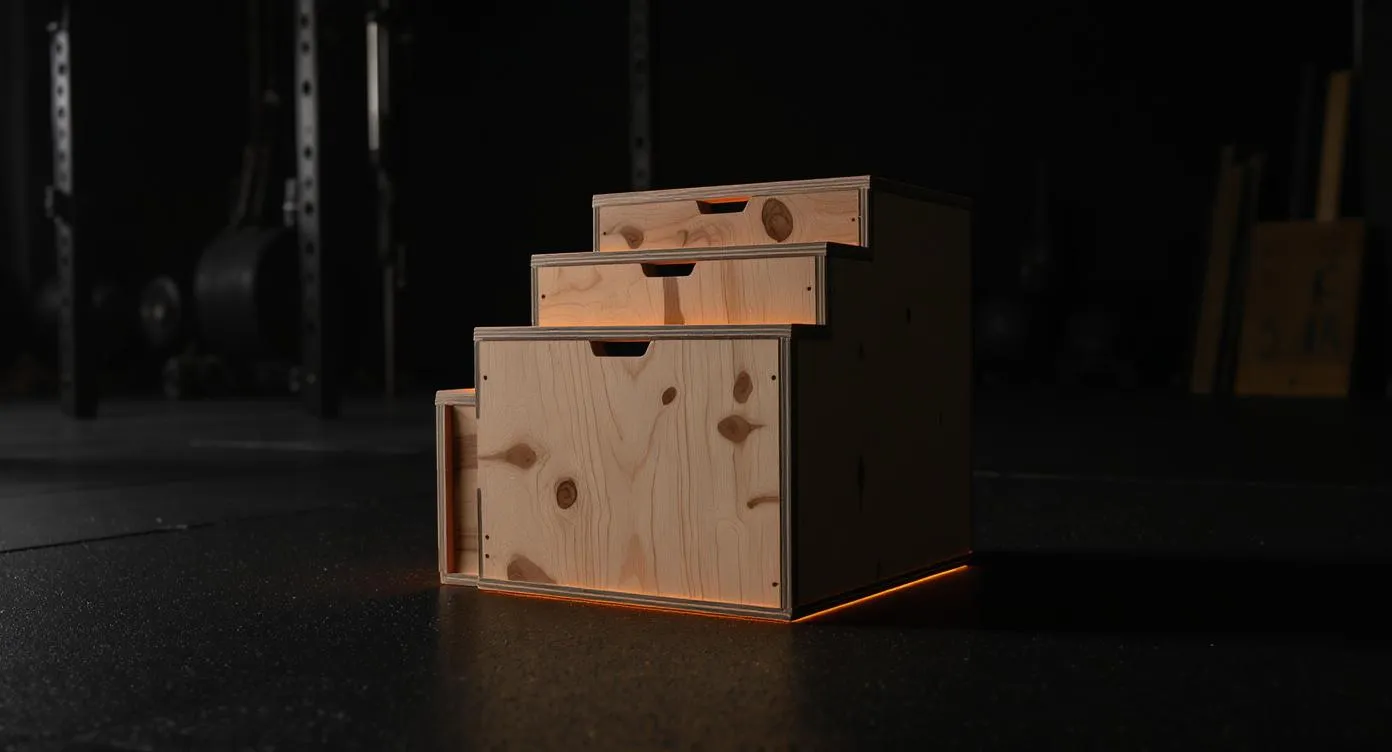
Yes4All 3-in-1 Wooden Plyo Box Review: Best Plyo Box Under $150
Hands-on review of the Yes4All 3-in-1 Wooden Plyo Box. Three heights in one box for $120 — is it worth it?
I have trained on plyo boxes almost every week for the last six years. Box jumps, depth jumps, weighted step-ups, seated box squats, decline push-ups, dips between two boxes, Bulgarian split squats with a rear foot elevated on the edge. A plyo box is one of those pieces of equipment that looks like a luxury until you own one, then it becomes a fixture in nearly every session. The Yes4All 3-in-1 Wooden Plyo Box is the best-selling wooden plyo box on Amazon, and after eight months of consistent use in my garage gym, I can tell you exactly why it holds that spot and where it falls short.

Yes4All Plyo Box, 3-in-1 Wooden Box Jumps with Smooth Edges & Wide Handles
Capacity
450 lbs
Steel
Wood
Footprint
20" x 24" x 30" (3-sided)
Price
$100.46
- 4.7+ star rating on Amazon with 3,500+ reviews
- Three heights in one box (20/24/30 inches)
- Sturdy 13-ply birch construction
- 550 lb static weight capacity
- Pre-cut interlocking pieces — easy assembly
- Best value plyo box on Amazon
- Edges are sharp until sanded by user
- Assembly requires a drill (screws included)
- Heavier than steel boxes once assembled
Price and availability may change
Why a 3-in-1 Design Changes the Equation
Most plyo boxes give you a single height. You pick 20 inches, 24 inches, or 30 inches, and that is what you get for the life of the box. The Yes4All solves this by building a rectangular box with three different dimensions. Rotate the box to a different face and you switch heights instantly. No stacking, no adjustments, no extra purchases.
This matters more than most people realize. Here is why:
- Progressive overload for jumping. A 20-inch box jump is appropriate for most beginners. Within 8 to 12 weeks of consistent training, that same height becomes a warm-up. With the Yes4All, you rotate to 24 inches and keep progressing. Six months later, 30 inches becomes the working height. One box covers the entire progression arc.
- Multiple users, one box. If you train with a partner, spouse, or teenager, everyone can use the same box at their appropriate height. My wife uses the 20-inch side for step-ups while I use the 30-inch side for depth jumps. No need to buy separate boxes.
- Exercise-specific height selection. I use 30 inches for box jumps, 24 inches for seated box squats, and 20 inches for decline push-ups and Bulgarian split squats. Having three heights available without any additional equipment is genuinely useful for programming variety.
- Space savings. A single 3-in-1 box occupies about 2.5 square feet of floor space. Three separate fixed-height boxes would require stacking or storing individually, eating into your training area. In a small garage gym, this matters.
The 3-in-1 design is the single biggest reason to choose the Yes4All over cheaper fixed-height alternatives. If you are only ever going to use one height, a simpler box will do. But most athletes outgrow a single height within the first few months.
Detailed Specifications
Quick Specs · Yes4All Plyo Box, 3-in-1 Wooden Box Jumps with Smooth Edges & Wide Handles
The Yes4All is built from 13-ply birch plywood, the same laminated material used in gymnastics flooring and heavy-duty furniture. At 13 layers, the plywood is approximately 3/4 inch (19mm) thick on each face. This is the standard thickness for commercial plyo boxes and provides excellent rigidity under load.
The box carries a 550-pound static weight capacity. In practical terms, this means a 250-pound athlete landing on the box with impact forces of roughly 2 to 2.5 times bodyweight is well within the safety margin. I weigh 205 pounds and have never felt even a hint of flex or instability during box jumps. The box does not wobble, creak, or shift under landing forces.
Overall dimensions are 30 x 24 x 20 inches, and the assembled weight is approximately 35 pounds. Heavy enough that the box stays planted during jumps, but light enough to move around the gym by hand. For comparison, steel plyo boxes in this size range weigh 20 to 25 pounds, and foam boxes are closer to 15 pounds.
Assembly: Plan for 30 to 45 Minutes
The Yes4All ships flat-packed in a single box. Inside you will find six pre-cut plywood panels with interlocking finger joints, a bag of wood screws, and an instruction sheet. You will need a power drill or impact driver with a Phillips bit. This is not included.
Assembly is straightforward but requires attention. The finger joints slide together tightly, and the panels are labeled with numbers to match corresponding sides. My recommendation: dry-fit all six panels first without screws, confirm everything lines up, then drive the screws. Each panel gets four to six screws along its edges. Total screw count is around 30.
The entire process took me 35 minutes solo on my first box. A second person to hold panels steady while you drive screws would cut that to 20 minutes. One critical note: the pre-drilled pilot holes are accurate but shallow. Use your drill on a low-torque setting to avoid stripping the plywood. If you over-torque, the screw will spin freely and lose holding power.
Once assembled, the box is solid. The interlocking joints plus screws create a rigid structure that does not loosen over time. I have not had to re-tighten any screws after eight months.
What We Love
- Three usable heights (20/24/30 inches) in a single box eliminates the need for multiple boxes
- 13-ply birch plywood is genuinely sturdy with no flex under 200+ pound landings
- 550 lb static weight capacity provides serious safety margin for heavier athletes
- Pre-cut interlocking finger joints make assembly precise and the final structure rigid
- 35 lb assembled weight keeps the box planted during jumps without being too heavy to reposition
- Flat landing surface is large enough (30x24 inches on the biggest face) for confident two-foot landings
- Natural wood finish looks clean in a home gym and can be sanded or stained to match your space
- Price point around $100-120 undercuts most comparable 3-in-1 boxes by $30-50
What Could Be Better
- Edges and corners are sharp out of the box and will scrape shins on missed jumps — sanding is mandatory before first use
- Assembly requires a power drill which is not included — this should be stated more clearly on the product listing
- Plywood corners can develop minor splintering after 6-12 months of heavy use at the edges
- The box is heavier than foam and steel alternatives, making it less portable
- No anti-slip surface on top — the bare plywood can be slick with sweat during high-rep conditioning
- At 30 inches tall the box is intimidating for true beginners who might benefit from a 16-inch starting height
- Flat-pack shipping means panels can occasionally arrive with minor cosmetic dents from transit
The Shin Scrape Problem (And How to Fix It)
Let me be direct about the biggest complaint with any wooden plyo box: shin scrapes. If you miss a box jump and your shin catches the edge of a wooden box, you are getting a nasty scrape. This is not a flaw specific to the Yes4All. It is inherent to the material.
Here is what I did during setup and what I recommend:
- Sand all edges. Use 120-grit sandpaper and round over every exposed edge, especially the top edges of whichever face you will use most. This takes about 10 to 15 minutes and makes a dramatic difference. A sharp 90-degree edge will cut skin. A slightly rounded edge will still hurt on impact but is far less likely to break skin.
- Apply edge padding. For an extra layer of protection, wrap the top edges with 1-inch foam pipe insulation from any hardware store. A 6-foot length costs about $3 and covers all four edges of one face. Secure with adhesive or gaffer tape.
- Wear tall socks. This sounds basic, but knee-high athletic socks are standard in CrossFit boxes for a reason. They provide a thin layer of abrasion protection that prevents most minor scrapes.
After sanding and adding pipe insulation to the 30-inch face (my primary box jump height), I have not had a single shin scrape in eight months. The 5-minute modification is absolutely worth doing before your first jump.
Programming Plyo Box Training for Your Home Gym
A plyo box is more versatile than most people realize. Here is how I program it across different training goals.
For Power Development
Box jumps are the primary plyometric exercise for developing lower-body power. The key is jumping for maximum height, not maximum reps. Program 3 to 5 sets of 3 to 5 reps with full recovery (60 to 90 seconds) between sets. Reset completely between each rep: step down, set your feet, pause, then jump. Do not bounce. This is not conditioning. This is power training.
Depth jumps are the advanced progression. Stand on the box, step off, and immediately jump vertically upon ground contact. The stretch-shortening cycle generates more power than a standard box jump. Use the 20-inch height for depth jumps regardless of your box jump ability. The landing forces are significantly higher and 20 inches provides enough stimulus without excessive joint stress.
For Conditioning and HIIT
Box jump burpees, lateral box jumps, and high-rep step-ups all turn the plyo box into a conditioning tool. For a simple 12-minute workout: alternate 30 seconds of box jump step-downs with 30 seconds of rest. Aim for 8 to 10 reps per 30-second work period at 24 inches. This protocol reliably pushes heart rate above 85% max and builds anaerobic capacity.
For something more structured, try this 20-minute AMRAP (as many rounds as possible):
- 5 box jumps at 24 inches
- 10 push-ups
- 15 air squats
This is a classic CrossFit-style workout that pairs perfectly with minimal equipment. If you have a jump rope, substitute 30 double-unders for the air squats and you have a brutally effective conditioning session.
For Strength Training
The plyo box is an underrated strength training accessory. Box squats (squatting down to a seated position on the box, pausing, then standing) teach proper squat depth and build power out of the hole. Use the 20-inch height for most athletes, which approximates a parallel squat position. Powerlifters use this technique extensively to break through squat plateaus.
Weighted step-ups with dumbbells or a barbell are one of the best unilateral leg exercises available. Use the 20-inch height with moderate weight (30 to 50 percent of your back squat) for 3 sets of 8 to 10 per leg. The single-leg demand exposes and corrects strength imbalances between legs. If you are building out a CrossFit-style home gym, the plyo box paired with a barbell covers an enormous range of programming.
For Bodyweight Training
Decline push-ups with feet elevated on the box shift more load to the upper chest and anterior deltoids. At 20 inches of elevation, the angle approximates a 30-degree decline bench press. This is my go-to chest variation when I want to train push movements without loading a barbell.
Bulgarian split squats with the rear foot on the box are punishing in the best way. The stretch on the rear-leg hip flexor combined with the single-leg demand on the working leg makes this one of the most effective lower-body exercises with zero equipment beyond the box. Three sets of 10 per leg, two to three times per week, will build noticeable quad and glute size within 8 weeks.
Tricep dips between two sturdy surfaces work as well. If you have two plyo boxes, place your hands on one and feet on the other for parallel bar dip simulation. With a single box, place your hands on the box edge behind you for bench dips. Either variation effectively targets the triceps and anterior deltoids.
How It Compares to Alternatives
Yes4All vs. Foam Plyo Boxes
Foam plyo boxes (like the Rep Fitness 3-in-1 Soft Plyo Box at around $130) eliminate the shin scrape problem entirely. The foam exterior absorbs impact and will not cut skin on a missed jump. However, foam boxes have drawbacks: they are less stable under lateral forces, the foam compresses over time creating an uneven landing surface, and they cannot support heavy loads for exercises like box squats with a loaded barbell. If shin safety is your primary concern and you only plan to do box jumps, foam is a reasonable choice. For everything else, wood wins.
Yes4All vs. Steel Plyo Boxes
Steel plyo boxes are lighter, do not splinter, and arrive fully assembled or with minimal setup. The Rogue Games Box ($170) is the gold standard in this category. However, steel edges are significantly more dangerous on missed jumps than wood. A steel edge will open skin instantly, while sanded wood creates a scrape. Steel boxes also tend to be louder on landing and can slide on smooth floors. For a home gym where noise matters, wood is the better choice.
Yes4All vs. Rogue Wood Plyo Box
The Rogue Games Box in wood ($185) is the direct premium competitor. It uses thicker plywood, has slightly better edge finishing, and arrives fully assembled. The build quality difference is real but marginal. For an extra $65 to $85 over the Yes4All, you are paying primarily for pre-assembly and the Rogue name. If you own a drill and 30 minutes, the Yes4All delivers 90% of the Rogue experience at 60% of the price.
Long-Term Durability: 8 Months In
After eight months of 3 to 4 sessions per week involving the plyo box, here is the wear report:
- Structural integrity: No loosening, no wobble, no creaking. The finger joints and screws have held perfectly. The box is as solid as the day I assembled it.
- Surface wear: The landing surfaces show scuff marks from shoe contact. This is cosmetic only and does not affect function. A light sanding would remove them if appearance matters to you.
- Edge condition: The edges I sanded during setup have remained smooth. Two corners that I did not sand as thoroughly have developed minor splintering. A quick pass with sandpaper fixed both in under a minute.
- Bottom faces: No visible wear. The rubber gym flooring underneath has prevented any damage to the bottom panels.
Based on this trajectory, I expect the Yes4All to last 3 to 5 years of regular training use with minimal maintenance. Occasional sanding of high-contact edges is the only upkeep required. If you have proper gym flooring underneath, the box and floor protect each other.
Who Should Buy the Yes4All 3-in-1 Plyo Box
This box is ideal for:
- Home gym owners who want a versatile conditioning and strength accessory under $150
- Athletes who follow CrossFit, HIIT, or general athletic training programs
- Households with multiple users at different fitness levels
- Anyone who values the progressive 20/24/30-inch height range
- Garage gym builders working within a budget-conscious setup
Consider alternatives if:
- Shin safety is your overriding concern (choose a foam box instead)
- You have zero interest in box jumps and only want a step-up platform (a cheaper fixed-height box works fine)
- You cannot handle basic tool assembly (you need a drill, and this is non-negotiable)
- Your training space has no room for a 30 x 24 x 20-inch permanent fixture
Final Verdict
The 3-in-1 design eliminates the need for multiple boxes, and 13-ply birch construction handles athletes well over 200 lbs. The sharp edges are the main drawback — miss a rep and you will scrape your shins badly. Rounding the edges with sandpaper before first use is strongly recommended. At $120 it costs $60-$85 less than Rogue and Titan equivalents, making it the best value in wooden plyo boxes if you respect the landing surface.
Price and availability may change
The Yes4All 3-in-1 Wooden Plyo Box earns a 4.6 out of 5. It is the best value in the wooden plyo box category and the right purchase for the vast majority of home gym owners. The 3-in-1 design genuinely eliminates the need for multiple boxes. The 13-ply birch construction is sturdy enough for athletes well above 200 pounds. The price is $60 to $85 less than comparable boxes from Rogue or Titan.
The only real drawback is edge sharpness out of the box, and that is a 10-minute fix with sandpaper. Sand the edges, add pipe insulation if you want extra protection, and you have a piece of equipment that will serve your training for years. For a comprehensive look at all the options in this category, check our best plyo boxes roundup.
Yes4All
Yes4All Plyo Box, 3-in-1 Wooden Box Jumps with Smooth Edges & Wide Handles
4.7+ star rating on Amazon with 3,500+ reviews
Three heights in one box (20/24/30 inches)
Price and availability may change
Frequently Asked Questions
What size plyo box should a beginner start with?
Is the Yes4All plyo box safe for heavy athletes over 250 pounds?
How do you prevent shin scrapes on a wooden plyo box?
Can you use a plyo box for exercises other than box jumps?
How long does the Yes4All plyo box take to assemble?
Does the Yes4All plyo box slide on smooth floors?
How does a wooden plyo box compare to a foam plyo box?
Additional Resources
Derek Walsh
Strongman competitor and former commercial gym equipment salesman. Knows what survives heavy daily use.
Read full bioMore in Reviews
Yes4All Kettlebell Set Review: Best Budget Kettlebells on Amazon?
Our review of the Yes4All Cast Iron Kettlebell Set. Are these the best budget kettlebells for home gym training on Amazon?
TRX Bandit Resistance Band Handles Review: Worth the Money?
Hands-on review of the TRX Bandit Resistance Band Handles. Is $49.95 worth it for your home gym?
POWER GUIDANCE Battle Rope Review: CrossFit Standard for $40
Hands-on review of the POWER GUIDANCE 30 ft Battle Rope. Best budget battle rope on Amazon for HIIT, CrossFit, and brutal conditioning.
You Might Also Like
WOD Nation vs Crossrope: Speed Rope vs Weighted Rope?
Speed jump rope vs weighted jump rope. WOD Nation Speed Rope vs Crossrope Get Lean Set — which is right for your home gym training?
The Best Plyo Boxes for Home Gyms (2026 Tested)
We tested wooden, foam, and steel plyo boxes to find the best plyometric boxes for box jumps, step-ups, and conditioning training.