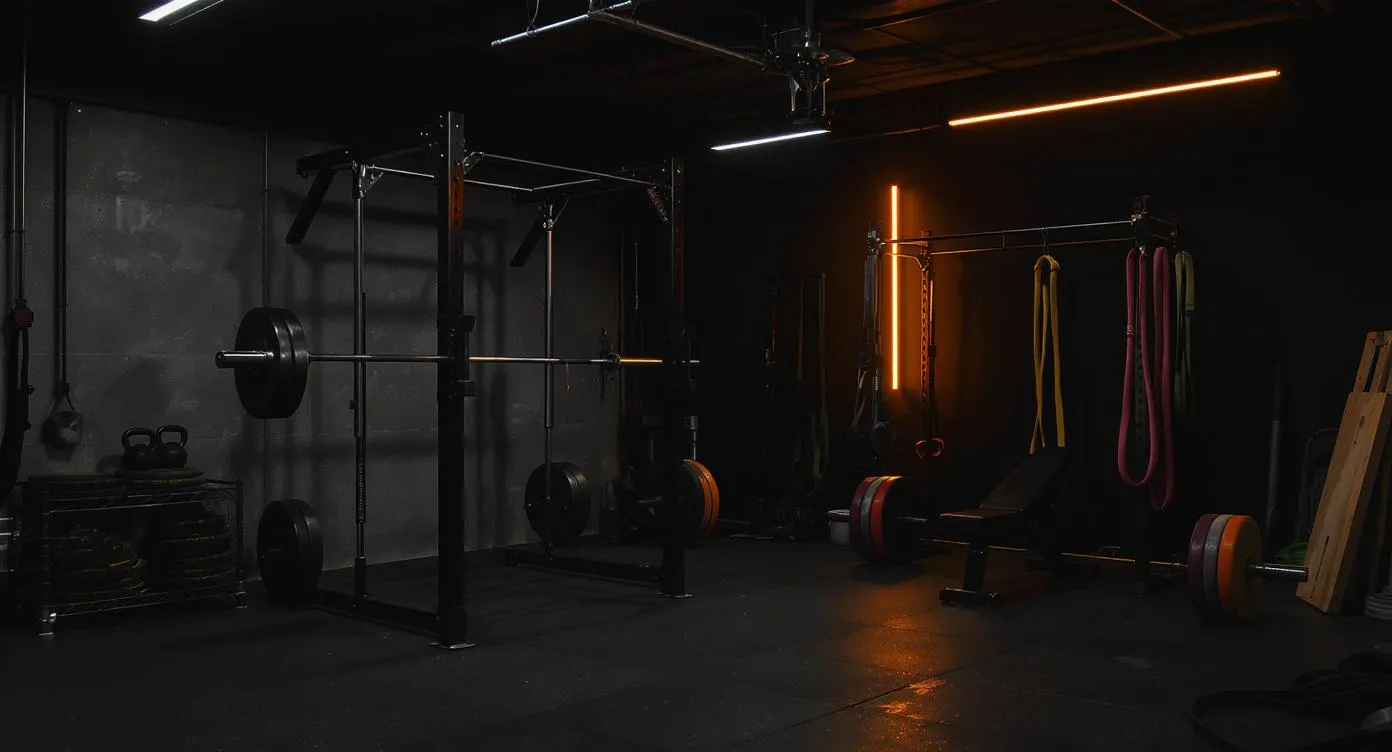
Women's Home Gym Build: Complete Equipment Guide (2026)
Build the perfect home gym for women. Glute-focused equipment, strength training essentials, and space-efficient picks for every budget.
I spent six years coaching women in commercial gyms before building my own home setup, and the difference was immediate. No waiting for the single hip thrust station. No self-conscious glances during glute bridges. No rushing through supersets because someone is hovering over the cable machine. A home gym built around your actual training goals — not whatever equipment the gym owner decided to buy in 2014 — changes everything about how you train.
This guide is the build I wish I had when I started. It covers roughly $1,200 in equipment, prioritizes the posterior chain and glute development that most women are training for, and includes a complete 4-day program you can run the day your equipment arrives. Every product is verified on Amazon with 2026 pricing, and every recommendation has been tested in real training by myself and the women I coach.
If you are working with a tighter budget, our home gym under $1,000 build covers the barbell essentials. If you are returning to training after pregnancy, our postpartum home gym guide covers equipment modifications and programming adjustments for safe re-entry.
Why Women Should Strength Train at Home
Let me address the myths first, because they still circulate in 2026 despite decades of research proving them wrong.
Myth: Lifting heavy makes women bulky. Women produce roughly 15 to 20 times less testosterone than men. Building significant muscle mass requires years of dedicated hypertrophy training, caloric surplus, and often pharmaceutical assistance. What heavy lifting actually does for women is increase bone density, improve metabolic rate, reduce injury risk, and build the glute and leg development that no amount of cardio or bodyweight work can replicate. The American College of Sports Medicine recommends resistance training at least two days per week for all adults, and their position stands consistently show greater benefits at higher intensities.
Myth: You need machines to train glutes effectively. The hip thrust, Romanian deadlift, Bulgarian split squat, and cable kickback are the four highest-EMG glute exercises according to research from the National Strength and Conditioning Association. Three of those four require nothing more than a barbell and a bench. The fourth needs a cable or resistance band. Every exercise in a well-designed glute program can be performed with the equipment in this build.
Myth: Home gyms are only for advanced lifters. The opposite is true. Beginners benefit more from a home gym because there is no social pressure, no intimidation factor, and no time constraint. You can practice hip hinge mechanics for twenty minutes without feeling like you are hogging equipment. You can film your form from multiple angles without awkward gym selfie energy. And you can train at 5 AM or 11 PM without driving anywhere.
The real reasons a home gym works better for most women:
- Privacy for learning. Barbell hip thrusts look awkward when you are figuring out pad placement. At home, nobody is watching.
- Programming freedom. Glute-focused programs require long rest periods between heavy compound sets and short rest between isolation supersets. Commercial gyms make this almost impossible during peak hours.
- Consistency. The number one predictor of training results is adherence. Removing the 20-minute commute, the parking search, and the locker room routine eliminates the three biggest excuses for skipping a session.
- Cost efficiency. A $50/month gym membership costs $600 per year. This entire build pays for itself in two years and then costs nothing forever.
For a deeper dive into programming considerations specific to women, see our women's home gym guide which covers hormonal cycle training, recovery protocols, and exercise selection in more detail.
The Complete $1,200 Women's Build
This build is designed around three priorities: glute and posterior chain development, full-body strength training capability, and space efficiency. Every piece serves multiple purposes, and nothing here is single-use fluff.
| Equipment | Product | Cost |
|---|---|---|
| Power Rack | ULTRA FUEGO Power Cage | $389.99 |
| Adjustable Bench | FLYBIRD Adjustable Bench | $110 |
| Barbell + Plates (300 lb set) | CAP Barbell Olympic Set | $340 |
| Kettlebell Set | Yes4All Kettlebell Set | $120 |
| Resistance Band Set | Bodylastics Resistance Bands | $80 |
| Rubber Flooring (4 mats) | BalanceFrom Puzzle Mat | $90 |
| Hip Thrust Pad + Collars | Generic Amazon picks | $30 |
| Total | $1,100 |
That leaves roughly $100 in the budget for a foam roller, mini bands, lifting straps, and a yoga mat — small accessories that round out the setup.
Equipment Checklist
7 itemsEquipment Breakdown
1. ULTRA FUEGO Power Cage — $389.99

ULTRA FUEGO Power Cage, Multi-Functional Power Rack
Capacity
800 lbs
Steel
2x2" 14-Gauge Steel
Footprint
50.5" L x 46.5" W x 83.5" H
Price
$389.98
- 4.5+ star rating on Amazon with 5,000+ reviews
- Excellent value under $350
- 800 lb weight capacity
- Includes multi-grip pull-up bar
- Standard 2x2 hole spacing for attachments
- Optional lat pulldown attachment available
- 14-gauge steel is thinner than premium racks
- Plastic J-cup liners can wear over time
- Not ideal for lifters squatting 600+ lbs
Price and availability may change
The power rack is non-negotiable. Safety bars let you squat heavy without a spotter, which is critical when you train alone at home. The ULTRA FUEGO Power Cage hits the sweet spot at this budget: 800 lb weight capacity, steel safety bars with 19 adjustment positions, and a multi-grip pull-up bar built in.
For women specifically, two features stand out. First, the adjustable safety bar height means you can set up for hip thrusts by positioning the bench inside the rack and loading the bar at hip height — no need to awkwardly roll a heavy barbell over your legs from the floor. Second, the pull-up bar offers neutral grip handles, which are easier on smaller hands and wrists than a straight bar.
The footprint is 50.5" x 46.5" x 83.5" tall — compact enough for a single-car garage or a large spare bedroom with 8-foot ceilings. For a detailed look at whether this rack fits your space and goals, check our how to choose a power rack guide.
- Steel safety bars for solo training — squat and bench press without a spotter
- Multi-grip pull-up bar with neutral handles easier on smaller hands
- 2x2 uprights accept dip attachments and landmine posts for future expansion
- 800 lb capacity covers any realistic home training load
- Most affordable full-size rack with genuine safety features
- Assembly takes 2-3 hours and benefits from a second person
- 83.5 inches tall — requires 8-foot ceiling minimum
- No cable or pulley system included (add one later for $80-120)
- Powder coat scratches during plate loading
2. FLYBIRD Adjustable Bench — $110

FLYBIRD WB2 Weight Bench, Utility Adjustable Weight Bench
Capacity
800 lbs (ASTM Certified)
Steel
Commercial-Grade Steel Frame
Footprint
48.4" L x 16.5" W x 17" H (folded)
Price
$109.99
- 4.6+ star rating on Amazon with 25,000+ reviews
- Unbeatable value under $120
- ASTM-certified 800 lb weight capacity
- 8 backrest angles (90° to -30° FID)
- Folds flat for easy storage in small spaces
- Quick 10-minute assembly
- Gap between seat and backrest at steep inclines
- No decline position on some variants
- Pad is narrower (10.2") than premium benches (12")
- Feet can slide on smooth concrete without rubber mats
Price and availability may change
The FLYBIRD bench is the most recommended budget bench on this site for good reason. Seven back positions (flat through steep incline plus decline), a 500 lb rated capacity, and a compact fold-flat design for storage. At 110 dollars, nothing else comes close.
For this build, the bench serves double duty. It is your pressing station for dumbbell and barbell work, and it is your hip thrust platform. Position it perpendicular to the rack, set your shoulder blades on the pad, and thrust with the barbell across your hips. The bench height (17.5 inches) is ideal for hip thrusts for most women between 5'2" and 5'8" — your shins should be roughly vertical at the top of the movement.
- 7 adjustable positions including decline for versatile pressing
- 500 lb weight capacity handles heavy hip thrusts
- Folds flat for storage in small spaces
- 17.5-inch seat height ideal for hip thrusts for most women
- Vinyl padding may wear after 2-3 years of heavy use
- No wheels for easy repositioning
- Slight wobble at steepest incline under heavy loads
3. CAP Barbell 300 lb Olympic Set — $340

CAP Barbell 300-Pound Olympic Set (Includes 7 Feet Bar)
Capacity
300 lbs total (255 lbs plates + 45 lb bar)
Steel
Cast Iron Plates / Chrome Bar
Footprint
7ft Olympic Bar (28mm shaft)
Price
$499.99
- 4.5+ star rating with 8,000+ reviews
- Complete barbell + plate set in one purchase
- Standard Olympic 2" sleeves fit all racks
- Includes: 2x45, 2x35, 2x25, 2x10, 4x5, 2x2.5 lb plates
- Cast iron plates are durable and accurate
- Best value starter weight set available
- Bar is entry-level (bushing sleeves, mild knurling)
- Plates are not calibrated for competition use
- No bumper plates — not safe to drop on concrete
- Chrome plating on bar chips over time
Price and availability may change
Three hundred pounds sounds like a lot, and for most women starting out, it is more than you will need for a year or more. But the economics matter: buying a 300 lb set costs far less per pound than buying plates individually. The set includes a 7-foot Olympic bar, two 45s, two 35s, two 25s, two 10s, four 5s, two 2.5s, and spring collars.
The bar weighs 45 lbs with a 28mm shaft diameter. Women with smaller hands sometimes prefer a 25mm women's Olympic bar, but at this budget, the standard 28mm bar works well enough — and you can always add a women's bar later as a dedicated deadlift or clean bar. For grip, a pair of $12 lifting straps solves any issue on pulling movements.
Why 300 lbs matters for glute training: A well-trained woman can hip thrust 185 to 315 lbs within her first two years of consistent training. Romanian deadlifts progress to 135 to 225 lbs. Bulgarian split squats with 95 to 135 lbs on the bar become normal. The 300 lb set covers all of these progressions with room to spare.
4. Yes4All Kettlebell Set — $120

Yes4All Cast Iron Kettlebell 5-80 Lb for Full Body Workout
Capacity
5-80 lbs options
Steel
Solid Cast Iron
Footprint
Varies by weight
Price
$79.97
- 4.7+ star rating on Amazon with 12,000+ reviews
- Solid cast iron construction
- Durable painted finish
- Standard grip width for most users
- Available individually or in sets
- Best budget kettlebell option
- Cheaper competition-grade bells exist
- Paint can chip with heavy use
- Not ideal for kettlebell sport (uniform size)
- Handle texture varies between batches
Price and availability may change
Kettlebells are the secret weapon in a women's home gym. Kettlebell swings are one of the highest-power glute exercises available — they train the hip hinge explosively, build posterior chain endurance, and double as conditioning work. A set with 15, 20, and 25 lb bells covers goblet squats, single-leg deadlifts, swings, Turkish get-ups, and loaded carries.
The Yes4All cast iron set is simple, durable, and flat-bottomed (important for renegade rows and floor-based movements). No fancy coating, no gimmicks — just iron that lasts forever.
- Cast iron construction lasts a lifetime with zero maintenance
- Flat bottom for stable floor exercises like renegade rows
- Multiple weights enable progressive overload on swings and goblet squats
- Compact footprint — store all three in a corner
- Cast iron handle can be rough on uncalloused hands — chalk helps
- No half-sizes available for micro-progression
- Fixed weight requires buying additional bells as you get stronger
5. Bodylastics Resistance Bands — $80

Bodylastics PRO Series Resistance Band Set (6 Bands, 280 lbs)
Capacity
6 bands stackable to 280 lbs
Steel
Anti-Snap Natural Latex Tubing
Footprint
Handles, ankle straps, door anchor + carry bag
Price
$61.97
- 4.6 star rating on Amazon with 2,600+ reviews
- Patented anti-snap inner cord for safety
- 6 bands stackable up to 280 lbs total resistance
- Includes handles, ankle straps, and door anchor
- Lifetime replacement on bands
- Travel-friendly storage bag
- Resistance feels different than free weights
- Door anchor requires an inward-opening door
- Handles wear faster than the bands
Price and availability may change
Resistance bands fill the gap left by not having a cable machine. Banded hip thrusts, pull-aparts, face pulls, lateral walks, monster walks, clamshells, and cable kickback substitutes all use bands. The Bodylastics stackable system lets you combine multiple bands for resistances from 3 lbs up to 150+ lbs, which covers everything from warm-up activation to heavy banded deadlifts.
Bands also let you add accommodating resistance to barbell movements. Looping a medium band around the bar and the base of the rack during squats teaches you to accelerate through the sticking point — a technique the ACE (American Council on Exercise) recognizes as effective for building strength past plateaus.
6. BalanceFrom Puzzle Mat Flooring — $90

BalanceFrom Puzzle Exercise Mat 1/2' Thick, EVA Interlocking Foam Floor Tiles for Home Gym, Mat for Home Workout Equipment, Floor Padding for Kids, Black, 24 in x 24 in x 1/2 in, 24 Sq Ft - 6 Tiles
Capacity
N/A — flooring
Steel
High-Density EVA Foam (1/2" thick)
Footprint
24 sq ft (6 tiles)
Price
$25.99
- 4.5+ star rating on Amazon with 40,000+ reviews
- 24 sq ft covers a full lifting platform area
- 1/2 inch thick EVA foam absorbs impact and noise
- Interlocking design — no adhesive needed
- Easy to cut for custom fit around racks
- Best budget gym flooring on Amazon
- Puzzle seams can separate under heavy racks
- Not as durable as horse stall mats for deadlifts
- Slight chemical smell for first few days
Price and availability may change
Four puzzle mats cover roughly 48 square feet — enough to protect the floor under and around your rack. The BalanceFrom mats are 3/4-inch thick EVA foam, which absorbs noise and protects both your floor and your equipment from dropped weights.
For a garage gym, horse stall mats from Tractor Supply ($50 each) are the more durable long-term option, but they are extremely heavy and require a truck for pickup. Puzzle mats ship to your door, weigh a fraction as much, and work perfectly well for the controlled lifting in this program. If you plan to do heavy Olympic lifts with drops, upgrade to stall mats later.
Full Build Cost Summary
Space Requirements and Layout
This build requires a minimum of 8 feet x 10 feet (80 square feet) with at least 8-foot ceiling height. That is a single-car garage, a large spare bedroom, or a basement section.
Recommended layout:
- Rack zone (5 x 4 feet): Against a wall, centered, with the bench positioned inside the rack for squats and hip thrusts
- Open floor space (5 x 6 feet): In front of and beside the rack for deadlifts, kettlebell swings, lunges, and band work
- Storage corner (2 x 3 feet): Wall-mounted band hooks, kettlebells stacked, foam roller and accessories
Key layout tips:
- Position the bench so you can slide it in and out of the rack easily. You will reposition it every session between hip thrusts (perpendicular, shoulder blades on pad) and bench press (parallel, lying flat).
- Keep kettlebells near the open floor space. Swings require 3 to 4 feet of clearance in front of you.
- Mount a cheap full-length mirror on one wall. Form feedback is critical for hip hinges and squats, especially when training alone. A $15 door mirror from Amazon works perfectly.
- If your space has 7-foot ceilings, do overhead press seated inside the rack and perform pull-ups with bent knees. Everything else works normally.
The 4-Day Women's Strength Program (Upper/Lower Split, Glute Emphasis)
This program is designed specifically for the equipment in this build. It runs Monday/Tuesday/Thursday/Friday with Wednesday and weekends for recovery. Each session takes 45 to 60 minutes including warm-up.
Day 1 — Lower Body (Glute Focus)
| Exercise | Sets x Reps | Rest |
|---|---|---|
| Barbell Hip Thrust (bench as platform) | 4 x 8-10 | 2-3 min |
| Barbell Back Squat | 4 x 6-8 | 2-3 min |
| Romanian Deadlift | 3 x 10-12 | 90 sec |
| Bulgarian Split Squat (barbell or kettlebell) | 3 x 10 each leg | 90 sec |
| Banded Lateral Walk | 3 x 15 each direction | 60 sec |
| Kettlebell Swing | 3 x 15 | 60 sec |
Day 2 — Upper Body (Push + Pull)
| Exercise | Sets x Reps | Rest |
|---|---|---|
| Barbell Overhead Press | 4 x 6-8 | 2-3 min |
| Barbell Bent-Over Row | 4 x 8-10 | 2 min |
| Incline Dumbbell Press (use kettlebells or barbell) | 3 x 10-12 | 90 sec |
| Band Pull-Apart | 3 x 15-20 | 60 sec |
| Band Tricep Pushdown (anchor to rack) | 3 x 12-15 | 60 sec |
| Band Bicep Curl | 3 x 12-15 | 60 sec |
Day 3 — Lower Body (Posterior Chain Focus)
| Exercise | Sets x Reps | Rest |
|---|---|---|
| Barbell Deadlift (conventional or sumo) | 4 x 5-6 | 3 min |
| Barbell Hip Thrust (lighter, pause at top for 2 sec) | 3 x 12-15 | 90 sec |
| Goblet Squat (kettlebell) | 3 x 12-15 | 90 sec |
| Single-Leg Romanian Deadlift (kettlebell) | 3 x 10 each leg | 90 sec |
| Banded Clamshell | 3 x 20 each side | 60 sec |
| Banded Glute Bridge (high rep burnout) | 2 x 25 | 60 sec |
Day 4 — Upper Body + Core
| Exercise | Sets x Reps | Rest |
|---|---|---|
| Barbell Bench Press | 4 x 6-8 | 2-3 min |
| Pull-Up or Band-Assisted Pull-Up | 4 x max reps | 2 min |
| Barbell Upright Row or Band Lateral Raise | 3 x 12-15 | 60 sec |
| Band Face Pull | 3 x 15-20 | 60 sec |
| Hanging Knee Raise (from rack pull-up bar) | 3 x 12-15 | 60 sec |
| Kettlebell Turkish Get-Up | 2 x 3 each side | 90 sec |
Warm-Up Protocol (Every Session)
Do not skip this. Five minutes of targeted activation before every session:
- 90/90 hip switches — 10 each side (hip mobility)
- Banded monster walks — 15 steps each direction (glute activation)
- Cat-cow stretches — 10 reps (spinal mobility)
- Band pull-aparts — 15 reps (shoulder health)
- Bodyweight glute bridges — 15 reps with 2-second hold (posterior chain activation)
Then perform 2 to 3 warm-up sets of your first exercise at 40%, 60%, and 80% of working weight.
Progressive Overload Strategy
Progressive overload is the single principle that separates training from exercise. Without it, your body has no reason to adapt. Here is how to apply it with this equipment.
Week-to-week progression model:
- Primary compounds (squat, deadlift, hip thrust, bench, overhead press): Add 5 lbs total (2.5 lb plates on each side) when you hit the top of your rep range for all prescribed sets. If the program says 4 x 6-8 reps and you get 4 sets of 8, add weight next session. If you only manage 6-6-7-6, keep the weight the same and aim for more reps.
- Accessory movements (RDL, split squats, rows): Add weight when you complete all sets at the top of the rep range with good form. Progression here is slower — expect to add weight every 2 to 3 weeks.
- Band and kettlebell work: Progress by adding reps first (up to 20-25), then move to a heavier band or heavier kettlebell. For kettlebell swings, once you can comfortably do 3 x 20 with the 25 lb bell, it is time to buy a 30 or 35 lb bell.
When to deload: Every 4 to 6 weeks, or whenever you miss reps on two consecutive sessions of the same exercise, drop all working weights by 10 to 15% and rebuild over 2 weeks. Deloads are not optional — they are where recovery and adaptation actually happen.
Tracking: Use a simple notebook or a free app like Strong. Record every set, every rep, every weight. If you are not tracking, you are guessing, and guessing does not produce results.
Micro-loading for upper body: Women often stall on overhead press and bench press because a 5 lb jump represents a larger percentage of their working weight than it does for men pressing 200+ lbs. Buy a pair of 1.25 lb fractional plates ($15 on Amazon) to make 2.5 lb jumps instead of 5 lb jumps on upper body lifts. This single purchase will prevent weeks of frustrating plateaus.
Nutrition Fundamentals (Brief Overview)
Training equipment means nothing without adequate nutrition. Three non-negotiable principles:
- Protein intake: Aim for 0.7 to 1.0 grams per pound of body weight daily. For a 140 lb woman, that is 100 to 140 grams of protein. This is the single most important dietary factor for building muscle and recovering from training.
- Caloric context matters. If you want to build glutes, you need to eat at maintenance calories or a slight surplus (100-200 calories above maintenance). You cannot build significant muscle in a deficit. If fat loss is the primary goal, a moderate deficit of 300-500 calories preserves muscle while losing fat, but muscle gain will be minimal.
- Meal timing around training. Eat a meal containing protein and carbohydrates 1 to 3 hours before training and within 2 hours after. This is not magic — it is just ensuring your body has fuel for performance and materials for recovery.
Common Questions
Do I really need a power rack, or can I start with just dumbbells and bands?
Will this build work for postpartum training?
How much space do I actually need?
Can I build this gym for less than $1,200?
Is a 45 lb barbell too heavy for beginners?
Should I buy a women's 15 kg (33 lb) Olympic bar instead?
How long before I see visible glute results?
Can I do cardio with this setup?
Additional Resources
- NSCA Position Statement on Resistance Training for Women
- ACSM Physical Activity Guidelines
- ACE Strength Training Fundamentals
Related Content
- Women's Home Gym Guide: Programming and Equipment
- Postpartum Home Gym: Safe Return to Training
- Complete Home Gym Under $1,000
- How to Choose a Power Rack
- Garage Gym Safety: Training Alone
- Home Gym Programming for Beginners
- Best Weight Benches Under $300
The Bottom Line
This $1,100 build is not a "women's gym" in the pink-dumbbells-and-a-yoga-mat sense. It is a serious strength training facility designed around the goals most women actually have: glute and leg development, full-body strength, and the ability to train hard without waiting for equipment or dealing with gym anxiety. The power rack keeps you safe alone, the barbell and plates provide years of progressive overload, the bench doubles as a hip thrust platform, and the kettlebells and bands fill every gap a cable machine would otherwise cover.
Two years from now, this gym has paid for itself compared to a commercial membership. More importantly, you will have trained with more consistency, more focus, and more intensity than you ever would in a crowded gym at 6 PM on a Monday. That consistency is what builds results — not the equipment itself, but the fact that it is always ten steps away and always available.
Start with the rack, bench, and barbell if you need to spread out the cost. Add kettlebells and bands in month two. Within 60 days you will have a complete training facility that handles everything from your first barbell squat to a 225 lb hip thrust and beyond.
ULTRA FUEGO
ULTRA FUEGO Power Cage, Multi-Functional Power Rack
4.5+ star rating on Amazon with 5,000+ reviews
Excellent value under $350
Price and availability may change
Lena Park
Former NCAA Division I rower and USA Weightlifting coach. Specializes in conditioning equipment and women's training.
Read full bioMore in Budget Builds
Olympic Weightlifting Home Gym Build (2026)
Build a home gym for Olympic weightlifting. Platform specs, bar selection, bumper plates, and everything you need to snatch and clean at home.
The Best Home Gym Build for Seniors (2026)
Build a safe, effective home gym for seniors. Joint-friendly equipment picks, fall-prevention features, and age-appropriate training programs.
The Complete Beginner Home Gym Build (2026)
Your first home gym, done right. A tested beginner build with exactly what you need, nothing you don't, and a plan to grow.