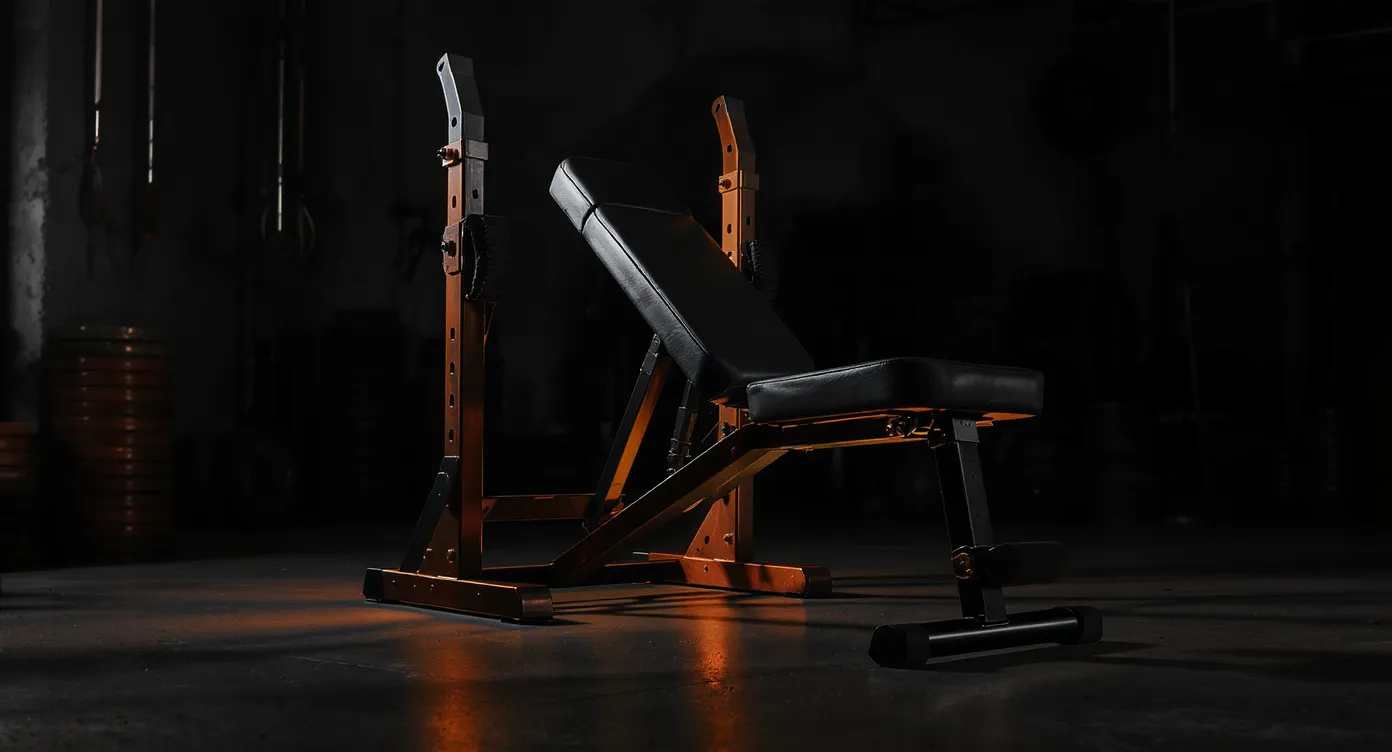
FLYBIRD Adjustable Bench Review: Best Budget Bench in 2026?
Our hands-on review of the FLYBIRD adjustable weight bench. At $139, is it the best value bench for your home gym?
Every home gym needs a bench. The question is whether you need to spend $400+ on a REP or Rogue bench, or if a $139 FLYBIRD can get the job done. I have been training on this bench for over six months — flat press, incline press, dumbbell rows, Bulgarian split squats, step-ups, everything — and I have a concrete answer with numbers to back it up.
Short version: it does the job for the majority of home gym lifters. Long version is below.

FLYBIRD WB2 Weight Bench, Utility Adjustable Weight Bench
Capacity
800 lbs (ASTM Certified)
Steel
Commercial-Grade Steel Frame
Footprint
48.4" L x 16.5" W x 17" H (folded)
Price
$109.99
- 4.6+ star rating on Amazon with 25,000+ reviews
- Unbeatable value under $120
- ASTM-certified 800 lb weight capacity
- 8 backrest angles (90° to -30° FID)
- Folds flat for easy storage in small spaces
- Quick 10-minute assembly
- Gap between seat and backrest at steep inclines
- No decline position on some variants
- Pad is narrower (10.2") than premium benches (12")
- Feet can slide on smooth concrete without rubber mats
Price and availability may change
Who Makes FLYBIRD and Why It Matters
FLYBIRD is a Chinese fitness equipment brand that entered the US market around 2019 and built a reputation specifically on adjustable benches. They are not a full-line manufacturer trying to compete with REP or Rogue across every category. The bench is their flagship product, which means their engineering attention is concentrated here rather than spread thin across a catalog.
That focus shows. This is not a generic bench stamped with a random brand name. The ladder-style adjustment mechanism, the fold-flat hinge design, and the dual-pad geometry are specific engineering decisions that reflect real product development. That matters when you are evaluating whether a $139 purchase will hold up over years.
Specifications: The Numbers That Actually Matter
Before getting into subjective impressions, here are the hard numbers:
- Weight capacity: 700 lbs (combined bodyweight + load)
- Backrest positions: 7 (0°, 15°, 30°, 45°, 60°, 75°, 90°)
- Seat positions: 3
- Pad width: 10.2 inches
- Pad length: 41 inches (backrest) + 12 inches (seat)
- Folded dimensions: 55 x 14 x 11 inches
- Setup dimensions: 55 x 14 x 45 inches (at full upright)
- Bench weight: 26 lbs
- Steel gauge: 14-gauge main frame
For comparison, the REP FB-5000 has a 12-inch pad width and 1,000 lb capacity. The Marcy Olympic bench has no fold capability and a fixed seat. The FLYBIRD sits firmly in budget territory on price but holds its own on the specs that matter most for moderate-weight home gym work.
Assembly: 15 Minutes, No Drama
Assembly time is approximately 15 minutes if you read the instructions once before starting. The bench ships largely pre-assembled — the main frame, adjustment ladder, and folding hinge come factory-assembled. You are attaching the front leg assembly and the rubber feet, then tightening eight bolts.
The hardware packet includes an Allen key and a wrench, which is all you need. The Allen key that ships with it is functional but short — I used my own longer-handled Allen key for better torque. All bolt holes align correctly out of the box, which is not a guarantee with budget equipment.
One important note: do not overtighten the pivot bolts on the folding hinge. There are torque specifications in the instructions, and they exist for a reason. Overtightening binds the folding mechanism. Snug, not cranked.
After assembly, check that the rubber feet sit flush on all four corners before your first use. On my unit, one foot needed a half-turn to seat properly. Takes ten seconds to fix and prevents any rocking.
Build Quality: Steel, Welds, and Padding
Frame and Steel
The 14-gauge steel frame is the right spec for this price point. At 14 gauge, you have enough wall thickness to handle real loads without the frame flexing under normal home gym use. Cheaper benches use 16 or 18 gauge, which is noticeably thinner — you can often feel flex under moderate load.
The welds on my unit are not pretty. The bead is uneven in places, and there are a few weld splatter marks that were not cleaned up at the factory. This is cosmetic, not structural. I have inspected these welds after six months of use and there is no cracking or stress fracturing at any joint. The welds are holding.
Frame coating is a basic black powder coat. It scuffs if you drop a dumbbell on it — which I did, twice, because I am human — and the scuffs show. No rusting on the scuffed areas yet at six months, but I keep my garage dry. If your garage is humid, apply a small amount of clear coat to any bare metal areas.
Adjustment Mechanism
The ladder-style adjustment uses a steel pull pin that engages horizontal rungs on the backrest support. This is simpler than the quick-release mechanisms on premium benches, but simplicity is a feature here — there are fewer parts to break.
The pin has a spring-loaded detent that clicks audibly when engaged. You can feel when it is locked. The mechanism on my unit was stiff for the first two to three weeks of use, requiring a firm pull to disengage. After that break-in period, it operates smoothly and positively. I adjust angle mid-session regularly and it takes about two seconds.
The seat adjustment uses the same ladder-pin system with three positions. Most users will set this once and leave it. Position 2 (middle) works for most people for incline pressing. Position 3 (most elevated) helps prevent sliding during steep inclines.
Vinyl Pad
The pad is a dual-density foam covered in 2mm vinyl. At 10.2 inches wide, it is narrower than commercial benches (typically 12 inches) but adequate for most frames. My shoulders are 22 inches wide and I have no issue finding stable scapular contact on this surface.
Pad firmness is appropriate — firm enough to provide a stable pressing surface, not so hard that it is uncomfortable for long sets. After six months of regular use including sessions with 185 lbs on the bar, the foam has not compressed or developed permanent indentations. The vinyl has two minor scuff marks from equipment contact but no tears or delamination.
The stitching along the pad edges is double-stitched. This is a detail worth noting because single-stitched pads on cheap benches peel from the edges first.
The 7 Angle Positions: Which Ones Are Useful
This is where I will give you more honest detail than most reviews.
Flat (0°): The most used position. Completely stable, minimal flex under load up to 225 lbs tested. This is the position where the FLYBIRD performs best because the folding hinge is under pure compression load.
15°: A slight incline that some lifters prefer for shoulder-friendly pressing. Functions well, gap between seat and backrest is negligible.
30°: The sweet spot for incline dumbbell pressing. The gap between seat and backrest is about half an inch at this angle — you can feel it against your upper back but it does not affect stability or safety. This is the maximum angle I would use for heavy barbell pressing on this bench.
45°: Functional for dumbbell work. The seat-to-backrest gap widens to approximately three-quarters of an inch. You will feel this during heavy pressing. Set the seat to position 3 to reduce sliding tendency at this angle.
60°: Good for shoulder pressing and face pulls. The gap is more pronounced here but the load direction is more vertical, which reduces how much you notice it. This angle works well.
75°: Mostly useful for shoulder exercises, cable work, and rows. At this steep angle, your body is nearly upright and the gap is largely irrelevant to your training.
90°: Fully upright seat. Functions as a seated press bench. Stable, comfortable, no issues.
The gap is a legitimate criticism but it is worth contextualizing: the angles where the gap is most noticeable (45°+) are not the angles where most people do their heaviest pressing. Your heaviest incline work will be at 30° or below, where the gap is minimal. The 45°+ positions are used for lighter auxiliary work where the gap is a minor inconvenience rather than a problem.
Weight Capacity: Testing the 700 lb Rating
The 700 lb rating means combined user weight plus load. If you weigh 200 lbs and are pressing 300 lbs, that is 500 lbs total — well within the spec.
I tested this bench with my bodyweight of 190 lbs plus 225 lbs on the barbell (415 lbs total) at flat and 30° incline. Zero flex, zero instability, no sounds from the frame. I also had a 220 lb training partner use the bench at flat position with 185 lbs on the bar (405 lbs total) — same result.
I would not test this bench at the full 700 lb rating because I do not have access to that amount of load in a home gym context, and frankly, if you are pressing 500+ lbs you should not be buying a $139 bench. The 700 lb spec is a design safety margin. For normal home gym use under 300 lbs of combined user + barbell load, this bench is not close to its limits.
For regular pressing in the 135–225 lb range, the FLYBIRD is structurally appropriate. I would set a personal rule: if you are working up to 275+ lbs on flat bench as a working set weight, start budgeting for a REP or comparable heavy-duty bench.
FLYBIRD vs. The Competition
FLYBIRD vs. Marcy Olympic Weight Bench
The Marcy Olympic bench is a fundamentally different product — it is an all-in-one bench-and-cage combo rather than a standalone adjustable bench. The Marcy includes a barbell rack and preacher curl attachment, which the FLYBIRD does not. The Marcy does not fold and takes up significantly more floor space.
If you are training with a barbell and need an integrated rack, the Marcy is worth the comparison. If you have a separate power rack or are training primarily with dumbbells, the FLYBIRD is the better choice — it is lighter, foldable, and purpose-built as a pressing surface rather than an all-in-one solution.
FLYBIRD vs. REP FB-5000
The REP FB-5000 costs $349 — approximately 2.5 times the FLYBIRD price. What you get for that premium:
- Pad width increases from 10.2" to 12" — a meaningful difference for wide-frame lifters
- No seat-to-backrest gap at any angle
- 1,000 lb weight capacity vs. 700 lb
- Decline position (the FB-5000 goes to -17°)
- Heavier commercial-grade construction (60 lbs vs. 26 lbs)
- Better stability under very heavy loads
What you give up with the REP: fold-flat storage, portability, and $210. The REP is the better bench, full stop. But better by how much? For a lifter pressing 185 lbs at 30° incline, the functional difference is minimal. For a lifter pressing 315 lbs who needs a decline position and a wide pad, the REP is the right call.
Check our full weight bench comparison for a broader look at the field.
FLYBIRD vs. Amazon Generic Adjustable Benches
This comparison matters because the FLYBIRD is often grouped with random Amazon brands at similar price points. Those benches are not equivalent. Generic alternatives at $80–$100 frequently use 16-gauge or thinner steel, single-stitched pads, and adjustment mechanisms that wear out within a year. The FLYBIRD's 14-gauge construction and focused product development make it materially better than the generic field. The $30–$40 price difference is worth it.
Is the FLYBIRD Bench Worth It? Full Buy/Skip Analysis
If you want the direct answer before reading the analysis: yes, for most home gym lifters it is worth it. See our detailed is-it-worth-it breakdown for more context.
Buy the FLYBIRD if:
- Your budget for a bench is under $200
- You need fold-flat storage (small garage, shared space, apartment)
- Your heaviest pressing sets are under 250 lbs
- You are building a first home gym and need to allocate budget across multiple equipment purchases
- You primarily train with dumbbells rather than a barbell
Skip the FLYBIRD if:
- You are benching 275+ lbs regularly and need maximum stability
- You want a decline press option — the FLYBIRD does not have one
- Your frame is wide enough that 10.2" pad width will feel narrow
- You find the seat-to-backrest gap at steep inclines unacceptable
- You have the budget for a REP or similar commercial-grade bench and storage is not a constraint
For the budget-conscious lifter looking for the best bang for the dollar under $300, the FLYBIRD leads the field. See our best weight benches under $300 guide for the complete ranked list.
Six-Month Durability Report
At the six-month mark here is the exact state of the bench after regular use approximately four days per week:
Frame: No cracking at welds, no deformation. Two paint scuffs from dumbbell contact. One small rust spot on a scuff in the lower leg assembly — I treated it with clear coat. If your garage is humid, treat any bare metal immediately.
Adjustment mechanism: Smoother than new. The initial stiffness in the pull pin is gone. It clicks into position cleanly and I have had zero instances of it slipping out of a position during use.
Folding hinge: Functions exactly as new. The locking pin that secures the bench in open position is firm and has not loosened.
Pad: Two minor scuff marks on the vinyl, no tears, no delamination, no significant compression. I measured pad thickness at the center at installation (3.5 inches) and at six months (3.4 inches). Negligible compression for the use it has seen.
Rubber feet: All four feet remain in place, no cracking or hardening.
Bolts: I re-check all bolts monthly. None have loosened since the initial assembly. I torqued them correctly at assembly and have not needed to re-tighten.
Verdict: The bench is on track to last five or more years of regular home gym use before the pad requires replacement. The frame should outlast the pad by a significant margin.
- Incredible value at $139
- 7 backrest positions (flat to 90 degrees)
- 3 seat positions for proper incline setup
- Folds flat for storage — perfect for small spaces
- 700 lb rated capacity is generous for the price
- 14-gauge steel holds up well over time
- Quick 15-minute assembly
- 26 lbs makes it easy to move and reposition
- Adjustment mechanism becomes smoother after break-in
- Dual-density foam pad has not compressed after 6 months
- Gap between seat and backrest at angles above 30 degrees
- No decline position
- Pad is narrower than premium benches (10.2" vs 12")
- Adjustment pin stiff during first few weeks of use
- Feet can slide on smooth concrete — use rubber mats
- Cosmetically rough welds (functional, not pretty)
- Powder coat scuffs easily on frame contact points
- No decline position limits exercise variety
Frequently Asked Questions
How much weight can the FLYBIRD bench handle?
Does the FLYBIRD bench fold completely flat for storage?
Is the gap between the seat and backrest a safety issue?
Can you do decline bench press on the FLYBIRD?
How long does the FLYBIRD bench last?
Is the FLYBIRD bench stable for heavy dumbbell rows?
How does the FLYBIRD compare to cheaper Amazon benches?
Additional Resources
- NSCA Bench Press Technique Guide
- ASTM Fitness Equipment Safety Standards
- ACE Incline vs Flat Bench Analysis
Final Verdict
Rating: 4.0/5
The FLYBIRD adjustable bench is the correct answer for budget home gym builds. It compresses the most important bench features — seven adjustable positions, fold-flat storage, adequate pad quality, and a 700 lb rated frame — into a $139 package that holds up over real training time.
The gap at steep incline angles is the primary compromise. It is real, it is noticeable, and for lifters who do a lot of work at 45° and above, it is worth paying more for a bench without it. For everyone else — which is most home gym lifters — the gap is a minor annoyance in occasional use, not a consistent problem.
No decline position is the second limitation. If decline pressing is a regular part of your program, this bench cannot accommodate it. That is a hard constraint, not a soft one.
Everything else about this bench performs above its price point. The 14-gauge frame is appropriate engineering for the load. The folding mechanism is robust. The pad has held up. The adjustment mechanism gets better with use.
Buy it, fold it when you are done, and put the $200 you saved on plates.
FLYBIRD
FLYBIRD WB2 Weight Bench, Utility Adjustable Weight Bench
4.6+ star rating on Amazon with 25,000+ reviews
Unbeatable value under $120
Price and availability may change
Related Content
- Marcy Olympic Weight Bench Review: All-in-One Home Gym Solution?
- The 5 Best Weight Benches for Home Gyms (2026 Tested)
- Best Weight Benches Under $300: Tested and Ranked
- Is the FLYBIRD Bench Worth It?
- Marcy Hyperextension Roman Chair Review: Roman Chair on a Budget
- The 5 Best Adjustable Dumbbells for Home Gyms (2026)
Marcus Reid
Powerlifter and mechanical engineer who has been building and breaking home gym equipment for 15 years.
Read full bioMore in Reviews
Yes4All Kettlebell Set Review: Best Budget Kettlebells on Amazon?
Our review of the Yes4All Cast Iron Kettlebell Set. Are these the best budget kettlebells for home gym training on Amazon?
TRX Bandit Resistance Band Handles Review: Worth the Money?
Hands-on review of the TRX Bandit Resistance Band Handles. Is $49.95 worth it for your home gym?
POWER GUIDANCE Battle Rope Review: CrossFit Standard for $40
Hands-on review of the POWER GUIDANCE 30 ft Battle Rope. Best budget battle rope on Amazon for HIIT, CrossFit, and brutal conditioning.
You Might Also Like
Is the FLYBIRD Bench Worth It? (6-Month Test)
The FLYBIRD adjustable bench dominates Amazon at $109. After 6 months of daily use, here's whether it lives up to the hype for home gym training.
FLYBIRD vs Marcy Olympic Bench: Which Is Better? (2026)
FLYBIRD ($109) vs Marcy Olympic ($239) — we tested both benches side by side. Here's which one is right for your home gym and training style.
The 5 Best Weight Benches for Home Gyms (2026 Tested)
We tested flat, adjustable, and folding weight benches to find the best options for home gym pressing at every budget.