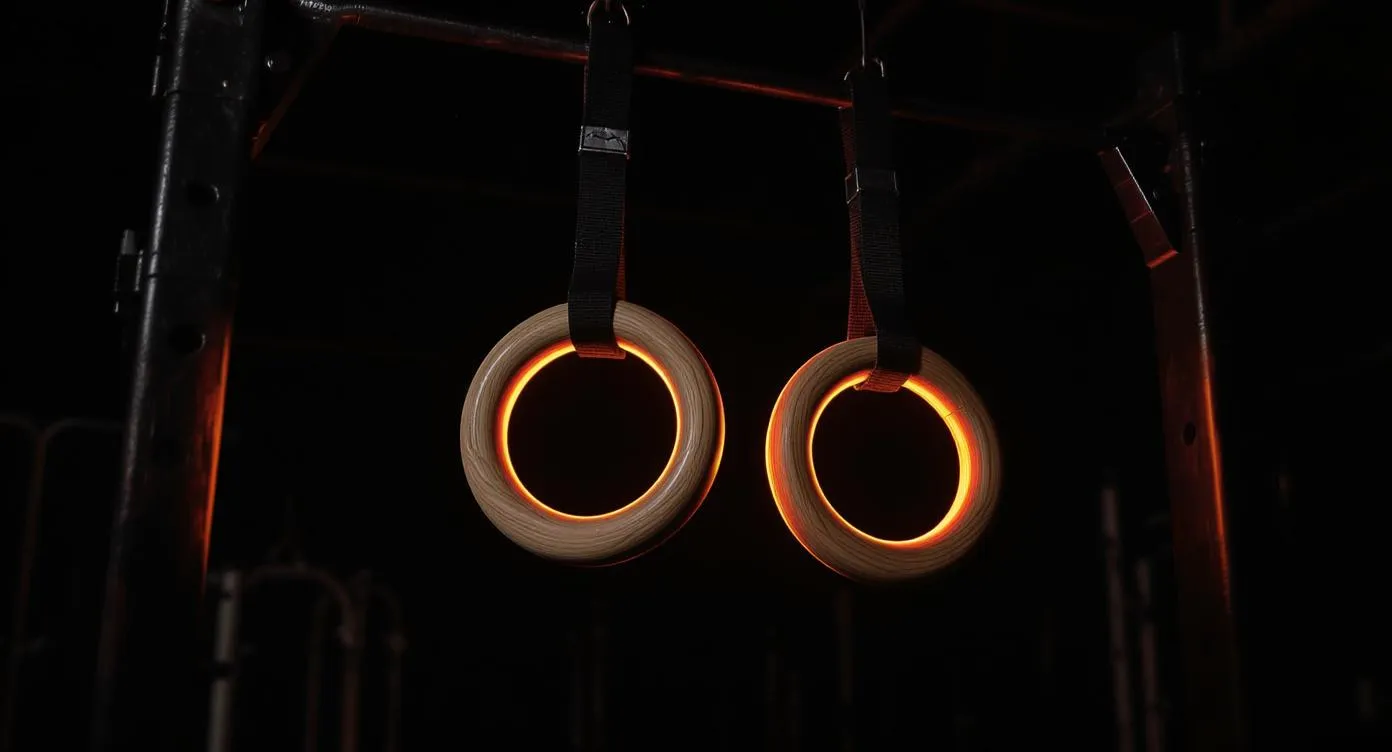
Double Circle Wood Gymnastics Rings Review (2026)
Hands-on review of the Double Circle Wood Gymnastics Rings. Best budget rings on Amazon for muscle-ups, dips, rows, and ring training.
I have trained on gymnastic rings for over six years. I have done thousands of ring dips, hundreds of muscle-ups, and spent more hours than I care to count chasing the iron cross. In that time, I have used five different ring sets ranging from $25 plastic Amazon specials to $90 Rogue wood rings. The Double Circle Wood Gymnastics Rings sit at $49.97 and deliver roughly 90% of what rings costing twice as much offer. After eight months of near-daily use, here is my honest, detailed breakdown.

Double Circle Wood Gymnastics Rings with Quick Adjust Numbered Straps
Capacity
880 lbs
Steel
Wood / Nylon Webbing
Footprint
Multi-size wood rings with numbered straps
Price
$49.97
- 4.7+ star rating on Amazon with 8,000+ reviews
- 880 lb weight capacity handles any user
- Solid birch wood (not plastic)
- 15 ft adjustable nylon straps with metal buckles
- Easy on the hands compared to plastic rings
- Best budget gymnastic rings on Amazon
- No carry bag included
- Wood needs occasional sanding to prevent splinters
- Buckles can slip slightly under heavy load (re-adjust)
Price and availability may change
Why Gymnastic Rings Belong in Every Home Gym
If you only had one piece of equipment for upper body training, rings would be the correct choice. No other single tool gives you horizontal pushing (ring push-ups), vertical pushing (ring dips), horizontal pulling (ring rows), vertical pulling (pull-ups and muscle-ups), and static holds (support hold, L-sit, front lever) all in one package.
Rings also force stabilizer engagement that fixed bars cannot replicate. Research from the Journal of Strength and Conditioning Research (Calatayud et al., 2015) has shown ring dips activate 15-20% more pectoral and deltoid muscle fiber compared to parallel bar dips due to the instability demand. Your shoulders, rotator cuffs, and scapular stabilizers work overtime on every rep. This translates directly to injury resilience and stronger pressing when you return to the barbell.
For garage gym owners working with limited space, rings fold up and hang from a single anchor point. They weigh under 2 lbs total and take up zero floor space. If you already have a power rack or pull-up bar, you already have everything you need to mount them.
Why Wood Beats Plastic (And It Is Not Close)
Cheap rings are made of ABS plastic or composite. Premium rings are made of birch, beech, or maple wood. The difference is not aesthetic preference; it is functional performance.
Grip under sweat. Wood grain absorbs moisture and becomes grippier as your hands sweat. Plastic becomes slippery the moment moisture appears. During a set of ring muscle-ups where your heart rate is above 160 BPM and your palms are soaked, this difference is the margin between completing the set and losing your grip mid-transition. I have experienced both, and the plastic failure is not fun.
Hand comfort over volume. Plastic rings create hot spots and accelerate callus tearing during high-rep sets. Wood distributes pressure more evenly across the palm. Over a training session with 50-80 total reps of pulling and pushing, my hands feel noticeably better on wood. After a month of daily training, the difference in callus health is dramatic.
Durability. Wood rings last decades with minimal care. Every 6-12 months, give them a light pass with 220-grit sandpaper to smooth any roughness that develops, then apply a thin coat of food-grade mineral oil. That is the entire maintenance protocol. Plastic rings, by contrast, develop stress cracks at the strap attachment points after 1-2 years of regular use.
Ring diameter matters. The Double Circle rings use a 1.25-inch (32mm) outer diameter, which matches FIG (Federation Internationale de Gymnastique) competition specifications. This is not arbitrary. A 1.25-inch diameter optimizes the balance between grip security and wrist comfort during false grip work. Thinner rings (1.1 inch) dig into the wrist painfully during false grip muscle-ups. Thicker rings (1.5 inch) make the false grip harder to maintain. The standard exists for a reason.
The Specs
Quick Specs · Double Circle Wood Gymnastics Rings with Quick Adjust Numbered Straps
Build Quality and Materials Assessment
The Double Circle rings are made from laminated birch wood with a smooth, lightly sanded finish out of the box. The grain pattern is consistent and there are no voids, knots, or rough patches on any of the four rings I have handled (I bought two sets, one for my garage and one for outdoor use).
The ring diameter measures 1.25 inches (32mm) with an inner diameter of 7.09 inches (180mm). The inner diameter is important because it determines how much room you have during false grip transitions. At 180mm, these match the competition standard and provide plenty of clearance for wrists of all sizes.
Strap quality is where budget rings typically cut corners. The Double Circle straps are 15-foot nylon webbing with numbered markings every 2 inches. The numbering system is genuinely useful because it lets you set both rings to identical heights quickly. The metal cam buckles are functional but not exceptional. They hold firmly under bodyweight loads during normal training, but I have noticed approximately 0.25-0.5 inches of slip during explosive kipping muscle-ups above 200 lbs of dynamic force. For strict training, this is a non-issue. For high-volume kipping CrossFit work, you may want to double-check strap tension between sets.
The rated weight capacity is 880 lbs, which is substantially more than any individual will generate during ring training. Even accounting for dynamic loading during muscle-ups (which can briefly produce 2-2.5x bodyweight forces), a 200 lb athlete generates roughly 400-500 lbs of peak force, well within the safety margin.
What We Love
- Solid birch wood construction with smooth finish and no rough spots out of the box
- 1.25-inch (32mm) ring diameter matches FIG competition specifications exactly
- 880 lb rated weight capacity provides massive safety margin for all users
- 15 ft numbered nylon straps allow precise, symmetrical height adjustment
- 4.7+ star rating on Amazon with 8,000+ verified reviews validates long-term durability
- Price point of $49.97 makes wood rings accessible without sacrificing quality
- Compact and portable: total weight under 2 lbs, folds into any gym bag
What Could Be Better
- No carry bag included, which is standard on $50+ ring sets from Rogue and Titan
- Cam buckles can slip 0.25-0.5 inches under explosive dynamic movements like kipping muscle-ups
- Straps lack quick-adjust cam buckles found on premium sets, making height changes take 15-20 seconds longer
- Wood arrives unfinished and will need mineral oil treatment after 3-4 months of heavy use
- Strap numbering can fade after 6+ months of outdoor use and UV exposure
- No textured grip zone on the straps for false grip assistance (a feature some $60+ rings include)
Ring Training Programming: A Complete Progression Guide
This is where most ring reviews fail you. They list exercises but give you no structure. Here is the exact progression I use with clients and follow myself, broken into four phases based on training age with rings.
Phase 1: Foundation (Weeks 1-4)
Your first month on rings is about building stabilizer strength and connective tissue resilience. Do not rush this. Shoulder injuries from premature ring progression are common and entirely preventable.
Ring support hold: Jump up to the top of a dip position and hold. Arms locked, rings turned out 15-30 degrees, body tight. Start with 4 sets of 15 seconds. Progress to 4 x 30 seconds before moving to Phase 2. This single exercise builds more shoulder stability than months of rotator cuff band work.
Ring rows: Set rings at chest height. Lean back at a 45-degree angle. Pull chest to rings, squeeze shoulder blades. 3 sets of 10-12 reps. Progress by lowering the ring height (more horizontal body = harder).
Ring push-ups: Rings set 6-8 inches off the ground. Perform push-ups with rings turned out at the top. 3 sets of 8-10 reps. The instability will humble you, even if you can do 50 regular push-ups.
Ring dead hangs: Hang from rings with a relaxed grip. 3 sets of 30-45 seconds. This builds grip endurance and decompresses the spine.
Phase 2: Strength Building (Weeks 5-12)
Ring dips: Full range of motion, shoulders below elbows at the bottom, rings turned out at the top. 3-4 sets of 5-8 reps. Ring dips are substantially harder than parallel bar dips. If you can do 10 bar dips, expect to manage 4-6 ring dips initially.
Ring chin-ups: Supinated grip, full range of motion. 3-4 sets of 5-8 reps. The free rotation of rings is easier on the wrists than a fixed bar, making these excellent for athletes with wrist mobility limitations.
Feet-elevated ring rows: Feet on a 20-inch box, body horizontal. 3 sets of 8-10 reps. This is the bridge between basic rows and inverted rows.
Ring L-sit hold: Support position with legs extended parallel to the ground. Start with tucked knees. Work toward 4 sets of 10-15 seconds with straight legs.
Phase 3: Intermediate Skills (Weeks 13-24)
False grip conditioning: Wrap your wrists over the top of the rings so the ring sits in the crease of your wrist. Hang in false grip for sets of 10-15 seconds. This grip is the prerequisite for strict muscle-ups and feels genuinely terrible for the first 2-3 weeks. Stick with it.
Strict muscle-up progression: Start with a high pull from false grip, aiming to pull the rings to your sternum. Once you can consistently hit sternum height, begin the transition: pull high, lean forward aggressively, and press out. Most athletes need 8-12 weeks of dedicated practice to achieve their first strict ring muscle-up.
Ring Bulgarian split squats: Lower the rings to knee height. Place one foot in a ring behind you. Perform split squats. The ring instability adds a proprioceptive challenge that fixed-bench Bulgarian split squats lack.
Phase 4: Advanced (6+ Months)
Kipping muscle-ups: Add a swing to generate momentum through the transition. This is faster than strict but requires solid shoulder stability from Phase 1-3 work. Sets of 3-5 reps.
Front lever progressions: Hang from rings, body horizontal, face up. Start with tucked knees, progress to single leg extended, then straddle, then full front lever. This takes most athletes 12-24 months of dedicated work.
Back lever progressions: Similar timeline to front lever but hanging face down. Start tucked and progress gradually.
If you are pairing ring work with barbell training, I recommend placing ring accessories on upper body days. A strong pairing is barbell bench press followed by ring dips, or barbell rows followed by ring rows. The instability work complements the heavy loading beautifully. For a complete approach to structuring your home training, check out our home gym programming guide.
Setup and Mounting Options
The rings need a sturdy overhead anchor rated for at least 300 lbs of dynamic load. Here are your options ranked by quality.
Power rack pull-up bar (best option). If you have a power rack, you already have the ideal mounting point. Wrap the straps around the pull-up bar and you are training in 30 seconds. The rack structure absorbs the lateral forces from swinging without issue. This is how I mount mine in my garage gym.
Ceiling-mounted eye bolts (best permanent option). Install two 3/8-inch eye bolts into ceiling joists, spaced 18-20 inches apart. Use lag bolt eye bolts rated for overhead loads, not screw-in hooks. This gives a clean, permanent setup with no lateral sway. Pre-drill pilot holes and verify you are drilling into the center of the joist, not the edge.
Tree branch (outdoor option). A live hardwood branch at least 6 inches in diameter will support ring training for any user under 300 lbs. Avoid dead branches, pine trees, and branches with visible cracks. Throw the straps over the branch 20 inches apart. I have trained outdoors on oak branches for years without issues.
Doorway pull-up bar (worst option). Spring-loaded doorway bars were not designed for the lateral forces rings create. They can shift or disengage during dynamic movements. If this is your only option, limit yourself to ring rows and ring push-ups with feet on the ground. Do not attempt dips, pull-ups, or muscle-ups from a doorway bar. For better options, read our guide to choosing a pull-up bar.
Height settings reference: Set rings at chest height for rows, shoulder height for dips and push-ups, and 8+ feet for pull-ups and muscle-ups. The 15-foot straps on the Double Circle set accommodate ceilings up to 12 feet with room to spare.
Double Circle vs. Premium Ring Sets: Is the Upgrade Worth It?
The main competitors at higher price points are the Rogue Wood Gymnastic Rings ($75), Titan Fitness Wood Rings ($55), and Nayoya Wooden Rings ($50).
Rogue rings use thicker, higher-quality nylon straps with faster cam buckles that allow one-handed adjustment. The wood quality is marginally better (denser birch, smoother initial finish). The rings themselves are functionally identical in diameter and performance. You are paying $25 extra primarily for better straps and the Rogue name.
Titan rings split the difference with decent straps and solid wood at a mid-range price. They include a carry bag, which is a nice touch.
The verdict: If you train rings 5+ days per week and frequently adjust ring height between exercises, the Rogue strap upgrade is worth the premium. For everyone else, including serious athletes who set their rings at one height per session, the Double Circle set delivers identical training stimulus at half the cost.
Who Should Buy These Rings
Buy the Double Circle rings if:
- You have a power rack, ceiling anchor, or sturdy overhead mounting point
- You want to add bodyweight skill work alongside your barbell training
- You do CrossFit, calisthenics, or functional fitness programming
- You want to learn muscle-ups and have the patience for a 3-6 month progression
- You are building a home gym on a budget and need maximum training versatility per dollar
Skip rings entirely if:
- You have no safe overhead anchor point and cannot install one
- You have active shoulder injuries that have not been cleared for overhead or dip movements
- You exclusively train powerlifting movements and have zero interest in bodyweight skills
Care and Maintenance
Wood rings require minimal but consistent maintenance to last a decade or more.
Monthly: Wipe rings down with a damp cloth to remove chalk residue and sweat salts. Let them air dry completely before storing.
Every 3-4 months: Apply a thin coat of food-grade mineral oil (available at any pharmacy for under $5). Rub it in with a lint-free cloth, let it soak for 30 minutes, then wipe off the excess. This prevents the wood from drying out and cracking.
Every 6-12 months: Light sanding with 220-grit sandpaper to smooth any roughness that develops from chalk, sweat, and grip wear. Follow with mineral oil. This takes about 5 minutes per ring.
Strap care: Machine wash the straps in cold water every 2-3 months if they develop odor. Air dry only. Do not put nylon straps in the dryer; heat degrades nylon webbing strength.
Storage: Hang the rings or store them flat. Do not leave them in direct sunlight for extended periods, as UV exposure will fade the strap markings and can dry out the wood over time.
Frequently Asked Questions
Are wood gymnastic rings better than plastic rings for home gym use?
How long does it take to learn a muscle-up on rings?
Can the Double Circle rings support a 250 lb person for muscle-ups?
What is the ideal height to hang gymnastic rings?
How do Double Circle rings compare to Rogue gymnastic rings?
Do gymnastic rings damage pull-up bars or power racks?
Can I use gymnastic rings outdoors?
Additional Resources
- NSCA Training Equipment and Accessories
- ACE Strength Training Fundamentals
- ASTM Fitness Equipment Safety Standards
Final Verdict
Solid birch wood with a sanded finish that grips well when chalked and improves with use as your hands polish the surface. Competition 1.25-inch diameter and 880 lb capacity mean these are not toy rings — they handle muscle-ups, weighted dips, and iron cross progressions. The 15-foot numbered straps make height adjustment fast, though the cam buckles need periodic retightening under heavy dynamic loads. At $50, the gap between these and $120 Rogue rings is cosmetic, not functional.
Price and availability may change
The Double Circle Wood Gymnastics Rings earn a 4.6 out of 5 because they deliver on the promise that matters: high-quality wood rings at a price that removes every excuse not to own a set. The wood is solid birch with a proper competition diameter. The straps are functional and long enough for virtually any mounting scenario. The 880 lb capacity provides a genuine safety margin, not a marketing number.
The 0.4-point deduction comes from the straps and accessories. Premium sets from Rogue include faster cam buckles, a carry bag, and slightly thicker webbing. If you train rings daily and change heights between exercises, those quality-of-life improvements matter. For the 90% of home gym owners who set their rings at one height and train, the Double Circle set is the clear value winner.
Pair these with a solid power rack for mounting, add a dip belt once bodyweight ring dips become easy, and you have a complete upper body training station for under $100 total. That is hard to beat.
Derek Walsh
Strongman competitor and former commercial gym equipment salesman. Knows what survives heavy daily use.
Read full bioMore in Reviews
Yes4All Kettlebell Set Review: Best Budget Kettlebells on Amazon?
Our review of the Yes4All Cast Iron Kettlebell Set. Are these the best budget kettlebells for home gym training on Amazon?
TRX Bandit Resistance Band Handles Review: Worth the Money?
Hands-on review of the TRX Bandit Resistance Band Handles. Is $49.95 worth it for your home gym?
POWER GUIDANCE Battle Rope Review: CrossFit Standard for $40
Hands-on review of the POWER GUIDANCE 30 ft Battle Rope. Best budget battle rope on Amazon for HIIT, CrossFit, and brutal conditioning.
You Might Also Like
The 10 Best Garage Gym Accessories Under $50 (2026)
The most useful garage gym accessories that cost less than $50. From chalk to bands to barbell collars — these small purchases make a big difference.
Doorway vs Wall-Mounted Pull-Up Bar: Which Should You Buy?
Doorway pull-up bar or wall-mounted? We compare the Iron Gym doorway bar vs wall-mounted options for home gyms, apartments, and serious lifters.
15 Best Home Gym Accessories Under $50 (2026)
We tested the top budget gym accessories on Amazon. Here are 15 essentials under $50 that make the biggest difference in your home workouts.