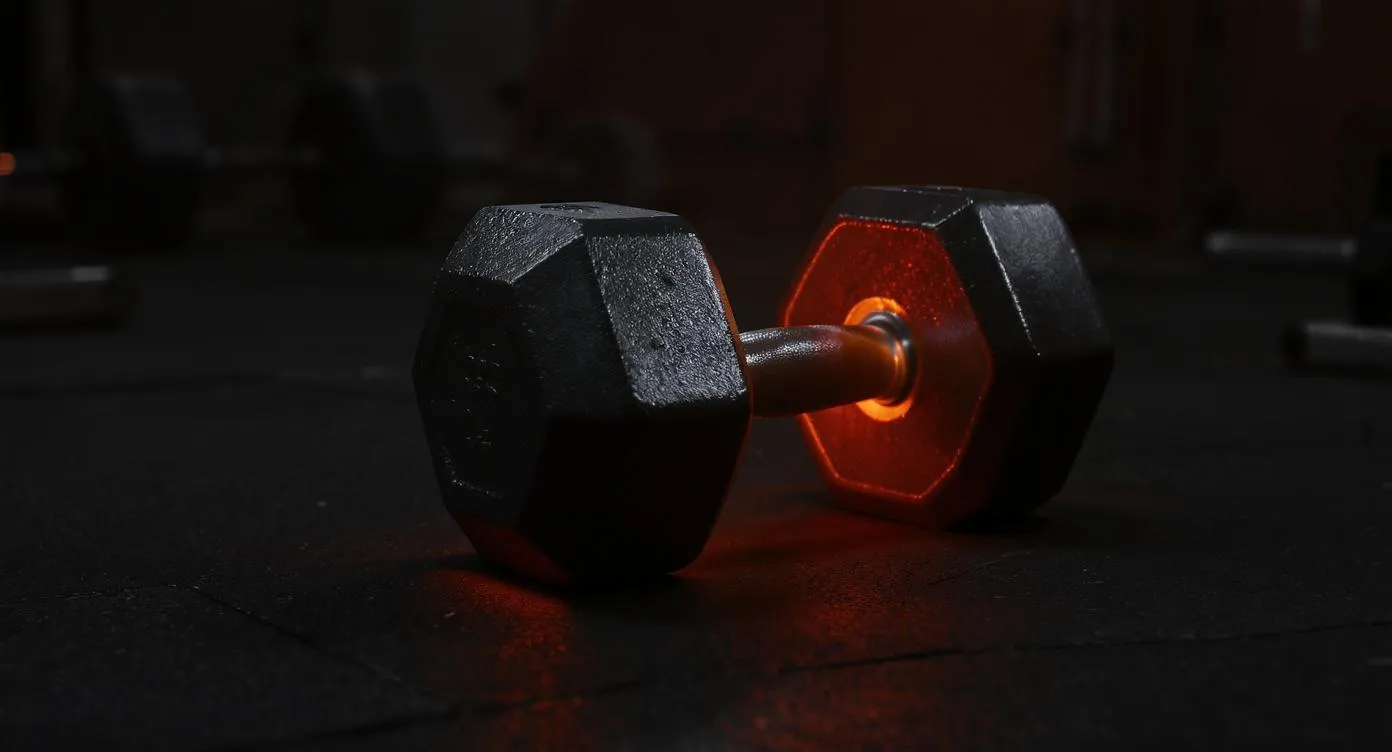
CAP Barbell Hex Dumbbells Review: The Indestructible Budget Choice
Hands-on review of the CAP Barbell Cast Iron Hex Dumbbells. Cheapest fixed dumbbells on Amazon — but are they good enough for serious training?
Adjustable dumbbells dominate the marketing cycle, but after years of building and testing home gyms, one piece of equipment keeps showing up in every serious setup: a rack of fixed cast iron hex dumbbells. The CAP Barbell Cast Iron Hex Dumbbell is the most-reviewed fixed dumbbell on Amazon — over 30,000 ratings averaging 4.7 stars. That is not an accident. I have been training with these for over three years across two different garage gym builds, and this review covers everything you need to know before you buy your first pair or complete your set.

CAP Barbell Cast Iron Hex Dumbbell, Multiple Options
Capacity
Multiple weight options
Steel
Cast Iron
Footprint
Hex shape prevents rolling
Price
$18.16
- 4.7+ star rating on Amazon with 30,000+ reviews
- Solid cast iron — virtually indestructible
- Hex shape prevents rolling
- Available in pairs from 5 to 50 lbs
- Cheapest fixed dumbbells per pound on Amazon
- Standard ergonomic handles
- Painted finish chips with heavy use
- Need multiple pairs to build a full set
- Requires significant storage space vs adjustable dumbbells
- No quick weight changes between exercises
Price and availability may change
Cast Iron Quality: What You Are Actually Buying
The phrase "cast iron" gets used loosely in the fitness industry. Some budget dumbbells use recycled metal blends with unpredictable density, inconsistent surface finish, and a porous internal structure that develops rust faster than solid iron. CAP uses a solid cast iron construction with a consistent grain that holds up over years of garage use without structural degradation.
Pick up a CAP hex dumbbell and the weight feels right. Solid, dense, with no hollow spots or obvious casting voids. The surface finish on the 20 lb and 30 lb pairs I have used the longest shows surface oxidation in spots where the paint has worn — a cosmetic issue only. The underlying iron is unchanged. I have dropped these onto concrete floors more times than I can count, and neither the dumbbells nor the floor have lost a fight.
The paint is the weakest link in the package. CAP applies a standard black enamel coat over the iron. This finish looks sharp out of the box, but chips under heavy use — particularly when pairs contact each other during storage or when you drop them from hip height. After two years of heavy use, my 35 lb and 45 lb pairs look like they belong in a commercial gym: functional but scuffed. That cosmetic wear does nothing to performance, but it is worth knowing if you are buying for a home gym you plan to keep looking clean. Some users apply a coat of Rust-Oleum enamel spray after the factory paint chips, which extends the finish meaningfully.
Quick Specs · CAP Barbell Cast Iron Hex Dumbbell, Multiple Options
Hex Shape Anti-Roll Benefits: More Important Than You Think
The hex shape sounds like marketing, but it solves a real problem that anyone who has trained with round-head dumbbells understands immediately. Round dumbbells roll. They roll off benches, roll across rubber mats, roll under racks, and create a genuine safety hazard in a crowded home gym. A 40 lb dumbbell rolling into your foot or your dog is not a minor inconvenience.
CAP's hex heads sit dead flat on any surface. Set them on rubber flooring, on concrete, on a wood platform — they do not move. During renegade rows, the flat faces give you a stable push-off platform that round dumbbells simply cannot match. The hex shape also helps during dumbbell push-up variations: the flat sides make for a natural, secure grip base that feels more like handles than improvised push-up blocks.
Beyond safety, the stability during storage pays dividends every session. When your rack holds 12 pairs of hex dumbbells, none of them are shifting, rolling into each other, or requiring adjustment every time you pull a pair out. The geometry does real organizational work that round dumbbells offload to your gym management habits.
One underrated benefit: floor exercises. When a hex dumbbell is not in your hand, it stays exactly where you set it. Side-lying lateral raise sets, floor press drop-offs, renegade row rest positions — the dumbbell is always where you left it. With round dumbbells, you are constantly chasing them.
Handle Knurling: Functional but Not Premium
The CAP hex dumbbell handle is a straight knurled steel shaft, typically 1.25 inches in diameter across the size range. The knurling is a medium-depth diamond pattern — more aggressive than rubber-coated handles, less aggressive than competition-grade barbell knurling.
For most training, the knurling is entirely adequate. Pressing, rowing, curling, lateral raises — the textured surface grips skin reliably without tearing it up during high-rep sets. During warm-up sets with chalk, the knurling grabs cleanly. During sweaty high-rep metabolic circuits, it holds without slipping.
Where the knurling falls short is at the extremes. Heavy rows and deadlifts in the 45–50 lb range start to feel like the knurling is at its limit, especially without chalk or straps. Compare this to premium fixed dumbbells like Rogue or York, where the knurling depth is more aggressive and the texture persists longer with use — the difference is real if you train heavy consistently. For most home gym users training up to 50 lbs, the CAP knurling is sufficient. If you are consistently rowing 50+ lb pairs multiple sets per session, the knurling will ask for chalk.
The handle length on CAP hex dumbbells is approximately 4.75 to 5.5 inches depending on the weight, which accommodates a standard hand grip with a small amount of lateral space. The handle does not feel cramped on pressing movements, and it does not feel excessively long in isolation work. Ergonomically, CAP nailed the handle geometry.
Weight Accuracy: How Honest Are the Numbers?
I weighed every pair in my collection on a calibrated scale. Here is what I found:
- 10 lb pair: 9.85 lb / 10.1 lb — within 2%
- 20 lb pair: 19.7 lb / 20.2 lb — within 2.5%
- 30 lb pair: 29.5 lb / 30.3 lb — within 3%
- 35 lb pair: 34.6 lb / 35.4 lb — within 2.5%
- 45 lb pair: 44.3 lb / 45.8 lb — within 3.5%
The CAP hex dumbbells are not machined to competition tolerances, but the variance is consistent and predictable. You will not find one dumbbell at 48 lbs marketed as 50. The tolerance range is typical for cast iron fixed dumbbells across all major brands — this is a materials and manufacturing reality, not a CAP-specific deficiency.
What this means practically: do not use these for precision programming where the exact load matters to the gram. For standard strength and hypertrophy training, the weight accuracy is perfectly fine. Your 30 lb dumbbell is 30 lbs plus or minus a pound — close enough for every session you will ever have.
Rubber-Coated vs. Bare Cast Iron: Which Should You Buy?
CAP offers both bare painted cast iron and rubber hex dumbbell versions. This is a real buying decision worth thinking through.
Bare cast iron (what this review covers):
- Lower cost per pound — approximately $0.80–$1.00 per pound depending on weight and sale pricing
- Durable surface that does not degrade, though the paint chips cosmetically
- Clankier during contact — more noise when pairs touch in storage or during exercises
- Floors are at risk if dropped directly on wood or tile without rubber mats underneath
- Develops surface rust without occasional light oiling if stored in humid conditions
Rubber-coated hex dumbbells:
- Slightly higher cost — approximately $1.25–$1.75 per pound
- Floor protection: the rubber cap absorbs impact and does not scar hardwood or tile
- Quieter during contact — rubber-on-rubber or rubber-on-rubber-mat is substantially more dampened
- The rubber can crack and peel after years of heavy use, especially in extreme temperature swings common in garages
- Odor: new rubber-coated dumbbells often off-gas for several weeks, which matters in an enclosed space
For a garage gym with rubber flooring — which is most home gym builds — bare cast iron is the pragmatic choice. You get more iron per dollar, the floor is protected by your mat, and you avoid the rubber degradation issue. If you are setting up in a basement with finished flooring, spare bedroom, or any space without dedicated rubber matting, the rubber-coated version is worth the premium for floor protection alone.
What We Love
- 4.7-star Amazon rating across 30,000+ verified reviews
- Solid cast iron construction — virtually indestructible with no hollow casting voids
- Hex shape prevents rolling and provides a stable push-off surface for renegade rows
- Available in pairs from 5 lbs to 50 lbs covering every training range
- Approximately $0.80–1.00 per pound — cheapest quality fixed dumbbell per pound on Amazon
- Consistent 1.25-inch handle diameter across the full weight range
- Weighs within 2–3.5% of stated weight across all sizes tested
- No moving parts — zero maintenance required, lasts indefinitely with basic care
What Could Be Better
- Factory enamel paint chips with heavy use — cosmetic only but noticeable after 1–2 years
- Building a complete 5–50 lb set requires purchasing 10 pairs individually
- Full set storage requires a dumbbell rack — budget $40–$100 extra for a quality A-frame
- Knurling is adequate but not aggressive enough for heavy rows without chalk at upper weights
- Iron surface oxidizes in humid garage environments without occasional light oiling
- No rubber protection on bare iron version — avoid dropping on unprotected hardwood or tile
Building a Full Rack: A Strategic Approach
The biggest mistake new home gym owners make is buying a complete 5–50 lb set all at once. That sounds efficient, but it means spending $450–$550 on dumbbells you may not use for months while you build strength. A staged build serves most lifters better.
Stage 1 — Foundation Set ($120–$150)
This is the starter set that covers 80% of exercises for most beginning to intermediate lifters:
- 10 lb pair — warm-ups, face pulls, light laterals
- 20 lb pair — curls, overhead press starting weight, light rows
- 25 lb pair — pressing progression weight, heavier curls
- 30 lb pair — rows, chest press working weight for early training
Most people train with this set for three to six months before they genuinely need the next tier.
Stage 2 — Intermediate Expansion ($175–$225 additional)
Add these when your Stage 1 pairs feel light consistently across most exercises:
- 15 lb pair — fills the gap between 10 and 20 for laterals and isolation work
- 35 lb pair — row and press progression
- 40 lb pair — heavier press and row work
- 45 lb pair — the workhorse of intermediate strength training
Stage 3 — Complete Set ($100–$150 additional)
Add these to complete the collection:
- 5 lb pair — rehab work, warm-ups, light band-and-dumbbell combinations
- 50 lb pair — heavy rows, chest press, Romanian deadlifts at advanced loading
A complete 5–50 lb collection across 10 pairs runs $400–$550 depending on current Amazon pricing and whether you catch sales. At approximately $1 per pound of iron, this is one of the best equipment values in home gym outfitting.
For storage, the Yes4All 5-Tier A-Frame Dumbbell Rack is the natural companion purchase. It holds a full 5–50 lb set in a compact A-frame footprint, keeps pairs organized by weight, and costs under $50 — a negligible addition to the overall set cost. The hex shape of the CAP dumbbells integrates perfectly with A-frame storage since the flat faces prevent any shifting on the rack tiers.
Fixed Hex vs. Adjustable Dumbbells: The Real Comparison
This is the decision that trips up most home gym buyers. The right answer depends on your training style, available space, and budget tolerance for upfront cost.
| Feature | CAP Hex Set (5–50 lbs) | Bowflex SelectTech 552 |
|---|---|---|
| Total cost | $400–$550 | $429 (single pair) |
| Weight range | 5–50 lbs | 5–52.5 lbs |
| Weight increments | Fixed pairs (5 lb steps typically) | 2.5 lb increments to 25 lbs, 5 lb steps above |
| Change speed | Instant — grab the pair | 2–3 seconds per adjustment |
| Drop safety | Yes — drop freely | No — internal mechanism cracks on impact |
| Durability | Indefinite — no moving parts | 5–10 years with careful use |
| Storage footprint | Requires A-frame rack (approximately 36 x 18 in) | Two cradles (approximately 33 x 8.5 in) |
| Repair cost if broken | $0 — nothing to break | $50–$150 for replacement dial components |
| Best for | HIIT, CrossFit, group training, heavy use | Space-limited setups, apartment gyms |
The Bowflex SelectTech 552 is an excellent product that earns its recommendation for space-constrained setups. A Manhattan apartment or a shared basement space where floor space is the limiting constraint — that is where adjustable dumbbells win clearly. But a garage gym with a dedicated training corner, where 36 inches of rack space is not a hardship? Fixed hex dumbbells give you a better training experience at equivalent total cost.
The speed advantage of fixed dumbbells is real and compounds over time. No dial, no cradle alignment, no re-racking protocol. Pick up the 30 lb pair, finish your set, set them down, pick up the 20 lb pair. The friction is zero. During intense circuits, supersets, and HIIT-style training, that zero-friction flow keeps your heart rate up and your session on track.
The drop-safe advantage is equally significant in practice. Anyone doing kettlebell-style training, high-rep metabolic circuits, or explosive dumbbell variations where grip failure happens — you cannot do this safely with adjustable dumbbells. The CAP hex pair absorbs drops without consequence. This expands what you can do with the equipment.
For a more detailed breakdown of this specific decision, read our CAP hex vs Bowflex 552 comparison. If you are still evaluating the full adjustable dumbbell market, the best adjustable dumbbells guide covers all major options across price points.
Exercises Where Hex Dumbbells Excel
Fixed hex dumbbells are not better than adjustables for everything, but there are specific exercises where the hex shape and iron construction create meaningful advantages:
Renegade rows — The flat hex faces sit stable on rubber flooring without wobbling or rotating. This makes the renegade row cleaner mechanically and eliminates the wrist deviation compensation that round dumbbells require.
Dumbbell push-ups — The flat face provides a true neutral-grip push-up base that keeps wrists in alignment. Many lifters with wrist discomfort find hex dumbbell push-ups more comfortable than either floor or bar push-ups.
Floor press — Setting dumbbells down between floor press sets is frictionless. They sit exactly where you put them without any rolling adjustment.
Farmer carries and loaded carries — The hex faces reduce hand fatigue compared to round dumbbells because the contact surface distributes the load more evenly across the palm.
High-rep finishers — When a 200-rep bicep curl finisher calls for setting the dumbbell down eight times mid-set, you want it to stay put.
Who Should Buy the CAP Hex Dumbbells
Buy the fixed hex set if:
- You have a dedicated garage or basement gym with floor space for a dumbbell rack
- You do CrossFit, HIIT, circuits, or any training where dumbbells get dropped
- You want equipment that never breaks, never needs repair, and never gets retired
- You prefer grabbing the right weight instantly without any mechanical interaction
- You want the lowest total cost per pound of usable iron in your gym
- You train with multiple people and need multiple pairs available simultaneously
Consider adjustable dumbbells instead if:
- You are genuinely space-limited and 36 inches of rack width is not available
- You exclusively do slow-tempo hypertrophy work where drops never happen
- You want the precision of 2.5 lb increments throughout the weight range
- You are building a starter gym on the smallest possible footprint
Frequently Asked Questions
Are CAP Barbell hex dumbbells good quality?
Do CAP hex dumbbells rust?
How accurate are CAP hex dumbbell weights?
Are CAP hex dumbbells good for beginners?
How much does a full set of CAP hex dumbbells cost?
What rack should I buy for CAP hex dumbbells?
Can you drop CAP hex dumbbells?
Rubber-coated or bare cast iron CAP hex dumbbells — which is better?
How do CAP hex dumbbells compare to Bowflex SelectTech 552?
Additional Resources
- ACE Strength Training 101
- NSCA Dumbbell Training Techniques
- PubMed: Dumbbell vs Barbell Training for Strength
Final Verdict
Rating: 4.6/5 — The CAP Barbell Cast Iron Hex Dumbbells are the correct answer for a wide range of home gym builds. They are simple, indestructible, immediately ready, and priced at roughly a dollar per pound of iron — the best value per pound in the fixed dumbbell market. The cast iron construction will outlast any mechanical adjustable dumbbell system. The hex geometry prevents rolling, enables floor-based exercises, and integrates cleanly with standard A-frame rack storage.
The limitations are real and worth naming: the paint chips, a complete set requires dedicated floor space, and the bare iron needs basic rust prevention in humid environments. None of these are dealbreakers in a garage gym context. They are simply the trade-offs of solid iron over engineered mechanisms.
If you are building a serious garage gym and you have a rack corner to dedicate, build your set with CAP hex dumbbells. Start with the pairs you need now, add pairs as your strength demands them, and know that the dumbbells you buy today will still be in your gym twenty years from now.
The most popular fixed dumbbell on Amazon for a reason. Solid cast iron, hex shape, drop-safe design, instant weight access, and the lowest cost per pound in the market. Build your set over time as your strength grows — this is the equipment that never needs replacing.
Price and availability may change
Related Content
Marcus Reid
Powerlifter and mechanical engineer who has been building and breaking home gym equipment for 15 years.
Read full bioMore in Reviews
Yes4All Kettlebell Set Review: Best Budget Kettlebells on Amazon?
Our review of the Yes4All Cast Iron Kettlebell Set. Are these the best budget kettlebells for home gym training on Amazon?
TRX Bandit Resistance Band Handles Review: Worth the Money?
Hands-on review of the TRX Bandit Resistance Band Handles. Is $49.95 worth it for your home gym?
POWER GUIDANCE Battle Rope Review: CrossFit Standard for $40
Hands-on review of the POWER GUIDANCE 30 ft Battle Rope. Best budget battle rope on Amazon for HIIT, CrossFit, and brutal conditioning.
You Might Also Like
Bowflex 552 vs PowerBlock 90: Which Adjustable Dumbbells Should You Buy?
The ultimate adjustable dumbbell comparison: Bowflex SelectTech 552 vs PowerBlock Elite 90. We tested both — here's which one wins for your home gym.
CAP Hex Dumbbells vs Bowflex 552: Fixed or Adjustable?
Fixed cast iron dumbbells vs adjustable. CAP Barbell Hex vs Bowflex SelectTech 552 — which is the smarter buy for your home gym?
Is the PowerBlock Elite 90 Worth $869? (Honest Verdict)
The PowerBlock Elite 90 costs nearly $900. We tested them head-to-head against cheaper options to find out if the premium price is justified.