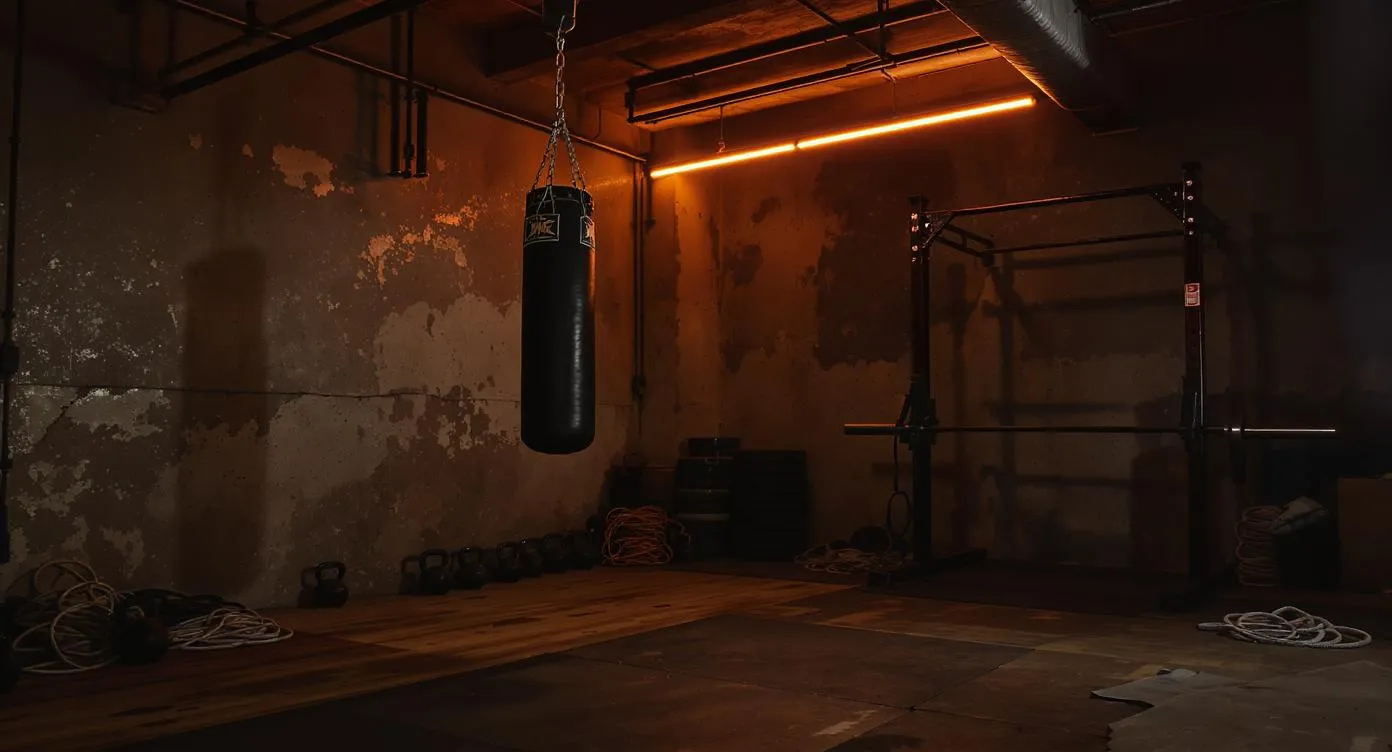
Home Gym for MMA & Combat Sports: Complete Equipment Guide
Build a complete home gym for MMA, boxing, and combat sports training. Conditioning equipment, strength training, and space-efficient gear.
Mixed martial arts demands more from your body than almost any other sport. A fighter needs bone-crushing takedown power, the cardio to sustain a five-round war, the grip to control an opponent in the clinch, and the rotational explosiveness to throw a head kick in the final seconds of a round. Traditional bodybuilding gyms are not built for this. Neither are most commercial fitness centers, where squat racks gather dust and the only conditioning equipment is a row of treadmills.
The good news: a properly equipped garage gym can deliver everything a combat athlete needs, often better than a commercial facility. You train on your own schedule, never wait for equipment, and can build a space tailored specifically to the physical demands of MMA, Muay Thai, Brazilian jiu-jitsu, wrestling, and boxing.
This guide walks you through every piece of equipment, how to select it, how to program around it, and how to avoid the mistakes that leave fighters overtrained or underprepared. If you are brand new to building a training space, start with our ultimate beginner's home gym guide for foundational setup advice, then come back here for fight-specific details.
What Combat Sports Actually Demand From Your Body
Before spending a single dollar, understand the athletic profile you are training for. MMA fighters are not powerlifters, not marathon runners, and not bodybuilders. They sit at the intersection of multiple physical qualities:
- Maximal strength — Enough force production to dominate clinch exchanges, resist takedowns, and bridge out from bottom position. Compound lifts like squats and deadlifts at 80-90% of your one-rep max build this.
- Explosive power — The ability to generate force rapidly. Takedown shots, knockout punches, and scrambles all happen in fractions of a second. Olympic lift variations, plyometrics, and kettlebell ballistics are the primary developers.
- Anaerobic conditioning — Fighting is interval-based. A three-minute round of grappling operates almost entirely on the glycolytic energy system. Air bike sprints, heavy bag rounds, and kettlebell complexes replicate this demand.
- Aerobic base — Without an aerobic foundation, your recovery between rounds collapses. A strong aerobic base also helps you sustain a high pace without accumulating lactate too quickly. Steady-state work on a rower or bike at 130-150 BPM builds this.
- Grip endurance — In grappling, your grip is your primary weapon. Gi and no-gi athletes both need forearms that refuse to quit. Dead hangs, farmer's walks, towel pull-ups, and thick-handle training develop this.
- Rotational core strength — Every punch, kick, and throw is powered by the trunk. Anti-rotation exercises, medicine ball slams, and Pallof presses build a core that transfers force efficiently.
- Mobility and flexibility — High kicks, deep guard retention, and fluid transitions all require above-average hip and shoulder mobility. Static stretching post-training, loaded stretches, and dedicated mobility circuits keep joints healthy.
A well-designed home gym must address every single one of these qualities. Here is exactly how to build it.
The Essential Fighter's Home Gym: Equipment Breakdown
1. Power Rack — The Foundation of Barbell Strength

Mikolo F4 2.0 Power Cage with Dual-Track Smooth Pulley System
Capacity
1,200 lbs
Steel
2x2" 12-Gauge Steel
Footprint
49" L x 49" W x 86" H
Price
$399.99
- 4.6+ star rating on Amazon with 3,000+ reviews
- 1,200 lb weight capacity — rare at this price
- Includes LAT pulldown and low row cable system
- 27 height adjustments with 2" hole spacing
- Dual-track pulley system
- Comes with multiple attachments included
- Assembly takes 3-4 hours
- Heavier than budget racks — needs two people to move
- Plate storage pegs sold separately
Price and availability may change
A power rack is non-negotiable for serious strength development. Squats, bench press, overhead press, and barbell rows form the backbone of a fighter's strength program, and all of them are best performed inside a rack with safety bars. The Mikolo F4 Power Cage stands out for combat athletes because it includes a LAT pulldown attachment, which directly trains the pulling muscles used in clinch work and grappling. The rack also features band pegs for accommodating resistance training, a technique that builds explosive lockout strength by increasing load at the top of each rep.
When choosing a rack, prioritize hole spacing (2-inch Westside spacing through the bench zone is ideal), weight capacity of at least 800 lbs, and compatibility with accessories you might add later like dip attachments or landmine posts. Read our full Mikolo F4 review for detailed specs and load-testing results. If you want to compare multiple options, our how to choose a power rack guide covers everything from footprint to steel gauge.
- Enables all major barbell lifts with safety bars for solo training
- LAT pulldown included for grappling-specific back work
- Band pegs support accommodating resistance for explosive strength
- Compact enough for a single-car garage
- Requires at least 8x8 feet of dedicated floor space
- Heavy — plan to assemble in place, not move after
- Does not include a barbell or weight plates
2. Olympic Barbell — Built for Explosive Lifts

Synergee Games 15kg and 20kg Colored Ceramic Coated Barbells
Capacity
1,500 lbs rated capacity
Steel
Ceramic Coated Steel / Needle Bearings
Footprint
28.5mm Shaft, 7ft Olympic Bar
Price
$149.95
- 4.7+ star rating on Amazon
- 1,000 lb capacity at mid-range price
- Needle bearings provide smooth spin for Olympic lifts
- 190K PSI tensile strength
- Dual knurling marks for powerlifting and Olympic lifts
- Best Amazon-available upgrade from budget bars
- Black phosphate finish requires regular oiling
- Not made in the USA
- Knurling is slightly less aggressive than premium bars
Price and availability may change
Combat athletes benefit enormously from Olympic lift variations — power cleans, hang snatches, push presses — because these movements train the rapid triple extension of ankles, knees, and hips that powers takedowns, sprawls, and strikes. A quality Olympic barbell with needle bearings (not bushing sleeves) allows the sleeve to spin freely during fast lifts, protecting your wrists and elbows from torque.
The Synergee Games Barbell uses needle bearings, has a 28.5mm shaft with moderate knurling (comfortable for high-rep sets), and a 190,000 PSI tensile strength rating. That is more than enough for any fighter's training loads. Pair it with bumper plates so you can safely drop the bar from overhead during cleans and snatches. For a deep dive into barbell selection, see our how to choose a barbell guide. Read our Synergee barbell review for hands-on testing notes.
3. Kettlebells — The Single Most Fighter-Friendly Tool

Yes4All Cast Iron Kettlebell 5-80 Lb for Full Body Workout
Capacity
5-80 lbs options
Steel
Solid Cast Iron
Footprint
Varies by weight
Price
$79.97
- 4.7+ star rating on Amazon with 12,000+ reviews
- Solid cast iron construction
- Durable painted finish
- Standard grip width for most users
- Available individually or in sets
- Best budget kettlebell option
- Cheaper competition-grade bells exist
- Paint can chip with heavy use
- Not ideal for kettlebell sport (uniform size)
- Handle texture varies between batches
Price and availability may change
If you could only buy one piece of equipment for MMA training, buy kettlebells. No other tool trains as many fight-relevant qualities simultaneously:
- Kettlebell swings (heavy, 10x10 EMOM) build explosive hip extension — the same movement pattern as throwing a punch or shooting a double-leg takedown. A 2012 study in the Journal of Strength and Conditioning Research found that kettlebell swing training significantly improved explosive strength compared to traditional weight training alone.
- Turkish get-ups train full-body stability under load through multiple planes of motion, mimicking the positional changes fighters make on the ground.
- Goblet squats build deep squat strength and hip mobility simultaneously.
- Kettlebell cleans and snatches develop grip endurance and unilateral explosive power.
- Kettlebell complexes (swing-clean-press-squat sequences) create brutal conditioning circuits that mirror the metabolic demands of a fight round.
The Yes4All Vinyl Coated Kettlebell Set gives you a range of weights to progress through. Start with a 16 kg (35 lb) bell for swings if you are a male fighter under 180 lbs, or 24 kg (53 lb) if you are over 180 lbs. Female fighters should start with 12 kg (26 lb) for swings. Read our Yes4All Kettlebell review and our broader how to choose a kettlebell guide for weight selection advice.
4. Air Bike — The Conditioning King

Sunny Health & Fitness Premium Smart Cross-Training Fan Bike SF-B223018
Capacity
330 lbs user weight
Steel
Steel Frame
Footprint
50.95" L x 23.34" W x 50" H
Price
$699.99
- 4.5+ star rating on Amazon with 3,000+ reviews
- The original and most iconic air bike
- Programmable workouts (Tabata, HIIT, custom)
- LCD console with chest strap heart rate support
- Proven durability over a decade
- Great for CrossFit-style conditioning
- Chain-driven (louder than belt-driven competitors)
- Requires occasional chain lubrication
- Heavy at 98 lbs — hard to relocate
- Premium price vs. budget air bikes
Price and availability may change
An air bike is the closest thing you will find to replicating fight-level exhaustion without a training partner. The fan resistance means the harder you push, the harder it pushes back — exactly like a fight. Unlike a spin bike or treadmill, an air bike engages both the upper and lower body simultaneously, draining your energy stores in the same total-body way that grappling and striking do.
The Sunny Health & Fitness SF-B223018 Fan Bike has been the standard in MMA gyms and CrossFit boxes for years. Its belt-driven system is quieter than chain-driven alternatives, and the LCD console tracks calories, watts, distance, and heart rate. For fighters, the key metric is watts — aim to sustain 400+ watts during 30-second sprints as a baseline for competitive conditioning.
Fighter-Specific Air Bike Protocols:
- Tabata intervals: 20 seconds max effort / 10 seconds rest, 8 rounds. This 4-minute session produces a conditioning effect that rivals 45 minutes of steady-state cardio.
- Fight simulation: 5 minutes moderate pace / 30 seconds max effort (simulating a flurry), repeat for 3-5 rounds with 1-minute rest between rounds.
- Aerobic base building: 30-45 minutes at 120-140 BPM heart rate, 2x per week.
Read our Sunny Health SF-B223018 review for durability and noise-level testing. If you are comparing conditioning tools, our how to choose a cardio machine guide covers rowers, bikes, and ski ergs side by side.
5. Adjustable Dumbbells — Unilateral Power Development

BowFlex Results Series SelectTech Dumbbells
Capacity
5-52.5 lbs each
Steel
Steel Plates / Nylon Dial Mechanism
Footprint
16.9" L x 8.3" W x 9" H each
Price
$429.00
- 4.7+ star rating on Amazon with 15,000+ reviews
- Replaces 15 sets of dumbbells (5-52.5 lbs)
- Fastest weight change system on the market (2 seconds)
- 2.5 lb increments up to 25 lbs
- Compact cradle storage footprint
- Sold as a pair
- Cannot be dropped — internal mechanism is fragile
- Length at 52.5 lbs feels awkward on some exercises
- Price has increased from original $349 MSRP
- 5 lb increments above 25 lbs
Price and availability may change
Fighting is an asymmetric sport. You throw a cross with your rear hand, shoot a takedown off your lead leg, and defend submissions from awkward angles. Barbell training alone creates bilateral strength but can mask side-to-side imbalances. Adjustable dumbbells let you train each limb independently, exposing and correcting weaknesses.
The Bowflex SelectTech 552 adjusts from 5 to 52.5 lbs in 2.5 lb increments, replacing 15 pairs of dumbbells in a footprint smaller than a milk crate. Use them for single-arm rows (grip and lat strength for grappling), dumbbell floor presses (punch-specific horizontal pressing), single-leg Romanian deadlifts (posterior chain balance), and weighted Turkish get-ups.
Read our Bowflex 552 review and our how to choose adjustable dumbbells guide if you want to compare against competitors like the PowerBlock Elite or Ironmaster Quick-Lock.
Additional Fight-Specific Equipment
Beyond the five core pieces, these additions round out a complete combat athlete's training space:
Heavy Bag (Essential for Strikers)
A 100 lb heavy bag is the most important striking tool you can own. It lets you practice punches, kicks, knees, and elbows with real force and proper technique when you do not have a training partner. Hanging bags (ceiling-mounted or beam-mounted) provide the most realistic movement and feedback. Freestanding bags like the Century Wavemaster are easier to set up but tend to tip during hard kicks and do not absorb impact as naturally.
Specs to look for: 100-150 lbs filled weight for adult fighters, synthetic leather shell (more durable than canvas), D-ring or chain attachment at the top. Budget $150-300 for a quality bag. You will also need a heavy-duty ceiling mount ($30-60) or a heavy bag stand ($100-200). If you choose a ceiling mount, make sure your garage has exposed joists or engineered beams rated for dynamic loads — a heavy bag generates significant shock force during hard kicks.
Boxing Gloves and Hand Wraps
Bag work without proper hand protection will end your training career with broken metacarpals. Use 12-14 oz gloves for general bag work, 16 oz gloves for heavy sparring or partner mitt work. Mexican-style hand wraps (180 inches, semi-elastic) provide the best wrist and knuckle support. Budget $50-120 for quality gloves (Fairtex BGV1 and Twins Special are both excellent) and $10-15 for wraps.
Jump Rope
The single cheapest and most effective conditioning tool available. A speed rope builds footwork, coordination, timing, and aerobic capacity in a package that costs under $15 and fits in your gym bag. Fighters should aim for 10-15 minutes of continuous jumping as a warm-up benchmark. Weighted ropes (1/2 lb to 1 lb) add a shoulder endurance component that translates to keeping your guard up in later rounds.
Gymnastics Rings
Hang a pair of wooden gymnastics rings from your power rack's pull-up bar and you unlock dozens of advanced bodyweight exercises: ring rows, ring dips, ring push-ups, muscle-ups, and skin-the-cats. Ring training develops the kind of unstable upper-body strength and shoulder health that directly transfers to grappling. They cost $30-50 and take up zero floor space.
Medicine Ball (Slam Ball)
A 10-20 lb slam ball develops rotational power — the ability to generate force through the trunk, which powers hooks, uppercuts, round kicks, and hip throws. Medicine ball slams, rotational throws against a wall, and overhead toss-to-sprint drills are all fight-specific. Make sure you buy a slam ball (dead bounce), not a traditional rubber medicine ball (live bounce), to avoid it bouncing back into your face.
Flooring and Safety Considerations
Combat sports training puts unique stresses on your floor. Dropped barbells, heavy bag vibration, kettlebell swings, and sprawl drills all demand proper flooring. We cover this extensively in our garage gym flooring guide, but here are the fighter-specific essentials:
- Minimum 3/4-inch rubber stall mats under the lifting area. Horse stall mats from Tractor Supply Co (4x6 feet, $50 each) are the gold standard for home gym flooring.
- Puzzle-mat foam tiles in the striking and movement area if you plan to do any groundwork, sprawl drills, or shadow grappling. These are softer than rubber and protect joints during floor-based exercises.
- Never train barefoot on bare concrete. The impact forces from jumping, sprawling, and pivoting will destroy your feet and ankles over time.
- Secure your heavy bag mount properly. A falling heavy bag can cause serious injury. Lag bolt ceiling mounts into structural joists, not drywall. See our garage gym safety guide for mounting best practices.
Budget Breakdown for a Fighter's Home Gym
Minimum Viable Fighter Setup (~$1,500)
| Equipment | Estimated Cost |
|---|---|
| ULTRA FUEGO Power Cage | $389.99 |
| CAP 300 lb Olympic Barbell & Plate Set | $340 |
| Yes4All Kettlebells (3-5 bells) | $120-149 |
| FLYBIRD Adjustable Bench | $110 |
| Bowflex SelectTech 552 Dumbbells | $429 |
| Speed Jump Rope | $15 |
| Rubber Stall Mat Flooring (4 mats) | $200 |
| Total | ~$1,550-1,575 |
This setup covers strength training, explosive power development, and basic conditioning. Add a heavy bag and gloves ($200-350) when budget allows.
Complete Fighter Setup (~$3,000)
Take the minimum setup above and add:
| Equipment | Estimated Cost |
|---|---|
| Sunny Health & Fitness SF-B223018 Fan Bike | $700 |
| 100 lb Heavy Bag + Ceiling Mount | $200 |
| Boxing Gloves (14 oz) + Hand Wraps | $80 |
| Gymnastics Rings (wood) | $40 |
| Slam Ball (15 lb) | $35 |
| Additional Kettlebells (heavier bells) | $80 |
| Extra Flooring (puzzle mats for movement area) | $100 |
| Additional Total | ~$1,235 |
| Grand Total | ~$2,800-3,000 |
See our home gym under $3,000 build guide for a detailed equipment list and layout suggestions that apply to this budget tier. If you want the full MMA-specific build breakdown, check our MMA fighter home gym build page.
Sample Six-Day Fighter's Training Week
This program assumes you also attend skill-specific classes (grappling, striking, sparring) at an MMA gym 2-4 days per week. The home gym sessions focus on physical preparation, not technique work.
Monday: Lower Body Strength
| Exercise | Sets x Reps | Notes |
|---|---|---|
| Back Squat | 5x5 at 80-85% 1RM | Full depth, controlled eccentric |
| Trap Bar Deadlift | 3x5 at 80% 1RM | Reset each rep, no bounce |
| Bulgarian Split Squat | 3x8 each leg | Rear foot elevated on bench |
| Single-Leg Romanian Deadlift | 3x10 each leg | Dumbbell in opposite hand |
| Pallof Press | 3x12 each side | Band attached to rack upright |
Tuesday: Conditioning + Striking
| Exercise | Sets x Reps | Notes |
|---|---|---|
| Jump Rope Warm-Up | 10 minutes continuous | Alternate single-unders and double-unders |
| Sunny Health Fan Bike Intervals | 10 rounds: 30s hard / 30s easy | Target 400+ watts during work intervals |
| Heavy Bag Rounds | 5x3-minute rounds, 1 min rest | Mix punches, kicks, knees, elbows |
| Medicine Ball Slams | 3x15 | Explosive hip extension on each rep |
Wednesday: Upper Body Strength
| Exercise | Sets x Reps | Notes |
|---|---|---|
| Bench Press | 5x5 at 80-85% 1RM | Pause each rep on chest |
| Weighted Pull-Ups | 4x5 | Add weight via belt or dumbbell between feet |
| Overhead Press | 3x8 | Standing, strict form |
| Single-Arm Dumbbell Row | 3x10 each arm | Squeeze at the top for 1 second |
| Farmer's Walk | 3x40 steps | Heavy dumbbells, crush grip |
Thursday: Active Recovery
- 30 minutes easy pace on air bike at 120-130 BPM
- 20 minutes full-body stretching with emphasis on hips and shoulders
- Foam rolling: quads, IT band, thoracic spine, lats
- Optional: light shadow boxing (technique only, no power)
Friday: Explosive Power + Conditioning
| Exercise | Sets x Reps | Notes |
|---|---|---|
| Power Clean | 5x3 at 70-75% 1RM | Focus on speed, not load |
| Kettlebell Swings | 10x10 EMOM | Every minute on the minute |
| Box Jumps | 5x5 | Step down between reps to protect joints |
| Plyometric Push-Ups | 3x8 | Hands leave the ground on each rep |
| Ring Dips | 3x max reps | Slow eccentric, explosive concentric |
| Sunny Health Fan Bike Finisher | 3 rounds: 1 min hard / 2 min easy | Leave everything on the bike |
Saturday: Skills and Sparring
- Technical drilling at MMA gym or with training partners
- Light sparring or positional grappling
- Heavy bag work focused on combinations and movement
- This is not a max-effort day — the goal is skill refinement
Sunday: Full Rest
Complete rest. Sleep 8+ hours. Eat at a caloric surplus if you are trying to build muscle, or at maintenance if you are cutting for a fight. Hydrate aggressively.
Recovery and Injury Prevention for Combat Athletes
Fighters push their bodies harder than almost any other athletes, and a home gym that does not account for recovery is incomplete. Build these practices into your weekly routine:
- Sleep: Aim for 8-9 hours per night. Growth hormone — which drives muscle repair, joint recovery, and neural adaptation — peaks during deep sleep. No supplement or recovery tool replaces quality sleep.
- Nutrition timing: Consume 20-40g of protein within 60 minutes of training. Fighters cutting weight often under-eat protein, which slows recovery and increases injury risk.
- Foam rolling and lacrosse ball work: 10-15 minutes post-training targeting the thoracic spine, hip flexors, IT band, and pectorals. This is particularly important for grapplers who spend time in flexed, compressed positions.
- Cold exposure: A 2-3 minute cold shower or ice bath after intense sessions can reduce delayed-onset muscle soreness. Save cold exposure for conditioning days, not strength days — some evidence suggests cold immersion immediately after strength training may blunt hypertrophy adaptations.
- Deload weeks: Every 4-6 weeks, reduce training volume by 40-50% for one full week. Fighters who train year-round without deloads accumulate fatigue that eventually manifests as injury, illness, or performance plateaus.
Maintenance Tips for Combat Training Equipment
Heavy bag and kettlebell training beat up equipment faster than standard gym work. Keep your gear in fighting shape:
- Heavy bag: Check the chain or strap attachment monthly for wear. Rotate the bag 90 degrees each week to distribute impact evenly and prevent one side from breaking down. If the fill settles to the bottom, hang the bag upside down overnight to redistribute.
- Barbell sleeves: Clean and lubricate the sleeves every 3-6 months with 3-in-1 oil, especially if you train in a humid garage. Needle bearings corrode quickly without maintenance. See our barbell maintenance guide for a step-by-step process.
- Rubber flooring: Sweep weekly and mop monthly with a mild soap solution. Rubber mats absorb sweat and chalk, and will develop an odor if neglected.
- Air bike: Wipe the frame and seat after every session. Tighten pedal bolts monthly. Check the belt tension annually per the manufacturer's instructions.
Common Questions
Can I realistically train for MMA in a home gym?
What is the single most important piece of equipment for MMA home training?
Should MMA fighters prioritize strength or conditioning?
Are Olympic lifts necessary for MMA athletes?
What is the best cardio modality for fight conditioning?
How do I build the grip strength needed for grappling?
Do I need a heavy bag for MMA home training?
How much space do I need for an MMA home gym?
Additional Resources
Related Content
- MMA Fighter Home Gym Build
- Home Gym Under $1,500 Fighter Setup
- Home Gym Under $3,000 Complete Setup
- Best Kettlebells for Home Gyms
- All MMA & Combat Training Content
- Best Air Bikes
- Yes4All Kettlebell Review
- Sunny Health SF-B223018 Review
- Home Gym for Boxing
- CrossFit Home Gym Setup (similar conditioning focus)
- Garage Gym Flooring Guide
- Garage Gym Safety Guide
The Bottom Line
A complete fighter's home gym costs $1,500-3,000 and builds every physical attribute that MMA and combat sports demand: maximal strength, explosive power, anaerobic and aerobic conditioning, grip endurance, rotational core strength, and mobility. The core of the setup is a power rack, Olympic barbell, kettlebells, an air bike, and adjustable dumbbells. Add a heavy bag and gloves for striking work, gymnastics rings for upper-body stability, and a slam ball for rotational power.
Do not fall into the trap of building a bodybuilding gym and calling it fight training. Bilateral machine exercises, isolation movements, and steady-state treadmill jogging will not prepare you for the demands of the cage or the ring. Train the way you fight: explosive, unpredictable, and relentless. Your garage gym should reflect that.
Derek Walsh
Strongman competitor and former commercial gym equipment salesman. Knows what survives heavy daily use.
Read full bioMore in Guides
Strength vs Hypertrophy: How to Program for Your Goals (2026)
The definitive guide to programming for strength vs size in your home gym. Rep ranges, volume, intensity, and complete programs for both goals.
The Complete Home Gym Warm-Up Guide (2026)
Stop skipping your warm-up. Complete warm-up protocols for every training style, plus the equipment that makes preparation effortless at home.
Home Gym Deload Guide: When and How to Back Off (2026)
Learn when and how to deload in your home gym. Science-backed protocols, recovery strategies, and signs you need a rest week.