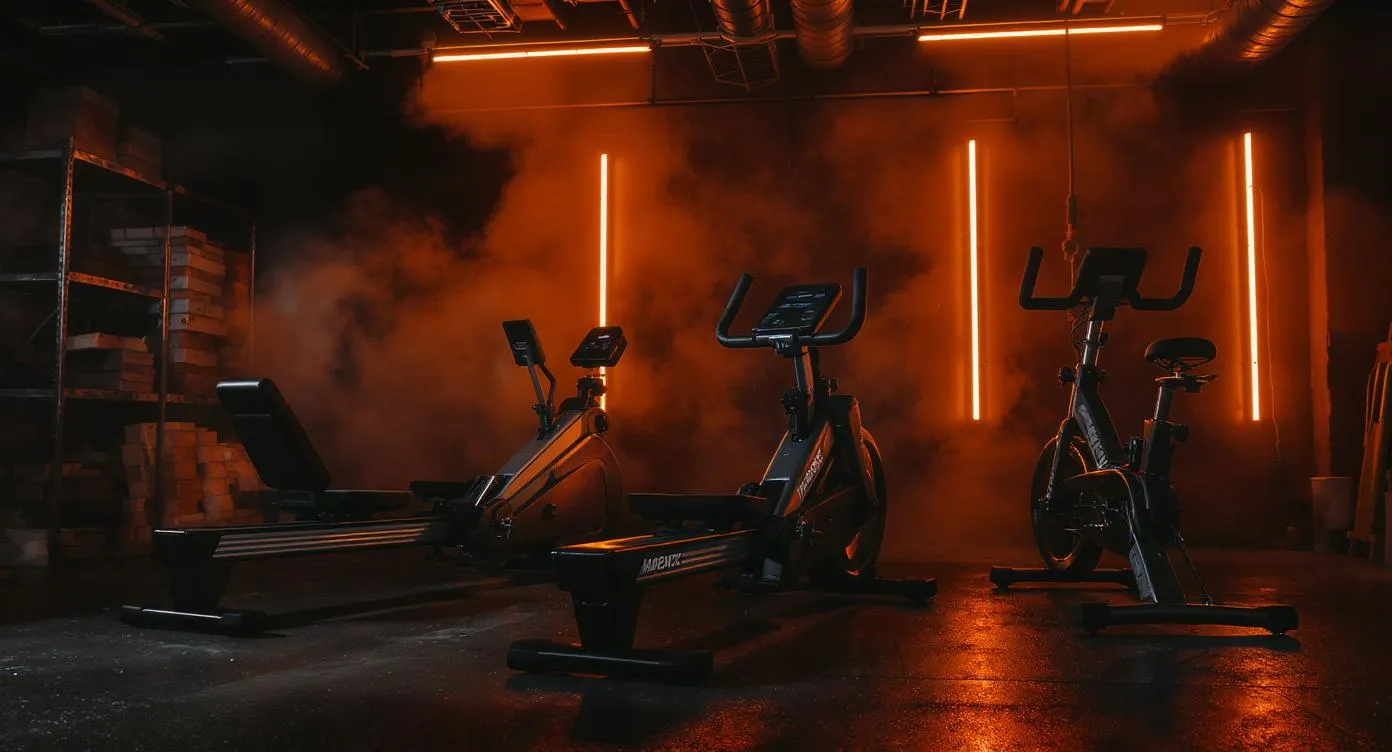
How to Choose a Cardio Machine for Home: Buyer's Guide (2026)
How to choose the right cardio machine for your home gym. Treadmills, rowers, bikes, and ellipticals compared with pros, cons, and recommendations.
A rowing machine is the best all-around cardio machine for a home gym — the Concept2 RowErg is the gold standard, or the Sunny Health SF-RW5515 at ~$300 if you are on a budget. Both fold for storage and deliver full-body conditioning.
A cardio machine is the second-biggest purchase in most home gyms, behind only the power rack. These machines take up significant floor space, cost anywhere from $250 to $3,000, and will either serve you faithfully for a decade or become the world's most expensive coat rack within six months. The difference between those two outcomes comes down to one thing: choosing the right machine for how you actually train.
Most buyers get this wrong. They buy a treadmill because "running is healthy" even though they hate running. They chase a Peloton because influencers told them to. They buy the cheapest machine on Amazon and wonder why it breaks in four months. This guide will help you avoid every one of those mistakes.
After spending over a decade training in home gyms, testing dozens of machines, and helping hundreds of garage gym owners make purchasing decisions, I have developed a clear framework for choosing cardio equipment. By the time you finish reading this, you will know exactly which machine type, resistance system, brand, and price point makes sense for your specific situation.
Why You Probably Need a Cardio Machine (But Maybe Not)
Before spending $300 to $2,000, let's address whether you need a dedicated cardio machine at all.
You definitely need one if: you train at odd hours when outdoor exercise is impractical, you live in a climate with extreme weather, you want to eliminate the friction between "deciding to do cardio" and actually doing it, or you follow a structured program that requires precise heart rate zone tracking and consistent pacing.
You might not need one if: you can walk or run outside year-round, you already own a jump rope (which delivers outstanding cardiovascular training for under $15), or your primary goals are strength and muscle with minimal cardio requirements.
For most serious home gym owners, a cardio machine is worth the investment because it eliminates excuses. Rain, snow, darkness, scheduling conflicts, gym commutes \u2014 none of them matter when the machine is ten feet from your squat rack. The consistency advantage alone pays for the machine within a few months.
The Five Cardio Machine Categories Compared
Each cardio machine category serves a different training purpose. Understanding those differences is how you avoid a $2,000 mistake.
1. Rowing Machines ($250-$2,500)
Best for: The majority of home gym owners. Full-body conditioning, strength endurance, and general fitness.
A rowing machine is the single most versatile piece of cardio equipment you can put in a garage gym. Each stroke engages your legs (the drive), back and core (the body swing), and arms (the finish), which means you are training roughly 86% of your total muscle mass with every rep. No other cardio machine comes close to that level of full-body engagement.
The Concept2 RowErg is the gold standard, used by Olympic rowers, CrossFit Games athletes, and elite military programs worldwide. It uses an air resistance flywheel, meaning resistance scales automatically with your effort \u2014 pull harder and you get more resistance. The PM5 monitor tracks meters, calories, watts, stroke rate, and splits with laboratory-grade accuracy.
For budget-conscious buyers, the Sunny Health SF-RW522016 delivers approximately 80% of the Concept2 experience at roughly 25% of the price. It uses magnetic resistance instead of air, which makes it nearly silent, and it folds vertically for compact storage.

Sunny Health & Fitness Magnetic Rowing Machine SF-RW522016 with Bluetooth & SunnyFit App
Capacity
250 lbs user weight
Steel
Steel Frame / Magnetic Resistance
Footprint
Extended slide rail
Price
$249.99
- 4.5+ star rating on Amazon with 25,000+ reviews
- 8 levels of magnetic resistance
- Whisper-quiet vs. air rowers
- Folds vertically for storage
- LCD monitor tracks time, distance, calories, strokes
- Best budget rower on Amazon under $300
- Magnetic resistance maxes out for advanced rowers
- Seat padding is thin on long sessions
- Not as smooth as Concept2 air resistance
Price and availability may change
The Sunny Health SF-RW522016 consistently ranks as our top budget cardio pick. For a full breakdown, read our Sunny Rower vs Concept2 comparison.
- Full-body workout engaging legs, back, core, and arms simultaneously
- Low impact with zero joint stress (ideal for heavier lifters and those with knee issues)
- Builds strength endurance that carries over directly to barbell training
- Most models fold vertically, reclaiming 5+ feet of floor space when not in use
- Magnetic models are nearly silent for early-morning or late-night sessions
- Long lifespan with minimal maintenance and no motors or electronics to fail
- Budget options under $300 deliver excellent training stimulus
- Learning curve for proper rowing technique (legs-back-arms sequence)
- Air resistance models (Concept2) are moderately loud
- Seat comfort can become an issue during sessions longer than 30 minutes
- Does not replicate running mechanics if you are training for a road race
- Long machines require 8-9 feet of clear floor space when in use
Verdict: If you can only buy one cardio machine, buy a rower. It handles steady-state aerobic work, HIIT intervals, and strength-endurance circuits with equal effectiveness. For 80% of home gym owners, this is the right choice.
2. Air Bikes ($400-$1,200)
Best for: HIIT training, CrossFit-style conditioning, and brutally efficient short workouts.
An air bike uses a large fan flywheel driven by both your legs (pedaling) and your arms (push-pull handles). Like an air rower, resistance is unlimited \u2014 it scales directly with your output. Pedal harder and the fan spins faster, generating more air resistance. This creates a unique training dynamic where you can never "outrun" the machine.
This is why air bikes have earned the nickname "the devil's bicycle." A 10-calorie sprint on an Sunny Health Fan Bike or Schwinn Airdyne Bike Series will humble even elite athletes. The total-body recruitment combined with unlimited resistance scaling makes air bikes the most metabolically demanding cardio equipment ever designed.
The Schwinn Airdyne Bike Series weighs 127 lbs with a heavy-duty steel frame, belt drive (quieter than the Sunny Health SF-B223018's chain), and a wind guard that reduces airflow noise. The Sunny Health & Fitness SF-B223018 Fan Bike pioneered the category and offers programmable interval workouts directly on its console, a feature the Schwinn Airdyne lacks.

Sunny Health & Fitness Premium Smart Cross-Training Fan Bike SF-B223018
Capacity
330 lbs user weight
Steel
Steel Frame
Footprint
50.95" L x 23.34" W x 50" H
Price
$699.99
- 4.5+ star rating on Amazon with 3,000+ reviews
- The original and most iconic air bike
- Programmable workouts (Tabata, HIIT, custom)
- LCD console with chest strap heart rate support
- Proven durability over a decade
- Great for CrossFit-style conditioning
- Chain-driven (louder than belt-driven competitors)
- Requires occasional chain lubrication
- Heavy at 98 lbs — hard to relocate
- Premium price vs. budget air bikes
Price and availability may change
The Sunny Health & Fitness SF-B223018 Fan Bike remains the industry standard for HIIT conditioning. See our detailed Concept2 vs Sunny Health Fan Bike comparison for a deep dive.
- Unlimited resistance that scales automatically with effort
- Full-body engagement through combined arm and leg drive
- Brutally effective workouts in 10-20 minutes
- Extremely durable with minimal moving parts and no motor
- Compact footprint compared to treadmills and ellipticals (approximately 4.5 x 2 feet)
- Tracks watts, calories, RPM, distance, and heart rate for precise programming
- No learning curve — just sit down and pedal
- Fan noise is significant, especially at high intensity
- Uncomfortable for steady-state sessions longer than 20 minutes
- Does not replicate any natural movement pattern (running, cycling, rowing)
- Limited workout variety compared to a rower or treadmill
- The seat is notoriously uncomfortable on budget models
Verdict: If your training style is HIIT-focused, CrossFit-influenced, or you simply want maximum cardiovascular stimulus in minimum time, an air bike is your machine. Pair it with a rower and you have an unbeatable conditioning setup.
3. Treadmills ($500-$3,000+)
Best for: Dedicated runners who need to train indoors, incline walking enthusiasts, and anyone preparing for a running event.
Treadmills are the most popular cardio machine in commercial gyms, but they are often the worst choice for a home gym. They are the largest, loudest, most expensive to maintain, and carry the highest injury risk of any cardio equipment. That said, if you are a runner, nothing else replicates the specific mechanics of running. A rower or bike will build your aerobic base, but it will not prepare your joints, tendons, and neuromuscular patterns for the impact forces of road running.
Motor quality is everything in treadmills. A continuous-duty motor rated at 3.0 HP or higher will handle steady running without overheating. Budget treadmills with 2.0-2.5 HP motors overheat during extended use and burn out within 1-3 years. This is why cheap treadmills are the single worst purchase in home fitness equipment.
Deck and belt quality determine how natural the running feel is and how long the machine lasts. Commercial-grade treadmills use a 1-inch-thick reversible deck (flip it after 3-5 years to double its lifespan) and a 2-ply belt. Home models often use thinner decks and single-ply belts that wear out faster.
Incline walking has become one of the most popular treadmill uses, and for good reason. Walking at 3.0-3.5 mph on a 12-15% incline burns roughly the same calories as jogging at 6.0 mph on a flat surface, with a fraction of the joint impact. If you want a treadmill primarily for incline walking, you can spend less on motor quality since walking puts far less stress on the motor than running.
- The only cardio machine that replicates actual running mechanics
- Adjustable incline (up to 15% on most models) adds enormous workout variety
- Incline walking is one of the most effective and joint-friendly cardio methods
- Easiest machine to follow guided programs and app-based coaching
- Precise speed and distance tracking for structured run training
- Best option for runners training for 5K, 10K, half marathon, or marathon events
- Largest footprint of any cardio machine (75-85 inches long, 35 inches wide)
- Loudest option, especially at running speeds (impact noise transfers through floors)
- Most expensive long-term due to motor, belt, and deck maintenance
- Motors on budget models fail within 1-3 years under regular running use
- Highest injury risk of any home cardio equipment (falls, overuse injuries)
- Heavy and difficult to move once placed (200-350 lbs assembled)
- Folding models compromise stability and motor quality
Verdict: Only buy a treadmill if you are a committed runner or an incline walking devotee. If you just want "cardio," a rower or bike will serve you better at lower cost, smaller footprint, and less maintenance hassle.
4. Stationary Bikes ($300-$2,500)
Best for: Cyclists, joint-sensitive users, long-duration steady-state cardio, and recovery sessions.
Stationary bikes come in three distinct formats, each serving a different purpose:
Spin bikes (also called indoor cycling bikes) mimic road cycling position with a forward lean, clipless pedals, and a heavy flywheel (30-50 lbs). These are best for high-intensity interval training and simulated hill climbs. The Sunny Health Indoor Cycling Bike is a strong budget option with a 49 lb flywheel and felt resistance pad.
Upright bikes place you in a more relaxed upright position with standard pedals. They are comfortable for longer sessions and work well for casual cardio. The Schwinn Fitness Upright Bike offers 25 levels of magnetic resistance and a decent console at a mid-range price point.
Recumbent bikes seat you in a reclined position with back support. These are specialized for users with back pain, mobility limitations, or balance concerns. They are not suitable for high-intensity training.
- Extremely low impact with virtually zero joint stress
- Comfortable for sessions lasting 45-90 minutes
- Quiet enough to use while watching TV, reading, or taking calls
- Compact footprint (approximately 4 x 2 feet)
- Magnetic resistance models are nearly maintenance-free
- Easy to use with zero learning curve
- Excellent for active recovery between hard training days
- Lower-body only with no upper-body engagement
- Lower calorie burn per minute compared to rowing or running at equivalent effort
- Can become monotonous without a screen or entertainment
- Spin bike seats are uncomfortable until you adapt (1-2 weeks)
- Does not build functional fitness or strength endurance like rowing
Verdict: Stationary bikes are an excellent choice for joint-sensitive users, cyclists, and anyone who wants quiet, comfortable, long-duration cardio. They are also the best "second cardio machine" because they complement the intensity of air bikes and rowers with easy recovery spinning.
5. Ellipticals ($500-$2,500)
Best for: Users with joint injuries, older adults transitioning from sedentary lifestyles, and physical therapy scenarios.
Ellipticals provide a smooth, low-impact stride that combines leg and arm motion without the impact forces of running or the learning curve of rowing. For users recovering from knee surgery, dealing with chronic joint pain, or easing into fitness after years of inactivity, an elliptical can be the bridge between doing nothing and doing something.
However, for serious trainees, ellipticals have significant limitations. The fixed movement path does not translate to any real-world athletic motion. The calorie burn is lower than rowing, running, or air biking at equivalent perceived effort. And the machines themselves tend to be large, mechanically complex, and prone to squeaking and rattling as bearings and pivot points wear over time.
- Very low impact with a smooth, joint-friendly stride
- Easy to use with virtually no learning curve
- Some upper-body engagement through the moving handles
- Adjustable stride length on premium models fits different body sizes
- Good option for physical therapy and rehabilitation scenarios
- Lower calorie burn than running, rowing, or air biking at equivalent effort
- Large footprint (approximately 70 x 28 inches plus safety clearance)
- Does not translate to any sport or real-world movement pattern
- Fixed movement path can cause repetitive strain in some users
- Mechanical complexity means more potential failure points
- Often becomes the least-used piece of equipment in home gyms
Verdict: Unless you have a specific medical or joint condition that prevents you from using other machines, an elliptical is generally the weakest choice for a serious home gym. A magnetic rower or stationary bike provides similar low-impact benefits with better training outcomes.
Critical Specs: What to Evaluate Before Buying
Understanding the core specifications will save you from buyer's remorse and keep you from overpaying for features you will never use.
Footprint and Ceiling Clearance
Measure your available space before you even start shopping. Here are the real-world footprints you need to plan for, including recommended safety clearance:
- Rowing machine: 9 ft x 4 ft (folds to approximately 2 ft x 4 ft x 7 ft tall when stored vertically)
- Treadmill: 8 ft x 4 ft (add 6 feet behind for safety if the belt runs at speed)
- Air bike: 5 ft x 3 ft (minimal clearance needed)
- Stationary bike: 5 ft x 3 ft (minimal clearance needed)
- Elliptical: 7 ft x 3.5 ft (add ceiling clearance for your height at full stride)
Also check ceiling height. Ellipticals raise you 8-12 inches at the top of the stride. Air bikes seat you roughly 42-48 inches high. If your garage has a low ceiling or hanging light fixtures, measure before you buy.
Resistance Type and Noise Level
The resistance mechanism determines how the machine feels, how loud it is, and how much maintenance it will need.
Magnetic resistance uses magnets positioned near a metal flywheel. Adjusting the distance between the magnets and flywheel changes resistance. This system is virtually silent, requires zero maintenance, and delivers smooth, consistent resistance. Found in rowers (like the Sunny SF-RW522016), stationary bikes, and ellipticals. Best for shared-wall apartments and early-morning or late-night training.
Air resistance uses a fan flywheel that generates resistance proportional to your effort. Pull or pedal harder and the fan spins faster, creating more resistance. This system is self-regulating and virtually indestructible, but it is loud \u2014 expect 70-80 decibels at high intensity, comparable to a vacuum cleaner. Found in the Concept2 RowErg, Sunny Health SF-B223018, and Schwinn Airdyne.
Belt/motor drive is specific to treadmills. An electric motor drives the belt at a set speed. Motor quality directly correlates with lifespan and reliability. Look for continuous-duty ratings of 3.0+ HP for running use or 2.0+ HP for walking-only use.
Friction resistance uses a brake pad pressing against the flywheel. Found in budget spin bikes. It wears down over time and requires periodic pad replacement, but it is cheap and effective. The Sunny Indoor Cycling Bike uses this system.
Weight Capacity and User Size
Most home cardio machines are rated for 250-300 lbs. If you weigh over 250 lbs (or plan to gain weight through strength training), check the manufacturer's weight capacity rating carefully and buy a machine rated at least 50 lbs above your body weight.
For tall users over 6 feet 2 inches, pay attention to rower rail length (Concept2 accommodates users up to 6 feet 6 inches), treadmill belt length (60 inches minimum for running), and bike seat post height range.
Console and Connectivity
Cardio machine consoles range from a basic LCD showing time, distance, and calories to full touchscreen displays with streaming classes, live leaderboards, and integrated entertainment.
Basic consoles ($0-50 value) show time, distance, speed/pace, calories, and sometimes heart rate. This is all most users need. Basic consoles use simple electronics that rarely fail.
Mid-range consoles ($50-200 value) add Bluetooth connectivity for heart rate chest straps, smartphone app pairing, and preset workout programs. The Concept2 PM5 monitor falls into this category and is widely considered the best mid-range console in the industry.
Premium smart consoles ($200-1,000+ value) include large touchscreens, streaming class subscriptions (often $15-40/month), live metrics, and social features. Peloton, NordicTrack, and Echelon build their business models around these subscriptions.
My recommendation: buy for the machine quality, not the console. A $2,000 Peloton bike is a $600 spin bike with a $1,400 tablet bolted to it. A fancy console that requires a monthly subscription is also the component most likely to become obsolete or break.
Build Quality Indicators
Cheap cardio equipment fails fast. Here is what to look for to distinguish quality from junk:
- Frame material: Steel is mandatory. Avoid aluminum frames on anything load-bearing.
- Bearings: Sealed bearings last years. Open bearings collect dust and grit, then fail.
- Maximum user weight rating: Higher capacity machines use heavier-gauge steel and stronger components throughout. A 350 lb-rated machine will outlast a 250 lb-rated machine even if you weigh 180 lbs.
- Warranty: Look for 2+ years on parts, 5+ years on frame, and lifetime on structural components. A 90-day warranty is a red flag.
- Brand parts availability: Concept2, Rogue, Assault, Schwinn, and Sunny Health all stock replacement parts. No-name Amazon brands do not.
How to Program Each Machine for Results
Owning a cardio machine is pointless if you do not use it effectively. Here are proven programming templates for each machine type.
Rowing Machine Programming
Steady-state aerobic base (Zone 2): 30-45 minutes at a pace where you can maintain a conversation. Target a stroke rate of 18-22 strokes per minute. Heart rate should stay at 60-70% of max. This is the foundation of all cardiovascular fitness.
Interval training: 5-8 rounds of 500 meters at 80-85% effort with 90 seconds of easy rowing between intervals. Total session time: 25-35 minutes. This builds anaerobic threshold and teaches you to recover under load.
Strength-endurance circuit: Row 500 meters, then immediately perform 10 push-ups, 15 air squats, and 10 sit-ups. Rest 60 seconds. Repeat for 5 rounds. This blends cardiovascular and muscular work in a time-efficient format that pairs perfectly with a home gym programming schedule.
Air Bike Programming
Tabata protocol: 8 rounds of 20 seconds maximum effort followed by 10 seconds complete rest. Total time: 4 minutes. Do not be fooled by the short duration \u2014 a properly executed Tabata on an air bike is one of the hardest cardiovascular efforts you will ever experience.
Calorie sprint intervals: Set a target of 10-15 calories and complete it as fast as possible, then rest until your heart rate drops below 130 BPM. Repeat for 8-10 rounds. Track your completion times to measure fitness improvement over weeks.
EMOM conditioning: Every minute on the minute, complete 12-15 calories on the bike. Whatever time remains in the minute is your rest. Continue for 10-20 minutes. As your fitness improves, increase the calorie target or add minutes.
Treadmill Programming
Incline walking (the 12-3-30 method): Set incline to 12%, speed to 3.0 mph, and walk for 30 minutes. This viral protocol works because it places significant metabolic demand on the posterior chain without the joint stress of running. Heart rate typically reaches 65-75% of max.
Structured running: Alternate between 3-4 days per week of easy runs (conversational pace, 30-45 minutes) and 1-2 days of interval work (8 rounds of 1 minute at hard effort followed by 1 minute at walking pace). Add a long slow run of 45-60 minutes on weekends if training for distance events.
Sprint intervals: After a 5-minute walking warmup, run at 90% effort for 30 seconds, then walk for 90 seconds. Repeat 8-10 times. Always hold the side rails when adjusting speed to prevent falls.
Stationary Bike Programming
Zone 2 endurance: 45-90 minutes at moderate effort where you could hold a conversation. This is the classic "base building" protocol used by professional cyclists and it works just as well on a stationary bike. Pair with a podcast or show to make the time pass.
Hill simulation intervals: Increase resistance every 2 minutes for 5 levels (10 minutes of climbing), then reduce resistance every 2 minutes back to baseline (10 minutes of descent). Repeat 2-3 times for a 40-60 minute session.
Active recovery: 20-30 minutes of easy spinning at minimal resistance between hard training days. The goal is blood flow and joint mobility, not cardiovascular training. Keep heart rate below 55% of max.
Machine Maintenance: Protecting Your Investment
Cardio machines are mechanical devices. Neglect them and they will break.
Rowing machines: Wipe the rail and seat rollers monthly with a damp cloth to remove dust and sweat residue. Lubricate the chain (air rowers) every 50 hours of use with the manufacturer's recommended oil. Magnetic rowers need virtually zero maintenance.
Air bikes: Keep the fan housing clear of dust and debris. Tighten pedal bolts and handle pivot bolts monthly. Lubricate the drive chain (Sunny Health SF-B223018) or check belt tension (Schwinn Airdyne) every 3 months.
Treadmills: Lubricate the belt and deck with silicone lubricant every 3-6 months (or as specified by the manufacturer). Vacuum under and around the machine monthly to prevent dust from entering the motor housing. Check belt alignment and tension quarterly. This is not optional \u2014 a dry belt is the number-one cause of treadmill motor failure.
Stationary bikes and ellipticals: Wipe down after every session to prevent sweat corrosion. Check pedal tightness monthly. Lubricate pivot points annually if you hear squeaking.
Universal rule: Place a rubber mat under every cardio machine. It protects your floor, reduces vibration and noise, and prevents sweat from pooling underneath the machine where it causes corrosion. Our gym flooring guide covers mat options in detail.
Essential Accessories for Your Cardio Setup
No matter which machine you choose, a few inexpensive accessories will dramatically improve your training experience.
Equipment Checklist
8 itemsThe Five Most Costly Buyer Mistakes
Mistake 1: Buying a Treadmill as Your First Cardio Machine
For most home gyms, a treadmill is the wrong first cardio purchase. It is the largest, loudest, most maintenance-intensive, and most expensive option. Unless you are a dedicated runner, you will almost certainly use a rower or bike more consistently. Start with a $250 magnetic rower. If you outgrow it or discover you need treadmill-specific running, add a treadmill later.
Mistake 2: Ignoring Real-World Footprint
Cardio machines are bigger than they appear online. Product photos compress depth. Specification sheets list dimensions without safety clearance. Before buying anything, tape out the full footprint on your gym floor using painter's tape, including 2 feet of clearance on all sides. Then stand inside the taped area and make sure you can still access your other equipment. Check our garage gym organization guide for layout planning tips.
Mistake 3: Prioritizing the Console Over the Machine
A $2,000 bike with a gorgeous touchscreen but a mediocre flywheel and frame is a worse investment than a $600 bike with excellent mechanicals and a basic LCD. Consoles become outdated. Screens crack. Subscription services shut down or raise prices. The flywheel, bearings, frame, and resistance mechanism are what determine whether you are still using the machine in 10 years.
Mistake 4: Buying for Aspirational Goals
Do not buy a treadmill because you "want to become a runner." Buy it because you already run and need an indoor option. Do not buy a Peloton because you "want to get into cycling." Buy a $300 stationary bike and see if you actually use it for 3 months first. Be honest about your current habits, not your hoped-for future habits.
Mistake 5: Dismissing Budget Options
The Sunny Health SF-RW522016 rower ($289), the Sunny Indoor Cycling Bike ($300), and budget magnetic exercise bikes ($200) deliver 80% of the training stimulus of machines costing 3-5 times more. For the vast majority of home gym users who are not competitive athletes, the budget option is not just acceptable \u2014 it is the smart choice. Save the difference for weight plates or flooring.
Frequently Asked Questions
What is the best cardio machine for a home gym in 2026?
Do I really need a cardio machine if I already lift weights?
How much should I spend on a home cardio machine?
What is the worst cardio machine to buy for a home gym?
Can I do all my cardio training on a rowing machine?
What is the most space-efficient cardio machine?
Is a rowing machine hard to learn compared to other cardio equipment?
How loud are different cardio machines?
Should I buy a Peloton or a budget stationary bike?
What maintenance do cardio machines require?
Additional Resources
- CPSC Fitness Equipment Safety Guide
- ASTM Fitness Equipment Safety Standards
- ACE Equipment Selection Guide
Related Content
- Sunny Health SF-RW522016 Review
- Best Rowing Machines
- Concept2 vs Sunny Health Fan Bike
- Sunny Health SF-B223018 Review
- Home Gym for Runners
- How to Choose a Kettlebell: Complete Buyer's Guide (2026)
- Best Cardio Machines for Home Gyms
- Best Cardio Machines Under $500
The Bottom Line
For most home gym owners, a magnetic rowing machine is the right first cardio purchase. It trains your entire body, generates zero joint stress, operates quietly, folds for storage, and costs as little as $250. Air bikes are the second-best choice for anyone focused on HIIT and short, intense conditioning sessions. Stationary bikes are ideal for joint-sensitive users and long-duration steady-state work. Treadmills belong in your gym only if you are a dedicated runner or incline walking enthusiast. Ellipticals are a last resort for users with specific medical or joint limitations.
Buy the machine you will actually use three to five times per week. Not the one that looks impressive in the corner. Not the one with the fanciest screen. The one that matches how you really train, fits your real space, and respects your actual budget. That is the machine that will still be earning its keep a decade from now.
Marcus Reid
Powerlifter and mechanical engineer who has been building and breaking home gym equipment for 15 years.
Read full bioMore in Guides
Strength vs Hypertrophy: How to Program for Your Goals (2026)
The definitive guide to programming for strength vs size in your home gym. Rep ranges, volume, intensity, and complete programs for both goals.
The Complete Home Gym Warm-Up Guide (2026)
Stop skipping your warm-up. Complete warm-up protocols for every training style, plus the equipment that makes preparation effortless at home.
Home Gym Deload Guide: When and How to Back Off (2026)
Learn when and how to deload in your home gym. Science-backed protocols, recovery strategies, and signs you need a rest week.