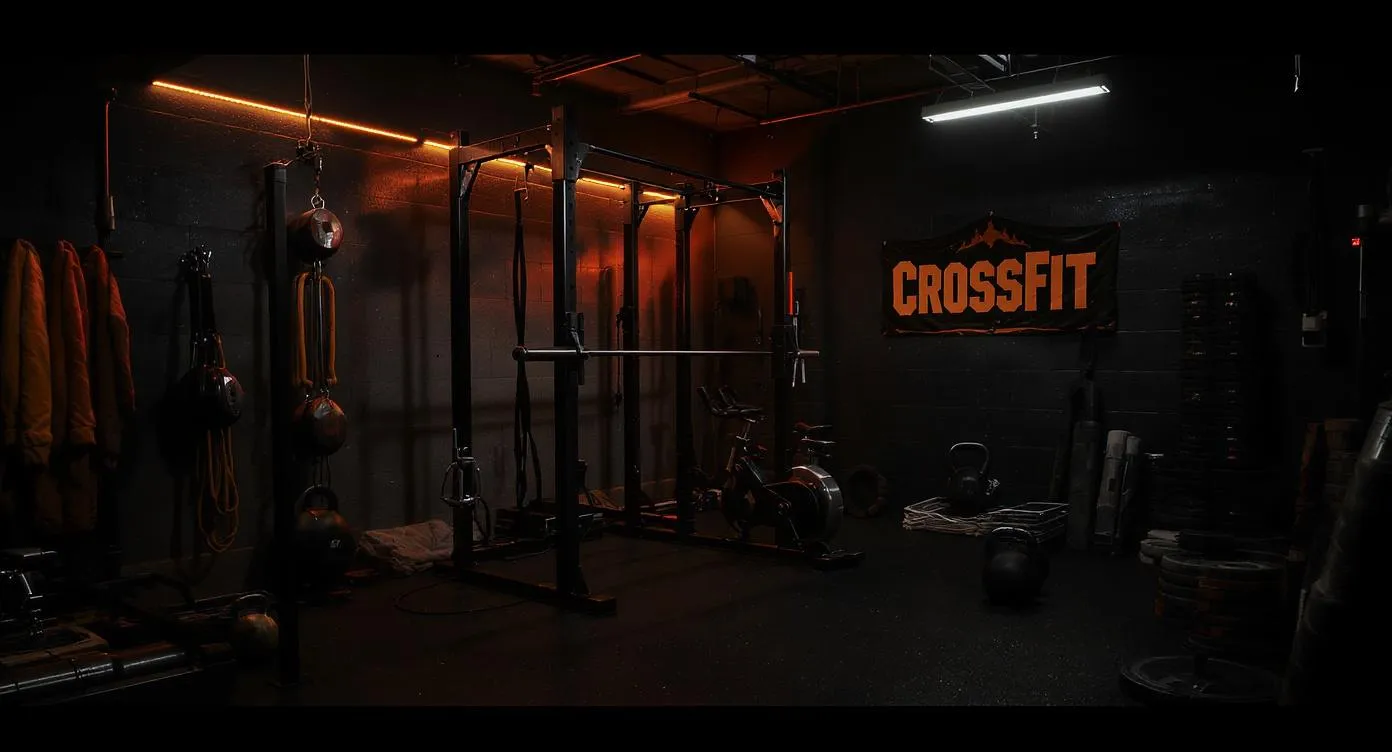
CrossFit Home Gym Setup: Complete Equipment Guide (2026)
How to build a complete CrossFit home gym. Equipment list, budget options, and programming for garage gym CrossFit training.
Start with a power rack with a pull-up bar, an Olympic barbell with needle bearings, bumper plates (250+ lbs), a jump rope, and a rower or air bike. Budget $1,200-$2,000 to cover roughly 70% of all CrossFit WODs.
CrossFit is one of the most demanding training methodologies to replicate at home because it touches every physical domain: Olympic weightlifting, powerlifting, gymnastics, monostructural cardio, and odd-object work. But here is the truth most people miss — a properly built garage gym is better than 90% of CrossFit affiliate boxes. No class schedules dictating your training windows. No waiting 15 minutes for a rack. No scaling movements because someone else is using the only pair of 53 lb kettlebells. You train on your schedule, with your equipment, at your intensity.
This guide breaks down the exact equipment you need, the order to buy it, budget tiers from $1,200 to $5,500+, sample programming, maintenance considerations, and the mistakes that waste money. Whether you are a former box member building a home setup or a general fitness athlete moving toward CrossFit-style training, everything you need is here.
Understanding CrossFit's Equipment Demands
Before spending a dollar, you need to understand what CrossFit actually programs. Unlike powerlifting (which needs a rack, bar, bench, and plates) or bodybuilding (which needs machines and isolation tools), CrossFit rotates through multiple training modalities every week. That means your equipment list is broader but each piece does not need to be competition-grade.
Weightlifting movements — cleans, snatches, thrusters, overhead squats, clean and jerks — require an Olympic barbell with rotating sleeves, bumper plates you can safely drop from overhead, and enough ceiling height (minimum 8 feet, ideally 9-10 feet) for full extension.
Gymnastics movements — pull-ups (strict, kipping, butterfly), muscle-ups, toes-to-bar, handstand push-ups, ring dips — require a sturdy pull-up bar rated for dynamic loads and, eventually, a pair of gymnastics rings.
Monostructural cardio — rowing, biking, running, jump rope — requires at least one dedicated cardio machine and ideally a speed rope for double-unders.
Odd-object and accessory work — kettlebell swings, wall balls, box jumps, dumbbell snatches, sandbag carries — fills out the rest of CrossFit programming and requires targeted purchases.
The key insight: you do not need everything on day one. Build in phases, prioritizing the equipment that unlocks the most WODs.
Phase 1: The Non-Negotiable Foundation
These five items unlock roughly 70% of all CrossFit benchmark and Hero WODs. Buy these first, no exceptions.
Power Rack with Pull-Up Bar

Mikolo F4 2.0 Power Cage with Dual-Track Smooth Pulley System
Capacity
1,200 lbs
Steel
2x2" 12-Gauge Steel
Footprint
49" L x 49" W x 86" H
Price
$399.99
- 4.6+ star rating on Amazon with 3,000+ reviews
- 1,200 lb weight capacity — rare at this price
- Includes LAT pulldown and low row cable system
- 27 height adjustments with 2" hole spacing
- Dual-track pulley system
- Comes with multiple attachments included
- Assembly takes 3-4 hours
- Heavier than budget racks — needs two people to move
- Plate storage pegs sold separately
Price and availability may change
The rack is your anchor. For CrossFit specifically, you need a cage with a multi-grip pull-up bar (not just a straight bar) because kipping and butterfly pull-ups generate significant lateral force. The Mikolo F4 handles this with a 1,200 lb weight capacity and includes a LAT pulldown attachment for strict pull-up progressions and accessory work. The J-hooks accommodate Olympic lifting re-racks, and the safety bars let you bail on failed squat cleans without a spotter.
Why the F4 over cheaper options? CrossFit racks take more abuse than powerlifting racks. You are dropping barbells back to J-hooks after thrusters, kipping aggressively on the pull-up bar, and transitioning between movements at speed. The F4's 14-gauge steel and bolted construction handle that punishment. Read our detailed Mikolo F4 review for the full breakdown.
Ceiling height matters. Measure before you buy. You need your standing height plus 12-18 inches above your extended reach for kipping pull-ups and overhead lifts. Most garage ceilings sit at 8-9 feet, which works for lifters under 6'2". Taller athletes may need a short rack or to move the rack closer to the garage door opening.
Olympic Barbell with Needle Bearings

Synergee Games 15kg and 20kg Colored Ceramic Coated Barbells
Capacity
1,500 lbs rated capacity
Steel
Ceramic Coated Steel / Needle Bearings
Footprint
28.5mm Shaft, 7ft Olympic Bar
Price
$149.95
- 4.7+ star rating on Amazon
- 1,000 lb capacity at mid-range price
- Needle bearings provide smooth spin for Olympic lifts
- 190K PSI tensile strength
- Dual knurling marks for powerlifting and Olympic lifts
- Best Amazon-available upgrade from budget bars
- Black phosphate finish requires regular oiling
- Not made in the USA
- Knurling is slightly less aggressive than premium bars
Price and availability may change
This is where CrossFit requirements diverge sharply from powerlifting. A powerlifting bar has bushing sleeves designed for slow, controlled lifts. CrossFit demands needle bearing sleeves because cleans and snatches require fast, smooth sleeve rotation — the bar spins independently of the plates as you transition under it. A bushing bar forces your wrists to absorb rotational force during the catch, leading to wrist strain and missed lifts at heavier weights.
The Synergee Games Barbell delivers needle bearings at the $200 price point, which is exceptional value. It also provides moderate knurling (aggressive enough for deadlifts, not so sharp it tears your hands during high-rep thrusters), a 28.5mm shaft diameter (the CrossFit competition standard), and a 190K PSI tensile strength rating. Read our Synergee barbell review for testing details.
Bar maintenance note: Needle bearing bars require more care than bushing bars. Wipe down after every session, apply 3-in-1 oil to the sleeves monthly, and store horizontally on J-hooks or a wall-mounted bar holder — never standing vertically in a corner, which lets moisture pool in the bearing assemblies. For full care instructions, see our barbell maintenance guide.
Bumper Plates (Minimum 230 lbs)
Bumper plates are mandatory for CrossFit — not optional, not "nice to have." Every clean, snatch, and thruster ends with the barbell being dropped from height. Cast iron plates will shatter on impact, destroy your barbell's sleeves, crack your garage floor, and wake up the entire neighborhood. Bumper plates are solid rubber, designed to absorb impact and bounce predictably.
Recommended starting set:
- 2 x 45 lb bumper plates ($180-220)
- 2 x 25 lb bumper plates ($100-130)
- 2 x 10 lb bumper plates ($60-80)
That gives you 160 lbs on the bar (205 lbs with a 45 lb barbell), which covers prescribed weights for most CrossFit WODs. Add cast iron change plates (5 lb, 2.5 lb pairs) for fine-tuning weights on strength work. You can expand to 300+ lbs over time by adding cast iron 45s for movements where you will not drop the bar (squats, bench press, deadlifts with controlled lowering).
Durability tip: Crumb rubber bumper plates last longer and bounce less erratically than virgin rubber plates. They also smell less. Expect to pay 10-15% more, but they will survive thousands of drops on a garage floor with basic horse stall mat protection.
Air Bike

Sunny Health & Fitness Premium Smart Cross-Training Fan Bike SF-B223018
Capacity
330 lbs user weight
Steel
Steel Frame
Footprint
50.95" L x 23.34" W x 50" H
Price
$699.99
- 4.5+ star rating on Amazon with 3,000+ reviews
- The original and most iconic air bike
- Programmable workouts (Tabata, HIIT, custom)
- LCD console with chest strap heart rate support
- Proven durability over a decade
- Great for CrossFit-style conditioning
- Chain-driven (louder than belt-driven competitors)
- Requires occasional chain lubrication
- Heavy at 98 lbs — hard to relocate
- Premium price vs. budget air bikes
Price and availability may change
The air bike is the single most programmed cardio machine in CrossFit. It appears in benchmark WODs, AMRAP conditioning pieces, buy-in/cash-out workouts, and active recovery sessions. Unlike a rower or ski erg, the air bike works both upper and lower body simultaneously with infinite resistance scaling — the harder you push, the harder it resists. There is no hiding from the air bike.
The Sunny Health & Fitness SF-B223018 Fan Bike is the standard in CrossFit boxes worldwide. Its chain drive system is durable and low-maintenance, the fan provides smooth progressive resistance, and the console tracks calories and distance accurately for WOD scoring. It handles sprint intervals (30 seconds on, 30 seconds off) just as well as 20-minute steady-state work.
Read our Sunny Health SF-B223018 review for long-term durability testing, or compare it head-to-head with the Concept2 BikeErg in our Concept2 vs Sunny Health Fan Bike comparison.
Alternative for tight budgets: A high-quality speed rope ($15-30) substitutes for air bike work in many WODs. Double-unders appear in CrossFit programming constantly, and a jump rope delivers brutal conditioning in minimal space. See our WOD Nation vs Crossrope comparison for recommendations.
Kettlebells

Yes4All Cast Iron Kettlebell 5-80 Lb for Full Body Workout
Capacity
5-80 lbs options
Steel
Solid Cast Iron
Footprint
Varies by weight
Price
$79.97
- 4.7+ star rating on Amazon with 12,000+ reviews
- Solid cast iron construction
- Durable painted finish
- Standard grip width for most users
- Available individually or in sets
- Best budget kettlebell option
- Cheaper competition-grade bells exist
- Paint can chip with heavy use
- Not ideal for kettlebell sport (uniform size)
- Handle texture varies between batches
Price and availability may change
Kettlebells appear in CrossFit workouts almost as often as barbells. Russian and American swings, Turkish get-ups, goblet squats, single-arm snatches, farmer carries, and overhead walks all require kettlebells. The prescribed weights in CrossFit are 53 lbs (24 kg) for men and 35 lbs (16 kg) for women, so you need at least those two weights.
The Yes4All set provides a solid cast iron construction with a powder coat finish that holds chalk well. The flat base allows for renegade rows and floor storage stability. Read our Yes4All Kettlebell review.
Progression recommendation: Start with 35 lb and 53 lb bells, then add a 70 lb (32 kg) for heavy swings and a 26 lb (12 kg) for Turkish get-ups and warm-up work. Four kettlebells cover virtually every CrossFit kettlebell movement.
Phase 1 Essentials
6 itemsPhase 2: Expanding Your WOD Coverage
Once Phase 1 is locked in, these additions push your WOD coverage from 70% to roughly 90% of all CrossFit programming.
Adjustable Dumbbells

BowFlex Results Series SelectTech Dumbbells
Capacity
5-52.5 lbs each
Steel
Steel Plates / Nylon Dial Mechanism
Footprint
16.9" L x 8.3" W x 9" H each
Price
$429.00
- 4.7+ star rating on Amazon with 15,000+ reviews
- Replaces 15 sets of dumbbells (5-52.5 lbs)
- Fastest weight change system on the market (2 seconds)
- 2.5 lb increments up to 25 lbs
- Compact cradle storage footprint
- Sold as a pair
- Cannot be dropped — internal mechanism is fragile
- Length at 52.5 lbs feels awkward on some exercises
- Price has increased from original $349 MSRP
- 5 lb increments above 25 lbs
Price and availability may change
CrossFit programs dumbbell movements frequently — Devil Press, dumbbell snatches, dumbbell thrusters, single-arm overhead squats, and dumbbell box step-overs all appear in competition and daily programming. The standard prescribed weights are 50 lbs per hand for men and 35 lbs per hand for women.
Adjustable dumbbells replace an entire rack of fixed dumbbells in under two square feet of floor space. The Bowflex SelectTech 552 adjusts from 5 to 52.5 lbs per hand in 2.5 lb increments, which covers every CrossFit dumbbell prescription. The dial adjustment takes about 3 seconds — fast enough that you will not lose intensity during timed workouts. Read our Bowflex 552 review for details on durability with CrossFit-style use.
For heavier athletes who need more than 52.5 lbs, check our adjustable dumbbell guide for models going up to 90 lbs per hand.
Flat/Incline Weight Bench
A bench may seem like a bodybuilding tool, but it shows up in CrossFit more than you would expect — bench press, dumbbell bench press, single-arm rows, box step-overs (as a height substitute), and seated overhead press variations. A flat-to-incline bench covers all these.
Choose a bench rated for at least 600 lbs (your body weight plus the barbell and plates during heavy bench press). Look for a bench narrow enough to fit inside your rack's uprights. Our weight bench selection guide walks through every consideration.
Gymnastics Rings
Rings unlock muscle-ups, ring dips, ring rows, ring push-ups, and dozens of accessory movements. Wooden rings (1.25" diameter) provide the best grip without chalk. Hang them from your pull-up bar with adjustable straps long enough to reach the floor for ring rows and ring push-ups.
Cost: $30-50 for a quality pair. This is the single best dollar-to-exercise-ratio purchase in your entire gym.
Rowing Machine (Concept2 RowErg)
The Concept2 RowErg is the gold standard rowing machine in CrossFit. It provides full-body low-impact conditioning, appears in dozens of benchmark WODs (including the legendary "Jackie" and many Open workouts), and the PM5 monitor integrates with CrossFit scoring apps. At $990-1,099, it is a significant investment but will last 15+ years with minimal maintenance.
If budget is a concern, prioritize the air bike first. A rower can wait — many WODs substitute a 250m row with a 15-calorie bike or a 200m run.
Phase 3: The Complete CrossFit Garage Gym
These items push you to 95%+ WOD coverage and add quality-of-life improvements.
- Plyo box (20/24/30" adjustable 3-in-1 foam or wooden) — for box jumps and box step-overs. You can DIY a wooden box from plywood for $30 or buy one from our best plyo boxes roundup
- Wall ball (20 lb / 14 lb) — for wall ball shots, a signature CrossFit movement. A heavy slam ball works as an alternative
- Ab mat — for GHD sit-up alternatives and abmat sit-ups
- Climbing rope (15 ft) — if you have ceiling height, rope climbs are a classic CrossFit skill
- Resistance bands — for pull-up progressions, warm-up activation, and banded mobility work
- Barbell collars — spring clips fail during drops. Invest in locking collars (OSO Mighty or Rogue HG 2.0)
Pros and Cons of a Home CrossFit Gym vs a Box Membership
- No monthly membership fees ($150-250/month saved after equipment payoff)
- Train any time — 5 AM or 11 PM, no class schedule constraints
- No waiting for equipment during peak hours
- Full control over programming and scaling decisions
- Equipment resale value retains 60-70% if you move or change goals
- No commute time — garage door opens and you're training
- Hygiene control — your equipment, your standards
- Higher upfront investment ($1,200-5,500 depending on tier)
- No coaching feedback on form for Olympic lifts and gymnastics
- Missing the competitive energy and accountability of group classes
- Space requirements (minimum 200 sq ft, ideally 300+ sq ft)
- Some movements are difficult to replicate (rope climbs, sled pushes, swimming)
- Equipment maintenance falls entirely on you
- Self-motivation required without a class community
CrossFit Home Gym Budget Tiers
Tier 1: Minimum Viable CrossFit ($1,200-1,600)
This tier covers the essential barbell, rack, bumper plates, kettlebells, and a jump rope. You skip the air bike (substituting running and jump rope work) and use bodyweight gymnastics only.
Tier 1 Budget Build
7 itemsWOD coverage: ~55%. You can do Fran, DT, Grace, Isabel, most Hero WODs with barbell/pull-up bar combinations, and any kettlebell-based workout. You will need to substitute bike/row calories with running or jump rope.
Tier 2: Complete CrossFit Setup ($2,800-3,500)
This is the sweet spot. Add the air bike, dumbbells, a bench, and gymnastics rings to Phase 1. This setup handles nearly every WOD in the CrossFit Open and most daily affiliate programming. See our full Home Gym Under $3,000 build guide for a detailed breakdown at this price point.
Tier 2 Complete Build
8 itemsWOD coverage: ~90%. The only gaps are rowing-specific WODs and some odd-object work.
Tier 3: Competition-Ready ($4,500-5,500+)
For athletes training for the CrossFit Open or local competitions. This tier adds a Concept2 RowErg, a full bumper plate set, premium dumbbells, specialty items, and upgraded everything.
Tier 3 Competition Build
12 itemsFlooring and Space Setup
Flooring is not optional for CrossFit. You will be dropping loaded barbells from overhead, doing burpees on concrete, and jumping on and off boxes. At minimum, cover your lifting area with 3/4" rubber horse stall mats from a local farm supply store (Tractor Supply carries 4x6 ft mats for about $50 each). Two mats side by side create a 4x12 ft lifting platform.
For a dedicated lifting platform, build an 8x8 ft platform using two layers of 3/4" plywood topped with horse stall mats on the sides and a bare wood center for your stance. This absorbs barbell drops, protects your garage floor, and provides a stable surface for Olympic lifts. Our how to build a lifting platform guide covers the full construction process.
Space requirements:
- Minimum (1-car garage): 200 sq ft — tight but workable. Rack against the back wall, air bike against the side, 8-10 ft of open floor in front of the rack
- Ideal (2-car garage or half of one): 300-400 sq ft — room for a rack, cardio machines, open floor for burpees/box jumps, and wall space for wall balls
- Ceiling height: 8 ft minimum. 9-10 ft gives overhead clearance for snatches and box jumps without fear
If you are working with a smaller footprint, see our small-space home gym guide for layout strategies and compact equipment alternatives.
Sample CrossFit Home Gym Programming
Here are classic benchmark WODs you can do with a home setup, organized by equipment requirements.
Rack + Barbell + Pull-Up Bar Only
"Fran" — 21-15-9 reps for time: Thrusters (95/65 lbs) and Pull-Ups. The quintessential CrossFit benchmark. Elite time: under 3 minutes. Equipment: barbell, plates, pull-up bar.
"Grace" — 30 Clean and Jerks for time (135/95 lbs). Pure barbell power. Elite time: under 2 minutes. Equipment: barbell, bumper plates.
"DT" (Hero WOD) — 5 rounds for time: 12 Deadlifts, 9 Hang Power Cleans, 6 Push Jerks (155/105 lbs). Equipment: barbell, bumper plates.
"Murph" — For time: 1-mile run, 100 Pull-Ups, 200 Push-Ups, 300 Air Squats, 1-mile run (with 20/14 lb vest). Equipment: pull-up bar, running route, weight vest (optional).
With Air Bike
"Sunny Health Fan Bike Death By" — Minute 1: 2 calories. Minute 2: 4 calories. Minute 3: 6 calories. Continue adding 2 calories each minute until failure. Deceptively brutal — most athletes fail between minutes 12-16.
Tabata Air Bike — 8 rounds of 20 seconds max effort / 10 seconds rest. Score is lowest calorie round. This takes 4 minutes and destroys you.
"Echo" (Home Gym WOD) — 5 rounds for time: 20-cal Air Bike, 15 Thrusters (75/55 lbs), 10 Pull-Ups. Total body devastation.
With Kettlebells
"Helen" — 3 rounds for time: 400m Run, 21 KB Swings (53/35 lbs), 12 Pull-Ups. Equipment: kettlebell, pull-up bar, running route.
"Simple and Sinister" (Dan John) — 100 one-arm KB Swings + 10 Turkish Get-Ups. Not a benchmark WOD, but outstanding CrossFit accessory work.
For more programming ideas using limited equipment, check our barbell-only exercises guide which covers 50 movements you can do with just a bar and plates.
Safety Considerations for Home CrossFit Training
CrossFit's combination of high-intensity effort, technical Olympic lifts, and gymnastic movements creates safety considerations that are more serious than standard gym training. Without a coach present, you are responsible for your own risk management.
Olympic lifting safety:
- Always use bumper plates on a proper surface. A missed snatch from overhead generates enormous force
- Learn to bail safely. On a failed snatch, push the bar forward and step back. On a failed clean, push elbows forward and let the bar slide off your shoulders
- Never max out alone without safety bars set at the correct height in your rack
- Film your lifts and review form, or post to online coaching communities for feedback
Gymnastics safety:
- Kipping pull-ups generate forces 2-3x your body weight. Your pull-up bar and rack must be rated for dynamic loading, not just static weight
- Progress through strict movements before adding kipping. If you cannot do 5 strict pull-ups, you are not ready for kipping
- Keep the floor under your pull-up bar padded. Falls happen, especially during muscle-up progressions
General safety:
- Install a wall-mounted fan or open the garage door for ventilation during intense WODs. Heat-related illness is a real risk in enclosed garages during summer. See our garage gym ventilation guide and summer cooling guide
- Keep a timer visible but not in your movement path
- Have water within arm's reach, not across the garage
- If training alone, tell someone your workout schedule. Serious injury with a barbell on your back and no spotter is a real scenario
Equipment Maintenance for CrossFit Use
CrossFit equipment takes more abuse than equipment in any other home gym discipline. Barbells get dropped thousands of times. Air bikes run at maximum intensity. Kettlebells hit the floor. Plan for maintenance.
Barbell care (weekly):
- Wipe down the shaft with a dry brush (nylon for stainless/chrome, brass for bare steel)
- Clean the knurling with a nylon brush to remove chalk and skin buildup
- Oil the sleeves monthly with 3-in-1 oil — spin the sleeves while applying
Bumper plate care:
- Inspect for cracks quarterly, especially on budget plates after 6+ months of heavy use
- Store flat or in a vertical plate tree — never leaning at an angle against a wall, which warps them over time
Air bike maintenance (monthly):
- Tighten pedal bolts and seat hardware
- Check the chain tension (Sunny Health SF-B223018) or belt condition (Concept2)
- Wipe down the electronics console — sweat corrodes contacts
Rack maintenance (quarterly):
- Check all bolts for tightness. Vibration from kipping and barbell drops loosens bolts over time
- Inspect J-hook plastic liners for cracking. Replace when worn — exposed metal damages your barbell's knurling
For a comprehensive maintenance routine covering all equipment types, read our equipment cleaning and maintenance guide.
Common Mistakes to Avoid
-
Buying a rower before an air bike. The air bike is programmed far more frequently in CrossFit and provides upper + lower body conditioning. The rower is a luxury addition.
-
Choosing a bushing barbell. Bushing bars are fine for powerlifting. They are not fine for snatches and cleans. Spend the extra $50-80 for needle bearings.
-
Skipping bumper plates. "I'll just lower the bar carefully" works until it doesn't — and one failed snatch onto cast iron plates costs you a barbell, plates, and potentially your garage floor.
-
Overbuying specialty equipment early. You do not need a GHD machine, a sled, a yoke, or a climbing rope in your first year. Master the fundamentals with basic equipment first.
-
Neglecting ceiling height. Measure before buying a rack. An overhead squat at the top of a snatch with 45 lb plates on the bar requires significant overhead clearance.
-
No flooring. Concrete is unforgiving on joints, destructive to dropped equipment, and slippery when wet with sweat. Horse stall mats cost $50 each and solve every problem.
For more pitfalls specific to garage gyms, see our garage gym mistakes to avoid guide.
Frequently Asked Questions
Can you really do CrossFit in a home gym?
Do I need bumper plates for CrossFit?
What's the minimum equipment for CrossFit at home?
Should I get a rower or an air bike for CrossFit?
Can I do Olympic lifting with a budget barbell?
How much space do I need for a CrossFit home gym?
How do I program CrossFit workouts without a coach?
Is a CrossFit home gym cheaper than a box membership?
Additional Resources
The Bottom Line
A complete CrossFit home gym costs between $1,200 and $5,500 depending on your training ambitions and budget. The non-negotiable core is a power rack with a sturdy pull-up bar, an Olympic barbell with needle bearing sleeves, bumper plates, kettlebells, and rubber flooring. An air bike is the single most impactful upgrade after that foundation is set.
Build in phases. Start with Phase 1, train for 3-6 months, and then add equipment based on what your programming actually demands rather than what looks impressive. A disciplined $1,500 setup with smart programming will outperform a $5,000 gym that collects dust.
The best CrossFit gym is the one you actually use — and nothing beats the convenience of walking into your garage and getting after it.
Derek Walsh
Strongman competitor and former commercial gym equipment salesman. Knows what survives heavy daily use.
Read full bioMore in Guides
Strength vs Hypertrophy: How to Program for Your Goals (2026)
The definitive guide to programming for strength vs size in your home gym. Rep ranges, volume, intensity, and complete programs for both goals.
The Complete Home Gym Warm-Up Guide (2026)
Stop skipping your warm-up. Complete warm-up protocols for every training style, plus the equipment that makes preparation effortless at home.
Home Gym Deload Guide: When and How to Back Off (2026)
Learn when and how to deload in your home gym. Science-backed protocols, recovery strategies, and signs you need a rest week.