Powerlifter Home Gym Build: $1,600 Complete Setup (2026)
Complete powerlifting home gym build for under $1,600. Power rack, Olympic bar, plates, bench, lifting belt, and accessories — all Amazon verified.
Powerlifting strips strength training to its purest form — three barbell lifts, maximum load, zero theatrics. The squat, bench press, and deadlift demand specific equipment that commercial gyms rarely configure properly: safeties at the right height, a stiff power bar with aggressive knurl, calibrated iron you can trust at lockout. Building a dedicated powerlifting home gym for under $1,600 is not only possible — it is arguably the single best investment a competitive or recreational powerlifter can make. You eliminate wait times for the squat rack, train at any hour, control every variable, and own equipment that holds its resale value for decades.
This guide walks through the exact equipment list, product-by-product, with specific models, prices, weight capacities, and the reasoning behind each choice. Every item ships from Amazon with verified availability as of early 2026. Whether you are running your first Sheiko cycle or peaking for a USAPL local meet, this build has you covered.
Why Powerlifters Need Different Equipment Than General Lifters
A CrossFitter needs bumper plates, wall balls, and pull-up rigs. A bodybuilder needs cables, dumbbells, and isolation attachments. A powerlifter needs exactly three things done exceptionally well: a rigid rack with bomb-proof safeties, a stiff barbell with center knurling, and enough iron to chase progressive overload for years.
The difference matters at the product level. A general-purpose barbell with excessive whip will oscillate during a heavy squat walkout — dangerous and energy-wasting. A bench without a wide enough pad shifts under heavy arch work. A rack with pin-pipe safeties instead of solid steel J-cups rattles confidence when you are grinding a max attempt.
This build prioritizes powerlifting-specific features at every price point. If you are coming from a general fitness background, you will notice the choices skew toward heavier duty, stiffer construction, and competition-adjacent specs. That is intentional. For broader home gym guidance, check our ultimate beginner's home gym guide first, then come back here for the powerlifting-specific build.
The Powerlifter's Equipment Priority List
A powerlifter's gear hierarchy looks fundamentally different from any other training style:
- Power rack with adjustable safeties — non-negotiable for solo squat and bench training
- Stiff Olympic barbell (20 kg / 45 lb) — the bar matters more than the plates for powerlifting
- Cast iron Olympic plates (255+ lbs) — no need for bumpers; iron is thinner and cheaper
- Flat/adjustable bench with wide pad — stable platform for competition-style bench press
- Genuine leather lifting belt — mandatory for max-effort squats and deadlifts
- Hex/trap bar — back-friendly deadlift variation for high-volume accessory blocks
- Hyperextension bench — posterior chain insurance against lower back injuries
- Rubber flooring — protects the floor, deadens noise, provides stable footing
This build covers all eight categories. No cardio machines, no cable systems, no distractions. Pure SBD infrastructure.
The Complete Powerlifter Build — $1,575 Total
Equipment Checklist
9 items1. Power Rack — ULTRA FUEGO Power Cage ($389.99)

ULTRA FUEGO Power Cage, Multi-Functional Power Rack
Capacity
800 lbs
Steel
2x2" 14-Gauge Steel
Footprint
50.5" L x 46.5" W x 83.5" H
Price
$389.98
- 4.5+ star rating on Amazon with 5,000+ reviews
- Excellent value under $350
- 800 lb weight capacity
- Includes multi-grip pull-up bar
- Standard 2x2 hole spacing for attachments
- Optional lat pulldown attachment available
- 14-gauge steel is thinner than premium racks
- Plastic J-cup liners can wear over time
- Not ideal for lifters squatting 600+ lbs
Price and availability may change
The ULTRA FUEGO Power Cage is the most recommended budget power rack in competitive powerlifting forums for good reason. It handles an 800 lb weight capacity across the frame, includes two-inch hole spacing through the bench zone for precise safety bar placement, and ships with a multi-grip pull-up bar that doubles as a chin-up station for back accessories.
Key powerlifting-specific features that matter at this price: the J-cups are lined with UHMW plastic to protect your barbell knurl, the safety bars are solid steel (not pin-pipe), and the 2x2-inch steel uprights accept most third-party attachments including dip handles, landmine posts, and plate storage horns. The footprint is 50.5 x 46.5 inches — compact enough for a single-car garage bay while still providing adequate walkout room for a wide squat stance.
For solo powerlifters, the adjustable safety bars are the single most important feature. Set them one inch below your lowest squat depth and one inch above your chest for bench press. You can bail any failed rep safely without a spotter. Read our full review for detailed assembly notes and long-term durability testing.
- 800 lb frame capacity handles 99% of powerlifters
- 2-inch hole spacing in bench zone for precise safety placement
- UHMW-lined J-cups protect barbell knurling
- Multi-grip pull-up bar included
- Compatible with third-party 2x2 attachments
- No westside hole spacing (1-inch) — 2-inch is adequate but not competition-level
- Pull-up bar height maxes at 83.5 inches — tall lifters may need to bend knees
- Bolts require periodic re-tightening after first month of heavy use
2. Olympic Barbell — Synergee Games 20 kg ($200)

Synergee Games 15kg and 20kg Colored Ceramic Coated Barbells
Capacity
1,500 lbs rated capacity
Steel
Ceramic Coated Steel / Needle Bearings
Footprint
28.5mm Shaft, 7ft Olympic Bar
Price
$149.95
- 4.7+ star rating on Amazon
- 1,000 lb capacity at mid-range price
- Needle bearings provide smooth spin for Olympic lifts
- 190K PSI tensile strength
- Dual knurling marks for powerlifting and Olympic lifts
- Best Amazon-available upgrade from budget bars
- Black phosphate finish requires regular oiling
- Not made in the USA
- Knurling is slightly less aggressive than premium bars
Price and availability may change
The barbell is where most budget powerlifting builds fail. Cheap bars flex excessively under heavy squats, have weak knurling that slips during deadlifts, and develop permanent bend after a few months of serious loading. The Synergee Games 20 kg Olympic Barbell avoids all three problems.
Specifications that matter for powerlifting: 190,000 PSI tensile strength steel, 28.5 mm shaft diameter (standard men's competition spec), needle bearings for smooth spin under cleans if you ever branch out, and — critically — dual knurling marks for both powerlifting (81 cm) and Olympic lifting grip widths. The center knurl is present but moderate, giving you grip feedback during squats without shredding your neck.
The 1,000 lb static weight rating means this bar will not bend under any load a home gym powerlifter realistically handles. Even if you eventually squat 600+ lbs, the Synergee Games holds its straightness. For comparison, the next step up — a Texas Power Bar or Rogue Ohio Power Bar — costs $350-400 and offers marginally more aggressive knurl and a stiffer 29 mm shaft. Worth it eventually, but not at the $1,600 budget level. For a deeper comparison of barbell options, see our how to choose a barbell guide.
Read our full review for knurl depth measurements and whip testing under load.
3. Olympic Weight Set — CAP Barbell 300 lb Set ($340)

CAP Barbell 300-Pound Olympic Set (Includes 7 Feet Bar)
Capacity
300 lbs total (255 lbs plates + 45 lb bar)
Steel
Cast Iron Plates / Chrome Bar
Footprint
7ft Olympic Bar (28mm shaft)
Price
$499.99
- 4.5+ star rating with 8,000+ reviews
- Complete barbell + plate set in one purchase
- Standard Olympic 2" sleeves fit all racks
- Includes: 2x45, 2x35, 2x25, 2x10, 4x5, 2x2.5 lb plates
- Cast iron plates are durable and accurate
- Best value starter weight set available
- Bar is entry-level (bushing sleeves, mild knurling)
- Plates are not calibrated for competition use
- No bumper plates — not safe to drop on concrete
- Chrome plating on bar chips over time
Price and availability may change
The CAP Barbell 300 lb Olympic Set is the workhorse plate package for budget powerlifting builds. You receive 255 lbs of cast iron Olympic plates (two 45s, two 35s, two 25s, two 10s, four 5s, two 2.5s) plus a bar and collars — though you will use the Synergee bar instead of the included CAP bar. Keep the CAP bar as a beater for landmine work or sell it to recoup $30-50.
Why cast iron over bumper plates for powerlifting: iron plates are thinner, meaning you can load more total weight onto the bar before running out of sleeve space. A set of iron 45s is roughly 1.1 inches thick per plate, versus 2.8 inches for competition bumpers. That difference means fitting six plates per side on iron versus three on bumpers. Since powerlifters lower every rep under control (no dropping), the noise and floor-protection advantages of bumpers are irrelevant.
The 255 lbs of plates plus the 45 lb Synergee bar gives you 300 lbs from day one — enough for an intermediate lifter's working sets on all three lifts. When you need more, add individual Yes4All 45 lb Olympic plates at roughly $55 each. Most lifters add two extra pairs within the first year, bringing the total loadable weight to 480 lbs. Read our full review for plate tolerance measurements.
4. Adjustable Bench — FLYBIRD Adjustable Weight Bench ($110)

FLYBIRD WB2 Weight Bench, Utility Adjustable Weight Bench
Capacity
800 lbs (ASTM Certified)
Steel
Commercial-Grade Steel Frame
Footprint
48.4" L x 16.5" W x 17" H (folded)
Price
$109.99
- 4.6+ star rating on Amazon with 25,000+ reviews
- Unbeatable value under $120
- ASTM-certified 800 lb weight capacity
- 8 backrest angles (90° to -30° FID)
- Folds flat for easy storage in small spaces
- Quick 10-minute assembly
- Gap between seat and backrest at steep inclines
- No decline position on some variants
- Pad is narrower (10.2") than premium benches (12")
- Feet can slide on smooth concrete without rubber mats
Price and availability may change
For powerlifting, a bench needs to do two things perfectly: stay completely stable under heavy bench press loads and adjust to flat with zero gap or wobble. The FLYBIRD delivers on both counts with an 800 lb user + weight capacity, 8 backrest positions (including true flat), and a 3.5-inch-wide pad that accommodates competition-style arch without the lifter sliding off.
The FLYBIRD is not a competition bench — it lacks the standardized 12-inch height and 17.7-inch pad width required by IPF rules. But for training purposes, it performs identically to benches costing twice as much. The fold-flat design is a bonus for garage gym owners who share space with vehicles: fold the bench against the wall, and you reclaim four feet of floor space.
One powerlifting-specific tip: set the bench inside the rack with the head toward the uprights. This lets you unrack without a handoff by pressing the bar off the J-cups yourself, and the safety bars catch any failed rep. This setup replicates competition conditions where you must take your own handoff if your handler is not perfectly positioned. Read our full review for padding density and stability testing. For more detailed bench selection criteria, see our how to choose a weight bench guide.
5. Lifting Belt — Dark Iron Fitness Genuine Leather Belt ($55)
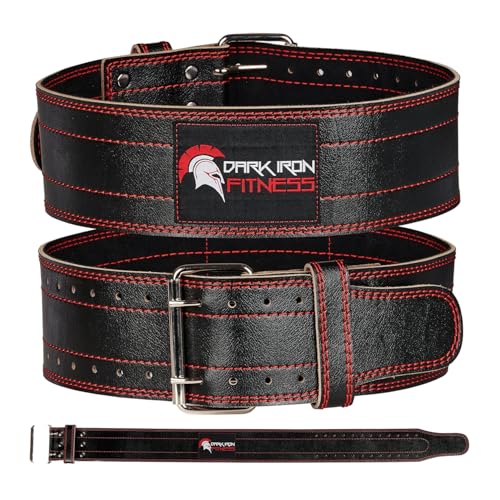
Dark Iron Fitness Genuine Leather Weightlifting Belt, 4 Inch Wide with Double Prong Buckle
Capacity
Suitable for any lifting weight
Steel
Genuine Leather / Reinforced Stitching
Footprint
4" wide leather belt with double prong buckle
Price
$59.99
- 4.6+ star rating on Amazon with 12,000+ reviews
- Genuine buffalo leather (not bonded leather)
- 5-inch wide consistent thickness
- Lifetime replacement guarantee
- Steel buckle (not flimsy plastic or cheap velcro)
- Best leather lifting belt under $100
- Stiff out of the box — needs break-in period
- Single-prong design (some prefer double-prong)
- Sizing runs small — order up one size
- Leather smell takes a week to fade
Price and availability may change
A lifting belt is not optional for serious powerlifting. It increases intra-abdominal pressure by 20-40% during heavy squats and deadlifts, stabilizes the lumbar spine, and provides a tactile cue for bracing. The Dark Iron Fitness Genuine Leather Belt is the best sub-$100 option on the market: 5 inches of consistent width all the way around (not tapered like bodybuilding belts), 10 mm thick genuine leather that breaks in within 2-3 sessions, and a single-prong steel buckle that locks without fumbling.
For powerlifters specifically, you want a belt that is the same width front and back — the 5-inch width provides equal support during squats (where pressure is against your front core) and deadlifts (where pressure shifts to your obliques). Tapered belts that narrow in front sacrifice exactly the support you need most.
Competition note: the Dark Iron belt is not IPF-approved (it lacks the required 10 cm width specification and approved manufacturer stamp). If you plan to compete in IPF/USAPL meets, you will eventually need a 10 mm or 13 mm lever belt from an approved manufacturer like Inzer, SBD, or Pioneer. But for training, the Dark Iron is functionally identical and costs one-third the price. Read our full review.
6. Trap Bar — Bells of Steel Open Trap Bar ($299.99)

Bells of Steel Trap Bar, Open Ended Hex Bar with Rotating Sleeves & Built-in Jack
Capacity
700 lbs
Steel
Heavy-Duty Steel / Rotating Sleeves
Footprint
Open-ended design, Olympic sleeves
Price
$299.99
- Open-ended design allows easier plate loading
- Rotating Olympic sleeves for smoother lifts
- Built-in barbell jack saves your back
- Dual handle heights for high or low pulls
- 700 lb weight capacity
- Great for deadlifts, shrugs, and farmer walks
- Pricier than basic hex bars
- Open ends require more space awareness
- Heavy unit at ~55 lbs unloaded
Price and availability may change
The trap bar is the most underrated tool in a powerlifter's arsenal. While you will never compete with a trap bar, it serves three critical training functions: high-volume deadlift work without fatiguing your lower back, farmer's carry variations for grip and conditioning, and a safer pulling option during deload weeks or when managing minor tweaks.
The Bells of Steel Open Trap Bar handles 750 lbs, features dual-height handles (standard and raised), and uses standard Olympic sleeves that accept your existing plates. The open-ended design lets you step into the bar from the side, and the raised handles reduce range of motion by approximately two inches — useful for lifters with mobility limitations or those recovering from back injuries who still need to pull heavy.
Programming tip: use the trap bar for your secondary deadlift day or as a T2 movement in a conjugate or Juggernaut-style program. Keep your competition deadlift (conventional or sumo) as the primary movement and use the trap bar at 60-70% of your conventional max for sets of 6-10. This builds pulling volume without accumulating spinal fatigue that compromises your next heavy session. Read our full review.
7. Hyperextension Bench — Marcy Hyperextension Roman Chair ($99.50)
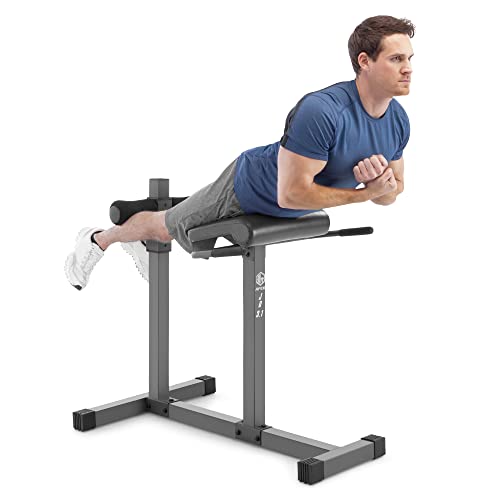
Marcy Adjustable Hyperextension Roman Chair / Hyper Bench JD-3.1
Capacity
300 lbs user weight
Steel
2x2" Steel Tubing / High-Density Foam
Footprint
43" L x 27.5" W x 37.5" H
Price
$99.50
- 4.4 star rating on Amazon with 3,300+ reviews
- Dedicated 45° hyperextension station for lower back, glutes, and hamstrings
- Adjustable foam leg holders and height settings
- Heavy-duty powder-coated steel frame won't sway under load
- Compact single-station footprint for home gyms
- Padded handles and high-density foam roller pads
- Single-function — hyperextensions and back work only
- Foam pads compress over years of heavy use
- Does not fold flat for storage
- Assembly required out of the box
Price and availability may change
Lower back injuries end more powerlifting careers than any other single factor. The Marcy Hyperextension Roman Chair directly addresses this by training the spinal erectors, glutes, and hamstrings through a full range of motion under controlled load. Three to four sets of hyperextensions after every squat and deadlift session builds the posterior chain resilience that keeps you healthy over years of heavy training.
The pad height adjusts to accommodate lifters from 5'4\u0022 to 6'4\u0022, and the frame handles 300+ lbs of body weight plus any plate you hold against your chest for weighted variations. Advanced powerlifters can hold a 45 lb plate for sets of 15-20, building muscular endurance in the exact muscle groups that stabilize the spine during heavy pulls.
This is not a glamorous piece of equipment. It will not add 20 lbs to your deadlift next month. But it will keep you training consistently for years by preventing the nagging lower back strains that force deload after deload. Read our full review.
8. Rubber Flooring — Horse Stall Mats ($60)
Purchase three to four horse stall mats from Tractor Supply Co. at approximately $50-60 total. Each mat is 4x6 feet and 3/4-inch thick — dense enough to protect concrete from dropped plates, dampen vibration, and provide stable footing for sumo deadlifts where foot grip matters.
Cut the mats with a utility knife to fit under your rack footprint and extend two to three feet in front for deadlift space. The total coverage area should be approximately 8x8 feet: the rack footprint plus a pulling lane. Do not use interlocking foam tiles — they compress under heavy loads and shift during lateral movement. Horse stall mats are solid rubber, weigh 100 lbs each, and stay put without adhesive.
If you later decide to build a dedicated lifting platform, these mats become the top layer. Check our how to build a lifting platform guide for the full construction walkthrough.
9. DMoose Dip Belt — $50 (Optional Upgrade)

DMoose Fitness Dip Belt with 36-Inch Steel Chain
Capacity
350 lbs added load
Steel
Neoprene Padding / Stainless Steel Chain / Coated D-Ring
Footprint
36-inch stainless steel chain
Price
$39.99
- 4.7 star rating on Amazon with 7,000+ reviews
- Heavy-duty 350 lb added load capacity
- Thick neoprene padding distributes weight comfortably
- 36-inch heavy-duty stainless steel chain
- Works for weighted dips, pull-ups, belt squats
- Coated D-ring resists scratching your plates
- Chain length can be awkward for very short users
- Neoprene can absorb sweat — needs occasional cleaning
- No quick-release buckle — chain threads through the D-rings
Price and availability may change
Weighted pull-ups and weighted dips are the two best upper-body accessories for powerlifters. The DMoose dip belt handles 200+ lbs of added weight via a heavy-duty chain and carabiner system. Hang it from the rack's pull-up bar for weighted chins or use the rack's dip attachment (sold separately) for weighted dips. Read our full review.
Total: $1,525 base build (or $1,575 with the optional dip belt). That leaves $25-75 within the $1,600 budget for chalk, barbell collars, wrist wraps, or the first pair of extra 45 lb plates.
Space Requirements and Gym Layout
A powerlifting home gym has a larger footprint than most general builds because the barbell extends 7.2 feet and you need clearance for plate loading on both sides. Here are the minimum dimensions:
- Minimum floor space: 10 x 10 feet (100 sq ft) — tight but functional
- Ideal floor space: 12 x 12 feet (144 sq ft) — comfortable with room for accessories
- Ceiling height: 8 feet minimum for standing in the rack; 9 feet if you plan to overhead press inside it
- Deadlift lane: 8 feet wide x 4 feet deep in front of the rack
Position the rack with its back against a wall, leaving 24 inches of clearance on each side for plate loading. Place the hyperextension bench perpendicular to the rack along the side wall. Store plates on the rack's weight horns (the ULTRA FUEGO supports add-on plate storage pegs) to keep the floor clear. The trap bar stores vertically in a corner when not in use.
Build Order: Assembly Sequence That Saves Time
Assemble in this exact order to avoid moving heavy equipment twice:
- Lay the rubber mats first — everything else goes on top
- Assemble the power rack in position — this is a two-person job; do not try to move an assembled ULTRA FUEGO
- Set the bench inside the rack — adjust safety bar height for your bench press and squat depth
- Organize plates on the rack — heaviest plates closest to you for fast loading
- Position the hyperextension bench — wherever you have remaining floor space
- Store the trap bar vertically — it leans in a corner when not in use
Total assembly time: approximately 3-4 hours for the rack, 30 minutes for the bench, 15 minutes for the Roman chair. Budget a full Saturday afternoon.
The Powerlifter's 12-Week Base Program
This program uses only the equipment in this build. It follows a 4-day upper/lower split with undulating periodization — the most evidence-backed approach for intermediate powerlifters.
Day 1: Squat Focus (Monday)
- Back Squat: 5x5 at RPE 7-8 (work up to a challenging set of 5, repeat for 5 sets)
- Romanian Deadlift: 3x8 at RPE 7 (hamstring and posterior chain volume)
- Bulgarian Split Squat: 3x10 each leg (single-leg strength and hip stability)
- Hyperextensions: 3x15 (bodyweight or holding a 10-25 lb plate)
Day 2: Bench Focus (Wednesday)
- Bench Press: 5x5 at RPE 7-8 (competition grip width, pause each rep on chest)
- Close-Grip Bench: 3x8 at RPE 7 (tricep overload, hands shoulder-width)
- Bent-Over Barbell Row: 4x6 at RPE 7 (upper back thickness for bench stability)
- Pull-Ups: 3 sets to technical failure (add weight via dip belt when bodyweight exceeds 10 reps)
Day 3: Deadlift Focus (Friday)
- Conventional or Sumo Deadlift: Work up to a top set of 3 at RPE 8, then 3x5 at 80% of top set
- Trap Bar Deadlift: 3x8 at RPE 6-7 (volume work, lighter than main pull)
- Hyperextensions: 3x20 (higher reps for muscular endurance and blood flow)
- Plank Holds: 3x60 seconds (anterior core stability for bracing under load)
Day 4: Upper Accessories (Saturday)
- Overhead Press: 4x6 at RPE 7 (shoulder strength for bench lockout)
- Barbell Row Variation: 4x8 (Pendlay rows or Yates rows — alternate weekly)
- Weighted Dips or Close-Grip Floor Press: 3x10
- Barbell Curls: 3x12 (bicep health for heavy pulling — not vanity, injury prevention)
Progression protocol: Add 5 lbs to squat and deadlift, 2.5 lbs to bench press each week when all prescribed reps are completed at the target RPE. When progression stalls for two consecutive weeks, deload by 10% and rebuild over three weeks. This linear approach works for lifters with squat under 405 lbs, bench under 275 lbs, and deadlift under 455 lbs. Beyond those numbers, switch to block periodization.
Maintenance Schedule for Powerlifting Equipment
Heavy powerlifting use accelerates equipment wear in specific ways. Follow this maintenance schedule to keep your gear lasting a decade or more:
Weekly tasks:
- Wipe the barbell shaft with a dry nylon brush to remove chalk buildup from the knurling
- Check rack bolts for looseness — heavy squats and re-racking create vibration that loosens hardware
- Wipe down the bench pad with a mild disinfectant to prevent material degradation from sweat
Monthly tasks:
- Apply 3-in-1 oil to the barbell sleeves (the spinning collar sections) — remove plates, apply a thin coat, spin the sleeves to distribute
- Inspect safety bars for any bending or deformation (replace immediately if you detect any curve)
- Clean rubber floor mats with a damp mop and mild soap
Quarterly tasks:
- Re-tighten every bolt on the rack with a torque wrench to the manufacturer's specification
- Inspect the bench frame welds for cracking, particularly around the adjustment pins
- Check the leather belt for cracking and apply leather conditioner if needed
Annually:
- Replace barbell collars if spring tension has weakened
- Assess plate condition — cracked cast iron plates should be replaced (they can shatter under impact)
- Consider replacing the bench pad if foam has compressed below 2 inches of thickness
What This Build Is Missing — And When to Upgrade
No $1,600 build covers everything. Here is what this setup lacks and when each upgrade becomes worth the money:
Adjustable dumbbells ($150-430): Add when you want dedicated accessories like dumbbell rows, lateral raises, or single-arm pressing. The Bowflex SelectTech 552 at $429 or the PowerBlock Elite at $350 are the two best options. Not essential for the first 6-12 months if your program centers on barbell compounds.
Specialty barbells ($150-350): A safety squat bar ($200-300) is the single best specialty bar purchase for powerlifters. It lets you squat heavy with reduced shoulder strain, trains quad-dominant squatting for carryover to competition style, and provides variation that prevents accommodation. Add this after your first year.
Competition bench ($250-400): A bench with standardized 12-inch height and 17.7-inch pad width becomes important if you compete regularly and want training to replicate meet conditions exactly. The REP FB-5000 at $289 is the best budget competition-style bench.
Bumper plates ($100-200 per pair): Only necessary if you begin doing deficit deadlifts from elevated platforms where the bar might slip off the stack, or if you train Olympic lifts as a supplement. Most powerlifters never need bumpers.
Calibrated plates ($400-800 for a full set): For lifters who compete and want their training loads to match meet plates exactly. Cast iron plates have +/- 3% tolerance; calibrated plates are within +/- 10 grams. A luxury, not a necessity.
Common Questions
Can I really train for a powerlifting meet in a $1,600 home gym?
Do I need bumper plates for powerlifting?
Is the Synergee Games barbell good enough for a 500+ lb squat?
Can I deadlift heavy on rubber stall mats without a platform?
Why do I need safety bars if I'm an experienced lifter?
How long until I outgrow this build?
What should I add first when I have more budget?
Can I do sumo deadlifts in the ULTRA FUEGO Power Cage?
Additional Resources
- NSCA Home Gym Design Principles
- CPSC Home Gym Equipment Safety Guide
- ACE Strength Training Fundamentals
Related Content
- Powerlifting Home Gym Setup Guide
- How to Choose a Power Rack
- How to Choose a Barbell
- How to Choose a Weight Bench
- How to Build a Lifting Platform
- Garage Gym Flooring Guide
- Synergee Olympic Barbell Review
- Dark Iron Fitness Lifting Belt Review
The Bottom Line
A serious powerlifting home gym does not require a $5,000 budget or commercial-grade equipment. This $1,575 build gives you everything needed to train the squat, bench press, and deadlift at a high level for years — possibly for your entire lifting career. The ULTRA FUEGO Power Cage rack provides bomb-proof safeties for solo training. The Synergee Games barbell handles over 1,000 lbs without bending. The CAP iron plates load efficiently and expand cheaply. The FLYBIRD bench stays stable under heavy pressing. And the accessory pieces — belt, trap bar, hyperextension bench — round out the posterior chain work and injury prevention that keep you training consistently.
Every piece of equipment in this build ships from Amazon, arrives within a week, and carries manufacturer warranties. The total investment is less than two years of commercial gym membership fees, and the equipment holds 60-70% of its resale value if you ever decide to sell. Build this gym on a Saturday afternoon, start your program on Monday, and stop worrying about rack availability, gym hours, or monthly fees. The barbell is always loaded. The rack is always open. The only variable left is how hard you are willing to work.
Marcus Reid
Powerlifter and mechanical engineer who has been building and breaking home gym equipment for 15 years.
Read full bioMore in Budget Builds
Women's Home Gym Build: Complete Equipment Guide (2026)
Build the perfect home gym for women. Glute-focused equipment, strength training essentials, and space-efficient picks for every budget.
Olympic Weightlifting Home Gym Build (2026)
Build a home gym for Olympic weightlifting. Platform specs, bar selection, bumper plates, and everything you need to snatch and clean at home.
The Best Home Gym Build for Seniors (2026)
Build a safe, effective home gym for seniors. Joint-friendly equipment picks, fall-prevention features, and age-appropriate training programs.