Marcy Hyperextension Roman Chair Review: Roman Chair on a Budget
Hands-on review of the Marcy Hyperextension Roman Chair. Best Roman chair under $150 for back, glute, and core training.
I have been using a Roman chair in every training block for the better part of a decade. After two herniated discs in my late twenties — the kind that make you reconsider whether you will ever squat again — back extensions became non-negotiable in my programming. I have used Rogue GHDs, Westside reverse hypers, commercial-grade 45-degree units, and a handful of budget options from Amazon. The Marcy Hyperextension Roman Chair is the one I recommend to anyone building a garage gym on a budget, and it is the unit I keep in my own home gym as a secondary station. At roughly $99.50, it punches so far above its price point that the value proposition borders on absurd.
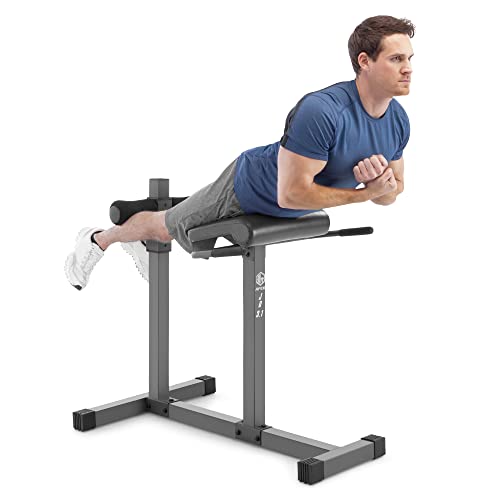
Marcy Adjustable Hyperextension Roman Chair / Hyper Bench JD-3.1
Capacity
300 lbs user weight
Steel
2x2" Steel Tubing / High-Density Foam
Footprint
43" L x 27.5" W x 37.5" H
Price
$99.50
- 4.4 star rating on Amazon with 3,300+ reviews
- Dedicated 45° hyperextension station for lower back, glutes, and hamstrings
- Adjustable foam leg holders and height settings
- Heavy-duty powder-coated steel frame won't sway under load
- Compact single-station footprint for home gyms
- Padded handles and high-density foam roller pads
- Single-function — hyperextensions and back work only
- Foam pads compress over years of heavy use
- Does not fold flat for storage
- Assembly required out of the box
Price and availability may change
Why Every Serious Lifter Needs a Hyperextension Bench
If you deadlift, squat, or do any kind of loaded hinge work, you are loading your spinal erectors under heavy compressive force. The posterior chain muscles that stabilize your spine — the erector spinae group, multifidus, and the deep stabilizers along the lumbar region — need direct, submaximal volume to stay resilient. Compound lifts alone do not provide enough targeted work for these structures.
Back extensions on a Roman chair deliver exactly what these muscles need: high-rep, low-load, full-range-of-motion work without axial spinal compression. Stuart McGill, the foremost spine biomechanics researcher, has repeatedly recommended hip-hinge extension movements as foundational for back health. Louie Simmons built Westside Barbell's entire posterior chain protocol around the reverse hyper and the GHD for the same reason.
Here is what a Roman chair adds to your training:
- Spinal erector endurance and hypertrophy — the primary defense against disc injuries under load
- Glute and hamstring development through full hip extension without knee flexion interference
- Core anti-extension strength when performing Roman chair sit-ups
- Active recovery and rehab work — bodyweight extensions at controlled tempos flush blood into injured or fatigued lower back tissue
- Deadlift lockout improvement — training end-range hip extension directly transfers to your pull
If you are building a powerlifting home gym, a hyperextension bench should be in your first or second equipment purchase after a rack and barbell. It is that important.
The Specs
Quick Specs · Marcy Adjustable Hyperextension Roman Chair / Hyper Bench JD-3.1
Build Quality and Construction
The Marcy frame is heavy-duty steel tubing with a powder-coat finish. At 300 lbs rated user capacity, the steel gauge and weld quality are more than adequate for nearly any lifter adding moderate load at the chest. I weigh 205 lbs and have used it while holding a 45 lb plate at my chest with zero flex or wobble in the frame.
The base footprint measures approximately 43 inches long by 27.5 inches wide, with an overall height near 37.5 inches. It is a compact single station that tucks into a corner. The unit weighs roughly 46 lbs assembled, which means it is movable but heavy enough to stay firmly planted during aggressive sets. Four rubber-capped feet prevent floor scratching and provide decent grip on rubber flooring or bare concrete.
The hip pad is a generously sized vinyl-wrapped high-density foam pad. Out of the box, the foam density is firm and comfortable. After about 18 months of consistent use (3 to 4 sessions per week), I noticed moderate compression in the center of the pad. It still works fine, but the foam does break down faster than commercial-grade pads. A folded towel solves the problem for another year or two.
The ankle rollers are padded cylinders that lock your lower legs in place. They adjust via a pull-pin mechanism, accommodating users from roughly 5 feet 2 inches to about 6 feet 2 inches. Taller users may find the range marginal. The foot platform is steel with a textured surface that grips well even in socked feet, though I always train in flat shoes for stability.
Assembly Experience
Plan for 30 to 45 minutes of assembly time. The hardware kit includes everything you need, and the instruction manual is readable if not elegant. The most common complaint online is that some bolt holes do not align perfectly, requiring light persuasion with a rubber mallet. I experienced this on one of the four leg bolts. A tip: thread all bolts finger-tight before torquing any of them down. This gives the frame enough play to self-align before you lock everything in place.
You will need a 14mm wrench or socket (included) and a Phillips screwdriver. No power tools required, though a ratchet speeds things up considerably.
What We Love
- 300 lb weight capacity handles even heavy lifters holding plates
- Adjustable footplate accommodates heights from roughly 5'2" to 6'2"
- Compact single-station footprint that tucks into a corner
- Extremely stable base with no lateral wobble during sets
- 3,300+ Amazon reviews with a 4.4-star average — validated by thousands of users
- Versatile for 5+ exercises: back extensions, glute hypers, reverse hypers, sit-ups, side bends
- Best-in-class value under $100 by a wide margin
- Steel foot platform with textured surface grips well even without shoes
What Could Be Better
- Hip pad foam compresses after 12 to 18 months of heavy use
- Ankle roller padding is thin — bony ankles may want extra padding
- Assembly bolt holes can be slightly misaligned requiring persuasion
- Pull-pin height adjustment is functional but not quick-change
- No decline angle option — pad is fixed at approximately 45 degrees
- Maximum height accommodation tops out around 6'2"
- Does not fold — needs dedicated floor space
- Single-purpose equipment compared to a full GHD
Head-to-Head: Marcy vs. Rogue GH-1 GHD
The obvious question: why not just buy a Rogue GHD? The Rogue GH-1 is a phenomenal piece of equipment. It also costs $600 to $700 before shipping, weighs over 100 lbs, and takes up a permanent 50-by-28-inch footprint. The Marcy does approximately 80 percent of what the Rogue does at roughly 20 percent of the price. You lose the glute-ham raise capability (which requires a specific pad shape and distance), you lose micro-adjustable pad positioning, and you lose commercial-grade foam. But for pure back extensions, glute-focused hypers, reverse hypers, sit-ups, and side bends, the Marcy performs identically. Unless you specifically need the glute-ham raise — which is an advanced movement most trainees cannot perform anyway — the Marcy is the smarter buy for a home gym.
The 7 Best Exercises on the Marcy Hyperextension Roman Chair
1. Standard 45-Degree Back Extensions
The bread and butter. Position your hips just past the edge of the pad, cross your arms over your chest or behind your head, and hinge at the hips to lower your torso toward the floor. Reverse the motion by contracting your erectors and glutes until your body forms a straight line. Do not hyperextend past neutral — that loads the facet joints unnecessarily.
Programming: 3 to 4 sets of 12 to 20 reps. When bodyweight becomes easy, hold a 10, 25, or 45 lb plate at your chest. Advanced lifters can hold a plate behind the head for increased moment arm.
2. Glute-Biased Hyperextensions
Same setup as the standard extension, but allow your upper back to round slightly throughout the movement. This reduces erector involvement and shifts the load to the glutes and hamstrings. Squeeze your glutes hard at the top and hold for a one-count. Ben Bruno and Bret Contreras both popularized this variation, and for good reason — it produces glute soreness like few other exercises.
Programming: 3 to 4 sets of 15 to 20 reps. Add a resistance band looped behind your neck and under the base for accommodating resistance.
3. Reverse Hyperextensions
Flip around so your torso is on the pad and your legs hang freely off the back. Grip the ankle rollers or frame for stability. Raise your legs until they are in line with your torso, squeeze your glutes at the top, and lower under control. This is Louie Simmons' signature posterior chain exercise, and even this improvised version on a Roman chair delivers real training effect.
Programming: 3 sets of 15 to 20 reps. Add ankle weights or a light dumbbell between your feet for progression.
4. Roman Chair Sit-Ups
Hook your ankles under the rollers, sit on the hip pad facing upward, and lower your torso back until you feel a deep stretch in the hip flexors and abs. Return to the upright position by contracting your abdominals. This trains the rectus abdominis through a much larger range of motion than floor crunches — roughly 90 to 120 degrees versus 30 degrees on the floor.
Programming: 3 sets of 10 to 15 reps. Hold a plate at your chest to progress. Caution: this exercise places significant stress on the hip flexors and lumbar spine. If you have existing back issues, start with bodyweight and a limited range of motion.
5. Lateral Hyperextensions (Side Bends)
Position yourself on your side with your hip on the pad and your feet stacked against the foot platform. Lower your torso laterally toward the floor, then contract your obliques to return to neutral. This is one of the few exercises that isolates the quadratus lumborum and obliques through a full range of motion.
Programming: 2 to 3 sets of 12 to 15 reps per side. Bodyweight is sufficient for most trainees.
6. Isometric Back Hold
Perform a standard back extension but hold the top position for time. This trains spinal erector endurance, which McGill identifies as more protective against back injury than spinal erector strength. Your target is a 2-minute hold. If you cannot hold for 90 seconds, your erector endurance is a limiting factor in your training.
Programming: 2 to 3 holds of 45 to 120 seconds. Progress by adding time, then by holding a light plate.
7. Tempo Back Extensions
Standard back extensions with a 4-second eccentric (lowering), 2-second pause at the bottom, and 2-second concentric (raising). The extended time under tension produces significant hypertrophy stimulus in the erectors and creates a massive pump. Excellent for rehab and for lifters returning from back injuries.
Programming: 2 to 3 sets of 8 to 12 reps at the prescribed tempo. Bodyweight only.
Programming the Roman Chair Into Your Training Week
The beauty of the Roman chair is that it can be used frequently without interfering with recovery from your main lifts. Back extensions at submaximal loads and higher reps create minimal systemic fatigue while driving substantial local adaptation.
For Powerlifters and Strength Athletes
Perform back extensions on every lower-body day as the final accessory movement. This means 3 to 4 sessions per week for most programs.
- Squat day: 3x15 bodyweight back extensions (active recovery for erectors)
- Deadlift day: 4x12 weighted back extensions with 25 to 45 lbs (direct erector hypertrophy)
- Light day: 3x15 glute-focused hypers + 2x60-second isometric holds
If you are following a bodybuilding home gym setup, add Roman chair sit-ups on your dedicated ab day for 3 sets of 12 to 15 reps.
For General Fitness and Back Health
Two to three sessions per week is sufficient for general posterior chain health.
- Session A: 3x15 back extensions + 2x12 lateral hypers per side
- Session B: 3x15 glute-focused hypers + 3x12 Roman chair sit-ups
For Rehab and Pain Management
If you are dealing with chronic lower back pain, consult your physical therapist before starting. That said, many PTs prescribe back extensions as part of lumbar rehab protocols. Start with bodyweight only, limited range of motion (half extensions), and a slow tempo. Progress to full range of motion over 4 to 6 weeks.
- Daily: 2x10 half-range back extensions with a 3-second hold at the top
- Progress to: 2x15 full-range extensions at bodyweight over 4 to 6 weeks
Our guide on home gym equipment for back pain covers complementary equipment and programming strategies in detail.
Durability and Long-Term Ownership
After 18+ months of ownership and regular use, here is what holds up and what does not:
Holds up well: The steel frame, welds, powder coat, foot platform, pull-pin mechanism, and ankle rollers are all in excellent condition. No rust, no loosening, no structural issues. The pull-pin height adjustments still lock securely.
Shows wear: The hip pad foam has compressed about 30 percent in the center where my hips sit. The vinyl cover is intact but shows surface wear marks. The ankle roller foam has also compressed slightly, though this is less noticeable since ankles are harder contact points.
Maintenance: Wipe down the pads after each session (sweat degrades vinyl). Check bolts for tightness every 3 months. Apply a thin coat of 3-in-1 oil to the pull-pin mechanism once a year if it gets stiff. That is the entirety of the maintenance protocol.
Who Should Buy the Marcy Hyperextension Roman Chair
Buy it if:
- You deadlift or squat regularly and want to bulletproof your lower back
- You have a history of lower back pain or disc issues
- You want dedicated glute and hamstring work without loading your spine
- You have a garage or basement gym with room for a dedicated posterior-chain station
- Your budget is under $200 for a posterior chain station
- You are building out a home gym for seniors — back extensions at bodyweight are one of the safest and most beneficial exercises for older adults
Skip it if:
- You need a full GHD with glute-ham raise capability (save up for the Rogue GH-1)
- Your total gym footprint is under 40 square feet (consider resistance band good mornings instead)
- You already own a reverse hyper machine (there is significant exercise overlap)
- You exclusively do bodyweight calisthenics with no interest in weighted work
Final Verdict
A dedicated posterior chain station that trains back extensions, reverse hypers, and decline sit-ups — the three movements most responsible for preventing lower back injuries in lifters who squat and deadlift heavy. The height adjustment accommodates most body types. The foam padding is adequate but not premium — it compresses after a year of regular use. This is not a Rogue GHD and cannot perform a true glute-ham raise. For the specific job of keeping your lower back healthy between heavy sessions, it earns its floor space.
Price and availability may change
The Marcy Hyperextension Roman Chair is the rare piece of budget equipment that I recommend without hesitation. It is not a Rogue GHD — the foam is not as durable, the adjustments are not as refined, and it cannot perform a true glute-ham raise. But it costs a fraction of what premium alternatives demand, and it performs the exercises that actually matter for back health and posterior chain development just as well.
At 4.4 out of 5, this is one of the highest-value purchases you can make for a garage gym. The $99.50 you spend here will save you thousands in physical therapy bills and missed training days. Every lifter who puts heavy weight on their back owes it to their spine to own one of these.
Marcy
Marcy Adjustable Hyperextension Roman Chair / Hyper Bench JD-3.1
4.4 star rating on Amazon with 3,300+ reviews
Dedicated 45° hyperextension station for lower back, glutes, and hamstrings
Price and availability may change
Frequently Asked Questions
Is the Marcy Roman chair worth buying?
What is the weight capacity of the Marcy Hyperextension Roman Chair?
Can tall people use the Marcy Roman chair?
How much space does the Marcy Hyperextension Roman Chair require?
What is the difference between a Roman chair and a GHD?
How often should I do back extensions?
Can back extensions help with lower back pain?
Does the Marcy Roman chair fold for storage?
Additional Resources
- NSCA Bench Press Technique Guide
- ASTM Fitness Equipment Safety Standards
- ACE Incline vs Flat Bench Analysis
Related Content
Derek Walsh
Strongman competitor and former commercial gym equipment salesman. Knows what survives heavy daily use.
Read full bioMore in Reviews
Yes4All Kettlebell Set Review: Best Budget Kettlebells on Amazon?
Our review of the Yes4All Cast Iron Kettlebell Set. Are these the best budget kettlebells for home gym training on Amazon?
TRX Bandit Resistance Band Handles Review: Worth the Money?
Hands-on review of the TRX Bandit Resistance Band Handles. Is $49.95 worth it for your home gym?
POWER GUIDANCE Battle Rope Review: CrossFit Standard for $40
Hands-on review of the POWER GUIDANCE 30 ft Battle Rope. Best budget battle rope on Amazon for HIIT, CrossFit, and brutal conditioning.
You Might Also Like
Is the FLYBIRD Bench Worth It? (6-Month Test)
The FLYBIRD adjustable bench dominates Amazon at $109. After 6 months of daily use, here's whether it lives up to the hype for home gym training.
FLYBIRD vs Marcy Olympic Bench: Which Is Better? (2026)
FLYBIRD ($109) vs Marcy Olympic ($239) — we tested both benches side by side. Here's which one is right for your home gym and training style.
The 5 Best Weight Benches for Home Gyms (2026 Tested)
We tested flat, adjustable, and folding weight benches to find the best options for home gym pressing at every budget.