Dark Iron Fitness Leather Lifting Belt Review (2026)
Hands-on review of the Dark Iron Fitness Genuine Leather Lifting Belt. Best leather belt under $100 — but how does it compare to premium options?
A lifting belt is one of those purchases that doesn't matter — until you go heavy. Then it matters enormously. After a decade of training in home gyms and coaching intermediate lifters through strength plateaus, I've handled dozens of belts across every price point: Inzer, Pioneer, SBD, Titan, and every Amazon brand that's ever ranked for "leather lifting belt." The Dark Iron Fitness Genuine Leather Belt at $55 has held the top spot on Amazon for years with over 12,000 reviews and a 4.6-star average. I've been training with one for six months under heavy squats and deadlifts. Here's the full truth.
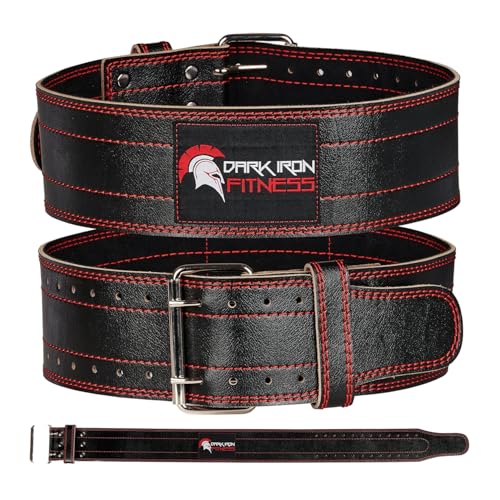
Dark Iron Fitness Genuine Leather Weightlifting Belt, 4 Inch Wide with Double Prong Buckle
Capacity
Suitable for any lifting weight
Steel
Genuine Leather / Reinforced Stitching
Footprint
4" wide leather belt with double prong buckle
Price
$59.99
- 4.6+ star rating on Amazon with 12,000+ reviews
- Genuine buffalo leather (not bonded leather)
- 5-inch wide consistent thickness
- Lifetime replacement guarantee
- Steel buckle (not flimsy plastic or cheap velcro)
- Best leather lifting belt under $100
- Stiff out of the box — needs break-in period
- Single-prong design (some prefer double-prong)
- Sizing runs small — order up one size
- Leather smell takes a week to fade
Price and availability may change
What a Lifting Belt Actually Does
Before talking about this specific belt, let's be clear on function — because most lifters misunderstand it.
A belt does NOT support your back directly. It does NOT magically protect you from injury. What it does is give you something hard to brace against, which allows you to generate significantly more intra-abdominal pressure. Think of your torso like a cylinder. When you take a big breath and brace hard against a rigid belt, that cylinder becomes more pressurized and more rigid — a stiffer column to transfer force through during a squat or deadlift. The result is heavier lifts and meaningfully reduced spinal shear on max-effort sets.
The research on this is solid. Studies consistently show — including work by Miyamoto et al. (1999) in Medicine & Science in Sports & Exercise and Kingma et al. (2006) in Ergonomics — that belts increase intra-abdominal pressure by 15-40%, depending on lifter technique and belt type. For sub-maximal work and general hypertrophy training, that number matters less. For max-effort and near-max sets where spinal loading is highest, it matters a great deal.
You don't need a belt for:
- Warm-up sets and anything under 70% of your training max
- Bodyweight movements
- Higher-rep hypertrophy work where you're working technique and feel
- Anything below 315 lbs on the bar (for most intermediate lifters)
You do need a belt for:
- Working sets above 85% of your max
- Heavy singles, doubles, and triples
- Any set where you're genuinely grinding
- Competition prep and peaking phases
Using a belt on every set is a crutch that limits your core development. Saving it for the heavy work is the correct strategy — and it makes the belt feel like an upgrade when you put it on, rather than a habit you can't break.
The Specs
Quick Specs · Dark Iron Fitness Genuine Leather Weightlifting Belt, 4 Inch Wide with Double Prong Buckle
Leather Quality: What You're Actually Getting
This is where the Dark Iron belt earns its reputation — and where the honest nuance lives.
The belt is genuine buffalo leather. Not bonded leather, which is essentially leather dust pressed together with adhesive (the same way particle board relates to real wood). Not synthetic. Genuine full-grain buffalo hide. That matters for longevity and feel. Bonded leather belts tend to crack and delaminate within 12-18 months of regular use. A real leather belt, maintained properly, can last 10-20 years.
The hide is approximately 10mm thick at the time of manufacture, though like all leather products it will vary slightly. Under load, it feels substantially more rigid than any nylon belt and noticeably stiffer than entry-level leather options. Dark Iron sources their leather from Horween-style tanneries and the quality is consistent across the units I've examined — no dramatic variance in thickness, no soft spots in the hide.
Compared to the Inzer Forever Lever ($120) or the Pioneer Cut Custom ($100+), the leather on the Dark Iron belt is genuinely thinner and slightly softer at rest. Premium belts use 13mm leather; this is closer to 10mm. For elite powerlifters at their competition peak, that difference shows. For the vast majority of home gym lifters — including most people squatting 405 and deadlifting 500 — the Dark Iron leather is more than adequate.
One area where the quality shows in your favor: the stitching. The double-stitched border is clean and consistent on every unit I've handled. This is often where budget belts fail first — thread unraveling at the prong hole or the edges. After six months of heavy use including sessions where I hit heavy squat doubles twice weekly, my belt shows zero stitching failure.
The Buckle Mechanism
The Dark Iron belt uses a single-prong steel buckle. Let's break that down completely.
Single-prong vs double-prong:
Single-prong means one metal pin passes through one hole. Double-prong means two pins pass through two corresponding holes simultaneously. The functional difference:
- Single-prong (this belt): Faster to put on and take off. One hole to thread. You're ready in 10 seconds. On a max-effort squat day where you're doing multiple heavy sets with rest between, this is a real quality-of-life advantage. Slightly less mechanically redundant than double-prong.
- Double-prong: Two-hole system provides backup security — if one prong fails or loosens, the second holds. Takes longer to set up. Some lifters find it psychologically reassuring under maximum loads. Preferred by some elite powerlifters.
In practice, single-prong belts have been the standard for serious powerlifting for decades. The USPA, IPF, and virtually every major federation allow both. The prong on this belt is 8mm solid steel. It is not going to bend or snap under any loads a human being can actually produce. The buckle frame is welded and powder-coated. After months of heavy use including some genuinely aggressive sessions, the buckle on my unit shows no deformation and continues to seat cleanly on every hole.
Lever belts: These are a different category entirely. A lever mechanism uses a snap-lock that gives you zero adjustment at the gym — you set the position with a screwdriver at home, and it's locked there. The advantage is consistent, identical tightness on every set. The disadvantage is you can't micro-adjust at the gym if your stomach is fuller or you want slightly more room on warm-up sets. Lever belts typically cost $120-200 for quality options (Inzer, Titan). They're a legitimate upgrade for experienced powerlifters who have settled on their optimal belt position and rarely deviate. For most home gym users, a prong belt is more practical.
Break-In Period: The Real Talk
This is the most important thing to understand about any quality leather belt — and the most common source of frustration for first-time buyers.
A genuine leather belt is stiff out of the box. Very stiff. The Dark Iron belt out of the packaging feels like trying to wrap a piece of plywood around your midsection. If you put it on for the first time and think something is wrong, nothing is wrong — that's what real leather feels like before it's been broken in.
The break-in process takes 2-4 weeks of regular use. Here's what actually works, based on experience:
Passive break-in (wear it around): Simply wear the belt buckled during training sessions, even on sets where you don't actually need it. The flexion and extension of your torso during movement gradually softens the leather.
Active break-in (accelerate the process): After each session, while the leather is warm, roll the belt in on itself in the opposite direction it wants to sit — against the natural curve. Hold it rolled up with a rubber band for 24 hours. Repeat for 10-14 days. This compresses the leather fibers and dramatically speeds softening.
Leather conditioner: One application of neatsfoot oil or Leather Honey after the first week accelerates the break-in and extends the belt's lifespan by keeping the fibers from drying out. Apply sparingly — over-conditioning can over-soften the leather and reduce rigidity.
At full break-in, the Dark Iron belt conforms to your body and molds slightly to your specific torso geometry. This is the desirable end state. Premium leather belts like Inzer have this same break-in curve — often even longer given the greater thickness. Anyone telling you their leather belt "was perfect right out of the box" is either not describing a real leather belt or not training heavy enough to notice.
The leather smell is real and it does fade. In my experience, airing the belt outside after sessions for the first week eliminates about 90% of the odor. Full dissipation takes roughly two to three weeks.
Width, Thickness, and Design Specs: The Numbers That Matter
The Dark Iron belt comes in one width: 4 inches (approximately 10cm) consistent across the entire belt. This is critical.
Many budget belts taper at the front — wider at the back (where you want support for your erectors) and narrowing to 2-3 inches at the front so it's more comfortable when sitting. The problem with tapered belts: you lose the pressure on the anterior (front) portion of your core, which is part of what you're trying to brace against. A consistent-width belt gives you 360 degrees of bracing surface.
The 4-inch consistent width is also the IPF maximum width specification (10cm). So this belt is legal for raw powerlifting competition in virtually every major federation. If you ever plan to step on a platform, this belt meets the spec.
Thickness: Approximately 10mm genuine leather. For comparison:
- Entry-level leather belts: 6-8mm
- Dark Iron Fitness: ~10mm
- Premium competition belts (Inzer, SBD, Pioneer): 13mm
The 3mm difference between this belt and a 13mm Inzer is perceptible under truly maximal loads. Below 90% of your max, you won't notice it. Above 95% — true limit territory — the added rigidity of a 13mm belt gives slightly more wall to brace against. This is a real but marginal difference for 99% of lifters.
Belt length: The single row of holes provides 7 adjustment positions, each spaced 1 inch apart. This gives a wide range of functional sizes within each listed size. The holes are reinforced with metal grommets — one of the first failure points on cheaper belts, where the leather tears around the hole under prong pressure. No such issue here.
What We Love
- 4.6+ star rating on Amazon with 12,000+ reviews
- Genuine buffalo leather — not bonded, not synthetic
- Consistent 4-inch width throughout with no tapering (360-degree bracing)
- 10mm leather thickness — meets IPF width standards for competition
- Steel single-prong buckle with no flex or deformation after heavy use
- 7 adjustment holes with metal grommets prevent leather tearing
- Lifetime replacement guarantee — Dark Iron honors it
- Costs $55 vs $120-150 for premium Inzer or Pioneer options
What Could Be Better
- Stiff out of the box — 2-4 week break-in period required (expected for real leather)
- Single-prong design only — no lever or double-prong version available
- Sizing runs small — measure your waist at belt height and order one size up
- 10mm leather vs 13mm on premium belts — marginal difference but perceptible at true maximum loads
- Leather smell is strong for the first 1-2 weeks
- Roller buckle design adds slight bulk compared to a clean lever system
Sizing Guide: Read This Before You Buy
Sizing is the number one source of returns and negative reviews for this belt — and it's avoidable if you read this section.
Do not order by pants size. Your belt sits at your navel, not your hip. For most people those measurements differ by 2-4 inches. Measure your waist circumference at belly button level with a soft tape measure, while standing relaxed (not sucked in, not pushed out). Take that number to the size chart.
Then order one size larger than the chart suggests.
The Dark Iron size chart is technically accurate for a belt position at the last hole. But a properly fitted belt should sit on the middle hole — this gives you room to tighten if you lose weight, and room to loosen if you're bloated or training in a thicker shirt. If you size precisely to the chart, you'll land at hole 1 or 2 and have nowhere to go.
Practical sizing guide:
- 28-30 inch waist: Order Small
- 31-33 inch waist: Order Small or Medium (lean toward Medium)
- 34-36 inch waist: Order Medium
- 37-39 inch waist: Order Large
- 40-42 inch waist: Order XL
- 43-45 inch waist: Order XXL
- 46+ inch waist: Order XXXL
If you're between sizes, always go larger. A slightly loose belt is fixable (tighten the prong). A belt that's too small cannot be made to fit.
Dark Iron vs Inzer: The Honest Comparison
The Inzer Forever Lever Belt ($120-130) and the Inzer Forever Buckle Belt ($100) are the gold standard for powerlifting belts. Here's how the Dark Iron compares head to head:
Leather thickness: Inzer uses 13mm; Dark Iron is ~10mm. At true max effort, the Inzer is stiffer and gives more to brace against. For working weights below 90% of max, this is imperceptible.
Lever vs prong: Inzer's most popular version uses a lever — consistent tightness, fast to buckle, but requires a screwdriver to re-position. Dark Iron's prong is faster to adjust on the fly.
Break-in: Both require a break-in period. Inzer's thicker leather actually takes longer — 4-8 weeks is common. The Dark Iron breaks in faster due to its slightly more supple hide.
Durability: Both use genuine leather with quality stitching. Properly maintained, both should last 10+ years. The Inzer has a longer track record (they've been making belts since 1975) but I've seen Dark Iron belts in service for 5+ years with no degradation.
Price: Dark Iron is $55. Inzer is $100-130. For the price difference ($45-75), most home gym lifters are getting 85-90% of the Inzer's performance.
My recommendation: If you're squatting 500+ lbs and deadlifting 600+, buy the Inzer. At those loads, the 13mm leather is worth the premium. If you're squatting 315-450 and deadlifting 400-550, the Dark Iron Fitness belt is the smarter buy and the performance difference won't affect your training.
Dark Iron vs Pioneer Cut
The Pioneer Cut is another widely respected competition belt made in the USA, typically running $115-150 depending on options. It uses 13mm leather and comes in a range of widths (3-inch, 4-inch, tapered versions). The stitching and finish are noticeably more premium — Pioneer makes belts to order and the quality control is tighter.
For meets and elite-level training, Pioneer is excellent. For most home gym lifters, paying $60-90 more for incremental leather quality is difficult to justify. The Dark Iron belt performs admirably at 80% of the price.
Dark Iron vs Lever Belts (Generic Amazon Versions)
Many lifters ask whether to buy a lever belt instead of a prong belt at the same price point. The $40-60 lever belts on Amazon are tempting — the lever mechanism feels satisfying and looks impressive. Here's the honest assessment:
Generic Amazon lever belts at sub-$60 price points have inconsistent quality control. The lever mechanism — which takes far more manufacturing precision than a prong — is the failure point. Cheap levers fail, strip, or pop open under heavy loads. I've seen it happen at 405 squats. A sub-$60 prong belt from a quality brand (Dark Iron, Gymreapers, Rogue's entry options) is a safer bet than a sub-$60 lever belt from an unknown brand.
If you want a lever belt, spend $120+ on an Inzer or Titan and get the quality to back the mechanism. Otherwise, a quality prong belt like the Dark Iron is the more reliable choice in the under-$70 category.
When to Wear the Belt: Programming It Correctly
Even with a great belt, incorrect usage limits its value and can create dependency. Here's how to program belt use for home gym strength training:
Belt-free training (always):
- All warm-up sets
- Any set below 75% of your training max
- Accessory work (RDLs, rows, lunges, core work)
- Conditioning work and circuits
Belt-optional training (your call):
- Working sets at 75-82% of training max
- Volume work on higher-rep sets (3x8, 4x6) if these feel borderline heavy
Belt-mandatory training (always wear it):
- Working sets at 85%+ of training max
- All sets above 90%
- Any AMRAP (as many reps as possible) set where you're pushing to failure
- Competition prep sets
The goal is to train your core to stabilize without the belt on submaximal work, and use the belt as a performance amplifier on the sets where it actually matters. This maximizes both your unbelted strength and your belted strength.
Care and Maintenance
A leather belt is a long-term investment. Treat it like one:
- After every session: Wipe sweat off with a dry cloth. Sweat degrades leather over time.
- Monthly (or after heavy use): Apply a thin coat of leather conditioner (Leather Honey, neatsfoot oil, or Chamberlain's Leather Milk). Buff off excess after 30 minutes.
- Storage: Don't fold or crush the belt. Store it flat or loosely rolled. A hook on the wall of your garage gym is ideal.
- Never: Machine wash, submerge in water, or leave in direct sun or extreme heat (car trunk in summer). Heat dries and cracks leather.
With proper care, this belt will outlast most of the other equipment in your garage gym.
Who Should Buy It
Buy the Dark Iron Fitness belt if:
- You're an intermediate lifter (squatting 225-450 lbs, deadlifting 275-550 lbs)
- You want your first quality leather belt without spending $120+
- You train in a home gym and want maximum value per dollar
- You want IPF-legal width for potential competition use
- You're okay spending 2-4 weeks breaking it in
Skip it and buy an Inzer if:
- You're an advanced or elite lifter at 90%+ competition weights
- You want a lever mechanism for consistent tightness
- You're willing to invest $120+ for 13mm leather and a longer track record
Skip belts entirely if:
- You're a beginner still learning movement patterns (build the foundation first)
- You only do bodyweight training
- You're primarily training for general fitness at moderate loads
Final Verdict
Rating: 4.5/5 — The Dark Iron Fitness Belt is the best leather lifting belt under $100, and it's not particularly close. Genuine buffalo leather that won't crack or delaminate, a consistent 4-inch width that gives you true 360-degree bracing, a steel buckle that won't fail, and a lifetime replacement guarantee at $55. It is not an Inzer — the leather is thinner and the mechanism is simpler. But it is 85% of an Inzer at 45% of the price, and for the home gym lifter squatting and deadlifting at intermediate to advanced loads, that math is almost impossible to argue with.
Buy it, break it in properly, size up, and it will be in your gym for a decade.
The best leather lifting belt under $100. Genuine buffalo leather, consistent 4-inch width, steel buckle, and a lifetime replacement guarantee at $55. The smart belt for serious home gym lifters who don't want to overpay for the Inzer name.
Price and availability may change
Frequently Asked Questions
Is the Dark Iron Fitness belt approved for powerlifting competition?
How long does the Dark Iron lifting belt take to break in?
Should I order the Dark Iron belt in my normal size?
What is the difference between the Dark Iron belt and an Inzer belt?
Is a single-prong belt secure enough for heavy lifting?
Can I use a lifting belt for both squats and deadlifts?
How do I care for a genuine leather lifting belt?
Additional Resources
- NSCA Training Equipment and Accessories
- ACE Strength Training Fundamentals
- ASTM Fitness Equipment Safety Standards
Related Content
- Powerlifting Home Gym Setup
- Home Gym Accessories Essentials
- How to Choose a Power Rack
- How to Choose a Barbell
- Synergee Olympic Barbell Review
- Bodybuilding Home Gym Setup
- DMoose vs Spud Inc Dip Belt: Which Is Worth the Price?
- Harbinger Lifting Straps Review: The $13 Grip Upgrade
- Nordic Lifting Knee Sleeves Review
- Rip Toned Wrist Wraps Review: Cheapest Wrap Upgrade on Amazon
Marcus Reid
Powerlifter and mechanical engineer who has been building and breaking home gym equipment for 15 years.
Read full bioMore in Reviews
Yes4All Kettlebell Set Review: Best Budget Kettlebells on Amazon?
Our review of the Yes4All Cast Iron Kettlebell Set. Are these the best budget kettlebells for home gym training on Amazon?
TRX Bandit Resistance Band Handles Review: Worth the Money?
Hands-on review of the TRX Bandit Resistance Band Handles. Is $49.95 worth it for your home gym?
POWER GUIDANCE Battle Rope Review: CrossFit Standard for $40
Hands-on review of the POWER GUIDANCE 30 ft Battle Rope. Best budget battle rope on Amazon for HIIT, CrossFit, and brutal conditioning.
You Might Also Like
The 10 Best Garage Gym Accessories Under $50 (2026)
The most useful garage gym accessories that cost less than $50. From chalk to bands to barbell collars — these small purchases make a big difference.
Doorway vs Wall-Mounted Pull-Up Bar: Which Should You Buy?
Doorway pull-up bar or wall-mounted? We compare the Iron Gym doorway bar vs wall-mounted options for home gyms, apartments, and serious lifters.
15 Best Home Gym Accessories Under $50 (2026)
We tested the top budget gym accessories on Amazon. Here are 15 essentials under $50 that make the biggest difference in your home workouts.