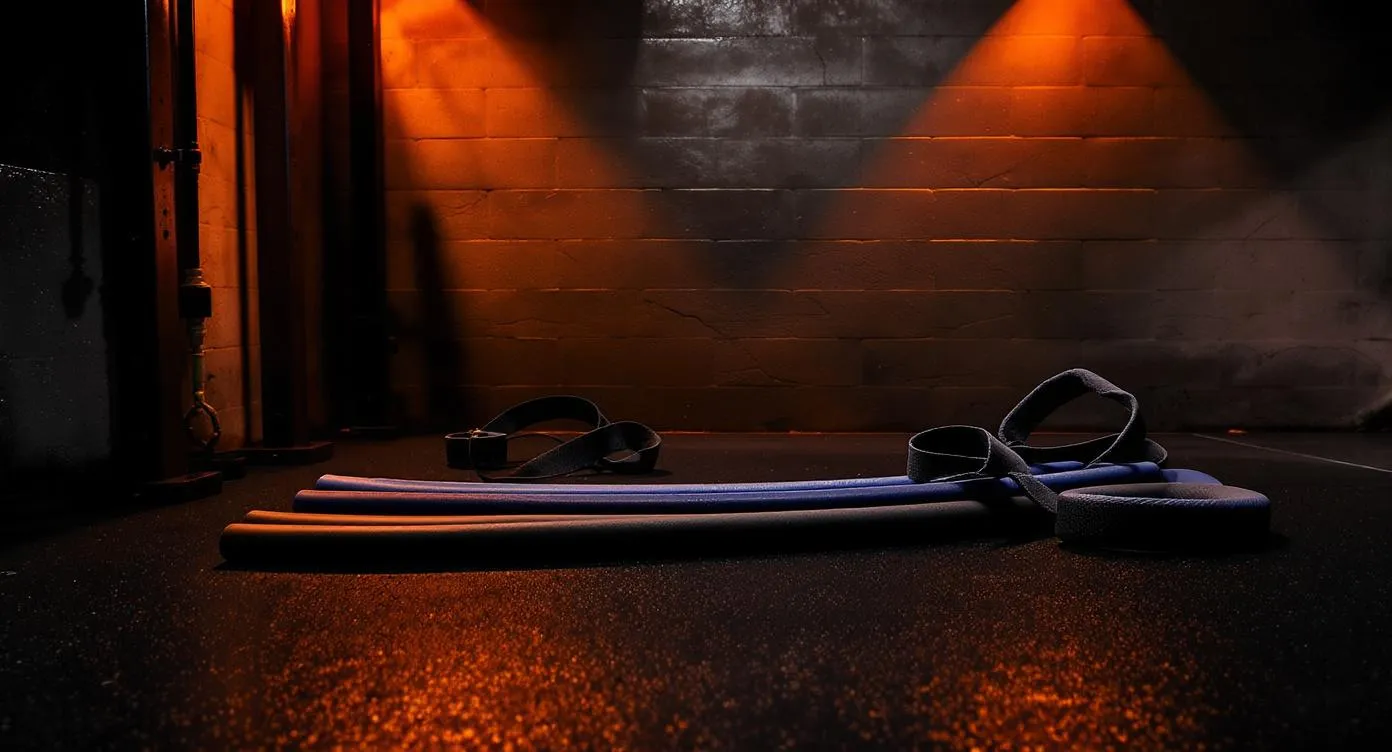
Bodylastics Resistance Bands Review: The Anti-Snap Bands That Actually Last
Hands-on review of the Bodylastics Stackable Resistance Bands. Patented anti-snap design, 280 lbs of stackable resistance, lifetime replacement — but is it worth $60?
Resistance bands are the most underrated training tool in a garage gym. They weigh nothing, cost a fraction of dumbbells, and cover a range of training stimulus that free weights simply cannot replicate. But the consumer resistance band market is flooded with garbage — thin latex tubes that degrade in sunlight, carabiners that corrode, handles that crack after three months. And when a cheap tube band fails mid-rep, it does not quietly deflate. It whips. At speed. Into your face.
Bodylastics built their entire brand around solving that specific problem. After nearly two decades on the market, they remain the gold standard for stackable tube bands because of one engineering decision: a patented anti-snap inner safety cord running through every tube. Everything else about the set — the handles, the door anchor, the stacking system — flows from the same philosophy of building gear that outlasts the competition.
After months of programming Bodylastics into strength, hypertrophy, and rehab protocols, here is everything you need to know.

Bodylastics PRO Series Resistance Band Set (6 Bands, 280 lbs)
Capacity
6 bands stackable to 280 lbs
Steel
Anti-Snap Natural Latex Tubing
Footprint
Handles, ankle straps, door anchor + carry bag
Price
$61.97
- 4.6 star rating on Amazon with 2,600+ reviews
- Patented anti-snap inner cord for safety
- 6 bands stackable up to 280 lbs total resistance
- Includes handles, ankle straps, and door anchor
- Lifetime replacement on bands
- Travel-friendly storage bag
- Resistance feels different than free weights
- Door anchor requires an inward-opening door
- Handles wear faster than the bands
Price and availability may change
The Latex Tube Construction: Why It Matters
Not all resistance band materials are equal, and the difference matters more than most people realize.
Bodylastics uses natural latex rubber tubes, not the TPE (thermoplastic elastomer) or synthetic blends found in budget sets. Natural latex has a higher tensile strength, better elasticity over repeated cycling, and superior UV resistance compared to synthetic alternatives. The tubing wall thickness on Bodylastics bands is noticeably heavier than Amazon generic competitors — you can feel it immediately when you run your fingers along the tube.
The tubes are extruded to consistent diameter throughout their length, which directly affects resistance consistency. Poorly manufactured bands have uneven wall thickness, which means the resistance curve is unpredictable — the band might be 20 lbs for the first six inches of stretch, then suddenly spike to 40 lbs as the thinned section catches. Bodylastics tubes maintain their rated resistance curves reliably.
The PRO set includes six color-coded tubes, each rated for its maximum safe tension:
- Band 1: 10 lbs
- Band 2: 20 lbs
- Band 3: 30 lbs
- Band 4: 50 lbs
- Band 5: 80 lbs
- Band 6: 90 lbs
Stacked together, the six tubes deliver up to 280 lbs of total resistance. Each band is rated for its resistance at maximum safe extension, which is typically 2.5x the natural tube length. Stretching beyond that is where failures occur — and where the anti-snap system becomes critical.
Patented Anti-Snap Safety Cord: Engineering Done Right
A snapping resistance band is a serious injury risk. The failure mode is always the same: rubber fatigue builds over hundreds of repetitions, an invisible micro-tear propagates, and then the tube ruptures under load and recoils at high velocity. At face height — which is where bands are for rows, curls, and chest presses — this is a genuine hazard.
Bodylastics solved this with a continuous internal nylon safety cord woven through the center of every latex tube. The cord is slack under normal operation — you never feel it, and it does not affect the resistance curve. But if the outer latex tube ruptures, the cord arrests the recoil instantly, limiting the snap energy to essentially zero.
This is not a marketing gimmick. It is a real engineering solution to a real problem, and it is backed by a lifetime replacement guarantee. If any band snaps despite the safety system, Bodylastics replaces it. No receipt, no expiration, no questions.
For anyone programming bands into daily training, this guarantee changes the calculus entirely. You are not buying a $60 set that you will replace every year. You are buying a system you use until the handles wear out — and even then, replacement handles cost a few dollars.
The practical benefit over years of use is hard to overstate. Compare this to fabric loop bands, which do not snap but do fray, deroll at the edges, and lose tension over time in ways that are subtle and difficult to detect. Tube bands with the anti-snap cord give you a clear failure mode (cord catch) versus a slow degradation that quietly undermines your training.
The Stacking System: One Kit Replaces a Dumbbell Rack
The core innovation of the Bodylastics system is the stackable handle design. Each handle has multiple band attachment points — small clips that accept the metal carabiners on each band end. You load one, two, three, four, or five bands onto the same handle to accumulate resistance:
- 1 band (10 lbs): Light warm-up and rehab work
- 1 band (90 lbs): Heavy single-band working sets
- 2 bands stacked: 50–110 lbs depending on combination
- 3–4 bands stacked: 130–200 lbs
- All 6 bands stacked: Up to 280 lbs total
One set covers what would otherwise require 10–15 pairs of dumbbells. For a garage gym where floor space is limited and budget matters, this is a compelling proposition.
In practice, the stacking system works cleanly up to four bands. At five and six bands, the handle geometry gets crowded — the carabiners are stacked close together, which can cause them to torque slightly under load. This is manageable for most movements, but you will notice it on exercises that require the bands to maintain a clean parallel pull, like cable crossovers or standing chest flyes. For heavy compound pulls and presses, it is not an issue.
The stacking increment system also allows micro-loading in ways free weights often cannot match. If 30 lbs is too easy and 40 lbs is too hard for a given exercise, you can combine a 6-lb and 30-lb band for 36 lbs, or a 10-lb and 30-lb band for 40 lbs. This kind of precision is genuinely useful for rehab progressions and for smaller muscle group work where the jump between dumbbell increments is disproportionate.
The Specs
Quick Specs · Bodylastics PRO Series Resistance Band Set (6 Bands, 280 lbs)
What We Love
- 4.6 star rating on Amazon with 2,600+ reviews
- Patented anti-snap inner cord — no whip-back failures
- 6 bands stackable up to 280 lbs total resistance
- Includes handles, ankle straps, door anchor, carry bag
- Lifetime replacement on all bands
- Natural latex tube construction with consistent resistance curve
- Micro-loading possible by combining band weights
- Travel-friendly — full set fits in a small bag
What Could Be Better
- Resistance feels different from free weights — ascending curve, not constant load
- Door anchor only works on inward-opening doors
- Handles wear faster than the bands themselves
- Stacking 4-5 bands gets unwieldy on certain exercises
- Not a substitute for progressive barbell loading in primary compound lifts
Door Anchor Mechanics: Understanding the Setup
The included door anchor is a deceptively simple piece of equipment that most people never think about — until they anchor it wrong and it pulls loose mid-rep.
The anchor is a padded loop with a flat nylon strap that slips over the top of a door. When the door is closed, the strap presses against the door frame on both sides, creating friction that locks the anchor in place. The padded loop then hangs on your side of the door at whatever height you need — top of the door for lat pulldowns and overhead tricep extensions, middle of the door for rows, low (door closed on the strap near the floor) for upward-pulling exercises like bicep curls and upward cable flyes.
The critical limitation: this only works on inward-opening doors. The door must close toward you — closing the door locks the strap against the frame. If you are in a room where the door swings away from you, the anchor has nothing to grip against. In apartments and hotels, this is usually not a problem; most interior doors open inward into the room you are standing in. But it is worth checking before you rely on it for a hotel workout.
The anchor loads are also distributed across the door frame rather than a single point. This means you should not anchor at the very edge of the door — anchor with the strap centered over the door's width to distribute force evenly. Over-anchoring at the hinge side or latch side repeatedly can eventually damage door trim on hollow-core interior doors.
For home use, a permanent anchor — a screw-in wall anchor, a pull-up bar, or a power rack attachment point — is always preferable to the door anchor. The door anchor is excellent for travel and the first six months of home use while you are figuring out your setup. Long-term, mount something permanent.
Handle Quality: An Honest Assessment
The Bodylastics handles are the weakest component in the system, not because they are bad, but because the bands are so durable that the handles end up being the limiting factor.
The handles are injection-molded plastic with a foam grip sleeve. The foam is comfortable and provides enough grip that chalk is never needed. The D-ring or clip attachment points are solid metal with good plating. Under normal use, these handles last two to four years before the foam begins to compress and the grip becomes less comfortable.
The attachment clips are where occasional failure happens. The spring-loaded gates on the clips can fatigue if you are connecting and disconnecting multiple bands multiple times per session. After a year or two of heavy use, the gates can lose some spring tension, which means the clips open more easily — this is not dangerous but it is annoying if you are in the middle of a set and a band falls off.
Replacement handles are available directly from Bodylastics and are inexpensive. Treat the handles as a consumable component that is expected to be replaced every few years, while the latex tubes last indefinitely.
The ankle strap attachments included with most sets are well-constructed — padded neoprene with D-ring clips that attach to any band carabiner. These are particularly useful for cable kickbacks, hip abduction work, and standing hamstring curls, exercises that are normally cable-machine-only in a commercial gym.
Resistance Curve: The Band Difference Explained
Understanding the resistance curve of bands is essential for programming them correctly, particularly if your primary training background is barbell or dumbbell work.
Free weights provide constant resistance throughout a range of motion (gravity is constant, after all). Bands provide ascending resistance — the more you stretch them, the more they resist. At the beginning of a movement, when the bands are least stretched, resistance is lowest. At end range, when the bands are most stretched, resistance peaks.
This has two important implications:
First, bands are mechanically hardest where many movements are biomechanically strongest. A band squat is hardest at the top of the movement, where your legs are in their strongest position. A band row is hardest at the contracted position, which is exactly where you want the stimulus. For pull patterns, bands are excellent — the resistance profile matches the strength curve well.
Second, bands underload the stretch position. A band deadlift is easiest at the bottom when the bar is near the floor, which is the hardest position biomechanically. This is the opposite of what you want for a primary strength stimulus. This is why band deadlifts and band squats work best as accessory work layered on top of free weight training, rather than as replacements for it.
For hypertrophy, bands produce significant metabolic stress due to the sustained tension throughout a set and the pump-inducing nature of the ascending resistance. Sets of 15–25 reps with bands feel very different from equivalent-weight dumbbell sets — the accumulation of tension at end range drives blood flow and metabolic stress that is genuinely useful for muscle building.
Bands vs Loop Bands vs TRX: Choosing Your Tool
The resistance band category has three major tool types, and each occupies a different niche in a garage gym.
Bodylastics-style stackable tube bands — These are load-specific tools. You choose a weight, attach bands to handles, and perform free-weight-style pulling and pressing movements. Best for exercises that mimic cable machine exercises: curls, tricep pushdowns, rows, chest flyes, lateral raises, face pulls, and similar isolation and semi-isolation work. The stacking system gives you genuine programmable resistance across a wide range.
Loop bands (fabric or latex) — These are not interchangeable with tube bands despite the shared "band" category. Loop bands are a single continuous loop with no handles. They are primarily used for assistance work (banded pull-ups, banded dips), accommodating resistance (banded barbell squats and deadlifts), mobility and warm-up drills (clamshells, hip circles, banded monster walks), and prehab work for the hip and shoulder complexes. Loop bands do not replace tube bands; they complement them. If you are building out a complete resistance band toolkit, you want both.
TRX-style suspension trainers — These are a completely different training modality. The TRX GO suspension trainer uses bodyweight and leverage rather than elastic resistance. Where bands are excellent for isolation and accessory movements, TRX is better for full-body compound movement patterns: rows, push-ups, squats, single-leg work, and core stability training. The TRX Bandit handles extend this further by allowing pulling movements through full ranges of motion. TRX and Bodylastics are excellent complements — together they cover nearly every training modality without a single plate or dumbbell.
For a complete portable gym, the combination of Bodylastics tube bands, a set of fabric loop bands, and a TRX covers strength, hypertrophy, and bodyweight training comprehensively. See our best resistance bands guide for a full breakdown of the category.
Programming for Strength: Accommodating Resistance
One of the most advanced applications of tube bands is accommodating resistance in conjunction with barbell training. This is a powerlifting and strength training technique where bands are anchored to the floor or rack and stretched over the barbell, adding band tension to the barbell load throughout the lift.
The result: at the bottom of the lift, resistance is low (the band is least stretched). At the top of the lift, resistance peaks (the band is most stretched). This trains the lifter to accelerate through the entire range of motion, not just to grind through the sticking point. For squats, bench press, and deadlifts, banded barbell work is a legitimate method for building bar speed and rate of force development.
Bodylastics tube bands are not the ideal tool for heavy accommodating resistance — they have carabiner attachment points designed for handles, not for wrapping around a barbell. Heavy resistance bands specifically designed for powerlifting use (thick, wide latex loops without hardware) are better for barbell work. However, lighter Bodylastics bands can be adapted with some creativity for moderate accommodating resistance work.
For general strength programming, bands are most effective in the following positions:
- Post-activation potentiation warm-ups: Light band pull-aparts and face pulls to activate the posterior shoulder complex before pressing.
- Accessory volume: 3–4 sets of band pull-downs, band rows, or band curls at the end of a training session to add muscle-building volume without fatigue that impacts recovery for the next session.
- Deload weeks: Replace 50–60% of free weight volume with band work to maintain stimulus while reducing joint and CNS load.
Programming for Rehab and Prehab
Resistance bands were originally developed as physical therapy tools, and this remains one of their most valuable applications. The ascending resistance curve, ability to micro-load, and low joint stress make bands ideal for:
Rotator cuff work: External rotation, internal rotation, and scaption movements are nearly impossible to load appropriately with dumbbells — the lightest dumbbell in most gyms is 5 lbs, which is too heavy for direct rotator cuff loading. A 3-lb or 6-lb band allows genuine rotator cuff strengthening without compensation patterns.
Knee rehabilitation: Terminal knee extensions (TKEs) and short arc quads are staple exercises in ACL and meniscus rehabilitation. These require very light loads with very precise resistance application — bands are the tool for this, not machines or free weights.
Hip and glute activation: Banded clamshells, lateral band walks, and hip thrusts with band resistance are standard in sports medicine rehab for gluteal inhibition, IT band syndrome, and patellofemoral pain. Fabric loop bands are often preferred here, but tube bands with ankle straps work equally well for many of these movements.
Progressive loading in early recovery: After surgery or injury, the ability to start with 3–6 lbs of resistance and progress in small increments is critical. Bodylastics allows 3-lb increments across the lower end of the resistance range, which matches typical physical therapy loading progressions.
The lifetime replacement guarantee is particularly relevant for rehab use — physical therapy bands are high-volume, low-load applications that cycle the latex through thousands of repetitions. Knowing the bands are replaced at no cost if they fail removes a financial barrier to using them appropriately.
Best Exercises With Resistance Bands
Based on months of programming experience, these are the exercises where Bodylastics tube bands genuinely outperform alternatives:
- Banded face pulls — shoulder health, rear delt development, and postural correction in a single movement. The band mimics a cable machine setup at a fraction of the cost.
- Banded pull-aparts — horizontal pulling for upper back activation and shoulder prehab. Two sets before any pressing session.
- Tricep pushdowns — the classic cable machine exercise replicated perfectly. Bands provide the continuous tension throughout the range of motion that makes cable pushdowns superior to dumbbell kickbacks.
- Banded rows — mid-back development and lat thickness work accessible anywhere with a door anchor.
- Banded curls — particularly effective for the peak contraction position, where bands are hardest exactly when the bicep is at its shortest and most contracted.
- Standing hip abduction — using ankle straps for glute medius work, lateral hip strength, and knee stability training.
- Banded Romanian deadlifts — light hamstring and hip hinge work that adds volume without barbell loading.
- External rotation series — rotator cuff health work for anyone who presses heavy.
Who Should Buy It
Buy it if:
- You travel frequently and need programmable resistance in a bag
- You live in an apartment where dropping weights is impossible
- You want a cable machine substitute for isolation work without the $800+ cost
- You do physical therapy, prehab, or sport-specific accessory work
- You want lifetime replacement on your training tools
- You want to add accommodating resistance principles to bodyweight training
- You are building a complete garage gym and want one versatile accessory kit
Skip it if:
- You already own a functional cable machine with a full weight stack
- You exclusively train heavy barbell compounds and have no interest in accessory work
- You are looking for a primary strength building tool rather than a complement to free weights
Alternatives
Budget: Generic Amazon resistance band sets ($20–30) — The tubes are thinner, there is no anti-snap cord, no lifetime warranty, and carabiners corrode within six months. Acceptable for occasional light use but not for systematic training.
Premium: Crossover Symmetry ($199) — A band-based system specifically designed for shoulder health and overhead athlete programming. Excellent product with an outstanding exercise library, but purpose-specific. Not a general-purpose replacement for Bodylastics.
Loop band alternative: Perform Better or Rogue SuperBands — High-quality latex loop bands for accommodating resistance and pull-up assistance. Complementary to, not competitive with, tube band sets.
Suspension alternative: TRX GO — For bodyweight compound movements. Different tool, different stimulus, worth owning alongside Bodylastics.
Final Verdict
Rating: 4.6/5 — Bodylastics earns its price premium on the anti-snap cord alone. That single engineering decision, backed by a lifetime replacement guarantee, separates this product from every generic competitor in the category. Add the genuine versatility of the stacking system, the natural latex tube quality, and the breadth of included accessories, and you have a resistance training kit that covers isolation work, cable machine substitution, rehab protocols, and travel training in a bag that weighs under two pounds.
The resistance curve difference from free weights is real and worth understanding before you program bands into your training. They are not a replacement for barbells or dumbbells. They are a complement — and a uniquely good one.
The only resistance band set worth buying. Patented anti-snap inner cord prevents face-whipping injuries, six bands stackable up to 280 lbs, and lifetime replacement. The set every home gym should own.
Price and availability may change
Frequently Asked Questions
Can Bodylastics bands replace dumbbells entirely?
How long do the latex tubes actually last?
Do the bands work with a power rack?
What's the difference between the 6-band PRO and 5-band sets?
Are Bodylastics bands good for pull-up assistance?
Additional Resources
- NSCA Training Equipment and Accessories
- ACE Strength Training Fundamentals
- ASTM Fitness Equipment Safety Standards
Related Content
- Best Resistance Bands for Home Gyms
- TRX GO Suspension Trainer Review
- TRX Bandit Handles Review
- Home Gym for Travel
- Home Gym Small Spaces
- Home Gym for Rehab and Recovery
- Home Gym for Seniors
- Apartment Home Gym Under $300
- Rip Toned Wrist Wraps Review: Cheapest Wrap Upgrade on Amazon
- Teclor Parallettes Review: Unlock Calisthenics for $29.98
Derek Walsh
Strongman competitor and former commercial gym equipment salesman. Knows what survives heavy daily use.
Read full bioMore in Reviews
Yes4All Kettlebell Set Review: Best Budget Kettlebells on Amazon?
Our review of the Yes4All Cast Iron Kettlebell Set. Are these the best budget kettlebells for home gym training on Amazon?
TRX Bandit Resistance Band Handles Review: Worth the Money?
Hands-on review of the TRX Bandit Resistance Band Handles. Is $49.95 worth it for your home gym?
POWER GUIDANCE Battle Rope Review: CrossFit Standard for $40
Hands-on review of the POWER GUIDANCE 30 ft Battle Rope. Best budget battle rope on Amazon for HIIT, CrossFit, and brutal conditioning.
You Might Also Like
The 10 Best Garage Gym Accessories Under $50 (2026)
The most useful garage gym accessories that cost less than $50. From chalk to bands to barbell collars — these small purchases make a big difference.
Doorway vs Wall-Mounted Pull-Up Bar: Which Should You Buy?
Doorway pull-up bar or wall-mounted? We compare the Iron Gym doorway bar vs wall-mounted options for home gyms, apartments, and serious lifters.
15 Best Home Gym Accessories Under $50 (2026)
We tested the top budget gym accessories on Amazon. Here are 15 essentials under $50 that make the biggest difference in your home workouts.