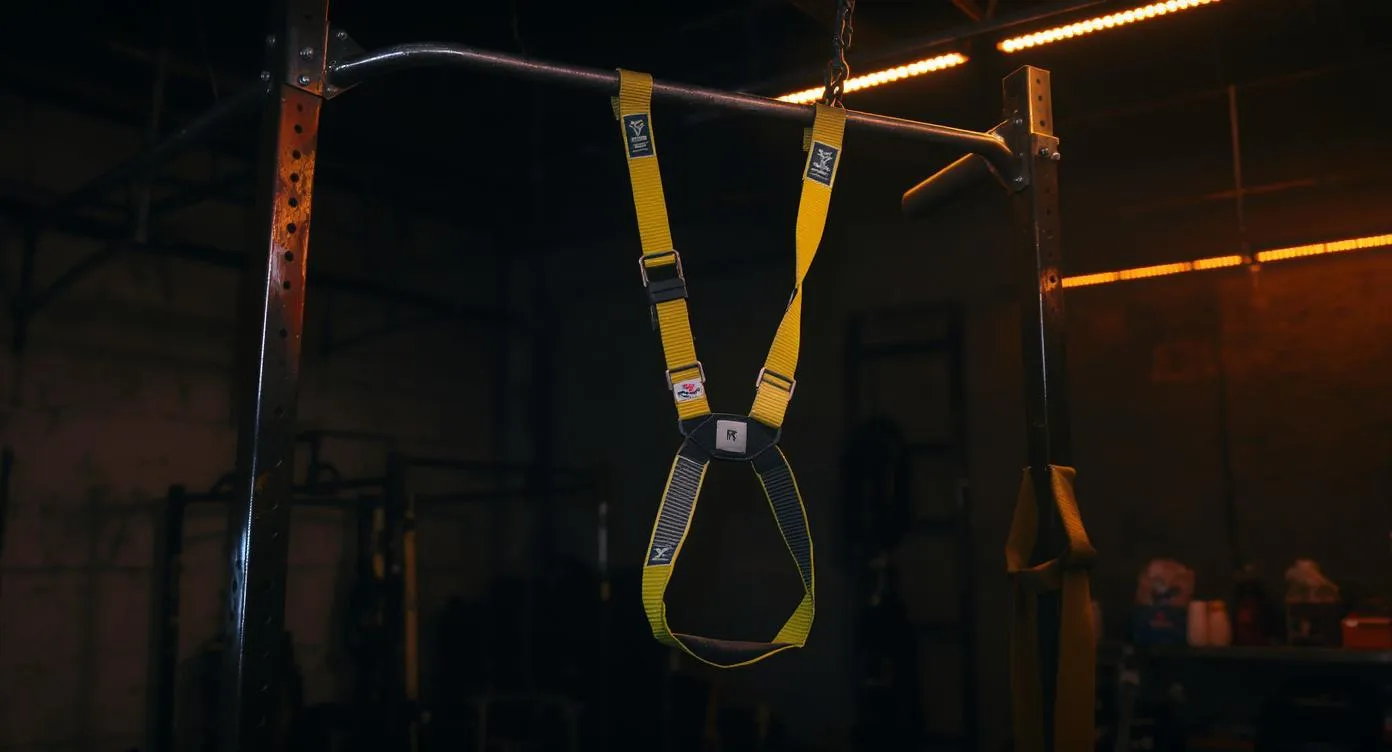
TRX GO Suspension Trainer Review: The Original Travel Gym
Hands-on review of the TRX GO Suspension Trainer System. The pocket gym for travel, apartments, and bodyweight training.
Suspension trainers have been around since 1997, when a Navy SEAL named Randy Hetrick sewed a prototype from jiu-jitsu belt webbing and parachute repair materials. Nearly three decades later, the product that emerged from that deployment — the TRX — has become the single most replicated piece of fitness equipment on Amazon. There are dozens of knockoffs priced between $15 and $40, all copying the same basic layout of two adjustable nylon straps with handles and foot cradles hanging from a single anchor point.
The TRX GO is TRX's travel-specific model, stripped down to 1.56 lbs and sold at $130. That is a steep price for what looks like two nylon straps. After six months of programming the TRX GO into upper body, core, and conditioning sessions — in hotel rooms, public parks, garage gyms, and hanging off power rack J-cups — here is a thorough breakdown of whether the original justifies the premium.

TRX GO Suspension Trainer, Portable Gym for Full Body Exercise
Capacity
350 lbs user weight
Steel
Mil-Spec Nylon Webbing / Reinforced Hardware
Footprint
Fits in a small bag
Price
$139.95
- 4.6+ star rating on Amazon with 5,000+ reviews
- Original TRX brand quality
- Fits in a backpack (best for travel)
- 300+ exercises possible
- Includes door anchor and carry bag
- Lifetime warranty on hardware
- Pricier than knockoff suspension trainers
- Requires a sturdy anchor point overhead
- Door anchor only works on inward-opening doors
- Not ideal for explosive movements
Price and availability may change
Build Quality and Materials: What $130 Actually Buys
The first thing you notice holding a TRX GO next to a $25 Amazon knockoff is the webbing. TRX uses a proprietary woven nylon strap with a tighter weave density than any competitor I have handled. The edges are heat-sealed cleanly with no fraying potential, and the stitching at load-bearing junctions uses a box-X reinforcement pattern — the same pattern used in climbing harness construction. The rated capacity is 350 lbs of body weight, though the actual breaking strength is significantly higher based on the engineering margins TRX builds in.
The carabiners are locking steel, not the aluminum spring-gate clips found on budget trainers. This matters because aluminum carabiners can deform under dynamic loading — when you do explosive movements or generate momentum during exercises like TRX power pulls, the peak force on the anchor point can briefly exceed 2x your body weight. Steel locking carabiners eliminate the risk of gate opening under load.
The handles are a dense rubber-over-plastic construction with textured grip zones. They are noticeably more comfortable than the thin foam-wrapped handles on knockoffs, which compress flat after a few weeks of sweaty use. The foot cradles are wider than competitors (approximately 7.5 inches across versus 5-6 inches on generic versions), which makes single-leg exercises and plank variations significantly more stable.
The single best engineering feature is the cam-lock adjustment mechanism. You pull the yellow tab, slide the strap to adjust length, and release — one hand, under one second. On every knockoff I have tested, adjustment requires two hands and 3-5 seconds of fumbling with a friction buckle. When you are programming circuits with 15-second transitions between exercises at different strap lengths, that difference is the gap between a flowing workout and a frustrating one.
The Specs
Quick Specs · TRX GO Suspension Trainer, Portable Gym for Full Body Exercise
What We Love
- Mil-spec nylon webbing with box-X stitching rated to 350 lbs
- One-handed cam-lock adjustment changes length in under 1 second
- Weighs only 1.56 lbs — fits in any backpack or carry-on
- Steel locking carabiners prevent gate-opening under dynamic load
- Wide 7.5-inch foot cradles stable enough for single-leg work
- Includes door anchor, mesh carry bag, and workout poster
- Lifetime warranty covers hardware defects permanently
- 300+ documented exercises covering every major muscle group
What Could Be Better
- $130 price tag is 3-5x more than functional knockoffs
- Lighter webbing than the TRX PRO4 means slightly more flex under heavy loads
- Door anchor only works on inward-opening doors with solid frames
- No padding on the straps where they contact forearms during certain exercises
- Mesh carry bag is flimsy — a stuff sack would be more durable
- Single anchor point limits bilateral loaded movements compared to rings
TRX GO vs Amazon Knockoffs: The Honest Breakdown
This is the question everyone asks, and the honest answer has nuance. A $25-40 Amazon suspension trainer uses the same fundamental design — two straps, two handles, two foot cradles, one anchor point. For someone who uses a suspension trainer twice a week for basic rows, push-ups, and planks, a knockoff will work fine for 6-12 months before the buckles stiffen, the foam handles compress, and the stitching starts looking questionable.
The TRX GO earns its premium in three specific use cases. First, daily use: the cam-lock mechanism and webbing quality hold up to 5-7 sessions per week without degradation, while knockoff buckles develop friction issues within 2-3 months of daily use. Second, travel: at 1.56 lbs with a compact fold, the GO was designed for suitcases and carry-ons. Knockoffs weigh 2-3 lbs and fold bulkier. Third, programming complexity: if you are running circuits that require rapid strap-length changes between exercises, the one-handed adjustment is not a luxury — it is a requirement.
If you are a casual user who keeps a suspension trainer as a backup tool in your home gym accessories collection, save the money and buy a $30 knockoff. If you are a frequent traveler, a bodyweight training enthusiast, or someone who programs suspension work into structured training blocks, the TRX GO pays for itself in durability and usability within the first year.
Setup and Anchoring Options
The TRX GO ships with a door anchor — a flat nylon loop with a foam cylinder on one end. You drape the foam cylinder over the top of a door, close the door so the cylinder catches on the far side, and the straps hang from the loop on your side. It works, but with caveats: the door must open away from you (inward-opening from the anchor side), the door frame must be solid wood or metal (not hollow-core), and the anchor height is fixed at door-frame height (approximately 80-84 inches depending on your doors).
For garage gym use, the best anchor point is a power rack pull-up bar. Loop the TRX anchor strap over the bar and you get a rock-solid overhead mount with adjustable height if your rack has numbered uprights. This is actually the setup I use most often, even though I own the TRX dedicated ceiling mount. The power rack gives you floor space underneath, a stable frame that does not move, and the ability to superset TRX movements with barbell or dumbbell work without relocating.
Other proven anchor points include exposed ceiling joists (use a heavy-duty eye bolt rated to at least 500 lbs), outdoor pull-up bars at parks, sturdy tree branches (minimum 6 inches in diameter — test by hanging your full weight first), and playground structures. The TRX anchor strap wraps around any cylindrical object up to approximately 14 inches in circumference.
One setup I recommend avoiding: shower-curtain rods, closet rods, and any horizontal bar not rated for dynamic human loading. The peak forces during TRX exercises are substantially higher than static body weight, and a failed anchor point mid-exercise means falling onto a hard surface with no warning.
Programming the TRX GO: Real Training Protocols
Most TRX content online is generic "10 Best TRX Exercises" material. Here is how to actually program a suspension trainer into structured training for results.
Upper Body Strength Protocol
The TRX excels at horizontal pulling and pushing variations where instability forces recruitment of stabilizer muscles that barbell work does not adequately train. A solid upper body session:
- TRX Inverted Row (feet elevated on a box): 4 sets of 8-12 reps. Walk your feet forward until your body angle is 30-45 degrees from horizontal. This is harder than it sounds — most people cannot complete 8 clean reps at a 30-degree angle.
- TRX Push-Up (feet in cradles): 3 sets of 10-15 reps. The instability demands constant core activation. If you can do 20 regular push-ups but struggle with 10 TRX push-ups, your core stability is a limiting factor.
- TRX Y-Raise: 3 sets of 12-15 reps. Arms form a Y overhead. Devastating for rear delts and lower traps — muscles that are chronically underdeveloped in people who bench press but never do overhead pulling patterns.
- TRX Bicep Curl: 3 sets of 10-12 reps. Stand facing the anchor, lean back, and curl your body toward the handles. Adjust difficulty by foot position.
- TRX Tricep Extension: 3 sets of 10-12 reps. Face away from anchor, arms extended overhead, lower forehead toward hands. The angle of your body determines load.
Rest 60-90 seconds between sets. The entire session takes 25-35 minutes.
Core and Stability Protocol
This is where the TRX genuinely outperforms every other portable training tool. The unstable anchor point creates anti-rotation and anti-extension demands that no dumbbell, kettlebell, or resistance band can replicate.
- TRX Plank (feet in cradles): 3 sets of 30-45 seconds. Sounds easy. It is not. The swinging straps demand constant micro-corrections from your obliques and deep spinal stabilizers.
- TRX Mountain Climber: 3 sets of 20 reps (10 per side). Feet in cradles, drive knees to chest alternately. Keep hips level — if your hips rise and fall with each rep, slow down.
- TRX Pike: 3 sets of 8-10 reps. Feet in cradles, hike hips to ceiling while keeping legs straight. This is an advanced movement that requires significant hamstring flexibility and core strength.
- TRX Atomic Push-Up: 3 sets of 6-8 reps. A push-up with feet in cradles, followed by a knee tuck at the top. Two movements combined into one brutal compound exercise.
- TRX Side Plank with Reach: 3 sets of 8 per side. One foot in a cradle, side plank position, reach the top hand under your body and rotate. Anti-rotation at its finest.
Travel Hotel Room Circuit
This is the workout I actually run when I am traveling and have nothing but a door anchor and 20 minutes. No excuses, no equipment, full-body stimulus.
Perform each exercise for 40 seconds, rest 20 seconds, move to the next. Complete 3 rounds with 60 seconds rest between rounds. Total time: 18 minutes.
- TRX Row (moderate angle)
- TRX Push-Up (hands in handles)
- TRX Single-Leg Squat (alternating legs each round)
- TRX Hamstring Curl (supine, feet in cradles)
- TRX Plank (feet in cradles)
This circuit hits every major movement pattern — horizontal pull, horizontal push, squat, hip hinge, and core stability. Heart rate stays elevated throughout because transition time is minimal with the door anchor setup already at a fixed height.
Adjusting Difficulty: The Body Angle Principle
The fundamental mechanic of suspension training is that your body angle relative to the floor determines the load. For pulling exercises (rows, curls), the closer your body is to horizontal, the higher the percentage of body weight you are lifting. For pushing exercises (push-ups, chest press), the same principle applies in reverse.
Specific angles and their approximate load percentages for a TRX row:
- Standing nearly upright (70-80 degrees): approximately 20-30% of body weight. Suitable for warm-ups, rehab, and beginners.
- Moderate angle (45-55 degrees): approximately 40-55% of body weight. The working range for most intermediate trainees.
- Near horizontal (20-30 degrees): approximately 65-80% of body weight. Advanced territory. A 200 lb person is rowing 130-160 lbs per rep at this angle.
- Feet elevated on a box, body below horizontal: approximately 85-95% of body weight. Elite level. Very few people can complete 8 clean reps here.
This progressive difficulty system is what makes suspension trainers viable for both beginners and advanced athletes using the same piece of equipment. You do not need to buy heavier straps or add weight — you simply change your foot position.
Durability and Long-Term Ownership
After six months of near-daily use across multiple environments — outdoor park bars in direct sunlight, humid hotel rooms, a garage gym that hits 95 degrees in summer — the TRX GO shows zero material degradation. The webbing is not frayed, the cam-lock mechanism operates identically to day one, and the handles have not compressed or cracked. The rubber grip texture is slightly smoother than when new, which is normal wear.
By comparison, I have gone through two generic Amazon suspension trainers in the same period. The first developed a sticky friction buckle after three months that made adjustments tedious. The second had a foot cradle strap that began separating at the stitching after about four months of use. Neither failed catastrophically, but both degraded to the point of being annoying rather than functional.
TRX backs the GO with a lifetime warranty on hardware defects, which includes the carabiners, cam-lock mechanism, and anchor strap. Normal wear on handles and foot cradles is not covered, but at the rate the GO materials hold up, handle replacement is a years-away concern.
Who Should Buy the TRX GO
The ideal buyer is someone who trains 4+ days per week, travels regularly, and values bodyweight training as either a primary modality or a meaningful supplement to barbell work. If you already own a solid power rack setup and train at home exclusively, a suspension trainer is a useful accessory but not essential — gymnastic rings offer more exercise variety at a similar price point.
Apartment and small-space trainers get enormous value from the TRX GO. Combined with a set of resistance bands and a jump rope, you have a complete training system that fits in a single drawer and covers strength, conditioning, and mobility work. Total investment under $200 for equipment that handles any fitness goal short of maximal strength.
Rehab and over-40 athletes will appreciate the TRX for its scalable loading and low joint stress. Unlike free weights where the minimum load increment is usually 5 lbs, the TRX allows micro-adjustments in resistance by shifting your feet an inch forward or backward. This makes it excellent for progressive rehab protocols where load tolerance changes daily.
Skip the TRX GO if you are a casual exerciser who will use it twice a month — a $25 knockoff handles that workload fine. Also skip it if your primary goals are maximal strength or hypertrophy above intermediate levels — the TRX cannot replicate the loading of heavy squats, deadlifts, or bench press. It supplements those movements; it does not replace them.
TRX GO vs TRX PRO4: Which Model?
TRX sells two main models. The GO ($130) is the travel version with lighter webbing and a compact form factor at 1.56 lbs. The PRO4 ($200) is the gym version with thicker, more rigid straps, rubber-coated handles, and a locking carabiner that can anchor to permanent ceiling mounts.
For garage gym owners who plan to mount the TRX permanently, the PRO4's thicker straps provide a more stable feel during heavy-load exercises. For everyone else — travelers, apartment dwellers, people who anchor to a power rack or door frame — the GO is the better choice. The weight savings (the PRO4 weighs 2.5 lbs versus 1.56 lbs for the GO) and compact fold matter more than the marginal stability improvement of thicker webbing.
If you already own a GO and train at home, do not upgrade to the PRO4. The performance difference is not worth $70.
Final Verdict
The original TRX in travel-friendly form. Pocket-sized, lifetime warranty, and 300+ exercises. The right choice for travelers and apartment dwellers who want a real gym anywhere.
Price and availability may change
TRX
TRX GO Suspension Trainer, Portable Gym for Full Body Exercise
4.6+ star rating on Amazon with 5,000+ reviews
Original TRX brand quality
Price and availability may change
Frequently Asked Questions
Can the TRX GO replace a full gym membership?
How high does the anchor point need to be?
Is the TRX GO safe for people over 250 lbs?
What's the difference between TRX suspension training and gymnastic rings?
How do I clean the TRX GO after sweaty workouts?
Can I use the TRX GO with a power rack?
Additional Resources
- NSCA Training Equipment and Accessories
- ACE Strength Training Fundamentals
- ASTM Fitness Equipment Safety Standards
Related Content
Derek Walsh
Strongman competitor and former commercial gym equipment salesman. Knows what survives heavy daily use.
Read full bioMore in Reviews
Yes4All Kettlebell Set Review: Best Budget Kettlebells on Amazon?
Our review of the Yes4All Cast Iron Kettlebell Set. Are these the best budget kettlebells for home gym training on Amazon?
TRX Bandit Resistance Band Handles Review: Worth the Money?
Hands-on review of the TRX Bandit Resistance Band Handles. Is $49.95 worth it for your home gym?
POWER GUIDANCE Battle Rope Review: CrossFit Standard for $40
Hands-on review of the POWER GUIDANCE 30 ft Battle Rope. Best budget battle rope on Amazon for HIIT, CrossFit, and brutal conditioning.
You Might Also Like
The 10 Best Garage Gym Accessories Under $50 (2026)
The most useful garage gym accessories that cost less than $50. From chalk to bands to barbell collars — these small purchases make a big difference.
Doorway vs Wall-Mounted Pull-Up Bar: Which Should You Buy?
Doorway pull-up bar or wall-mounted? We compare the Iron Gym doorway bar vs wall-mounted options for home gyms, apartments, and serious lifters.
15 Best Home Gym Accessories Under $50 (2026)
We tested the top budget gym accessories on Amazon. Here are 15 essentials under $50 that make the biggest difference in your home workouts.