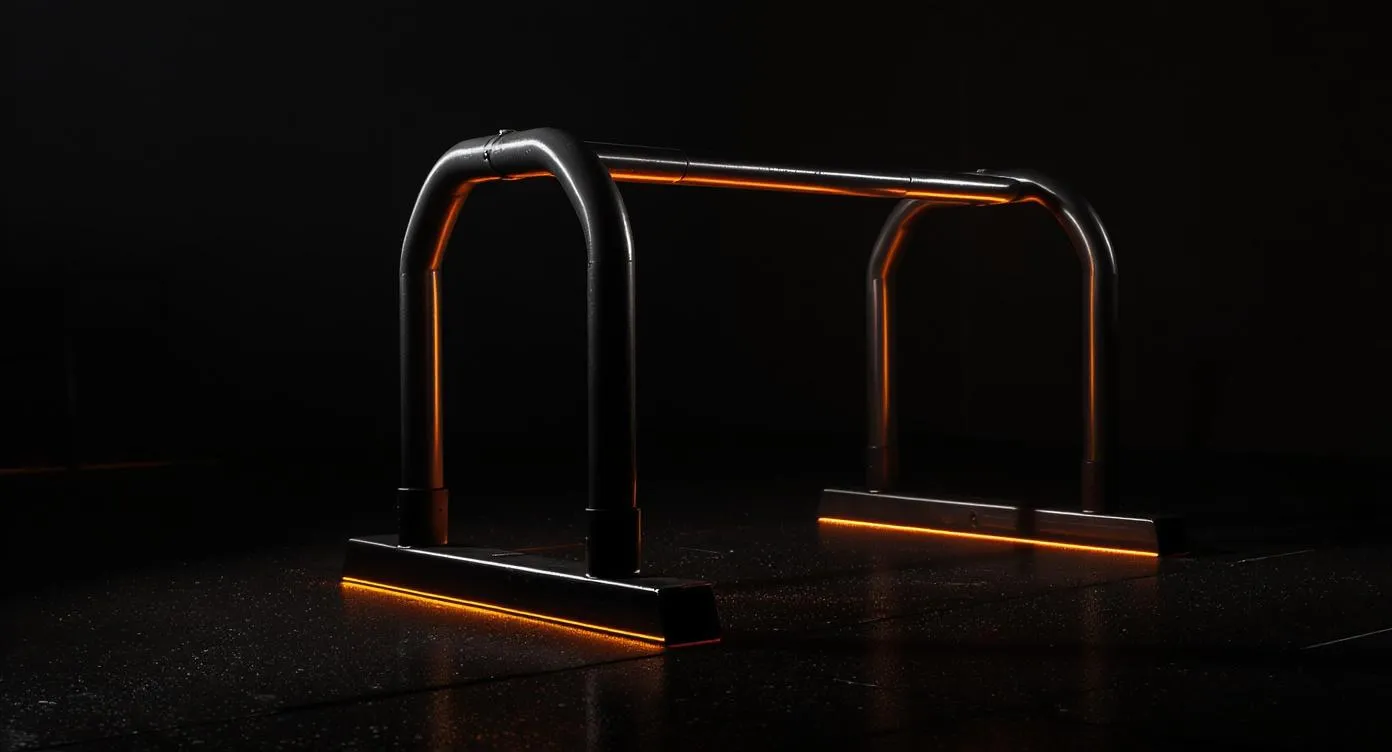
Teclor Parallettes Review: Unlock Calisthenics for $29.98
Hands-on review of the Teclor Parallettes Push-Up Bars. Best budget parallettes on Amazon for L-sits, planche progressions, and calisthenics.
If you want to train calisthenics at home and you have $29.98, the Teclor Parallettes are the single best investment you can make. I have been using a pair for over fourteen months now, running them through everything from basic push-up progressions to 60-second L-sit holds and tuck planche work. They have held up, they perform, and they cost less than a single month at most commercial gyms.
Parallettes are deceptively simple: two small elevated bars that you grip while performing bodyweight exercises. But that elevation changes everything. It unlocks wrist-neutral training, deeper ranges of motion on push-ups, and entire categories of movements that are impossible or uncomfortable on the floor. L-sits, planche progressions, handstand push-ups, shoot-throughs, dips, and dozens of other exercises become accessible the moment you have a solid pair of parallettes under your hands.
The Teclor Parallettes are the best-selling parallettes on Amazon with over 5,000 reviews and a 4.6-star average rating. Here is my detailed breakdown after putting serious mileage on them.

Teclor Push Up Bar, Parallettes Bars For L-sit & Dip, Heavy-Duty No Wobbling Parallel Bars Stand For Handstands, Full Planche, Calisthenics, 9.5in High Workout Stands for Home Fitness Training
Capacity
660 lbs (pair)
Steel
Heavy-Duty Steel / Foam Grip
Footprint
15.7" L x 7.5" W x 9.5" H each
Price
$35.99
- 4.6+ star rating on Amazon with 5,000+ reviews
- 660 lb weight capacity (pair)
- Heavy-duty steel construction
- Foam grips reduce hand fatigue
- Unlocks L-sits, planche progressions, handstand push-ups
- Best budget parallettes on Amazon
- Feet can slide on smooth concrete
- Low profile limits some variations
- Foam grips compress after 1-2 years
Price and availability may change
Why Parallettes Belong in Every Home Gym
I spent years training push-ups, dips, and handstands on the floor before picking up parallettes. The difference was immediate and significant. Here is what changes when you elevate your hands by just 8 inches:
Wrist health improves dramatically. Floor push-ups force your wrists into 90 degrees of extension under load. Over hundreds of reps per week, this causes chronic wrist pain for many trainees. Parallettes let you grip a bar with a neutral wrist position, eliminating the extension stress entirely. If you have ever felt that sharp ache in the top of your wrist after a high-volume push-up session, parallettes solve it.
Range of motion increases on pressing movements. On floor push-ups, your chest stops at ground level. On parallettes, your chest can drop 3 to 4 inches below your hands, loading the pecs and anterior deltoids through a significantly greater range. In a 2019 study published in the Journal of Strength and Conditioning Research, greater range of motion in pressing movements correlated with superior hypertrophy outcomes. The practical difference is noticeable within weeks: deeper push-ups on parallettes build more chest thickness than standard floor push-ups at the same rep count.
Calisthenics skills become trainable. Trying to hold an L-sit on the floor requires your hands to be flat with fingers pointed forward, and your hips must clear the ground with zero clearance. On parallettes, you have 8 inches of clearance beneath you, which makes the L-sit dramatically more accessible for beginners while still being brutally challenging for the core. The same principle applies to tuck planches, shoot-throughs, and handstand work.
If you are building a home gym on a budget, parallettes deliver more exercise variety per dollar than almost any other piece of equipment.
The Specs
Quick Specs · Teclor Push Up Bar, Parallettes Bars For L-sit & Dip, Heavy-Duty No Wobbling Parallel Bars Stand For Handstands, Full Planche, Calisthenics, 9.5in High Workout Stands for Home Fitness Training
Build Quality and Construction
The Teclor Parallettes are built from heavy-duty welded steel tubing. Each bar sits on two flat feet that provide a stable base approximately 14 inches long and 9.5 inches wide. The total height from floor to the center of the grip is approximately 8 inches.
The welds on my pair are clean and consistent. There is no wobble or flex when I load them at 215 lbs body weight. The frame feels rigid even during dynamic movements like shoot-throughs and swing-to-L-sit transitions where lateral forces come into play. Teclor rates the pair for 660 lbs total capacity, which is more than sufficient for any bodyweight application.
The grips are covered in a medium-density foam sleeve. The foam is about 5 mm thick and has a slightly textured surface that provides decent grip without being abrasive. The grip diameter with the foam is approximately 1.5 inches, which is comfortable for most hand sizes. The foam does compress over time with heavy use. After fourteen months of 4 to 5 sessions per week, my foam grips have flattened noticeably on the top surface where my palms rest. They still function fine, but the padding is maybe 60 percent of its original thickness. You can replace the foam with handlebar tape or tennis overgrip for about three dollars if it bothers you.
The finish is a basic black powder coat. It has held up well in my garage gym environment, with only minor scratches where I occasionally bump them against my dip stand during storage.
What We Love
- Exceptional value at $29.98 — cheapest legitimate parallettes available
- 660 lb weight capacity handles any bodyweight athlete
- Heavy-duty welded steel construction with zero flex or wobble
- Wrist-neutral grip eliminates chronic push-up wrist pain
- 8-inch elevation unlocks L-sits, planche progressions, and deep push-ups
- Foam grips provide comfortable padding during long hold sessions
- 14-inch base length provides excellent stability even during dynamic movements
- Simple assembly — fully usable within 5 minutes out of the box
What Could Be Better
- Feet can slide on polished concrete or hardwood — add grip tape or use on rubber flooring
- Low 8-inch profile limits clearance for taller athletes on L-sits with long legs
- Foam grips compress to about 60% thickness after 12+ months of heavy daily use
- Not collapsible or foldable for travel — fixed welded steel frame
- Base width of 9.5 inches is slightly narrow for wide-grip handstand push-up variations
- No knurling or textured metal under the foam — if foam tears, grip quality drops significantly
Real-World Testing: 14 Months of Daily Use
I incorporated parallettes into my training four to five days per week over the past fourteen months. Here is how they performed across the main use cases.
Push-Up Variations
The most immediate benefit is the depth increase on push-ups. I measured my chest-to-floor distance during a standard floor push-up versus a parallette push-up: the parallettes added approximately 3.5 inches of range at the bottom of each rep. Over a set of 20 reps, that is 70 additional inches of total range of motion per set. The difference in pec engagement is substantial.
I regularly perform four push-up variations on the parallettes: standard deep push-ups (4 sets of 15 to 20), diamond push-ups (3 sets of 12), wide-grip push-ups (3 sets of 15), and archer push-ups (3 sets of 6 to 8 per side). The stability of the Teclor base has never been an issue during any of these variations, even the archer push-ups where your weight shifts aggressively to one side.
L-Sit Progressions
This is where parallettes earn their keep. My L-sit progression over fourteen months looked like this:
- Weeks 1 to 4: Tuck sit hold with knees to chest. Started at 10-second holds, built to 30 seconds by week 4.
- Weeks 5 to 12: Single-leg extension L-sit. One leg tucked, one leg extended. Alternating legs each set. Built from 8-second holds to 20 seconds.
- Weeks 13 to 24: Full L-sit with both legs extended parallel to the floor. Started at 5-second holds. Reached 15 seconds by week 24.
- Months 7 to 14: Full L-sit maintenance and volume building. Current best is a 62-second hold. Working sets are typically 4 sets of 20 to 30 seconds.
The 8-inch height of the Teclor Parallettes is adequate for L-sits if you are under about 6 feet tall. Taller athletes with longer legs may find their heels brushing the ground during a full L-sit, in which case you would want taller parallettes (12 inches or higher). At 5 feet 10 inches, I have about 2 inches of clearance at the bottom of my L-sit.
Planche Progressions
The planche is the pinnacle of pushing strength in calisthenics. I am currently working at the advanced tuck planche stage. My progression:
- Months 1 to 3: Planche lean on parallettes. Hands at hip level, lean forward until shoulders are in front of hands. Hold 20 to 30 seconds. This builds the anterior deltoid and scapular protraction strength needed for the planche.
- Months 4 to 8: Tuck planche. Body horizontal with knees pulled tight to chest. Started at 3-second holds, currently at 12-second holds.
- Months 9 to 14: Advanced tuck planche. Hips opened slightly, knees still tucked but further from chest. Currently at 6-second holds.
The parallettes are essential for planche training because the neutral wrist position reduces the enormous strain that a flat-hand planche lean places on the wrist joint. At the loads involved in planche work, wrist extension under bodyweight can lead to chronic issues or acute injury. The parallel grip eliminates this risk entirely.
Handstand Push-Ups
Parallettes add approximately 8 inches of depth to handstand push-ups compared to floor handstand push-ups. This extended range of motion is how gymnasts build the overhead pressing strength that transfers to ring work and floor routines. I perform these against a wall for safety: kick up into a wall-supported handstand on the parallettes, then lower until the top of my head is level with the bars, and press back up. Current working sets are 3 sets of 5.
The base stability matters here because you are inverted with your full body weight on the parallettes. The Teclor bars have never shifted or tipped during handstand work on my rubber gym flooring.
Programming Parallettes Into Your Training
Here is how I recommend integrating parallettes depending on your current fitness level and goals.
Beginner Program (Weeks 1 to 8)
Train parallettes 3 days per week. Each session takes 15 to 20 minutes.
- Wrist warm-up — 3 minutes of circles, wall stretches, and finger extensions
- Support hold — 4 sets of 20 to 30 seconds. Grip the bars, press your body up with straight arms, feet off the ground. Build to 4 sets of 60 seconds before progressing.
- Deep push-ups — 4 sets of 8 to 12 reps. Full depth, chest below hand level.
- Tuck sit — 4 sets of 10 to 20 seconds. Knees to chest, balance on locked arms.
- Planche lean — 3 sets of 15 seconds. Hands at hip level, lean forward until shoulders pass hands.
Intermediate Program (Weeks 9 to 24)
Train parallettes 4 days per week, alternating between a push-focused day and a hold-focused day.
Push Day:
- Archer push-ups — 4 sets of 6 to 8 per side
- Diamond push-ups — 3 sets of 12 to 15
- Dips between parallettes — 3 sets of 8 to 12
- Pseudo-planche push-ups (hands at hip level, lean forward, push up) — 3 sets of 6 to 8
Hold Day:
- L-sit progression (at your current stage) — 5 sets of max hold
- Tuck planche — 5 sets of max hold
- Support hold — 3 sets of 60 seconds
- Handstand hold on parallettes (wall-assisted) — 4 sets of 20 to 30 seconds
Advanced Program
At this stage, you are programming based on your specific skill goals. Pair parallette work with pull-up bar training for a complete upper body calisthenics program. A typical split:
- Monday: Planche progressions (5 to 8 sets) + push-up volume
- Tuesday: Pull-ups and rows
- Wednesday: L-sit and V-sit work + handstand push-ups
- Thursday: Rest or light mobility
- Friday: Full calisthenics circuit combining parallette and pull-up bar work
- Saturday: Skill practice (handstands, muscle-up attempts, planche holds)
Surface Compatibility and Grip Issues
The one legitimate complaint about the Teclor Parallettes is that the feet can slide on smooth surfaces. The rubber feet are small and relatively hard, and on polished concrete, epoxy-coated garage floors, or hardwood, they will shift under dynamic loading.
Solutions I have tested:
- Rubber gym flooring — The best fix. If you already have puzzle mats or rubber flooring in your gym, the parallettes grip perfectly. Zero sliding on 3/4-inch rubber tiles.
- Grip tape on the feet — Hockey tape or skateboard grip tape on the bottom of each foot pad adds enough friction for most smooth surfaces. Cost is about two dollars.
- Yoga mat underneath — Works for static holds but not ideal for dynamic movements. The mat can bunch up under the feet.
- Non-slip shelf liner — Cheap and effective. Cut two small rectangles, place them under the feet. Solid grip on concrete.
If your gym floor is bare polished concrete, budget an extra two to five dollars for grip tape. It solves the problem permanently.
Teclor Parallettes vs. Alternatives
At the $29.98 price point, the Teclor Parallettes have no meaningful competition. The closest alternatives are:
Juperbsky Parallettes ($35 to $40): Nearly identical steel construction with slightly thicker foam grips. Not worth the premium over the Teclor for most people.
ProsourceFit Push-Up Bars ($15 to $20): Cheaper, but these are push-up bars, not parallettes. The height is only about 5 inches, which is not enough clearance for L-sits. They work for push-ups only.
Wooden parallettes ($60 to $100): Higher-end option with better grip feel and no foam to wear out. The wood surface provides natural friction without padding. Worth the upgrade if you are doing daily planche and L-sit work and want a more premium grip feel. Not necessary for beginners.
DIY PVC parallettes ($10 to $15): You can build parallettes from PVC pipe. They work, but PVC flexes under load, the grip diameter is larger than ideal, and they can crack at the joints under heavy dynamic use. For ten dollars more, the welded steel Teclor set is a vastly better tool.
Safety Tips and Wrist Health
Three non-negotiable rules for parallette training:
1. Warm Up Your Wrists Every Session
Parallettes reduce wrist strain compared to flat-hand training, but they do not eliminate it. Your wrists still support your full body weight. Before every session, spend 3 to 5 minutes on wrist preparation:
- 20 wrist circles in each direction
- 30 seconds of wall wrist stretches (palm flat on wall, lean forward)
- 20 finger extensions with a rubber band around your fingers
- 10 fist-to-spread reps (clench tight, spread fingers wide)
This warm-up takes 3 minutes and prevents the gradual onset of wrist tendinitis that plagues calisthenics athletes who skip it.
2. Build Foundation Strength Before Skill Work
The support hold is the gatekeeper exercise. If you cannot hold a straight-arm support position on the parallettes for 60 seconds with control, you are not ready for L-sits, planche work, or handstand push-ups. The support hold builds the scapular stability and straight-arm strength that protects your shoulders during advanced movements.
Benchmark before progressing: 4 sets of 60-second support holds with depressed scapulae (shoulders pushed down away from ears) and full elbow lockout.
3. Respect the Timeline
Planche progressions take years, not weeks. Rushing from tuck planche to straddle planche before the connective tissue in your elbows and shoulders has adapted is a reliable path to tendinitis or bicep tendon strain. The general timeline for an average adult male training consistently:
- Tuck planche hold: 3 to 6 months
- Advanced tuck planche hold: 6 to 12 months
- Straddle planche hold: 12 to 24 months
- Full planche hold: 24 to 48+ months
Women and lighter athletes often progress faster due to favorable strength-to-weight ratios. Heavier athletes above 200 lbs will progress slower and may need to prioritize body composition alongside skill training.
Who Should Buy the Teclor Parallettes
Buy them if:
- You want to train calisthenics skills (L-sits, planche, handstand push-ups) at home
- You experience wrist pain during floor push-ups and want a neutral grip alternative
- You want to add upper body training variety to a home gym in a small space
- You are building a budget calisthenics station alongside a pull-up bar and dip stand
- You want deeper push-up range of motion for chest development
Skip them if:
- Your training is purely barbell-focused with no interest in bodyweight skills
- You already own a power tower or dip station with parallette handles built in
- You need taller parallettes (12+ inches) for long-legged L-sits or muscle-up transitions
Final Verdict
Welded steel construction with a 660 lb capacity that handles L-sits, planche progressions, handstand push-ups, and deep push-ups without flex or wobble. At $30, they unlock an entire category of calisthenics movements that flat-floor training cannot replicate. The foam grips compress after several months and eventually need replacing — wrapping them with hockey tape is a cheap permanent fix. The rubber feet slide on smooth concrete, so use them on rubber flooring or add grip tape to the base. Minor issues for a tool that fundamentally changes what bodyweight training can accomplish.
Price and availability may change
Teclor
Teclor Push Up Bar, Parallettes Bars For L-sit & Dip, Heavy-Duty No Wobbling Parallel Bars Stand For Handstands, Full Planche, Calisthenics, 9.5in High Workout Stands for Home Fitness Training
4.6+ star rating on Amazon with 5,000+ reviews
660 lb weight capacity (pair)
Price and availability may change
Related Content
- ProsourceFit Dip Stand Station Review
- Iron Gym Pull-Up Bar Review
- TRX GO Suspension Trainer Review
- Home Gym on a Budget Complete Guide
- Home Gym Small Spaces Guide
- CrossFit Home Gym Setup
Frequently Asked Questions
Are the Teclor Parallettes worth it for beginners?
How tall are the Teclor Parallettes and is 8 inches enough?
Do the Teclor Parallettes slide on concrete floors?
How long do the foam grips last on the Teclor Parallettes?
Can you do handstands on the Teclor Parallettes?
What is the difference between parallettes and push-up bars?
How long does it take to learn an L-sit on parallettes?
Additional Resources
Derek Walsh
Strongman competitor and former commercial gym equipment salesman. Knows what survives heavy daily use.
Read full bioMore in Reviews
Yes4All Kettlebell Set Review: Best Budget Kettlebells on Amazon?
Our review of the Yes4All Cast Iron Kettlebell Set. Are these the best budget kettlebells for home gym training on Amazon?
TRX Bandit Resistance Band Handles Review: Worth the Money?
Hands-on review of the TRX Bandit Resistance Band Handles. Is $49.95 worth it for your home gym?
POWER GUIDANCE Battle Rope Review: CrossFit Standard for $40
Hands-on review of the POWER GUIDANCE 30 ft Battle Rope. Best budget battle rope on Amazon for HIIT, CrossFit, and brutal conditioning.
You Might Also Like
The 10 Best Garage Gym Accessories Under $50 (2026)
The most useful garage gym accessories that cost less than $50. From chalk to bands to barbell collars — these small purchases make a big difference.
Doorway vs Wall-Mounted Pull-Up Bar: Which Should You Buy?
Doorway pull-up bar or wall-mounted? We compare the Iron Gym doorway bar vs wall-mounted options for home gyms, apartments, and serious lifters.
15 Best Home Gym Accessories Under $50 (2026)
We tested the top budget gym accessories on Amazon. Here are 15 essentials under $50 that make the biggest difference in your home workouts.