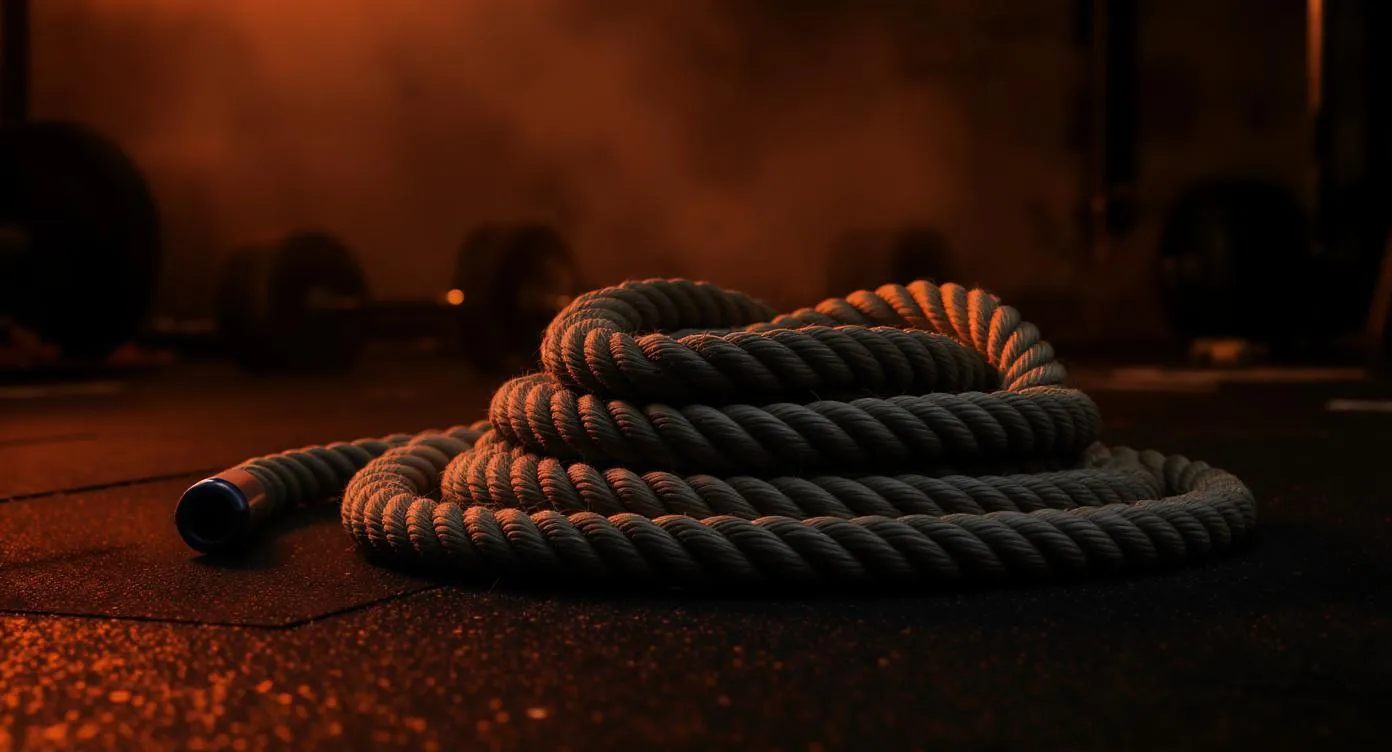
POWER GUIDANCE Battle Rope Review: CrossFit Standard for $40
Hands-on review of the POWER GUIDANCE 30 ft Battle Rope. Best budget battle rope on Amazon for HIIT, CrossFit, and brutal conditioning.
If you want cardio that builds shoulders, crushes your grip, and obliterates your lungs inside 30 seconds, you want a battle rope. It is the closest thing to a single piece of equipment that covers explosive power, conditioning, and metabolic work simultaneously. The POWER GUIDANCE Battle Rope is the best-selling battle rope on Amazon with over 7,000 reviews and a 4.6-star average. I have run it through CrossFit conditioning blocks, MMA circuit training, and straight HIIT work. Here is the full breakdown.
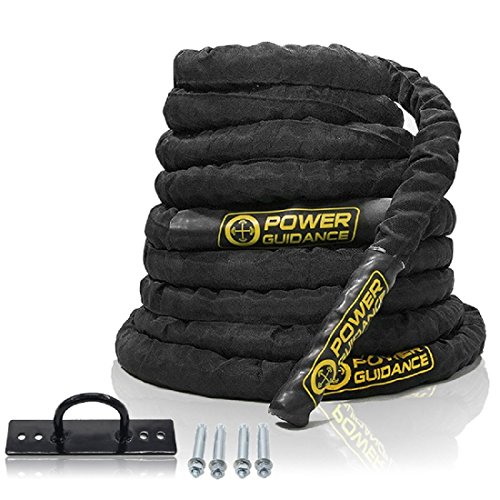
POWER GUIDANCE Battle Rope, 1.5/2 Inch Diameter Poly Dacron 30, 40, 50Ft Length Exercise Equipment for Home Gym & Outdoor Workout, Battle Rope Anchor Included
Capacity
Cardio and conditioning
Steel
Heavy-Duty Poly Dacron / Heat Shrink Handles
Footprint
30 ft length, 1.5 inch diameter
Price
$99.99
- 4.6+ star rating on Amazon with 7,000+ reviews
- Heavy-duty poly dacron doesn't fray easily
- Heat shrink handles prevent slipping
- 30 ft is the CrossFit standard length
- Includes anchor kit and carry bag
- Best value battle rope on Amazon
- Needs a sturdy anchor point (tree, pole, rack)
- Too loud for apartments (rope slaps floor)
- 1.5 inch diameter is challenging for small hands
Price and availability may change
Why Battle Ropes Are Overpowered for Conditioning
Most conditioning tools hit one energy system. Running hits aerobic endurance. Box jumps hit anaerobic power. Battle ropes do both inside the same set. Here is what you actually train when you pick up the ends:
- Explosive upper-body power — every wave demands maximum force production through the shoulders and arms
- Metabolic conditioning — 30 seconds of all-out waves will put your heart rate into zone 4 or 5
- Shoulder endurance — sustained wave patterns are one of the few tools that build rotator cuff endurance under load
- Grip strength — holding a 1.5-inch or 2-inch diameter rope under fatigue is a direct grip training stimulus
- Core anti-rotation stability — alternating waves create a lateral force the core must resist continuously
- Low-impact joint loading — no jumping, no compressive spinal load, no knee impact
Ten minutes of battle rope work produces a conditioning effect comparable to 30 minutes of moderate-pace running. The difference is that the rope achieves this through power output rather than duration. That is a critical distinction for athletes who are already doing heavy strength training and cannot afford additional joint stress from high-impact cardio.
The Specs
Quick Specs · POWER GUIDANCE Battle Rope, 1.5/2 Inch Diameter Poly Dacron 30, 40, 50Ft Length Exercise Equipment for Home Gym & Outdoor Workout, Battle Rope Anchor Included
Rope Material: Poly-Dacron vs Manila vs Nylon
This is where most buyers make uninformed decisions. Battle ropes come in three primary materials and they are not interchangeable.
Poly-Dacron (What the POWER GUIDANCE Uses)
Poly-dacron is a blended synthetic fiber — polyester core wrapped with dacron (a polyester brand name) or similar synthetic braiding. This is the correct material for a training rope used outdoors or in a garage gym. Here is why:
Durability: Poly-dacron does not absorb water, which means it will not rot, mildew, or lose structural integrity from sweat or rain exposure. A manila rope left outside through a wet season becomes brittle, develops mold, and starts shedding fibers within months. Poly-dacron in the same conditions will still look new after two years of daily use.
Weight consistency: Because synthetic fibers do not absorb moisture, the rope's weight stays consistent between a dry summer session and a humid August morning. Manila ropes can gain 15-20% of their weight in moisture, which changes the feel and wave mechanics significantly.
Low fiber shedding: Poly-dacron sheds almost nothing after an initial break-in period. Manila ropes shed aggressively — the fibers work their way into your palms and the floor, and you will find rope debris on your hands and around your training space for the first several months.
Manila Rope
Traditional manila is a natural fiber rope made from abaca plant stalks. It was the standard before synthetic alternatives became mainstream. Manila has a natural, rough texture that some users prefer for grip feel. The downsides are significant for home gym use: it absorbs moisture aggressively, it rots if stored damp, it sheds fibers constantly, and it has a shorter service life than poly-dacron in most training environments. If you train exclusively indoors on sealed floors and store the rope dry, manila is workable. For a garage gym with humidity swings and occasional outdoor use, it is the wrong choice.
Nylon
Nylon battle ropes are the high-end option. Nylon is more elastic than poly-dacron, which creates a slightly different wave dynamic — the rope has a bit of spring that makes wave propagation feel snappier. Nylon is also more abrasion-resistant than either manila or poly-dacron. The tradeoff is cost: quality nylon battle ropes typically run $80-150 versus $35-50 for poly-dacron. For a home gym user doing 3-5 sessions per week, the poly-dacron rope will outlast its useful life many times over before the material difference becomes relevant. Nylon makes sense for commercial gym environments with 8+ hours of daily use.
Verdict: Poly-dacron is the correct choice for home gym use. The POWER GUIDANCE rope uses heat-shrunk poly-dacron with reinforced end caps that prevent fraying at the handles. After six months of use including outdoor sessions through spring rain, the rope shows zero degradation.
Diameter Selection: 1.5 Inch vs 2 Inch
The POWER GUIDANCE Battle Rope comes in 1.5-inch diameter as the primary option. Some manufacturers also offer 2-inch versions. This decision matters more than most people realize.
1.5 Inch Diameter
The 1.5-inch rope is the CrossFit standard and the correct choice for the majority of users. At 1.5 inches, a 30-foot poly-dacron rope weighs approximately 18-22 lbs depending on exact construction. This weight produces waves with a frequency and amplitude that allows training in the 20-60 second range without the movement becoming mechanically compromised from fatigue. Grip circumference is manageable for most hand sizes, including smaller hands.
The 1.5-inch rope also generates higher wave frequency, which means you can create tighter, faster alternating waves. This is relevant for conditioning work focused on shoulder endurance and cardiovascular output where the goal is sustained high-rep wave production.
2 Inch Diameter
The 2-inch rope weighs approximately 28-35 lbs for the same length. Wave production requires significantly more force. The larger diameter also demands more grip strength to hold through a full set — most users will find grip failure occurring before cardiovascular or muscular failure, especially in the first few months. The 2-inch rope is a legitimate strength and power tool. Sets are shorter, heavier, and more focused on raw force production than conditioning density.
Who should buy 2-inch: Athletes with specific grip strength goals, strongman competitors, or experienced rope users looking for a progression tool. For CrossFit conditioning, HIIT circuits, or MMA work, the 1.5-inch rope gives you more training variety and better cardiovascular stimulus. The POWER GUIDANCE 1.5-inch is the right call for 85% of home gym users.
Length Selection: 30 ft vs 40 ft vs 50 ft
30 feet is the CrossFit standard and the POWER GUIDANCE's primary configuration. At 30 feet, you stand 15 feet from the anchor point (the rope loops back so each hand holds the end, and you stand at the midpoint). This 15-foot working distance is the minimum needed for proper wave mechanics — shorter setups do not allow the wave to fully propagate down the rope and back.
40 feet gives you a 20-foot working distance. The longer rope produces slower, heavier waves with more momentum. This is useful for power-focused work and for users with more space who want a different training stimulus.
50 feet is a specialty rope primarily used in team training or commercial gym settings where space is not a constraint.
For a standard garage gym (20 feet minimum depth) or outdoor training space, the 30-foot rope is the correct choice. It covers everything from conditioning circuits to power training and requires only 15 feet of clear space in front of the anchor.
What We Love
- 4.6+ star rating on Amazon with 7,000+ reviews
- Poly-dacron construction resists moisture, rot, and fraying — outlasts manila in any real garage gym environment
- Heat-shrink handles prevent slipping under sweat and maintain grip integrity after years of use
- 30 ft CrossFit-standard length works for conditioning, power training, and AMRAP circuits
- Includes anchor strap and carry bag — everything needed to train from day one
- Best price-to-quality ratio of any battle rope on Amazon at the $35-45 price point
- Wave mechanics are consistent and predictable — no dead spots or uneven weight distribution
- Low-shedding synthetic construction keeps your training space clean
What Could Be Better
- Requires a legitimate anchor point — a tree, bolted rack, or fixed post. The included anchor strap is functional but basic
- Floor slap noise during slams and heavy waves makes indoor apartment use impractical
- 1.5-inch diameter is genuinely challenging for users with small hands during long sets
- End caps, while heat-shrunk, can loosen after years of very heavy use — a wrap of athletic tape solves this
- No 2-inch diameter option in the standard configuration — users wanting heavier gauge need a different product
Anchor Setup: Getting This Right Matters
A bad anchor setup ruins the training experience and can be dangerous. The rope anchor is the most overlooked part of battle rope training. Here are the four setups ranked by quality:
1. Outdoor Tree (Best Option)
A tree with a trunk diameter of 6 inches or greater is the ideal anchor. Loop the included anchor strap around the trunk at approximately knee height — lower anchors keep the rope close to the ground and prevent the rope ends from riding up during waves. Stand 15 feet back (the rope's natural working distance). The tree absorbs force passively and the organic surface is gentler on the rope than sharp metal edges.
2. Bolted Power Rack Base
If your power rack is anchored to a concrete floor with anchor bolts, looping the rope around a base upright is a legitimate option. The critical consideration is protecting the rope from the metal edge. Wrap the contact point with a folded gym mat or rubber sleeve to prevent abrasion wear at the loop point. An unprotected metal edge will fray a poly-dacron rope over months of training. Check the anchor point on the rope every few weeks.
3. Fixed Post or Pole
Any fixed structural post works: a lamp post, a structural steel column, a fence post set in concrete. The same edge-protection principle applies — if the post has sharp edges, protect the rope at the contact point. Round posts are ideal.
4. Heavy Kettlebell or Barbell Stack
This is the compromise option when no fixed structure is available. The rope anchor will pull a kettlebell across the floor under load if the weight is insufficient. You need a minimum of 100 lbs of stable weight, and even then, the anchor can creep during aggressive wave sets. If you go this route, position the anchor against a wall so it cannot slide away, and use the heaviest available weight.
The anchor height matters: a low anchor (6-12 inches off the ground) is correct for most wave work. High anchor points change the rope angle and make wave generation less efficient.
Wave Mechanics: How the Physics Actually Works
Understanding what is happening in the rope makes you better at using it. When you move one end of the rope in an alternating up-down pattern, you create a transverse wave that travels down the rope toward the anchor. The wave's amplitude and frequency are determined by your input force and speed. The wave reflects off the anchor and returns back toward you.
What you feel as "rope weight" or "rope resistance" is actually the rope's mass being accelerated by your movement. A heavier rope requires more force to generate waves of the same amplitude. A longer rope has more mass in motion and builds momentum that requires more energy to sustain and redirect.
Alternating waves (the most common pattern) create two out-of-phase waves traveling simultaneously. Your right hand creates a wave in one direction while your left hand creates a counter-wave. The waves pass through each other because they are traveling in opposite directions — this is constructive and destructive interference visible in real time.
Double waves (both hands moving in synchrony) create a single large-amplitude wave with twice the displacement. Double waves require more explosive hip drive and are more fatiguing but produce greater power output per repetition.
Circles (rotating the rope ends in a horizontal plane rather than vertical) create a different stress pattern that shifts loading from the anterior deltoid toward the rotator cuff stabilizers. Circles are excellent for shoulder health work and provide a different training stimulus than vertical waves.
Slams (raising both rope ends overhead and driving them forcefully into the ground) are a power expression movement. The rope does not travel anywhere during a slam — you are loading the eccentric and then expressing force concentrically. Slams are the battle rope equivalent of a power clean: low rep, high force, not a conditioning movement.
Conditioning Protocols and Heart Rate Zones
Battle rope training is most effective when you understand which heart rate zone you are targeting and program accordingly. Here are five protocols organized by training objective:
Protocol 1: Lactate Threshold Development (Zone 4)
Target heart rate: 80-90% of max
30 seconds of maximum effort alternating waves followed by 30 seconds of complete rest. Repeat for 10 rounds. Total work time: 5 minutes. Total session time: 10 minutes.
This protocol places you at or above lactate threshold during work intervals and uses the rest periods to partially clear lactate before the next effort. Over 6-8 weeks of consistent training, you raise the power output you can sustain before lactate accumulates — the functional definition of improved conditioning.
Protocol 2: VO2 Max Stimulus (Zone 5)
Target heart rate: 90-95%+ of max
20 seconds all-out alternating waves, 10 seconds rest. Eight rounds (the Tabata structure). Repeat for 3-4 total Tabata sets with 2 minutes between sets.
The 20/10 interval structure at maximum effort is the highest-intensity sustainable protocol in this training system. Heart rate will spike into zone 5 during work intervals and partially recover during the 10-second rest. VO2 max adaptations require this level of intensity — you cannot improve maximum aerobic power by training below it.
Protocol 3: Aerobic Base Building (Zone 2-3)
Target heart rate: 65-80% of max
Continuous alternating waves at a controlled, submaximal pace for 15-20 minutes. The goal is to keep the heart rate in zone 2-3 throughout — conversational intensity, but clearly working.
Most people do not associate battle ropes with low-intensity aerobic work, but sustained low-intensity wave work is genuinely effective for aerobic base building. The key is dramatically reducing the wave amplitude and frequency compared to conditioning intervals — think 50% effort, focused on smooth mechanics, for time rather than intensity.
Protocol 4: Metabolic Conditioning Circuit
Target heart rate: Variable (70-95%)
20 alternating waves, rest 10 seconds, 20 double waves, rest 10 seconds, 20 slams, rest 30 seconds. Repeat for 5 rounds.
The movement variation keeps the session from becoming purely a shoulder endurance test by cycling between the muscle recruitment patterns of alternating waves, double waves, and slams. Heart rate will fluctuate with movement type, creating a mixed-zone session that builds both aerobic and anaerobic capacity.
Protocol 5: Power Development
Target heart rate: Not the primary metric
5 maximum-effort slams, rest 60 seconds, 5 double waves with maximum amplitude, rest 60 seconds. Repeat for 6-8 rounds.
This is the lowest-conditioning, highest-power protocol. Long rest intervals allow near-complete recovery between efforts. The goal is maximum force production on each repetition, not cardiovascular stress. Use this protocol to build explosive power when the primary training goal is strength rather than endurance.
Battle Rope vs Other Conditioning Tools
Serious home gym builders want to know how the rope fits with other conditioning investments. Here is an honest comparison:
Battle Rope vs Air Bike
The air bike is the most potent conditioning tool for most home gym users — the Schwinn Airdyne Bike Series or Sunny Health SF-B223018 generates heart rate spikes that are difficult to replicate with any other tool. The air bike also produces more measurable data (calories, RPM, distance) which matters for structured programming. However, the battle rope costs $40 versus $750-900 for a quality air bike, and it trains upper-body explosive power in a way the bike does not. For budget-constrained home gyms, the rope is a legitimate primary conditioning tool. For serious CrossFit or combat sports athletes, the rope is a complement to the air bike rather than a substitute.
Battle Rope vs Jump Rope
The jump rope — particularly a weighted rope like those in our best home gym accessories under $50 guide — trains footwork, coordination, and cardiovascular efficiency in ways the battle rope does not. Jump rope is also genuinely viable in an apartment or any indoor space. Battle ropes produce more upper-body loading and require outdoor or large garage space. They are different tools with minimal overlap.
Battle Rope vs Slam Ball
The slam ball trains similar explosive conditioning patterns — both involve producing maximum force in a ballistic movement. The slam ball adds a loading variable (weight) and has a shorter learning curve. The battle rope provides more continuous training density (you can sustain 30 seconds of waves more easily than 30 continuous slams) and develops shoulder endurance the slam ball does not replicate well. Many CrossFit home gym setups include both for their complementary loading patterns.
Battle Rope vs Sunny Health SF-B223018 or Concept2 Rower
At $40, the battle rope does not compete on conditioning density with a $900 Schwinn Airdyne Bike Series or $990 Concept2 RowErg. But it does not need to. The rope trains things neither machine touches: bilateral explosive shoulder power, grip endurance, and rotational stability. For MMA training specifically — see our full home gym for MMA guide — the battle rope's functional carryover to clinch work and takedown defense makes it irreplaceable in a way that a rower or air bike is not.
Technique: Five Principles That Change Everything
Most people who try battle ropes and hate them are doing them wrong. These five principles fix the most common errors:
-
Drive waves from your hips, not your arms. The arms guide the rope; the hip hinge generates the power. Think of it like a deadlift — the arms are hooks, the posterior chain is the engine. Athletes who hinge at the hip can sustain waves 40% longer than pure arm movers.
-
Maintain a soft knee bend throughout. Locked knees prevent hip hinge. They also remove the legs as a power source and force all loading onto the lumbar spine under fatigue. A 30-degree knee bend and a hip-width stance is the universal starting position.
-
Stand at the correct working distance. For a 30-foot rope, stand 15 feet from the anchor. Too close and the rope has slack that kills wave mechanics. Too far and you are trying to wave a rope under tension — also wrong. The correct distance puts the rope in a slight positive arc from your hands to the anchor.
-
Keep your grip light. Gripping maximally reduces endurance dramatically. A medium grip — firm enough to control the rope, light enough to sense feedback through your hands — keeps the forearms functional through longer sets.
-
Vary your movement patterns. Alternating waves, double waves, circles, and slams all stress different aspects of the shoulder complex. Training exclusively with alternating waves creates imbalanced development and overloads the anterior deltoid. Rotating through all four patterns within a session produces better shoulder health outcomes.
Who Should Buy This Rope
Buy it if:
- You have outdoor space or a large garage with a fixed anchor point
- You train CrossFit, MMA, boxing, or any combat sport
- You want brutal cardiovascular conditioning with zero joint impact
- You are building a conditioning-focused home gym on a real budget
- You want a tool that can serve as primary cardio for 10 minutes of daily work
Skip it if:
- You train in an apartment — the floor-slap noise is not manageable in shared buildings
- You have active shoulder injuries, particularly rotator cuff tears or impingement
- You have no viable anchor point (a fixed structure capable of handling 50+ lbs of dynamic force)
- Your primary training goal is hypertrophy — battle ropes build shoulder endurance but not meaningful muscle mass
Final Verdict
Rating: 4.6/5 — The POWER GUIDANCE Battle Rope is the best budget battle rope on Amazon. Thirty feet of poly-dacron construction, heat-shrunk handles that hold up to years of sweat and weather, and a complete anchor kit for under $40. The material choice is correct for real-world home gym conditions where manila would rot and nylon costs three times as much for the same conditioning output. If you have outdoor space and a fixed anchor point and want the highest conditioning return per dollar in your home gym, this is the buy.
Poly-dacron is the right material for a garage or outdoor rope — it resists rot, sheds water, and handles concrete and asphalt without disintegrating the way manila does. The 30-foot length works in a standard two-car garage with the anchor at the far wall. Heat-shrink handles hold up to sweat better than tape. The anchor kit is functional but basic — a heavy-duty carabiner and wall anchor upgrade for $12 makes it bombproof. At $40 with everything included, this delivers the highest conditioning output per dollar in any home gym.
Price and availability may change
Frequently Asked Questions
How do I anchor a battle rope if I don't have a power rack or tree?
What is the difference between 1.5 inch and 2 inch battle ropes?
Can I use a battle rope in a small space?
How long do battle ropes last?
Are battle ropes good for weight loss?
Do battle ropes build muscle?
Additional Resources
Related Content
Derek Walsh
Strongman competitor and former commercial gym equipment salesman. Knows what survives heavy daily use.
Read full bioMore in Reviews
Yes4All Kettlebell Set Review: Best Budget Kettlebells on Amazon?
Our review of the Yes4All Cast Iron Kettlebell Set. Are these the best budget kettlebells for home gym training on Amazon?
TRX Bandit Resistance Band Handles Review: Worth the Money?
Hands-on review of the TRX Bandit Resistance Band Handles. Is $49.95 worth it for your home gym?
Synergee Games Olympic Barbell Review: The Best Amazon Bar Under $200?
Our hands-on review of the Synergee Games 20kg Olympic Barbell. Is it the best sub-$200 barbell on Amazon for home gyms?
You Might Also Like
WOD Nation vs Crossrope: Speed Rope vs Weighted Rope?
Speed jump rope vs weighted jump rope. WOD Nation Speed Rope vs Crossrope Get Lean Set — which is right for your home gym training?
The Best Plyo Boxes for Home Gyms (2026 Tested)
We tested wooden, foam, and steel plyo boxes to find the best plyometric boxes for box jumps, step-ups, and conditioning training.