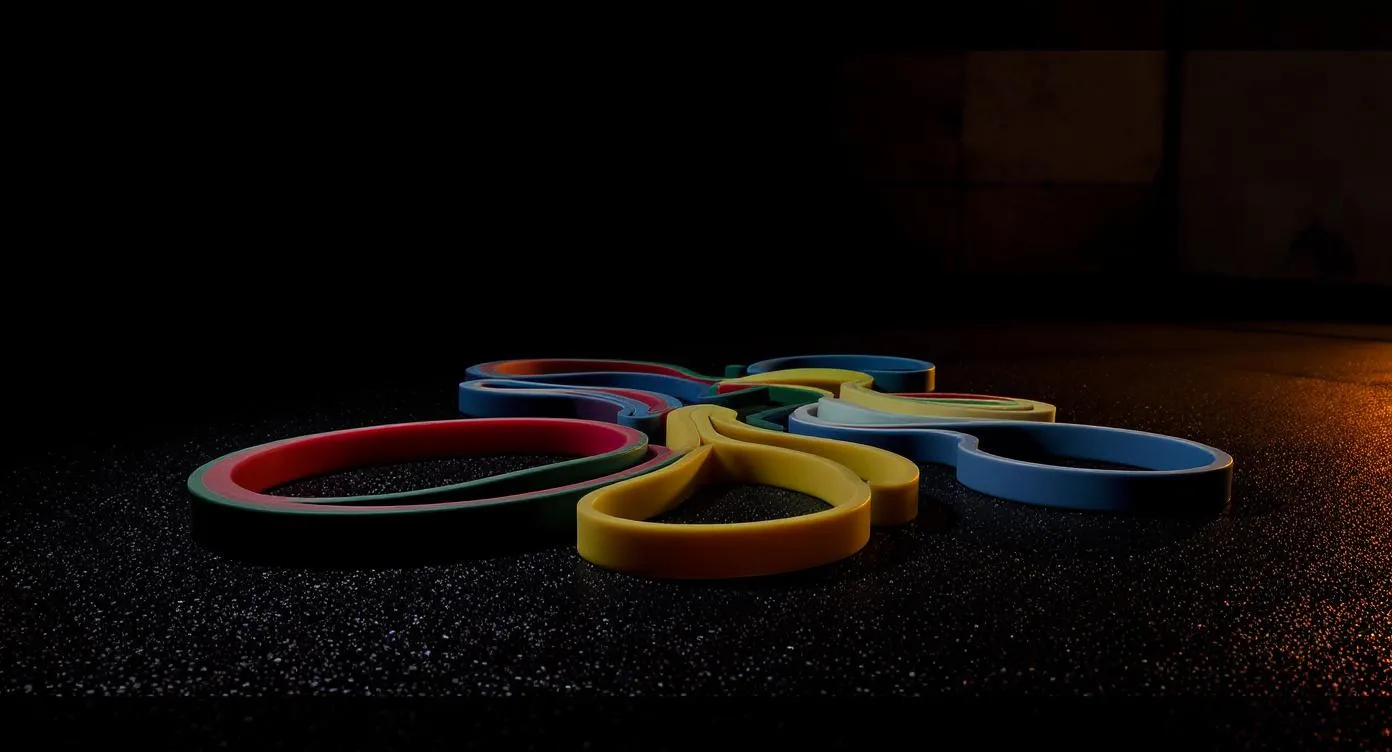
The Best Resistance Bands for Home Gyms (2026 Tested)
We tested loop bands, tube bands, and mini bands to find the best resistance bands for warm-ups, accessory work, and banded barbell training.
Resistance bands are the single most versatile piece of equipment you can add to a garage gym. They weigh almost nothing, cost less than a single month of gym membership, and unlock dozens of exercises that would otherwise require a full cable stack. Whether you are rehabbing an injury, warming up for heavy squats, or building a complete home training system on a tight budget, bands deliver results that punch far above their price tag.
We spent six months testing seven different band sets across every common use case: banded barbell work, pull-up assistance, face pulls, hip activation, rehab protocols, and travel workouts. Below you will find everything you need to choose the right bands for your training goals, plus our top picks after thousands of reps.
Why Every Garage Gym Needs Resistance Bands
A loaded barbell is the king of strength training, but it has blind spots. Cable machines fill those gaps in commercial gyms, yet most home lifters cannot justify spending $1,500 or more on a functional trainer. Resistance bands solve this problem for a fraction of the cost.
Bands provide accommodating resistance, meaning the load increases as you stretch them further. This trains you to accelerate through sticking points and generates a unique stimulus your muscles cannot get from free weights alone. Westside Barbell popularized banded squats and bench presses decades ago, and the principle holds just as true in your garage as it does in a world-class powerlifting gym.
Beyond accommodating resistance, bands excel at:
- Joint-friendly warm-ups that increase blood flow without fatiguing the muscles
- Shoulder prehab and rehab through pull-aparts, dislocates, and external rotations
- Glute activation before heavy lower body sessions
- Replacing cable machines for isolation work like tricep pushdowns, face pulls, and lat pulldowns
- Assisted pull-ups and dips that let beginners build toward unassisted reps
- Travel training when you cannot access a gym
If you are building a budget-friendly home gym under $100, a quality band set should be one of your first purchases.
Types of Resistance Bands Explained
Not all bands are the same. The three main categories serve different purposes, and a well-equipped garage gym eventually owns all three.
Loop Bands (Power Bands)
Large continuous loops made from layered natural latex, typically 41 inches long. These are the workhorses of serious home training.
Best for: Banded squats and deadlifts, pull-up and dip assistance, heavy stretching, accommodating resistance on barbell lifts, mobility work
What to buy: A full set of 4-5 bands ranging from roughly 15 lbs to 125+ lbs of resistance at full stretch. Quality sets cost $30-60.
Key consideration: Thicker bands last longer but also produce more resistance at shorter stretch lengths. If you primarily use them for pull-up assistance, start with a medium (green/blue) band rather than the heaviest option.
Tube Bands with Handles
Rubber tubes with molded or foam-padded handles on each end. Usually sold in stackable sets with a door anchor, ankle straps, and a carrying bag.
Best for: Mimicking cable machine exercises, isolation movements, rehabilitation protocols, travel workouts, upper body pump work
What to buy: A set of 5 stackable tubes with clip-in handles, a door anchor, and ankle straps. Budget $20-50 for a set that will last.
Key consideration: Look for anti-snap construction where an internal safety cord runs through the tube. This prevents the band from whipping back if it fails under load.
Mini Bands (Hip Circles)
Small loop bands — typically 12-14 inches in circumference — designed for placement above or below the knees during lower body work.
Best for: Glute activation, banded walks, clamshells, hip stability drills, warm-up circuits, physical therapy exercises
What to buy: A set of 3-4 mini bands in light, medium, and heavy resistance. Fabric-covered bands grip better and last longer than plain latex.
Key consideration: Fabric mini bands do not roll up the leg like latex bands do. They cost a few dollars more but the comfort difference is enormous during high-rep sets.
Our Top Pick

Bodylastics PRO Series Resistance Band Set (6 Bands, 280 lbs)
Capacity
6 bands stackable to 280 lbs
Steel
Anti-Snap Natural Latex Tubing
Footprint
Handles, ankle straps, door anchor + carry bag
Price
$61.97
- 4.6 star rating on Amazon with 2,600+ reviews
- Patented anti-snap inner cord for safety
- 6 bands stackable up to 280 lbs total resistance
- Includes handles, ankle straps, and door anchor
- Lifetime replacement on bands
- Travel-friendly storage bag
- Resistance feels different than free weights
- Door anchor requires an inward-opening door
- Handles wear faster than the bands
Price and availability may change
The Bodylastics Stackable Resistance Bands set earned our top recommendation after six months of testing. The patented anti-snap inner cord is the critical differentiator: a braided safety cable runs through each tube so that if the latex fails, the cord catches it before it can whip back and injure you. We have seen cheap bands snap during loaded stretches, and the potential for eye or face injury is real.
The set delivers up to 280 lbs of total stackable resistance through six color-coded tubes that clip into a single pair of cushioned handles. The included door anchor, ankle straps, and carrying bag make this a complete portable gym. Build quality held up through our entire testing period with no visible degradation, and the lifetime replacement guarantee provides long-term peace of mind.
- Patented anti-snap inner safety cord prevents whip-back injuries
- Stackable design allows fine-tuned resistance from 10 lbs to 280 lbs
- Lifetime replacement guarantee on all bands
- Complete accessory kit includes door anchor, ankle straps, and carrying bag
- Cushioned handles reduce hand fatigue during high-rep sets
- Clips make swapping resistance levels between sets fast and easy
- Door anchor requires a solid door frame — hollow-core doors are not safe
- Maximum resistance lower than a dedicated power band set for barbell work
- Handle clips can occasionally unclip if not fully seated
- Not ideal for banded squats or deadlifts — loop bands serve that role better
Read our full Bodylastics review for detailed testing notes. If you are deciding between these and a suspension trainer, our TRX vs Bodylastics comparison breaks down which tool suits different training styles.
How to Program Bands Into Your Training
Owning bands is only half the equation. Knowing how to use them effectively is what separates productive training from wasted effort.
Daily Warm-Up Protocol (5-7 Minutes)
Every training session should begin with band work to prime the joints and activate stabilizers:
- Band pull-aparts: 3 x 15 reps (targets rear delts and rhomboids for shoulder health)
- Band dislocates: 2 x 10 reps (improves thoracic mobility and overhead position)
- Banded walks: 2 x 20 steps each direction (fires glute medius before squats or deadlifts)
- Banded external rotations: 2 x 12 each arm (protects rotator cuff before pressing)
This five-minute investment dramatically reduces injury risk and improves performance on your working sets.
Accommodating Resistance for Barbell Lifts
Loop bands attached to your barbell — anchored to the base of your power rack or heavy dumbbells — add progressive tension through the range of motion. At the bottom of a squat or bench press, the band is slack and contributes minimal resistance. As you drive upward and the band stretches, resistance increases, forcing you to accelerate aggressively through lockout.
This method, championed by Louie Simmons at Westside Barbell, develops rate of force development and teaches lifters to push hard through sticking points rather than decelerating near the top. Typical band tension for intermediate lifters:
- Banded squat: 60-100 lbs of band tension at lockout (use a medium and heavy loop band doubled over the barbell)
- Banded bench press: 40-80 lbs of band tension at lockout
- Banded deadlift: 80-120 lbs of band tension at lockout
Start with lighter band tension (roughly 20-25% of your max) and increase gradually as you learn to maintain bar speed.
Assisted Pull-Ups and Dips
Loop a power band over your pull-up bar and place your knee or foot in the hanging loop. The band provides maximum assistance at the bottom of the movement (where you are weakest) and decreases help as you pull higher. This is superior to machine-assisted pull-ups because it teaches proper bar path and body tension.
Progress by moving to thinner bands over time. A typical progression:
- Heavy band (blue/black, 40-80 lbs assistance) — sets of 5-8
- Medium band (green, 25-50 lbs assistance) — sets of 5-8
- Light band (red, 10-25 lbs assistance) — sets of 5-8
- No band — unassisted pull-ups
Most people can move from heavy band to unassisted pull-ups within 8-12 weeks of consistent training.
Cable Machine Replacement Exercises
With a door anchor and tube bands, you can replicate virtually every cable machine exercise:
- Face pulls (eye-level anchor) — critical for shoulder health and posture
- Tricep pushdowns (high anchor) — isolates triceps without shoulder stress
- Lat pulldowns (high anchor) — builds lats when you cannot yet do pull-ups
- Cable crossovers (high anchor) — chest isolation and stretch
- Pallof press (mid-level anchor) — anti-rotation core training
- Cable curls (low anchor) — constant bicep tension
- Woodchops (high or low anchor) — rotational power and oblique development
The resistance curve differs from cables — bands get progressively harder as you stretch them — but the training effect is comparable for hypertrophy and muscular endurance.
How Long Do Resistance Bands Last?
Band longevity depends on material quality, storage conditions, and frequency of use. Here are realistic timelines:
- Latex loop bands: 6-12 months of daily use, 12-18 months of moderate use (3-4 sessions per week)
- Tube bands with anti-snap cord: 12-24 months depending on usage intensity
- Fabric mini bands: 18-36 months — the fabric covering protects the internal elastic from UV and abrasion
- Plain latex mini bands: 4-8 months before they stretch out or crack
Signs it is time to replace your bands:
- Visible cracks, nicks, or thin spots anywhere on the surface
- Band does not return to its original resting length after being stretched
- Color fading (indicates UV degradation of the latex)
- Uneven or jerky resistance through the range of motion
- A powdery or sticky texture on the surface
Tips to extend band life:
- Store bands away from direct sunlight and heat sources
- Wipe down with a damp cloth after sweaty sessions — salt accelerates latex breakdown
- Never stretch a band beyond 2.5x its resting length
- Inspect before every use — a snapped band under tension causes serious injury
Complete Resistance Band Setup for a Home Gym
Equipment Checklist
5 itemsTotal investment: approximately $153 for a complete band arsenal that replaces thousands of dollars in cable equipment and unlocks dozens of exercises impossible with free weights alone.
Resistance Bands vs Other Home Gym Equipment
How do bands compare to other popular home gym tools? Here is a practical breakdown:
For most garage gym owners, the ideal setup combines bands with a barbell and rack. The bands handle everything the barbell cannot: joint prehab, isolation work, warm-ups, and deload sessions. If you are also considering a cable machine for your home gym, bands still earn their place for travel and warm-up use.
Common Mistakes to Avoid
After testing bands extensively and coaching dozens of home gym athletes, these are the errors we see most often:
1. Anchoring to unstable objects. Never wrap a band around a doorknob, furniture leg, or anything that can shift under load. Use a proper door anchor, rack attachment, or a fixed structural element.
2. Stretching bands beyond their rated capacity. Most loop bands are designed for a maximum stretch of 2-2.5x their resting length. Exceeding this accelerates wear and increases snap risk.
3. Using bands as a crutch for pull-ups. Band-assisted pull-ups are a progression tool, not a permanent solution. Actively work toward reducing band thickness every 2-3 weeks.
4. Ignoring eccentric control. Bands want to snap back to resting length. Control the return on every rep rather than letting the band yank your joints. Slow eccentrics (3-4 seconds) also increase time under tension for better muscle growth.
5. Storing bands in sunlight. UV radiation degrades latex rapidly. Keep bands in a drawer, bag, or covered bin away from windows and garage doors.
Frequently Asked Questions
Can resistance bands build muscle as effectively as free weights?
Can resistance bands fully replace a cable machine?
What resistance bands should a beginner buy first?
How often should I replace my resistance bands?
Are resistance bands safe?
What is the difference between loop bands and tube bands?
Additional Resources
- NSCA Training Equipment and Accessories
- ACE Strength Training Fundamentals
- ASTM Fitness Equipment Safety Standards
The Bottom Line
Every garage gym needs resistance bands. They cost less than a restaurant dinner, store in a drawer, and add dozens of exercises to your programming. For warm-ups alone they are worth the investment — and their ability to replicate cable machines, assist pull-ups, and add accommodating resistance to barbell lifts makes them arguably the highest-value purchase in home fitness.
Start with a loop band set for foundational versatility. Add fabric mini bands for glute activation and lower body warm-ups. Graduate to a tube band set with an anti-snap door anchor system when you want full cable machine replacement capability. Our top pick, the Bodylastics Stackable Set, covers the tube band category with the best safety features and build quality we have tested.
Combined with a solid barbell, a rack, and a bench, bands complete a garage gym that can rival any commercial facility for a fraction of the cost.
Related Content
- Bodylastics Resistance Bands Review: The Anti-Snap Bands That Actually Last
- TRX vs Bodylastics: Which Portable Training System Wins?
- The Best Cable Machines for Home Gyms (2026)
- The 10 Best Garage Gym Accessories Under $50 (2026)
- Best Home Gym Equipment Under $100 (2026)
- The Best Power Racks Under $500 (2026)
Derek Walsh
Strongman competitor and former commercial gym equipment salesman. Knows what survives heavy daily use.
Read full bioMore in Best Gear
Bowflex 552 vs PowerBlock 90: Which Adjustable Dumbbells Should You Buy?
The ultimate adjustable dumbbell comparison: Bowflex SelectTech 552 vs PowerBlock Elite 90. We tested both — here's which one wins for your home gym.
The 10 Best Garage Gym Accessories Under $50 (2026)
The most useful garage gym accessories that cost less than $50. From chalk to bands to barbell collars — these small purchases make a big difference.
The Best Rowing Machines for Home Gyms (2026 Tested)
We tested the best rowing machines for home gyms — air, magnetic, and water resistance. Our picks for budget, mid-range, and premium.
You Might Also Like
DMoose Dip Belt Review: 350 lbs of Weighted Pull-Ups for $40
Hands-on review of the DMoose Dip Belt. Best budget dip belt on Amazon — but does it hold up to heavy loading?
Teclor Parallettes Review: Unlock Calisthenics for $29.98
Hands-on review of the Teclor Parallettes Push-Up Bars. Best budget parallettes on Amazon for L-sits, planche progressions, and calisthenics.
Fat Gripz Original Review: Worth the Money?
Hands-on review of the Fat Gripz Original. Is $39.95 worth it for your home gym?