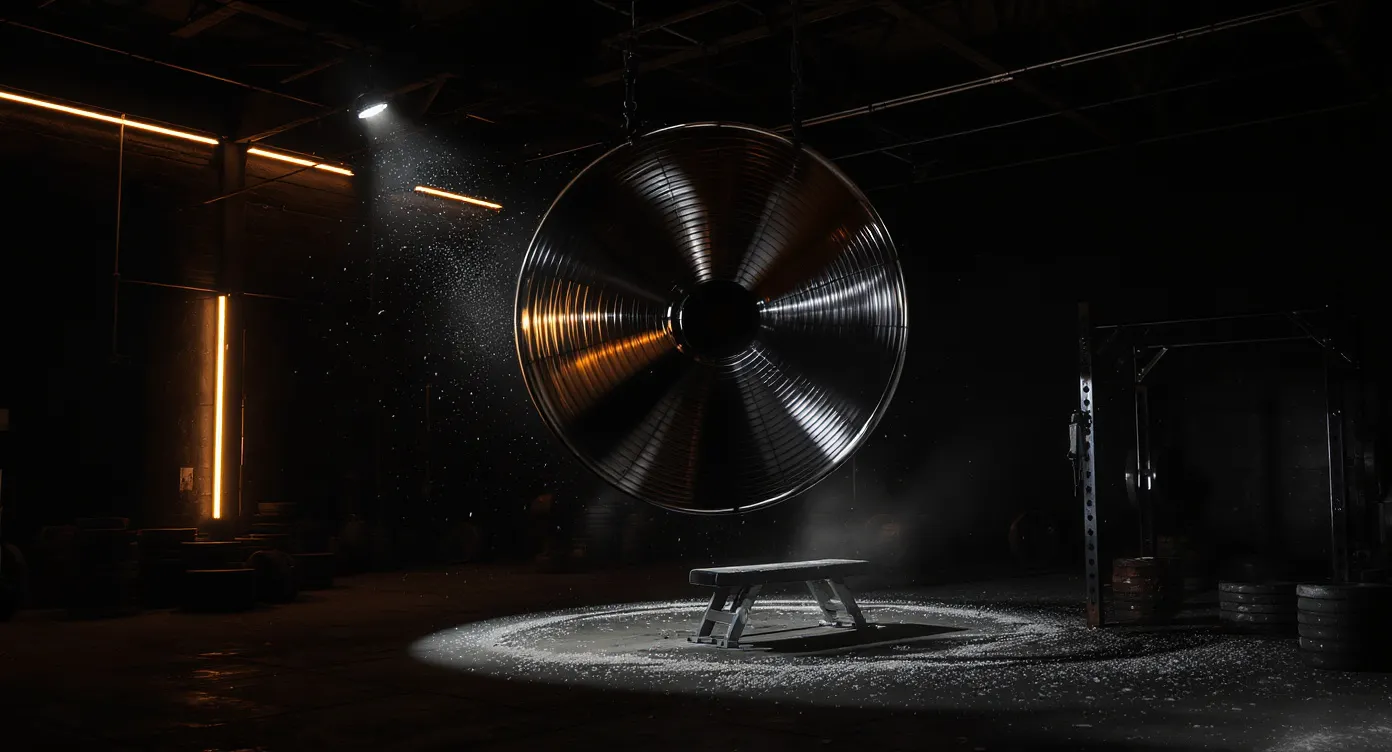
Garage Gym Ventilation & Climate Control Guide (2026)
How to keep your garage gym cool in summer and warm in winter. Complete guide to fans, heaters, insulation, and airflow.
Open the garage door for cross-ventilation and add a 20-inch box fan or wall-mounted fan ($30-$60) to circulate air. For extreme heat, a portable evaporative cooler ($100-$200) drops temps 10-15 degrees; for winter, a 240V garage heater ($150-$300) keeps the space trainable.
Training in an unventilated garage is a fast track to abandoned fitness goals. When summer pushes indoor temperatures past 110 degrees Fahrenheit and winter drops them below freezing, your garage gym becomes a place you avoid rather than a place you train. Proper ventilation and climate control are not luxury upgrades. They are foundational infrastructure that determines whether your home gym gets used 300 days a year or collects dust after February.
This guide covers everything from basic airflow physics to advanced HVAC systems, with specific equipment recommendations, installation tips, and budget breakdowns for every climate zone in North America. Whether you spent $500 or $5,000 on your garage gym build, investing in climate control protects both your health and your equipment.
Why Garage Ventilation Matters More Than You Think
A standard two-car garage has roughly 400 to 576 square feet of floor space and a volume of around 4,000 to 5,800 cubic feet. Unlike the rooms inside your house, garages are designed as semi-outdoor spaces. They lack the insulation, ductwork, and vapor barriers that regulate temperature and humidity in your living areas. This creates three critical problems for training.
Heat Accumulation
Garages with sun-facing doors routinely reach 100 to 130 degrees Fahrenheit during summer afternoons. Concrete slab floors absorb and radiate heat. Metal garage doors act as solar collectors. A single high-intensity training session in these conditions can push core body temperature into dangerous territory within 20 minutes, causing heat exhaustion, impaired cognitive function, and drastically reduced performance.
Cold Exposure
In winter, an uninsulated garage tracks outdoor temperatures closely. When the ambient temperature drops below 50 degrees Fahrenheit, grip strength decreases measurably. Below 40 degrees, bare steel barbells become painful to hold. Below freezing, rubber bumper plates become brittle and prone to cracking, hydraulic dampers in machines stiffen, and your warm-up time doubles or triples just to reach baseline function.
Air Quality Degradation
Even in mild weather, a closed garage accumulates airborne contaminants that affect respiratory health and training performance:
- Volatile organic compounds (VOCs) from rubber flooring, especially new horse stall mats or rubber tiles during the first 2 to 4 weeks
- Chalk dust particles that accumulate in the breathing zone during overhead pressing and deadlifting
- Carbon dioxide buildup from heavy exertion in a sealed space, which causes fatigue and headaches faster than you might expect
- Vehicle exhaust residue if you park a car in the same space
- Mold spores from moisture condensation on cold concrete and metal surfaces
The bottom line: ventilation directly impacts your training quality, your long-term health, and the lifespan of your equipment.

Sunny Health & Fitness Premium Smart Cross-Training Fan Bike SF-B223018
Capacity
330 lbs user weight
Steel
Steel Frame
Footprint
50.95" L x 23.34" W x 50" H
Price
$699.99
- 4.5+ star rating on Amazon with 3,000+ reviews
- The original and most iconic air bike
- Programmable workouts (Tabata, HIIT, custom)
- LCD console with chest strap heart rate support
- Proven durability over a decade
- Great for CrossFit-style conditioning
- Chain-driven (louder than belt-driven competitors)
- Requires occasional chain lubrication
- Heavy at 98 lbs — hard to relocate
- Premium price vs. budget air bikes
Price and availability may change
Understanding Airflow Principles for Garage Gyms
Before spending money on fans and HVAC systems, understanding basic airflow physics helps you make smarter decisions.
The Stack Effect
Hot air rises. In a garage with a peaked or vaulted ceiling, the hottest air collects at the highest point. If you can create an exhaust point near the ceiling and an intake point near the floor, natural convection does a surprising amount of work for free. This is the stack effect, and it is the foundation of passive ventilation design.
Cross-Ventilation
Air moves from high-pressure zones to low-pressure zones. Opening two opposing sides of your garage, even partially, creates cross-ventilation that can move 5 to 15 air changes per hour depending on wind conditions. A garage door cracked 12 to 18 inches on one side combined with an open side window or a louvered vent on the opposite wall creates a natural wind tunnel.
Negative vs. Positive Pressure
Exhaust fans create negative pressure, pulling stale air out and drawing fresh air in through any available opening. Supply fans create positive pressure, pushing fresh air in and forcing stale air out through gaps. For garage gyms, negative pressure (exhaust) systems generally work better because they actively remove heat, moisture, and airborne particulates at the source.
Summer Cooling: Strategies by Severity
Level 1: Passive Airflow (Cost: $0 to $50)
This is where every garage gym owner should start. Before buying any equipment, maximize what you already have.
Open the garage door 12 to 18 inches. This creates a low-intake channel that draws cooler ground-level air into the space. Opening the door fully actually reduces the chimney effect and can let more solar radiation in. The partially-open position is the sweet spot.
Train during off-peak hours. Garage temperatures peak between 1:00 PM and 5:00 PM. Training before 8:00 AM or after 7:00 PM can mean a 15 to 25 degree Fahrenheit difference in ambient temperature. This single change costs nothing and has the largest impact.
Use reflective garage door insulation. A radiant barrier kit like the Reach Barrier 3009 or SmartGARAGE reflective insulation ($30 to $80) reflects up to 95 percent of radiant heat from the garage door panels. Installation takes 1 to 2 hours with basic tools.
Level 2: Active Airflow with Fans (Cost: $40 to $200)
When passive strategies are not enough, mechanical air movement is the next step.
High-velocity floor fans are the workhorse of garage gym cooling. A 20-inch or 24-inch drum fan like the XPOWER FC-420 or the B-Air FIRTANA-20X moves 3,000 to 4,800 CFM (cubic feet per minute) and costs $60 to $120. Position it at floor level aimed diagonally across your training area for maximum body cooling.
Wall-mounted oscillating fans save floor space, which matters in a garage gym where every square foot counts. The Hurricane Wall Mount Fan (20-inch, $50 to $70) mounts at 7 to 8 feet and oscillates across the entire training area. Install it on the wall opposite your garage door for cross-flow.
Ceiling fans are excellent if you have 9-foot or higher ceilings. Industrial models like the Big Ass Fans Haiku or the Hunter Industrial Troposair Titan (60 to 72 inch blade span) move massive volumes of air and run quietly. Budget $150 to $400 for the fan plus electrical installation costs.
- Fans are cheap to buy and operate at 1 to 3 cents per hour in electricity
- Immediate cooling effect on skin through evaporative sweat response
- No installation complexity and fully portable for repositioning
- Year-round utility for air circulation even in winter
- Fans move air but do not actually lower the ambient temperature
- Effectiveness drops sharply above 100 degrees Fahrenheit when the air itself is hot
- High-velocity fans create significant noise at full speed
- Floor fans take up valuable training space in smaller garages
Level 3: Evaporative Coolers (Cost: $100 to $400)
Evaporative coolers, also called swamp coolers, pass air through water-saturated pads. The evaporation process drops the air temperature by 15 to 25 degrees Fahrenheit. They work brilliantly in dry climates where relative humidity stays below 40 percent.
Best for: Arizona, Nevada, New Mexico, inland California, Colorado, Utah, West Texas.
Do not bother in: Florida, Louisiana, Gulf Coast, coastal Southeast, or anywhere summer humidity regularly exceeds 50 percent. In humid conditions, evaporative coolers just make the air wetter without meaningful cooling.
Recommended models for garage gyms include the Hessaire MC37M (3,100 CFM, covers up to 950 square feet, around $250) and the NewAir AF-310 (portable unit, around $130 for smaller spaces).
Level 4: Portable Air Conditioning (Cost: $300 to $700)
Portable AC units are the first option that actually lowers the ambient temperature regardless of humidity. They use refrigerant-based compression cycles identical to your home AC. The critical requirement: they need an exhaust hose vented outside, typically through a window, wall port, or partially open garage door.
A 12,000 to 14,000 BTU portable AC unit will meaningfully cool a 2-car garage. The Whynter ARC-14S (14,000 BTU, dual-hose design, around $500) and the Black+Decker BPACT14WT (14,000 BTU, around $450) are strong choices. Dual-hose models are more efficient because they draw intake air from outside rather than creating negative pressure that pulls hot air into the garage through every gap.
Important sizing note: Garage gyms need more cooling capacity than standard room calculations suggest. The lack of insulation, concrete heat sinking, and metabolic heat from training mean you should oversize by 20 to 30 percent compared to the manufacturer's room size recommendation.
Level 5: Ductless Mini-Split Systems (Cost: $1,500 to $4,000 Installed)
A ductless mini-split is the definitive solution for year-round climate control. It provides both cooling and heating through a heat pump cycle, operates at 18 to 25 SEER efficiency ratings, and runs quietly at 19 to 40 dB. A single-zone 18,000 to 24,000 BTU unit handles most two-car garages.
Top brands for garage gym installations include Mitsubishi (MUZ/MSZ series), Fujitsu (Halcyon line), MRCOOL (DIY series with pre-charged lines for self-installation), and Pioneer.
The MRCOOL DIY 24,000 BTU ($1,400 to $1,800 for the unit) is popular with garage gym owners because its pre-charged refrigerant lines allow installation without an HVAC technician. However, you still need a dedicated 240V circuit, which means electrical work is part of the project.
Professional installation of a standard mini-split runs $1,500 to $3,500 total depending on unit size, line set length, and local labor rates. This is the best long-term investment for extreme climates and brings year-round usability with monthly operating costs of $30 to $80 depending on usage.
Winter Heating: Strategies by Severity
Insulation Comes First
Heating an uninsulated garage is like running hot water into a bathtub with the drain open. Before buying any heater, address the thermal envelope.
Garage door insulation is the single highest-impact winter upgrade. The garage door accounts for 25 to 40 percent of total heat loss in a typical garage. Foam board insulation kits like the Owens Corning Garage Door Insulation Kit ($80 to $120) or the Matador Garage Door Insulation Kit ($100 to $150) install in under 2 hours with no special tools. They reduce heat loss through the door by 50 to 70 percent.
Weatherstripping around the garage door perimeter, the door to the house, and any windows costs $20 to $50 and takes 30 minutes to install. This eliminates the cold air infiltration that undermines your heating efforts.
Wall and ceiling insulation provides further improvement but involves significantly more cost and effort. If your garage has exposed stud bays, unfaced R-13 fiberglass batts ($0.50 to $1.00 per square foot) are a straightforward weekend project. For finished walls, blown-in insulation requires professional equipment. Most garage gym owners get 70 to 80 percent of the thermal benefit from door insulation and weatherstripping alone.
Electric Heater Options
Ceramic space heaters ($40 to $100) are the simplest option. Models like the Dr. Infrared Heater DR-968 (1,500 watts, around $90) or the Lasko 755320 (1,500 watts, around $55) heat a localized area quickly. At 1,500 watts, they add roughly $0.15 to $0.20 per hour to your electric bill. Limitation: a single 1,500-watt unit struggles to heat more than 150 to 200 square feet of uninsulated garage space.
Electric infrared heaters ($100 to $400) heat objects and people directly through radiant energy rather than heating the air. This makes them more efficient in drafty spaces where heated air escapes quickly. The Dr. Infrared Heater DR-238 ($120) and the Heat Storm HS-1500-PHX ($80) are solid garage gym options. Wall or ceiling-mounted infrared panels from brands like Heatwell or EconoHome ($200 to $400) provide permanent radiant heat without taking up floor space.
Electric garage heaters ($150 to $500) are purpose-built for garage environments. Hard-wired 240V units like the Fahrenheat FUH54 (5,000 watts, around $200) or the NewAir G73 (5,000 watts, around $180) mount on the ceiling and heat a full two-car garage. They require a dedicated 240V circuit and 30-amp breaker, so factor in electrical work.
Propane and Gas Heater Options
Portable propane heaters like the Mr. Heater Buddy series ($70 to $150) produce 4,000 to 18,000 BTU and heat a garage fast. The Big Buddy model (18,000 BTU, around $150) can raise a two-car garage temperature by 20 to 30 degrees Fahrenheit in 15 to 20 minutes.
Critical safety warning: All combustion heaters produce carbon monoxide. Never operate a propane heater in a fully sealed garage. Crack the garage door at least 6 inches, ensure the unit has an oxygen depletion sensor (ODS), and install a battery-operated carbon monoxide detector at breathing height. Review our garage gym safety guide for complete safety protocols.
Forced-air gas heaters ($300 to $800) permanently mounted and vented through the wall or ceiling are common in cold-climate garages. The Modine Hot Dawg (45,000 to 75,000 BTU, $500 to $800) is the industry standard for garage heating. These require gas line access and professional installation but deliver serious, reliable heat.
Air Quality Management
Even with perfect temperature control, a garage gym needs deliberate air quality management. You are breathing 40 to 60 liters of air per minute during intense exercise, 10 to 15 times more than at rest. The quality of that air matters.
VOC Off-Gassing from Rubber Flooring
New rubber gym flooring releases VOCs including carbon disulfide, benzothiazole, and various sulfur compounds. That strong rubber smell you notice when you first install stall mats or rolled rubber is not just unpleasant but is actively irritating to the respiratory system.
Mitigation strategy: Ventilate aggressively for the first 2 to 4 weeks after installing new rubber flooring. Leave the garage door open 12 to 18 inches whenever possible. Run a fan continuously even when not training. The off-gassing rate drops by 80 to 90 percent within the first month under good ventilation. If you are sensitive, consider vulcanized rubber flooring from premium manufacturers like Regupol or Dinoflex, which has lower VOC emissions than recycled rubber products.
Chalk Dust Control
Lifting chalk (magnesium carbonate) particles are 1 to 10 microns in size and remain airborne for extended periods in still air. Chronic inhalation causes respiratory irritation. Liquid chalk reduces airborne dust by 90 percent or more compared to block chalk. If you prefer traditional chalk, a small HEPA air purifier ($60 to $150) near your lifting platform captures particles effectively. The Levoit Core 300 ($100) or the Medify Air MA-25 ($120) both cover a garage-sized space.
CO2 and Stale Air
During heavy compound lifts, your body produces 2 to 3 liters of CO2 per minute. In a sealed 5,000 cubic foot garage, CO2 levels can exceed 1,000 ppm within 30 to 45 minutes of intense training, causing noticeable fatigue, headaches, and reduced mental acuity. The solution is simple: always maintain at least one source of fresh air exchange. A cracked door, an open window, or a continuously running exhaust fan prevents CO2 accumulation.
Mold and Moisture Prevention
Garages in humid climates are prime environments for mold growth. Condensation forms on cold concrete and metal surfaces when warm, humid air enters the space. A dehumidifier rated for 50 to 70 pints per day keeps relative humidity below 50 percent, which is the threshold below which mold cannot grow and rust formation slows dramatically. The hOmeLabs 50-Pint ($230) and the Frigidaire FFAD5033W1 ($289) are reliable choices for garage applications. This also protects your barbell investment; read our barbell maintenance guide for more on preventing rust and corrosion.
Ventilation Strategy by Climate Zone
Your ventilation plan must match your geography. A setup that works perfectly in Phoenix will fail catastrophically in Houston.
Hot and Dry (Southwest, Inland California, Mountain West Below 5,000 Feet)
Primary threat: Extreme heat, 100 to 120 degrees Fahrenheit summer peaks.
Recommended setup: Reflective garage door insulation plus a high-quality evaporative cooler (Hessaire MC37M or similar, $200 to $300) plus a 20-inch drum fan for direct body cooling. This combination costs under $400 and drops effective temperature by 20 to 30 degrees. Train before 9:00 AM or after 6:00 PM from June through September. Winter is mild; a basic ceramic heater handles the occasional cold morning.
Hot and Humid (Southeast, Gulf Coast, Mid-Atlantic Summers)
Primary threat: Heat combined with oppressive humidity, making evaporative cooling useless.
Recommended setup: Portable dual-hose AC unit (12,000 to 14,000 BTU, $400 to $550) or a mini-split system for year-round use. A dehumidifier ($200 to $250) is essential to protect equipment from rust and prevent mold. Run fans continuously for air circulation. Budget $600 to $800 for a portable setup or $2,000 to $3,500 for a mini-split that handles both seasons.
Cold and Dry (Northern Plains, Mountain West Above 5,000 Feet, Upper Midwest)
Primary threat: Temperatures well below freezing for months at a time.
Recommended setup: Insulate the garage door and weatherstrip all gaps first. A ceiling-mounted 5,000-watt electric heater or a vented gas heater (Modine Hot Dawg, 45,000+ BTU) is essential for regular winter training. The dry air is actually beneficial for equipment longevity since rust is minimal. Consider a small humidifier if air drops below 20 percent relative humidity, which can irritate the respiratory system during heavy breathing.
Cold and Wet (Pacific Northwest, Northeast, Great Lakes Region)
Primary threat: Moisture and moderate cold creating a rust and mold paradise.
Recommended setup: A dehumidifier is non-negotiable, running year-round. Insulate the garage door and walls if possible. Use a ceramic or infrared electric heater for warmth (avoids adding combustion moisture to already-humid air). Run at least one fan continuously to prevent condensation on cold metal equipment. A mini-split with heat pump mode is the ideal long-term solution here, providing dehumidification, heating, and cooling in one system.
Mild Year-Round (Coastal California, Parts of the Pacific Northwest, Southern Coastal)
Primary threat: Minimal, though morning dampness and occasional heat waves require attention.
Recommended setup: Two fans (one floor, one wall-mounted) for summer circulation and a basic 1,500-watt ceramic heater for the coldest mornings. Focus your budget on equipment rather than climate control. Ensure adequate ventilation for rubber mat off-gassing and chalk dust. Total climate control cost: $100 to $200.
Budget Priority Order for Climate Control
If you are building out climate control incrementally, invest in this order for maximum return per dollar:
- High-velocity 20-inch fan ($40 to $60) - immediate impact on comfort, usable year-round for air circulation
- Garage door insulation kit ($80 to $120) - single biggest winter improvement, also reduces summer heat gain by 10 to 15 degrees
- Weatherstripping ($20 to $40) - seals gaps that undermine both heating and cooling efforts
- Ceramic or infrared space heater ($50 to $100) - makes winter training tolerable in all but the coldest climates
- Portable AC or evaporative cooler ($150 to $500) - summer game-changer for climates where fans alone fall short
- Dehumidifier ($150 to $250) - essential in humid climates, protects your entire equipment investment
- Mini-split system ($1,500 to $3,500 installed) - the endgame for year-round comfort and the best long-term investment
Minimum viable climate control budget: approximately $200. A fan, door insulation, and weatherstripping handle most mild to moderate climates.
Full year-round comfort budget: approximately $500 to $700 with a portable AC/heater combo. A mini-split system pushes total investment to $2,000 to $4,000 but pays for itself in consistent training adherence over years.
Installation Tips and Common Mistakes
Electrical Capacity
Garage circuits are often shared with the garage door opener, lights, and outlets. Running a 1,500-watt heater and a portable AC unit simultaneously can trip a 15-amp breaker. Before adding high-draw appliances, check your breaker panel and consider adding a dedicated 20-amp or 240V circuit. See our electrical setup guide for a complete walkthrough.
Fan Placement
The most common mistake is pointing a fan directly at yourself from 2 feet away. This creates a narrow cooling zone and does nothing for overall air circulation. Instead, position floor fans at a 30 to 45 degree angle relative to the long axis of the garage, creating diagonal airflow that sweeps the entire space. Wall-mounted fans should oscillate to prevent dead zones.
Heater Safety
Never place portable heaters within 3 feet of rubber flooring, foam rollers, resistance bands, or any flammable material. Wall or ceiling mounting eliminates this risk. Always use heaters with tip-over protection and automatic overheat shutoff. Never leave heaters running unattended in the garage.
Condensation Management
When you heat a cold garage, moisture in the air condenses on still-cold surfaces like barbells, weight plates, and rack uprights. Wipe down all metal equipment after heating the space, and allow the garage to warm gradually rather than blasting heat. Running a fan during heating distributes warmth evenly and reduces condensation.
Equipment Checklist
10 itemsFrequently Asked Questions
Is it safe to use a propane heater in a closed garage gym?
How do I prevent rust on gym equipment in a humid garage?
Can I install a mini-split AC system in my garage myself?
What is the cheapest way to cool a garage gym in summer?
Do I need to insulate my garage walls or just the door?
How many BTUs do I need to heat or cool my garage gym?
Will running fans increase my electric bill significantly?
How do I reduce rubber flooring off-gassing smell in my garage gym?
Additional Resources
The Bottom Line
Climate control is the invisible infrastructure that makes or breaks a garage gym. You can own the best power rack, the smoothest barbell, and a full set of calibrated plates, but none of it matters if your garage is 120 degrees in July or 25 degrees in January. A $200 investment in a fan, door insulation, and weatherstripping transforms a seasonal gym into a year-round training facility. A $500 to $700 investment with a portable AC and heater covers nearly every climate. And a mini-split system in the $2,000 to $3,500 range is the endgame that eliminates weather as an excuse forever.
Start with airflow. Add insulation. Then layer heating and cooling as your budget allows. Your consistency will thank you.
Related Content
Lena Park
Former NCAA Division I rower and USA Weightlifting coach. Specializes in conditioning equipment and women's training.
Read full bioMore in Guides
Strength vs Hypertrophy: How to Program for Your Goals (2026)
The definitive guide to programming for strength vs size in your home gym. Rep ranges, volume, intensity, and complete programs for both goals.
The Complete Home Gym Warm-Up Guide (2026)
Stop skipping your warm-up. Complete warm-up protocols for every training style, plus the equipment that makes preparation effortless at home.
Home Gym Deload Guide: When and How to Back Off (2026)
Learn when and how to deload in your home gym. Science-backed protocols, recovery strategies, and signs you need a rest week.