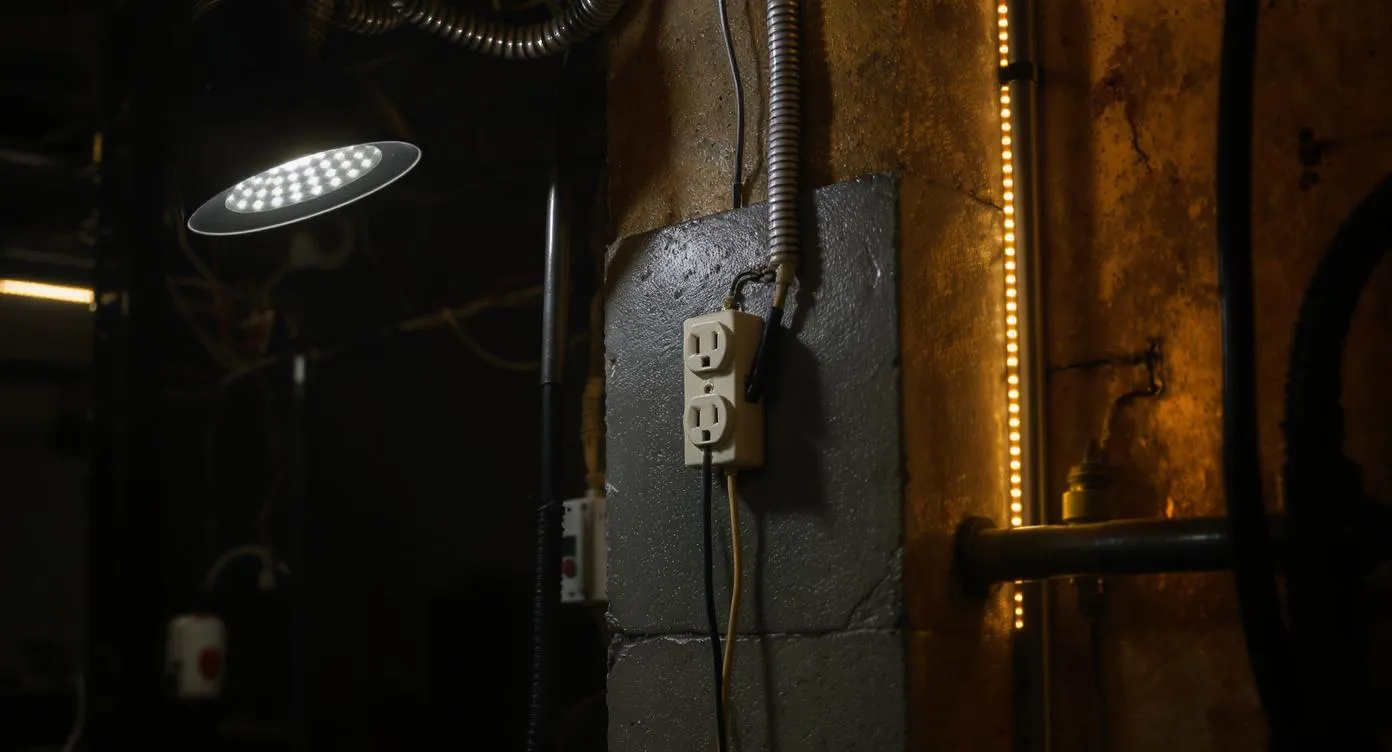
Garage Gym Electrical & Power Setup Guide (2026)
How to set up electrical power in your garage gym. Outlets, dedicated circuits, extension cords, and what equipment needs what power.
Most residential garages are wired with a single 15-amp circuit feeding one or two duplex outlets. That is perfectly adequate for a barbell, a set of plates, and a pull-up bar. But the moment you plug in LED shop lights, a high-speed fan, a motorized treadmill, a space heater for winter sessions, and a TV for training footage, you are stacking wattage on a circuit that was never designed for it. The result is a tripped breaker mid-set, or worse, an overheated wire behind your drywall that you cannot see until the damage is done.
This guide covers everything you need to know about powering a garage gym safely and efficiently: how residential electrical circuits work, what each piece of equipment actually draws, when you need a licensed electrician, how to handle extension cords and surge protectors, and how to plan your electrical layout so you never trip a breaker during a heavy deadlift session again.
How Residential Garage Electrical Circuits Work
Before you start plugging equipment in, you need to understand the electrical infrastructure you are working with. Residential garages in the United States are typically wired according to the National Electrical Code (NEC), which has specific requirements for garage circuits.
Circuit Basics: Amps, Volts, and Watts
Every circuit in your home has three key specifications:
- Amperage (amps): The maximum current the circuit can carry. Most garage circuits are 15-amp or 20-amp.
- Voltage (volts): Standard US residential outlets deliver 120 volts. Some large appliances (like dryers or welders) use 240-volt circuits.
- Wattage (watts): The actual power consumption, calculated as volts multiplied by amps. A 15-amp, 120-volt circuit can theoretically deliver 1,800 watts.
However, the NEC mandates an 80 percent continuous load rule. That means you should never load a circuit beyond 80 percent of its rated capacity for sustained periods. In practice:
| Circuit Rating | Max Capacity | Safe Continuous Load (80%) |
|---|---|---|
| 15-amp / 120V | 1,800W | 1,440W |
| 20-amp / 120V | 2,400W | 1,920W |
| 20-amp / 240V | 4,800W | 3,840W |
| 30-amp / 240V | 7,200W | 5,760W |
How to Identify Your Garage Circuit
Walk to your home's main electrical panel (the breaker box, usually in a utility closet, basement, or the garage itself). Look for the breaker labeled "Garage" or "GAR." Note two things:
- The amp rating printed on the breaker handle — it will say 15 or 20.
- Whether the breaker is shared — some homes wire the garage outlets on the same circuit as exterior outlets or even a hallway. If flipping the garage breaker also kills power to other rooms, you are sharing capacity with those outlets too.
A quick test: plug a lamp into the garage outlet, flip the breaker off, and walk the house checking which outlets lost power. This ten-minute exercise tells you exactly what you are working with.
GFCI Protection Requirements
The NEC requires all 120-volt, 15-amp and 20-amp outlets in garages to have Ground Fault Circuit Interrupter (GFCI) protection. A GFCI outlet monitors the current flowing through the hot and neutral wires. If it detects even a tiny imbalance (as little as 4 to 6 milliamps, which indicates current leaking through water or a person), it trips in under one-tenth of a second.
In a garage gym environment where sweat drips onto the floor, you move rubber mats, and condensation forms on concrete in winter, GFCI protection is non-negotiable. If your garage outlets are not GFCI-protected, that is the first electrical upgrade you should make. A GFCI outlet costs about $15 to $25 from Home Depot or Lowe's, and an electrician can install one in 15 to 20 minutes.

Schwinn Airdyne Bike Series
Capacity
350 lbs user weight
Steel
Steel Frame
Footprint
58.875" L x 29.875" W x 52.75" H
Price
$1,299.00
- Belt-driven fan — quieter and zero chain maintenance
- 127 lbs of steel — the most stable air bike available
- Powder-coated finish resists rust and scratches
- Simple LCD console — no batteries, no Bluetooth, no failures
- Overbuilt for commercial or garage gym abuse
- Lifetime of use with zero maintenance
- No programmable workouts — manual only
- 127 lbs makes it very hard to relocate
- Premium price at $895
- No Bluetooth or app connectivity
Price and availability may change
What Equipment Actually Draws in a Garage Gym
Not all gym equipment is created equal when it comes to electrical demand. The table below covers the realistic power draw of every common garage gym item, measured in watts during actual operation (not just nameplate ratings, which are often peak values).
| Equipment | Typical Draw | Circuit Impact | Notes |
|---|---|---|---|
| LED shop lights (4 fixtures) | 120-200W total | Low | Barrina or Hykolity 4-foot LED linkable lights draw 30-50W each |
| 20-inch box fan | 75-110W | Low | Lasko or Honeywell box fans draw modestly |
| 42-inch to 52-inch ceiling fan | 60-80W | Low | Hunter or Hampton Bay industrial styles |
| Bluetooth speaker | 10-25W | Negligible | JBL Charge or similar |
| Phone charger | 5-20W | Negligible | Even fast chargers are minimal |
| 32-inch to 55-inch TV/monitor | 40-120W | Low | LED/OLED screens are efficient |
| Portable space heater | 750-1,500W | HIGH | Dr Infrared DR-968 or similar ceramic heaters |
| Portable AC unit (8,000-12,000 BTU) | 900-1,500W | HIGH | Black+Decker BPACT08WT or similar |
| Mini-split HVAC (ductless) | 600-1,800W | HIGH | Mr Cool DIY or Pioneer; requires dedicated circuit by code |
| Motorized treadmill | 600-2,200W | HIGH | NordicTrack, Sole F63, or similar; varies by speed and incline |
| Commercial-grade treadmill | 1,800-3,000W | VERY HIGH | May require 20-amp dedicated or 240V |
| Motorized incline trainer | 1,000-1,800W | HIGH | NordicTrack X22i or similar |
| Air bike (fan resistance) | 0-5W | None | Sunny Health Fan Bike, Schwinn Airdyne Bike Series, Concept2 BikeErg — self-powered or battery console |
| Rowing machine | 0-5W | None | Concept2 Model D uses battery or self-powered PM5 |
| Garage door opener | 500-700W | Brief surge | Intermittent use; draws power for 15-20 seconds per activation |
| Air compressor (for cleaning) | 1,200-1,800W | HIGH | Brief but intense startup surge |
| Plug-in timer or smart plug | 1-3W | Negligible | Great for automating lights |
The critical rule: Anything with a motor (treadmill, AC compressor, air compressor) or a heating element (space heater, infrared heater) draws serious sustained wattage. Everything else is negligible. Plan your circuits around the heavy hitters.
Planning Your Garage Gym Electrical Layout
Smart electrical planning before you set up your gym prevents headaches later. Here is a systematic approach.
Step 1: Map Your Existing Outlets
Draw a rough floor plan of your garage. Mark every existing outlet, note which circuit it is on, and whether it has GFCI protection. Most two-car garages have two to four outlets total, often clustered on one wall.
Step 2: Plan Your Equipment Zones
Divide your garage gym into functional zones and assign electrical needs:
- Lifting zone (rack, bench, platform): Typically zero electrical needs. Maybe a fan and a Bluetooth speaker.
- Cardio zone (treadmill, rower, bike): This is where the big electrical demand lives. A motorized treadmill needs its own outlet, ideally on a dedicated circuit.
- Climate control zone: Your heater or AC unit. Always a dedicated circuit.
- Lighting and entertainment zone: LED shop lights, TV/monitor, speakers. Low draw; these can share a circuit comfortably.
Step 3: Calculate Total Load Per Circuit
Add up the wattage for every device that will run simultaneously on each circuit. If the total exceeds 80 percent of the circuit's capacity, you need to split the load or add a circuit. Here is a real-world example:
Scenario: Winter evening workout on a single 15-amp circuit (1,440W safe limit)
- 4x LED shop lights: 160W
- Box fan: 100W
- Bluetooth speaker: 15W
- Phone charger: 10W
- TV: 80W
- Total: 365W — Well within limits. No problems here.
Now add a space heater:
- Everything above: 365W
- Space heater on medium: 750W
- Total: 1,115W — Still under the 1,440W limit, but running the heater on high (1,500W) pushes you to 1,865W, which exceeds a 15-amp circuit and will trip the breaker.
This is why high-draw equipment needs dedicated circuits. The math does not lie.
- Dedicated circuits eliminate breaker trips during training sessions permanently
- Proper GFCI protection prevents electrical shock in a high-moisture gym environment
- A well-planned layout lets you run heating or cooling and cardio equipment simultaneously
- Professional wiring increases home resale value and passes inspection
- LED shop lights on a shared circuit barely register 200W leaving plenty of headroom
- Adding dedicated circuits requires a licensed electrician at $200 to $500 per circuit
- Older homes may need a sub-panel upgrade if the main panel has no open breaker slots
- Running conduit through finished garage walls adds labor and cost
- 240-volt circuits for commercial equipment require special outlets and wiring
- Permits and inspections add time and modest fees depending on your municipality
When You Need a Dedicated Circuit (And When You Do Not)
This is the most common question in garage gym electrical planning. Here is the definitive breakdown.
Always Requires a Dedicated Circuit
- Space heaters rated 1,500W — A ceramic or infrared heater on its highest setting draws the absolute maximum a 15-amp circuit can deliver. You cannot run a single additional device without exceeding the limit. Brands like Dr Infrared, Vornado, and Lasko all pull the same wattage at full power.
- Portable air conditioners (8,000+ BTU) — The compressor draws 900 to 1,500 watts when cycling, with startup surges even higher. The Black+Decker BPACT08WT draws approximately 950 watts, while larger 12,000 BTU units hit 1,400 watts.
- Motorized treadmills — Even a mid-range treadmill like the Sole F63 draws 800 to 1,200 watts during a run, spiking higher during incline changes or sprint intervals. Cheaper treadmills on underpowered circuits experience voltage drops that damage the motor over time, voiding the warranty.
- Mini-split HVAC systems — These require a dedicated 20-amp or 30-amp circuit (often 240-volt) by building code. Brands like Mr Cool DIY, Pioneer, and Mitsubishi all specify this in their installation manuals. Your HVAC installer will handle the electrical as part of the job.
- Air compressors — If you use a compressor for cleaning equipment or blowing out mats, the startup surge alone can draw 15 to 20 amps momentarily. Always a dedicated circuit.
Should Have a Dedicated Circuit If Possible
- Treadmill plus fan combination — A treadmill drawing 1,000W and a box fan drawing 100W totals 1,100W. Add lights and a TV, and you are at 1,300W on a 15-amp circuit. That is 90 percent capacity with zero safety margin.
- Multiple fans plus a dehumidifier — If you run a dehumidifier (300-700W) alongside fans and lights for summer cooling, the combined draw can approach 15-amp limits during peak humidity.
Perfectly Fine on a Shared Circuit
- LED shop lights — Four Barrina 4-foot LED linkable lights draw a combined 160 watts. You could run eight of them and still be under 350 watts. See our garage gym lighting guide for specific product recommendations.
- Fans (box or pedestal) — A 20-inch box fan draws 75 to 110 watts. Even two fans plus full lighting stays well under 500 watts total.
- Bluetooth speakers, phone chargers, TVs — Combined, these rarely exceed 150 watts. Plug them into a surge protector and forget about them.
- Self-powered cardio equipment — The Concept2 RowErg, Schwinn Airdyne Bike Series, and Sunny Health Fan Bike are self-powered or battery-operated. Zero circuit impact.
- Smart plugs and timers — Devices like the TP-Link Kasa smart plug draw under 3 watts. Use them to automate your lights on a schedule.
Extension Cords: The Rules That Actually Matter
Extension cords are unavoidable in many garage gyms because outlets are rarely where you need them. Used correctly, they are safe. Used incorrectly, they are a fire hazard. Here are the non-negotiable rules.
Wire Gauge and Amperage Rating
Extension cord capacity is determined by wire gauge (AWG). Lower gauge numbers mean thicker wire and higher capacity:
| Wire Gauge | Max Amps (25 ft) | Max Amps (50 ft) | Max Amps (100 ft) | Best For |
|---|---|---|---|---|
| 16 AWG | 13A | 10A | 7A | Lights, speakers, chargers only |
| 14 AWG | 15A | 13A | 10A | Fans, TVs, moderate loads |
| 12 AWG | 20A | 15A | 13A | Heavy-duty use, power tools |
| 10 AWG | 20A | 20A | 15A | Maximum residential capacity |
For a garage gym, always use 12 AWG or heavier. A 12-gauge, 25-foot outdoor-rated extension cord costs $20 to $35 at Home Depot and handles anything you will plug into it except heating equipment (which should never use an extension cord at all).
Extension Cord Safety Rules
Do:
- Use cords rated for indoor/outdoor use with a "W" designation on the jacket (e.g., SJTW or STW)
- Fully uncoil the cord before use — coiled cords trap heat and can melt their own insulation
- Run cords along walls, secured with cable clips, to prevent tripping hazards
- Inspect cords monthly for cracks, exposed wire, warm spots, or damaged prongs
- Use a single continuous cord of the correct length rather than joining two shorter ones
Do not:
- Daisy-chain multiple extension cords together — this increases resistance and fire risk
- Run cords under rubber gym mats or horse stall mats where heat cannot dissipate
- Use an extension cord for space heaters, portable ACs, or any device drawing over 1,500W
- Leave high-draw equipment plugged into an extension cord when not in use
- Use a cord with a missing ground prong (the third prong)
Power Strips vs Surge Protectors: What to Use Where
These look similar but serve different purposes.
Power strip: A basic multi-outlet device with no internal protection circuitry. It is just a convenience adapter that turns one outlet into six. Fine for low-draw electronics (lights, speakers, chargers) that do not need surge protection.
Surge protector: Contains a metal oxide varistor (MOV) that absorbs voltage spikes before they reach your equipment. Use a surge protector for any device with sensitive electronics: TVs, monitors, smart home hubs, Bluetooth speakers, and gaming consoles. Look for a surge protector rated at 1,000+ joules with indicator lights confirming protection is active. Brands like Tripp Lite, APC, and Belkin are reliable.
Neither power strips nor surge protectors should be used for: Space heaters, portable AC units, treadmills, or any high-draw motorized equipment. These devices must plug directly into a wall outlet. The internal wiring of most power strips and surge protectors is 14 or 16 AWG, which is undersized for sustained high loads and can overheat.
Recommended Electrical Setup Checklist
Equipment Checklist
10 itemsHiring an Electrician: What to Expect
If you need dedicated circuits, additional outlets, or any work inside your breaker panel, hire a licensed electrician. This is not a DIY project. Working inside a live electrical panel without training risks electrocution and house fires, and improper wiring will fail inspection if you ever sell the home.
What a Typical Garage Gym Electrical Upgrade Includes
- One dedicated 20-amp circuit with a new outlet: $200 to $400. The electrician runs 12-gauge Romex from the panel to your garage, installs a new 20-amp breaker, and adds a GFCI outlet where you need it. This takes 2 to 4 hours.
- Two dedicated circuits (one for climate control, one for cardio): $350 to $700. Slight efficiency savings when doing both at once.
- Sub-panel installation (if main panel is full): $500 to $1,200. If your breaker box has no open slots, the electrician installs a sub-panel in the garage with its own set of breaker slots. This adds capacity for multiple new circuits.
- 240-volt circuit (for mini-split HVAC or commercial equipment): $300 to $600. Requires heavier gauge wire and a double-pole breaker.
How to Find a Good Electrician
- Get three quotes minimum. Prices vary significantly by region.
- Verify their license on your state's contractor licensing board website.
- Ask specifically about garage experience — some electricians mostly do new construction and are less efficient at retrofit work.
- Confirm they will pull a permit and schedule inspection if required by your municipality. Permitted work protects your homeowner's insurance coverage.
Advanced Electrical Upgrades for Serious Home Gyms
If you are building a full-featured training space, consider these upgrades that go beyond basic power needs.
Smart Lighting Automation
Install smart switches (Lutron Caseta or TP-Link Kasa) so your gym lights turn on automatically when you open the garage door or trigger a motion sensor. This costs $25 to $50 per switch plus 30 minutes of installation. Pair with voice assistants for hands-free control between sets.
Dedicated Entertainment Circuit
If you are running a large wall-mounted TV (55 inches or bigger), a sound system, and streaming devices, put these on their own circuit with a high-quality surge protector. This prevents audio pops or video flickers caused by voltage fluctuations when the garage door opener or compressor kicks in.
Electric Vehicle Considerations
If you park an EV in the same garage where you train, your Level 2 charger (typically 30 to 50 amps on a 240-volt circuit) is a massive electrical load. Make sure your gym circuits are on separate breakers from the EV charger, and confirm your electrical panel has enough total amperage to handle both simultaneously. Many homes have 100-amp service, which can be tight. An upgrade to 200-amp service costs $1,500 to $3,000 but future-proofs everything.
Backup Power for Climate Control
A portable generator (3,000 to 5,000 watts) or a battery backup like the EcoFlow Delta 2 can keep your fans or a small heater running during power outages if you train regardless of conditions. Not essential, but worth considering if you live in an area with frequent outages and train on a strict schedule.
Common Electrical Mistakes in Garage Gyms
Avoid these errors that plague home gym owners:
- Running a treadmill on the same circuit as a space heater. This is the number one cause of tripped breakers in garage gyms. Each device needs its own circuit, period.
- Using a 16-gauge indoor extension cord for a treadmill. Lightweight cords overheat under sustained loads. Always use 12-gauge outdoor-rated cords, or better yet, add an outlet where you need it.
- Plugging a space heater into a power strip. This violates the instructions printed on literally every power strip and space heater. It is a documented fire hazard.
- Ignoring GFCI requirements. Sweat plus electricity plus concrete floor equals a serious shock risk. GFCI protection is cheap and required by code.
- Overloading a circuit without knowing it. Buy a $15 Kill A Watt meter and measure actual draw. Nameplate ratings are peak values; actual operating draw is often 20 to 40 percent lower, but you need to verify rather than guess.
- DIY electrical panel work. Your breaker panel carries enough current to kill you instantly. This is never a DIY project regardless of your confidence level.
Seasonal Electrical Considerations
Your garage gym's electrical demands change with the seasons, and planning for both extremes prevents mid-workout surprises.
Winter Electrical Loads
Cold weather adds significant demand. A space heater on high draws 1,500W, and you will want it running for at least 20 minutes before training to warm the space. If you train in a cold garage during winter, a dedicated heating circuit is not optional — it is essential. Infrared heaters like the Dr Infrared DR-968 are more efficient than ceramic fan heaters because they heat objects and people directly rather than the air, but they draw the same wattage.
Summer Electrical Loads
High humidity and heat bring their own demands. A portable AC unit or evaporative cooler draws 900 to 1,500W. A dehumidifier adds 300 to 700W. Running both plus your lights and fans can easily exceed a single circuit. Check our ventilation and climate control guide for the full breakdown on cooling strategies that balance effectiveness against electrical cost.
Spring and Fall
These are the easy seasons electrically. Moderate temperatures mean you likely need only fans for air circulation. Total electrical demand drops to 300 to 500 watts for lights, fans, and electronics — well within any single circuit's capacity.
Monitoring Your Electrical Usage
A P3 International Kill A Watt P4400 meter ($15 to $20 on Amazon) is the single most useful electrical tool for a garage gym owner. Plug it between any device and the wall outlet, and it displays real-time wattage, amperage, voltage, and cumulative energy usage.
Use it to:
- Verify actual draw of your treadmill at various speeds and inclines
- Confirm your space heater's wattage on each setting
- Calculate monthly electricity cost for each device (the meter tracks kilowatt-hours)
- Identify any device drawing more power than expected (which can indicate a failing motor or dirty filter)
For whole-circuit monitoring, a clamp meter like the Klein Tools CL800 ($50 to $80) clips around the wire at your breaker panel and reads total current on that circuit in real time. This is especially useful if you suspect a shared circuit is near capacity.
Frequently Asked Questions
Can I run a space heater and a treadmill on the same circuit?
Do I need GFCI outlets in my garage gym?
Is it safe to use extension cords permanently in a garage gym?
How much does it cost to add a new electrical circuit to my garage?
Can I plug gym equipment into a power strip?
What wire gauge extension cord do I need for a garage gym?
Do I need a permit to add electrical circuits in my garage?
Additional Resources
The Bottom Line
The vast majority of garage gym electrical needs are simple. If you are running lights, fans, a speaker, and a TV, your existing garage circuit handles it all without breaking a sweat. The only time you need to invest in electrical upgrades is when you add motorized equipment (treadmills, incline trainers) or climate control (space heaters, portable AC, mini-split systems).
A single dedicated 20-amp circuit from a licensed electrician costs $200 to $400 and permanently eliminates tripped breakers. Two circuits — one for climate control and one for cardio — cost $350 to $700 and cover virtually every garage gym scenario. It is one of the highest-return investments you can make in a home gym, right alongside proper flooring and adequate lighting.
Measure your actual loads with a Kill A Watt meter, hire a licensed electrician for any panel work, and never plug a space heater into a power strip. Follow those three rules and your garage gym's electrical system will be as reliable as the rest of your training.
Related Content
- The Complete Guide to Garage Gym Flooring (2026)
- Garage Gym Lighting Guide: Best Lights for Training (2026)
- Garage Gym Ventilation & Climate Control Guide (2026)
- Winter Garage Gym Training Guide (2026)
- How to Build a Garage Gym: Complete Guide (2026)
- Home Gym vs Commercial Gym: The Real Cost Comparison (2026)
- Garage Gym Summer Cooling Guide (2026)
Marcus Reid
Powerlifter and mechanical engineer who has been building and breaking home gym equipment for 15 years.
Read full bioMore in Guides
Strength vs Hypertrophy: How to Program for Your Goals (2026)
The definitive guide to programming for strength vs size in your home gym. Rep ranges, volume, intensity, and complete programs for both goals.
The Complete Home Gym Warm-Up Guide (2026)
Stop skipping your warm-up. Complete warm-up protocols for every training style, plus the equipment that makes preparation effortless at home.
Home Gym Deload Guide: When and How to Back Off (2026)
Learn when and how to deload in your home gym. Science-backed protocols, recovery strategies, and signs you need a rest week.