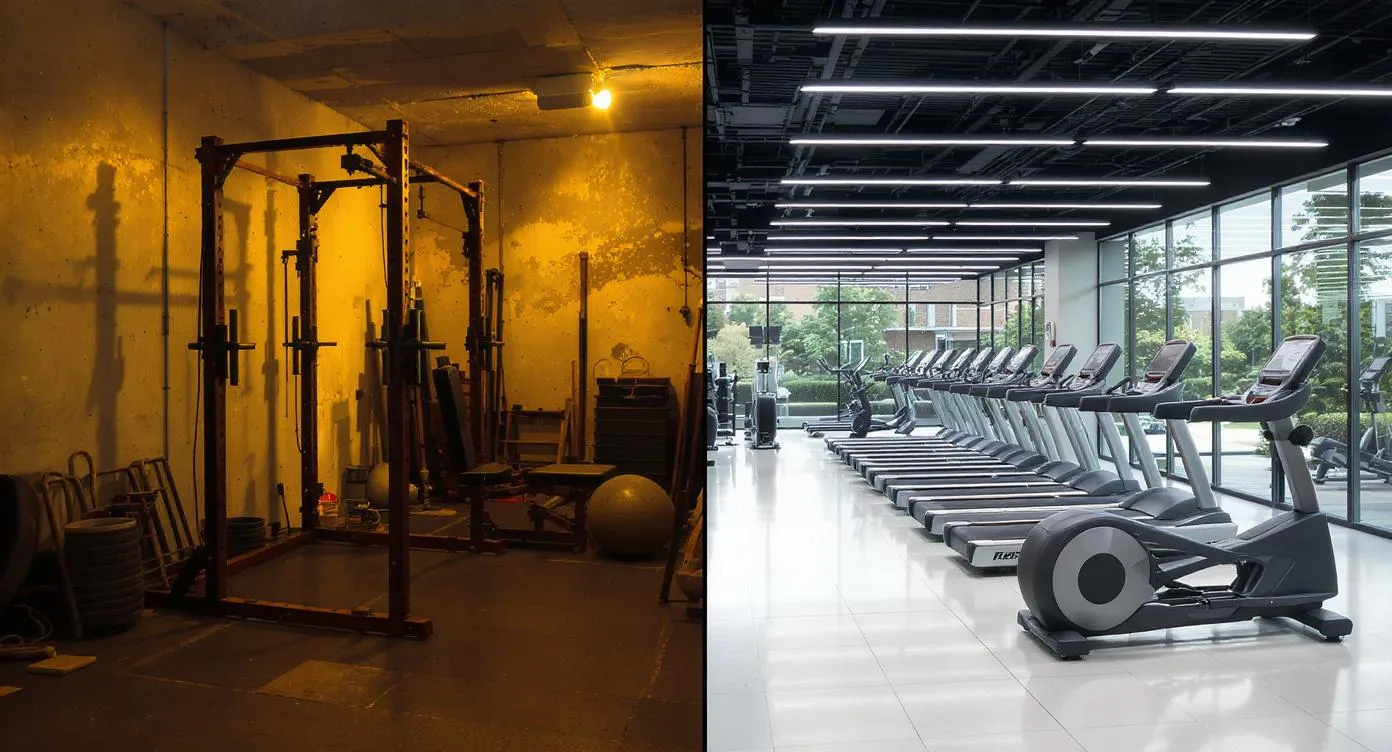
Home Gym vs Commercial Gym: The Real Cost Comparison (2026)
A brutally honest cost comparison between building a home gym and paying for a commercial gym membership. The math might surprise you.
A $1,000-$1,500 home gym pays for itself in 18-24 months compared to a mid-range gym membership, and saves you $10,000+ over 10 years — plus you eliminate commute time and never wait for equipment.
Every lifter reaches the same crossroad eventually: keep paying for a commercial gym membership, or invest in a home gym setup. The internet is full of surface-level takes on this decision, but most of them skip the hidden costs, ignore long-term math, and gloss over the lifestyle factors that actually determine which option wins for you.
We spent months collecting real cost data from gym owners, commercial gym members, and equipment retailers to build the most comprehensive comparison available. Whether you are considering a bare-bones garage setup or debating whether your Planet Fitness membership is truly worth the "savings," this guide lays out every dollar, every hour, and every trade-off so you can make a decision backed by evidence rather than opinion.
Understanding the True Cost of a Commercial Gym Membership
Most people calculate their gym cost as the monthly fee and nothing else. That is a critical mistake. The real cost of going to a commercial gym includes direct expenses, indirect expenses, and opportunity costs that compound over years.
Direct Monthly Expenses
The table below breaks down what members actually spend across three common gym tiers: budget chains like Planet Fitness, mid-range clubs like LA Fitness or Crunch, and premium facilities like Equinox or Lifetime Fitness.
| Expense | Budget Gym | Mid-Range Gym | Premium Gym |
|---|---|---|---|
| Monthly membership fee | $10 - $25 | $40 - $70 | $100 - $200+ |
| Enrollment/annual fee (amortized monthly) | $3 - $5 | $5 - $8 | $10 - $25 |
| Gas/commute (avg 10 mi round trip, 4x/week) | $28 - $35 | $28 - $35 | $28 - $35 |
| Parking (urban locations) | $0 | $0 - $15 | $20 - $50 |
| Gym bag essentials (lock, towel service, etc.) | $5 | $5 - $10 | $10 - $20 |
| Realistic monthly total | $50 - $70 | $80 - $140 | $170 - $330 |
Notice how the budget gym that advertises $10/month actually costs $50-$70 when you factor in the real expenses. That $10 sign on the door is a marketing number, not your actual cost of training.
The Annual Fee Increase Problem
Commercial gyms raise prices. According to industry data, the average annual membership increase runs between 3% and 7%. A $50/month mid-range membership today becomes $67/month in five years and $90/month in ten years at a 6% annual increase. Most break-even calculators ignore this escalation entirely, which makes the commercial gym look cheaper than it actually is over time.
Cumulative Commercial Gym Costs Over Time
| Timeframe | Budget Gym (with increases) | Mid-Range Gym (with increases) | Premium Gym (with increases) |
|---|---|---|---|
| 1 year | $720 - $840 | $960 - $1,680 | $2,040 - $3,960 |
| 3 years | $2,290 - $2,670 | $3,050 - $5,340 | $6,490 - $12,590 |
| 5 years | $4,060 - $4,730 | $5,410 - $9,470 | $11,500 - $22,320 |
| 10 years | $9,470 - $11,030 | $12,620 - $22,080 | $26,810 - $52,040 |
These numbers assume a conservative 5% annual increase. The 10-year cost of even a budget gym membership lands in the $9,000-$11,000 range. That buys an exceptional home gym with equipment that still has decades of useful life remaining.

ULTRA FUEGO Power Cage, Multi-Functional Power Rack
Capacity
800 lbs
Steel
2x2" 14-Gauge Steel
Footprint
50.5" L x 46.5" W x 83.5" H
Price
$389.98
- 4.5+ star rating on Amazon with 5,000+ reviews
- Excellent value under $350
- 800 lb weight capacity
- Includes multi-grip pull-up bar
- Standard 2x2 hole spacing for attachments
- Optional lat pulldown attachment available
- 14-gauge steel is thinner than premium racks
- Plastic J-cup liners can wear over time
- Not ideal for lifters squatting 600+ lbs
Price and availability may change

FLYBIRD WB2 Weight Bench, Utility Adjustable Weight Bench
Capacity
800 lbs (ASTM Certified)
Steel
Commercial-Grade Steel Frame
Footprint
48.4" L x 16.5" W x 17" H (folded)
Price
$109.99
- 4.6+ star rating on Amazon with 25,000+ reviews
- Unbeatable value under $120
- ASTM-certified 800 lb weight capacity
- 8 backrest angles (90° to -30° FID)
- Folds flat for easy storage in small spaces
- Quick 10-minute assembly
- Gap between seat and backrest at steep inclines
- No decline position on some variants
- Pad is narrower (10.2") than premium benches (12")
- Feet can slide on smooth concrete without rubber mats
Price and availability may change
The True Cost of Building a Home Gym
Building a home gym is a front-loaded investment. You pay the bulk upfront, then ongoing costs drop to almost nothing. The key is understanding what each tier of build actually gets you and how the long-term math works.
Tier 1: The Essentials Build ($500 - $700)
This build covers the fundamental movements that drive 80% of all strength and muscle gains. If you follow a program like Starting Strength, StrongLifts 5x5, or any basic linear progression, this setup handles everything.
Essentials Build Checklist
5 itemsTotal estimated cost: $505 - $740
This setup lets you squat, bench (floor press without a bench), deadlift, overhead press, barbell row, and do pull-ups. It covers every major muscle group with compound movements that have been the backbone of strength training for over a century.
Tier 2: The Complete Build ($1,000 - $1,500)
This is the sweet spot for most lifters. You get everything in Tier 1 plus the accessories that make training more comfortable, versatile, and enjoyable.
Complete Build Checklist
7 itemsTotal estimated cost: $915 - $1,350
With this build, you can run virtually any barbell-based program: 5/3/1, GZCLP, nSuns, PPL splits, or full-body routines. The adjustable bench opens up incline pressing, dumbbell work (if you add dumbbells later), and seated overhead pressing. For a deeper dive on selecting your rack, check our complete power rack buying guide.
Tier 3: The Premium Build ($2,000 - $3,500)
This build matches or exceeds what most commercial gyms offer for barbell and functional training. It adds cardio equipment, specialty items, and quality-of-life upgrades that make your garage gym a genuinely elite training facility.
Premium Build Checklist
9 itemsTotal estimated cost: $2,150 - $3,900
This tier gives you compound barbell work, isolation-friendly dumbbell and cable exercises, cardio conditioning, and specialty movements. For guidance on choosing the right cardio equipment, see our cardio machine selection guide.
Ongoing Annual Home Gym Costs
Once your gym is built, the annual running costs are remarkably low.
| Expense | Annual Cost |
|---|---|
| Additional plates or accessories | $50 - $200 |
| Electricity (fans, heater, lights, cardio) | $60 - $150 |
| Barbell and equipment maintenance | $15 - $30 |
| Replacement parts (bands, grips, etc.) | $20 - $50 |
| Annual total | $145 - $430 |
The high end of that range assumes you are actively expanding your gym each year. A mature setup where you are not adding equipment runs about $100-$150 per year total. For tips on keeping your equipment in peak condition, read our barbell maintenance guide.
The Break-Even Analysis: When Your Home Gym Pays for Itself
This is the section that changes minds. We calculated the break-even point for each home gym tier against each commercial gym tier, including ongoing home gym costs and a 5% annual membership increase.
Essentials Build ($600 avg) Break-Even
- vs Budget Gym ($65/month effective): 10 months
- vs Mid-Range Gym ($110/month effective): 6 months
- vs Premium Gym ($250/month effective): 3 months
Complete Build ($1,150 avg) Break-Even
- vs Budget Gym ($65/month effective): 19 months
- vs Mid-Range Gym ($110/month effective): 11 months
- vs Premium Gym ($250/month effective): 5 months
Premium Build ($3,000 avg) Break-Even
- vs Budget Gym ($65/month effective): 52 months (4.3 years)
- vs Mid-Range Gym ($110/month effective): 30 months (2.5 years)
- vs Premium Gym ($250/month effective): 13 months
The bottom line: Even the most expensive home gym build pays for itself within 2.5 years compared to a mid-range gym membership. The Complete Build — the tier we recommend to most people — breaks even in under a year against anything above a basic budget gym.
After break-even, every month is pure savings. Over a 10-year span, the Complete Build saves you $8,000 to $20,000+ compared to commercial gym memberships, depending on the tier.
Home Gym Pros and Cons
- No monthly fees after initial investment — equipment pays for itself within 1-2 years
- Zero commute time saves 100+ hours per year and eliminates transportation costs
- Train on your schedule — 4 AM, midnight, holidays, no blackout dates ever
- No waiting for equipment during peak hours, which saves 30-60 minutes per session
- Complete control over music, temperature, equipment selection, and training environment
- Equipment holds 60-80% resale value — Rogue, Rep, and Titan gear sells quickly on secondary markets
- No contracts, cancellation fees, or hidden annual charges
- Hygienic environment — your equipment, your cleanliness standards
- Family members train free, effectively multiplying the cost savings
- Build equity in physical assets rather than paying a recurring expense with zero return
- Requires upfront capital investment of $500-$3,000+ depending on build tier
- Needs dedicated space — minimum 100 sq ft for a basic setup, 150-200 sq ft ideal
- Limited machine variety unless you invest heavily in specialty equipment
- No pool, sauna, basketball court, or group fitness classes
- Self-motivation required — no training partners or gym atmosphere to push you
- Temperature control in garages can be challenging in extreme climates
- Potential noise issues with neighbors if deadlifting or using bumper plates
- Maintenance responsibility falls entirely on you
- Risk of outgrowing your setup as training goals evolve
Commercial Gym Pros and Cons
- Massive equipment variety including machines, cables, and specialty stations
- Social environment and potential training partners for motivation and spotting
- Pool, sauna, group classes, and other amenities depending on membership tier
- No space requirements in your home
- Climate-controlled year-round regardless of weather
- Staff available for equipment maintenance and facility cleaning
- Trial memberships let you test before committing long-term
- Good option for beginners who are still exploring different training styles
- Recurring monthly cost that never ends — you never own anything
- Commute time adds up to 100+ hours per year at average distances
- Peak-hour crowding means waiting 10-20 minutes for popular equipment
- Annual fee increases of 3-7% compound significantly over time
- Binding contracts with cancellation fees at many facilities
- Equipment cleanliness depends on other members and gym staff
- Limited training hours — closed on holidays, reduced weekend hours
- Music, temperature, and atmosphere controlled by the facility, not you
- No resale value — every dollar spent is gone permanently
The Hidden Value Factors Most Comparisons Ignore
Time Is Your Most Valuable Asset
The average gym-goer commutes 15-20 minutes each way. Training four times per week, that is 2 to 2.5 hours of weekly commute time. Over a year, you spend 104 to 130 hours — roughly five and a half full days — driving back and forth.
Over ten years, that is 1,040 to 1,300 hours sitting in your car. At even a modest $25/hour valuation of your time, that commute has a hidden cost of $2,600 to $3,250 per year, or $26,000 to $32,500 over a decade. Add that to the actual membership cost and the commercial gym becomes dramatically more expensive than the sticker price suggests.
A home gym commute? Walk to your garage or spare room. Thirty seconds, tops.
The Waiting Game Kills Workout Quality
Commercial gym peak hours — typically 5-7 PM on weekdays and Saturday mornings — create equipment bottlenecks that wreck training efficiency. Waiting 10-15 minutes for a squat rack or bench press adds up to 40 to 80 additional hours per year spent standing around. Worse, these forced rest periods disrupt your programming. Supersets become impossible, rest periods become unpredictable, and workout duration balloons from 60 minutes to 90+.
In a home gym, you walk to the rack and start lifting. Period.
Resale Value: The Factor Nobody Talks About
Quality gym equipment is one of the few consumer purchases that retains significant value. A Rogue Ohio Power Bar purchased for $295 resells for $200-$240 on the used market. Iron plates sell for $0.50-$0.75 per pound used, compared to $1.00-$1.50 per pound new. Power racks from reputable brands like Rep Fitness, Titan, and Rogue hold 50-70% of their retail value for years.
If you ever decide to sell your home gym, you recover a substantial portion of your investment. A commercial gym membership? Every dollar you have paid is gone. There is no refund, no residual value, and nothing to show for years of payments.
Family Multiplier Effect
A home gym membership is free for everyone in your household. If your partner, teenager, or parent also trains, you are effectively doubling or tripling the cost savings. Two people paying $50/month each for a mid-range gym spend $1,200/year. Three people spend $1,800. That Complete Build pays for itself in under six months when two people use it, and the ongoing savings are enormous.
When a Commercial Gym Is the Better Choice
Honesty matters more than ideology. There are legitimate situations where a commercial gym membership makes more sense than a home setup.
You need specialized machines. If your training demands leg presses, hack squats, cable crossovers, lat pulldown stacks, or other plate-loaded machines that cost $1,000+ individually, a commercial gym provides access to $50,000-$100,000 worth of equipment for a fraction of the cost.
You train for a social sport. CrossFit competitors, powerlifting meet prep athletes, and Olympic weightlifters often benefit from training partners, coaching, and the competitive atmosphere of a gym. The energy of training around other serious lifters is real and hard to replicate at home.
You genuinely lack space. Apartment dwellers, renters with no garage, and anyone sharing tight living quarters may not have the 100-150 square feet needed for even a minimal setup. If this is you, explore our guide on home gym solutions for small spaces before ruling it out entirely — creative solutions exist.
You are a true beginner. If you have never touched a barbell, spending a few months at a commercial gym to learn movement patterns with available mirrors, experienced lifters nearby, and potentially a personal trainer can be a wise investment before building your own setup.
You want amenities beyond weights. Swimming pools, hot tubs, basketball courts, saunas, and group fitness classes are legitimate features that a home gym cannot replicate without major construction.
How to Decide: A Practical Framework
Still unsure? Run through this decision checklist.
Choose a home gym if:
- You train primarily with barbells, dumbbells, and bodyweight
- You have at least 100 square feet of usable space (a single-car garage works)
- You are self-motivated and train consistently without external accountability
- You value time efficiency and hate commuting
- You plan to train for 2+ years (the longer your horizon, the bigger the savings)
- Privacy and schedule flexibility matter to you
Choose a commercial gym if:
- You need machine variety that would cost $5,000+ to replicate
- Social motivation is essential for your consistency
- You rent and move frequently (equipment moving is costly and tedious)
- You want amenities like pools, courts, or group classes
- Your training phase is exploratory and you have not settled on a style
Consider a hybrid approach if:
- You want a basic home setup for main lifts and a cheap gym membership for machines
- You travel frequently and need gym access on the road
- You train with a group but also want solo sessions on off days
The hybrid model — a Tier 1 or Tier 2 home gym plus a $10/month Planet Fitness membership for occasional machine work — gives you the best of both worlds for a modest total investment.
Making Your Home Gym Investment Last
If you decide to build a home gym, protect your investment with smart purchasing and maintenance habits.
Buy quality on the essentials. Your barbell and rack are the foundation of every workout. A cheap barbell with poor knurling, whip, and sleeve spin will frustrate you within months. Spend 60-70% of your budget on the bar, rack, and plates. You can always upgrade accessories later.
Start with iron, upgrade to bumpers later. Cast iron plates are significantly cheaper per pound than bumper plates and work perfectly for most training. Unless you are doing Olympic lifts and need to drop the bar from overhead, iron plates are the smarter first purchase.
Maintain your equipment. A light coat of 3-in-1 oil on your barbell sleeves and shaft every 2-4 weeks prevents rust and keeps the spin smooth. Wipe down your bench pad after every session. Tighten rack bolts quarterly. Basic maintenance extends equipment life by decades — literally.
Buy used strategically. The secondhand market for gym equipment is robust. Facebook Marketplace, Craigslist, and OfferUp regularly have quality barbells, plates, and racks at 40-60% of retail. Inspect for rust, check barbell straightness by rolling on a flat surface, and test rack welds before buying. Our guide to buying used gym equipment covers the full process.
Control your climate. Extreme heat and cold affect both your training and your equipment. Bare steel barbells rust faster in humid environments. Rubber flooring off-gasses more in heat. A basic fan for summer and a space heater for winter keep your garage gym usable year-round without major expense.
The 10-Year Projection: Final Numbers
Let us put it all together with a realistic 10-year comparison that includes everything: membership escalation, commute costs, ongoing home gym maintenance, and equipment expansion.
| Category | Commercial Mid-Range Gym | Home Gym (Complete Build) |
|---|---|---|
| Year 1 costs | $1,320 | $1,350 (build + maintenance) |
| Year 2 costs | $1,386 | $200 (maintenance + small additions) |
| Year 3 costs | $1,455 | $200 |
| Year 5 cumulative | $7,326 | $1,950 |
| Year 10 cumulative | $16,580 | $3,350 |
| Total 10-year savings | — | $13,230 |
| Resale value of equipment | $0 | $600 - $900 |
| Net 10-year advantage | — | $13,830 - $14,130 |
The home gym saves over $13,000 across a decade compared to a mid-range commercial gym, and that is a conservative estimate. Against a premium gym, the savings approach $30,000-$40,000.
The Verdict
For anyone who trains primarily with barbells, dumbbells, and basic equipment — which describes the vast majority of strength trainees, powerlifters, and general fitness enthusiasts — a home gym saves money within 1-2 years and saves time from day one.
The Complete Build tier ($1,000-$1,500) is the recommendation for most people. It breaks even against a mid-range commercial membership in about 11 months, provides a fully capable training environment for virtually any barbell program, and immediately eliminates 100+ hours of annual commute time.
The question is not whether you can afford a home gym. It is whether you can afford to keep paying a commercial gym $150-$300 per month — indefinitely, with annual increases — for equipment you will never own, in a facility you have to drive to, during hours someone else sets, surrounded by people you did not invite.
Your money. Your time. Your training. Own all three.
Frequently Asked Questions
How long does it take for a home gym to pay for itself?
What is the minimum space needed for a home gym?
Can I get a good workout with a home gym compared to a commercial gym?
What do commercial gyms offer that a home gym cannot match?
Does home gym equipment hold its resale value?
Is it hard to stay motivated training alone at home?
What is the best budget for a first home gym?
Should I buy new or used gym equipment?
Additional Resources
Related Content
Marcus Reid
Powerlifter and mechanical engineer who has been building and breaking home gym equipment for 15 years.
Read full bioMore in Guides
Strength vs Hypertrophy: How to Program for Your Goals (2026)
The definitive guide to programming for strength vs size in your home gym. Rep ranges, volume, intensity, and complete programs for both goals.
The Complete Home Gym Warm-Up Guide (2026)
Stop skipping your warm-up. Complete warm-up protocols for every training style, plus the equipment that makes preparation effortless at home.
Home Gym Deload Guide: When and How to Back Off (2026)
Learn when and how to deload in your home gym. Science-backed protocols, recovery strategies, and signs you need a rest week.