Garage Gym Lighting Guide: Best Lights for Training (2026)
How to light your garage gym properly. Best LED shop lights, placement tips, and budget-friendly setups for safe, motivating training.
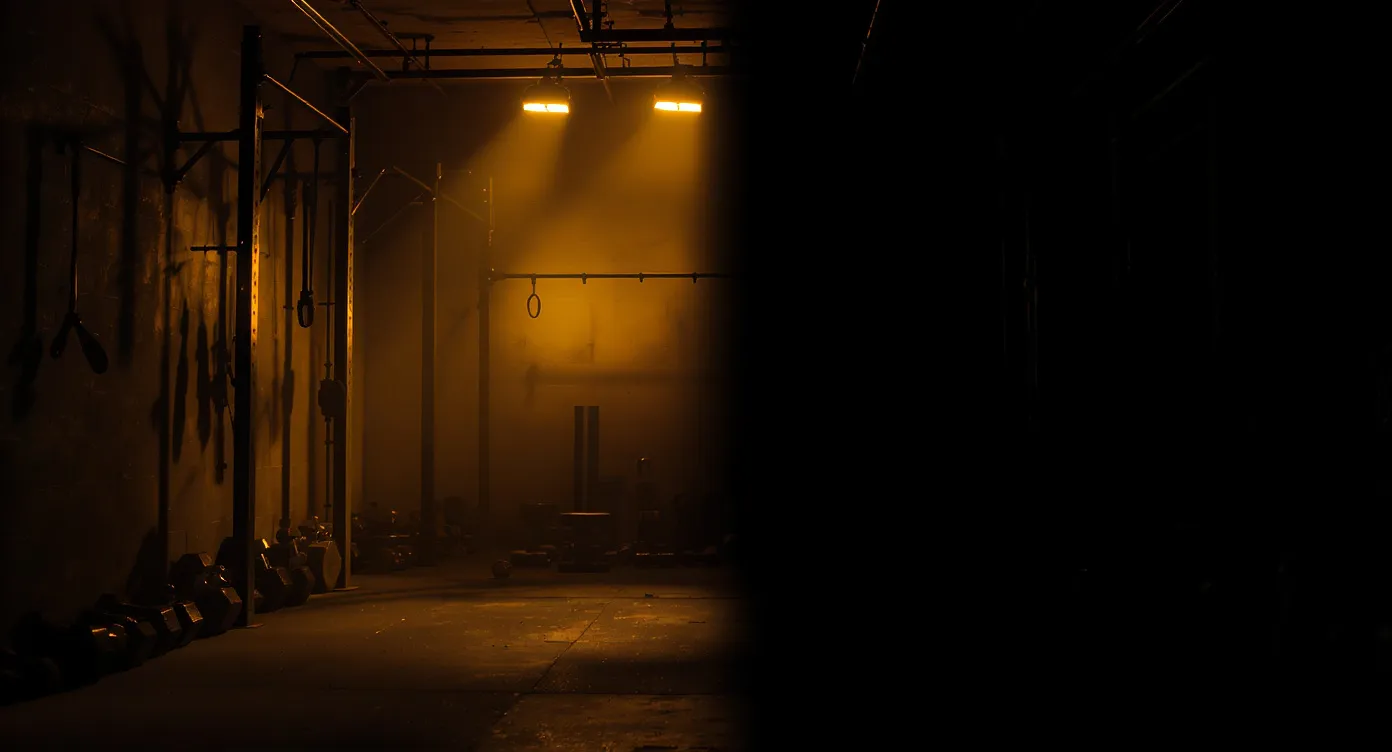
A single 60-watt incandescent bulb hanging from the center of your garage produces roughly 800 lumens of warm, yellowish light. That is about 5% of what you actually need to train safely. Poor lighting causes missed rack holes, misjudged barbell paths, and tripping hazards from plates left on the floor. It also makes your gym feel like a storage unit rather than a training facility. The fix is straightforward, costs under $150, and takes less than an hour to install.
This guide covers everything: how many lumens you need per square foot, the best LED shop lights by brand and model, placement strategies for every gym layout, wiring considerations, and smart upgrades that take your garage gym from functional to elite.
Why Garage Gym Lighting Matters More Than You Think
Lighting is one of the most underrated aspects of a home gym build. Most lifters obsess over barbells, racks, and flooring but train under lighting that would fail a basic workplace safety inspection. Here is why it deserves your attention.
Safety and Injury Prevention
The National Safety Council identifies poor lighting as a leading environmental factor in workplace injuries. Your garage gym is no different. You need to clearly see barbell knurl marks for hand placement, count rack holes when setting J-cups or safeties, spot trip hazards like stray resistance bands and fractional plates, and read the numbers on change plates. At minimum, you need 30 lumens per square foot for active training areas. For comparison, most commercial gyms run 40-50 lumens per square foot.
Training Performance and Motivation
Research in environmental psychology consistently shows that bright, daylight-temperature lighting increases alertness, energy, and perceived effort capacity. A study published in the Journal of Environmental Psychology (Knez, 2001) found that participants reported higher motivation and lower perceived exertion under 5,000K lighting compared to 3,000K warm light. Your garage gym should feel like a place you want to train, not a dungeon you tolerate.
Video and Form Check Quality
If you record lifts for form analysis or post training content, lighting is the single biggest factor in video quality — more than camera resolution or lens quality. Overhead 5,000K LED lighting eliminates the orange color cast from incandescent bulbs and provides even illumination that smartphone cameras handle well. Two well-placed shop lights will make your iPhone footage look better than a $2,000 camera in a dimly lit gym.

Fab Glass and Mirror Large Gym Mirror for Home Gym 48x32 - Full Length HD Tempered Glass Wall Panel - Professional Workout Display with Safety Backing - 1/4 Inch Commercial Grade
Capacity
N/A — wall-mounted mirror
Steel
1/4" Tempered Glass / Safety Backing
Footprint
48" x 32" (mount 2-3 for full wall)
Price
$119.94
- 4.4+ star rating on Amazon
- 6mm tempered glass — shatter-resistant
- Polished edges for safe handling
- 48x24 size — mount 2-3 for full wall coverage
- Form check on squats, deadlifts, and presses
- Best budget gym mirror on Amazon
- Mounting hardware not included
- Heavy — need two people to install
- Not truly shatterproof (tempered, not acrylic)
Price and availability may change
Understanding Light Specifications
Before buying anything, you need to understand four key specifications that determine whether a light is suitable for garage gym use.
Lumens (Brightness)
Lumens measure total light output. A standard 60-watt incandescent bulb produces about 800 lumens. A quality 4-foot LED shop light produces 4,000-5,500 lumens. For a standard two-car garage (roughly 400 square feet), you need 12,000-20,000 total lumens. For a single-car garage (roughly 200 square feet), aim for 6,000-10,000 total lumens.
Here is the math simplified: take your garage square footage, multiply by 30 for minimum or 50 for optimal, and that is your target lumen count. Then divide by the lumen output of your chosen light to get the number of fixtures.
Color Temperature (Kelvin)
Color temperature is measured in Kelvin (K) and determines how the light looks:
- 2,700-3,000K (Warm White) — yellowish, relaxed, like a living room lamp. Not ideal for training.
- 4,000K (Neutral White) — balanced, slightly warm. Acceptable but not optimal.
- 5,000K (Daylight) — bright, crisp, energizing. The gold standard for garage gyms.
- 6,500K (Cool Daylight) — very blue-white, clinical. Can feel harsh over long sessions.
Stick with 5,000K. It is bright enough to feel energizing, renders colors accurately for video, and does not cause the eye fatigue associated with 6,500K lighting.
Color Rendering Index (CRI)
CRI measures how accurately a light source renders colors compared to natural sunlight (CRI 100). For a garage gym, aim for CRI 80 or higher. Anything below 70 makes colors look washed out and gives skin an unflattering greenish tint on camera. Most quality LED shop lights from brands like Barrina, Hykolity, and Linkable score CRI 82-85.
Wattage and Efficiency
Modern LED shop lights consume 36-45 watts while producing 4,000-5,500 lumens. That means four lights draw roughly 150-180 watts total — less than a single old-school halogen shop light. Your electric bill impact for running four LEDs for 2 hours daily is about $1.50-2.00 per month at average U.S. electricity rates.
Best LED Shop Lights for Garage Gyms
After testing dozens of options and surveying hundreds of garage gym owners, these are the lights that consistently deliver the best combination of brightness, build quality, and value.
Barrina 4FT LED Shop Light (Best Overall)
The Barrina 4-foot integrated LED produces 4,400 lumens at 5,000K with a CRI of 82. It is linkable up to six units on a single daisy chain, meaning one outlet can power your entire gym lighting setup. Each fixture includes mounting hardware and connecting cables. At roughly $12-15 per light, a four-pack runs about $50-60.
Key specs: 44W, 4,400 lumens, 5,000K, CRI 82, linkable up to 6, 50,000-hour rated lifespan.
Hykolity 4FT LED Wraparound Light (Best Flush Mount)
If you have low ceilings (8 feet or under) and cannot sacrifice any headroom, the Hykolity wraparound mounts completely flush. It produces 4,800 lumens at 5,000K and has a wider beam angle than tubular shop lights, which means fewer dark spots between fixtures. The wraparound design also looks cleaner than exposed tube-style lights.
Key specs: 44W, 4,800 lumens, 5,000K, CRI 84, flush mount, 50,000-hour rated lifespan.
Sunco Lighting 4FT LED Utility Shop Light (Best Budget)
The Sunco utility light is a no-frills workhorse that delivers 4,100 lumens at 5,000K for around $10-12 per fixture. It uses a simple pull-chain on/off switch and plug-in power cord. Build quality is slightly below Barrina and Hykolity, but at this price point, you can buy six lights for under $70 and flood your garage with light.
Key specs: 40W, 4,100 lumens, 5,000K, CRI 80, pull chain, 45,000-hour rated lifespan.
Luxrite 4FT LED High Bay Light (Best for High Ceilings)
If your garage has 10-foot or higher ceilings (common in newer construction and RV garages), standard shop lights may not deliver enough focused light at floor level. The Luxrite high bay produces 13,000 lumens with a 120-degree beam angle designed to project light downward from height. One or two of these can replace four standard shop lights in a high-ceiling space.
Key specs: 100W, 13,000 lumens, 5,000K, CRI 85, chain-mount, motion sensor compatible.
- LED shop lights cost $10-15 each and last 50,000+ hours
- Installation requires zero electrical work for plug-in models
- Linkable designs mean one outlet can power 4-6 fixtures
- 5,000K daylight color temperature improves alertness and video quality
- Total energy cost is under $2 per month for a full setup
- Cheap LEDs can flicker, causing eye strain and headaches during long sessions
- Plug-in models require a nearby outlet or power strip
- Flush-mount options limit future height adjustments
- High-lumen lights directly overhead are blinding during bench press
How to Calculate Your Exact Lighting Needs
Use this formula to determine precisely how many lights your garage gym needs:
Step 1: Measure your garage floor area in square feet (length x width). A standard two-car garage is roughly 20 x 20 feet = 400 square feet. A single-car garage is roughly 12 x 20 feet = 240 square feet.
Step 2: Multiply square footage by your target lumens per square foot. Use 30 for minimum adequate lighting or 50 for bright, commercial-gym-level illumination.
- Single-car minimum: 240 x 30 = 7,200 lumens
- Single-car optimal: 240 x 50 = 12,000 lumens
- Two-car minimum: 400 x 30 = 12,000 lumens
- Two-car optimal: 400 x 50 = 20,000 lumens
Step 3: Divide your target lumens by the output of your chosen fixture.
- 12,000 lumens / 4,400 lumens per Barrina light = 2.7 lights (round up to 3)
- 20,000 lumens / 4,400 lumens per Barrina light = 4.5 lights (round up to 5)
Most garage gym owners land on 4 lights as the sweet spot. It provides ample coverage for a two-car garage and excellent coverage for a single-car space.
Placement Strategy: Where to Mount Your Lights
Buying the right lights is only half the equation. Placement determines whether you get even, shadow-free illumination or frustrating bright spots and dark zones.
Map Your Training Zones First
Before drilling a single hole, sketch your gym layout and identify your primary training zones. Most garage gyms have four: the power rack area, the bench press station, the deadlift or open floor zone, and the cardio or warm-up corner. Each zone needs direct overhead coverage. If you have already planned your gym flooring layout, use those zones as your lighting map.
Two-Light Setup (Minimum Viable Lighting)
Place two 4-foot LED lights parallel to the long axis of your garage, centered over your primary training area. Space them 6-8 feet apart. This setup provides roughly 8,800-10,000 lumens and is adequate for a single-car garage or a focused training area within a larger space. Mount them 2-3 feet apart from center to avoid a single bright stripe down the middle.
Four-Light Setup (Recommended Standard)
This is the configuration most garage gym owners should target. Arrange four lights in a rectangle pattern, with two rows of two lights. Space the rows 6-8 feet apart and offset the lights within each row by 4-6 feet. Center the rectangle over your primary training area. This delivers roughly 17,600-20,000 lumens of even, shadow-minimizing illumination.
Six-Light Setup (Full Coverage)
For two-car garages where you use the entire space, six lights arranged in a 2x3 or 3x2 grid provides wall-to-wall coverage with virtually no shadows. This is especially valuable if you have equipment spread across the full garage, including a cardio area, storage zone, and stretching space.
Critical Placement Rules
Offset lights from the bench press. This is the most common and most dangerous lighting mistake. A 5,000-lumen LED directly above your face while pressing 225 pounds overhead is blinding and hazardous. Mount lights 2-3 feet to either side of where your eyes are during bench press, or position them parallel to the bench rather than perpendicular.
Match lights to ceiling height. In a standard 8-foot ceiling garage, always flush-mount your lights. Hanging chains reduce clearance for overhead press, pull-ups, and kipping movements. If your ceiling is 9 feet or higher, you can use 6-12 inch chain drops for a more industrial look without clearance issues. Check our garage gym safety guide for overhead clearance recommendations.
Illuminate the mirror wall. If you have gym mirrors for form checks, position at least one light 2-3 feet in front of the mirror plane, angled slightly toward the glass. Mounting a light directly above or behind you while facing the mirror creates glare and hot spots that defeat the purpose.
Cover the garage door wall. When the garage door is down, you lose all natural light from that direction. Add dedicated lighting on the door side of your gym so brightness stays consistent regardless of whether the door is open or closed.
Do not neglect corners. Storage areas, plate trees, and accessory stations typically live in corners. A $10-15 plug-in LED puck light or short LED strip in each dark corner prevents tripping over plates, bands, and cables.
Electrical Considerations and Wiring
Plug-In vs. Hardwired Lights
For most garage gym owners, plug-in LED shop lights are the clear winner. They require zero electrical work, can be repositioned easily, and cost no more than hardwired alternatives. The only situation where hardwired fixtures make sense is if you want a clean, permanent installation with no visible cords and a wall switch controlling all lights simultaneously.
If you go hardwired, review our garage gym electrical setup guide for circuit planning and outlet placement.
Circuit Load Planning
Four 44-watt LED shop lights draw a total of 176 watts, which is roughly 1.5 amps on a standard 120V circuit. This is negligible. Even a dedicated 15-amp garage circuit can handle your lights plus a treadmill, fan, and phone charger simultaneously without approaching capacity. Lighting will never be the thing that trips your breaker.
Power Strip and Surge Protection
If you are linking multiple plug-in lights, use a quality surge-protecting power strip rated for at least 1,800 watts. Mount it to the wall or ceiling near your first light using screws or heavy-duty velcro. Keep the power strip accessible so you can easily reset it if needed. Avoid running extension cords across the floor where they become trip hazards.
Budget Lighting Setups by Price Tier
Under $60: The Essentials
| Item | Qty | Cost |
|---|---|---|
| Sunco 4FT LED Utility Light | 4 | $48 |
| Power strip with surge protection | 1 | $12 |
| Total | $60 |
This gets you roughly 16,400 lumens of 5,000K light, which meets the minimum standard for a two-car garage and exceeds it for a single-car.
Under $100: The Sweet Spot
| Item | Qty | Cost |
|---|---|---|
| Barrina 4FT LED Shop Light (4-pack) | 1 | $55 |
| LED puck lights for corners | 4 | $16 |
| Ceiling hooks and zip ties | 1 pack | $8 |
| Total | $79 |
This is the setup most garage gym owners should build. Four linkable Barrina lights give you 17,600 lumens of daisy-chained coverage plus corner illumination for storage areas.
Under $200: The Premium Setup
| Item | Qty | Cost |
|---|---|---|
| Hykolity 4FT LED Wraparound (6-pack) | 1 | $120 |
| RGB LED strip lighting (accent) | 1 kit | $30 |
| Smart plug with dimmer capability | 2 | $30 |
| Total | $180 |
Six wraparound flush-mount fixtures deliver 28,800 lumens of clean, even light with no exposed tubes. Add RGB accent strips behind mirrors or along baseboards for atmosphere, and smart plugs let you dim lights for stretching and mobility work.
Smart Lighting Upgrades
Once your core LED shop lights are installed, these upgrades add convenience and atmosphere without breaking the bank.
Dimmer Switches and Smart Plugs
A $15-20 smart plug with dimming capability lets you control brightness from your phone. Run lights at 100% for heavy compound lifts where visibility is critical, then dial down to 40-50% for stretching, yoga, or foam rolling sessions. Some lifters use dimming to simulate pre-competition warm-up room lighting conditions.
Motion Sensors
A plug-in motion sensor adapter ($10-15) turns your lights on automatically when you walk into the garage and off after a set period of inactivity. This is a small quality-of-life upgrade that eliminates fumbling for light switches with chalk-covered hands.
RGB LED Strip Lighting
LED strip kits ($20-40 for a quality 16-foot roll) add colored accent lighting around mirrors, under equipment, or along ceiling edges. While they provide minimal functional illumination, they dramatically change the atmosphere of your training space. Red lighting for intensity, blue for recovery sessions, or your favorite color for everyday motivation. These are purely aesthetic but undeniably effective at making your garage feel like a dedicated gym rather than a parking spot.
Smart Home Integration
If you use Amazon Alexa, Google Home, or Apple HomeKit, smart plugs let you voice-control your gym lights. Walk in, say "Alexa, gym lights on," and start training. Pair with a smart speaker for music and you have a fully voice-controlled training environment.
Maintaining Your Lighting Setup
LED shop lights are essentially maintenance-free, but a few habits will keep them performing at peak output for years.
Dust fixtures quarterly. Garage environments accumulate dust, chalk residue, and cobwebs faster than indoor spaces. A quick wipe with a dry microfiber cloth every three months keeps lumen output at its rated level. Heavy dust accumulation can reduce brightness by 15-20%.
Check connections annually. If you use linkable or daisy-chained lights, inspect the connecting cables once a year for wear, especially at the junction points. Vibration from heavy deadlifts and dropped weights can loosen plug connections over time.
Replace flickering lights immediately. LED flicker causes eye strain, headaches, and can trigger migraines in susceptible individuals. If a light starts flickering, it is failing and should be replaced. At $12-15 per fixture, this is not worth tolerating.
Test brightness with a smartphone app. Free lux meter apps like "Light Meter" (iOS) or "Lux Light Meter" (Android) let you measure actual illumination at floor level. Check annually and compare to your initial readings. If brightness has dropped more than 20%, it is time to replace that fixture.
Frequently Asked Questions
How many lumens do I need for a garage gym?
What color temperature is best for a garage gym?
Can I install LED shop lights myself?
How do I prevent lights from blinding me during bench press?
Are LED strip lights enough for a garage gym?
How much does it cost to run garage gym LED lights?
Additional Resources
The Bottom Line
Four to six 5,000K LED shop lights costing $50-120 total will transform your garage gym from a dim, uninspiring storage space into a bright, professional-feeling training facility. The Barrina 4FT linkable lights are the best all-around choice for most setups. Mount them in a rectangular grid pattern, offset from the bench press, and add corner puck lights for full coverage. The entire project takes 30-60 minutes and has an outsized impact on safety, motivation, and training quality.
Stop training in the dark. This is one of the cheapest, highest-impact upgrades you can make to your garage gym.
Related Content
Lena Park
Former NCAA Division I rower and USA Weightlifting coach. Specializes in conditioning equipment and women's training.
Read full bioMore in Guides
Strength vs Hypertrophy: How to Program for Your Goals (2026)
The definitive guide to programming for strength vs size in your home gym. Rep ranges, volume, intensity, and complete programs for both goals.
The Complete Home Gym Warm-Up Guide (2026)
Stop skipping your warm-up. Complete warm-up protocols for every training style, plus the equipment that makes preparation effortless at home.
Home Gym Deload Guide: When and How to Back Off (2026)
Learn when and how to deload in your home gym. Science-backed protocols, recovery strategies, and signs you need a rest week.