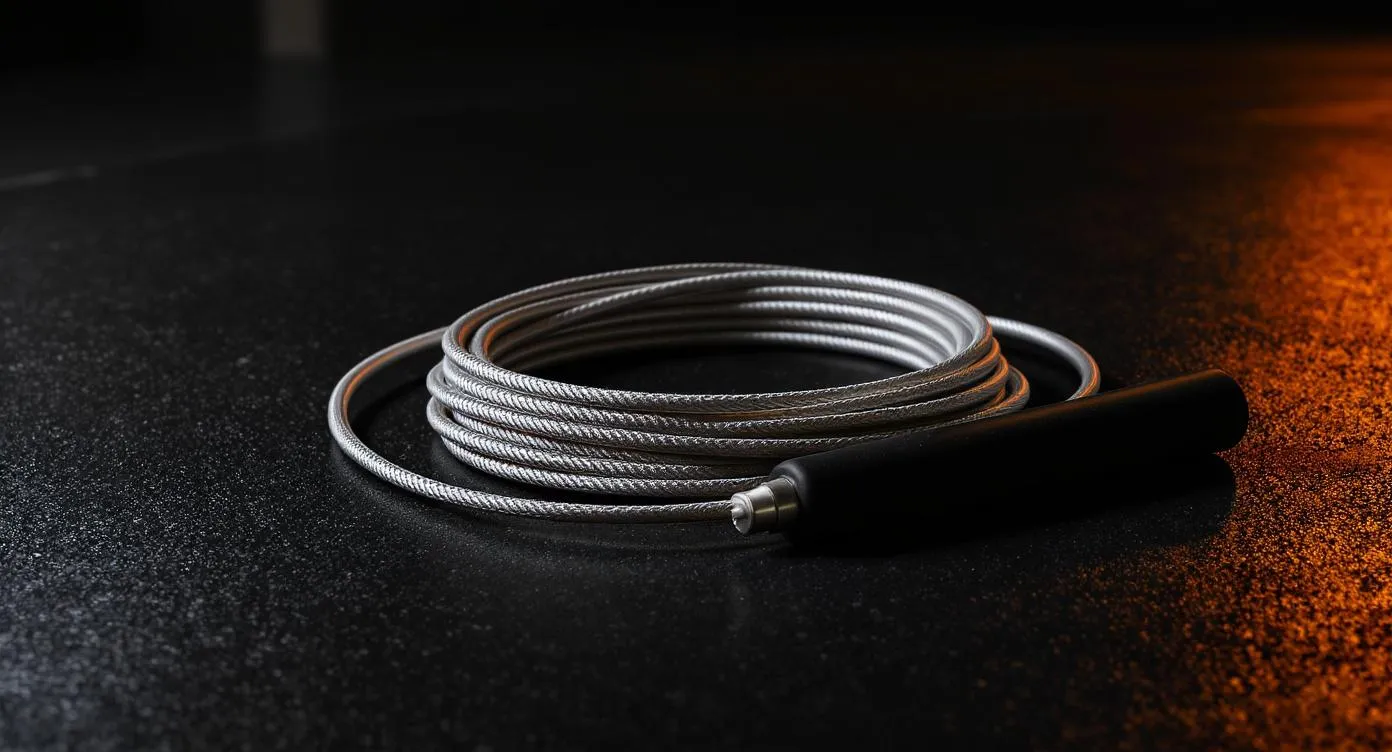
The Best Jump Ropes for Home Gym Conditioning (2026)
Speed ropes, weighted ropes, and beaded ropes compared. The best jump ropes for cardio, HIIT, warm-ups, and double-unders in your home gym.
A jump rope is the highest-ROI conditioning tool in any garage gym, period. No other piece of equipment delivers this much cardiovascular output per dollar. Ten minutes of moderate-intensity jump rope work burns roughly 120 to 150 calories, which is the metabolic equivalent of 20 to 25 minutes of steady-state jogging, while simultaneously training coordination, calf strength, shoulder endurance, wrist stability, and aerobic capacity. It fits in a gym bag, requires zero electricity, occupies zero permanent floor space, and works on any surface slightly larger than a yoga mat.
We have been testing jump ropes as warm-up tools, conditioning finishers, and standalone cardio sessions in our garage gym for over three years. During that time, we have burned through steel cable speed ropes, weighted ropes, beaded ropes, leather ropes, PVC speed ropes, and hybrid systems with interchangeable cables. We have tested them during CrossFit metcons, boxing-style three-round sessions, Tabata finishers after heavy squat days, HIIT intervals paired with kettlebell swings, and dedicated 20-minute steady-state sessions on active recovery days. Every recommendation on this page comes from that hands-on testing.
If you are building out a complete cardio setup in your home gym, check our best cardio machines for home gyms roundup for context on how jump ropes compare to rowers, air bikes, and other conditioning tools. For budget-focused builds, our guide to the best home gym accessories under $50 covers the jump rope alongside other high-value picks. And if you want to see how conditioning tools fit into a full garage gym plan, our best garage gym accessories guide maps out every essential category.
Head-to-Head Comparison
| Spec | WOD Nation Adjustable Speed Jump Rope |
|---|---|
| Capacity | Adjustable up to 11 ft |
| Steel | Alloy Steel Cable / Aluminum Handles |
| Footprint | Pocket-sized |
| Price | $17.99 |
| Buy | Check Price on Amazon Price and availability may change |
Why Every Home Gym Needs a Jump Rope
Most garage gym owners pour serious money into barbells, racks, and plates but neglect conditioning almost entirely. A $700 to $900 air bike solves that problem beautifully, but a $15 jump rope solves it just as effectively for a fraction of the cost and without surrendering a single square foot of floor space. Here is why a jump rope deserves a permanent spot next to your pull-up bar and chalk bucket.
Calorie burn per minute is elite across all exercise modalities. Harvard Health research consistently shows that a 155-pound person burns approximately 12 to 14 calories per minute jumping rope at moderate intensity, and up to 17 to 20 calories per minute at high intensity. That puts jump rope ahead of running (7 to 8 calories per minute at moderate pace), cycling (8 to 10), rowing (8 to 12), and most machine-based cardio options on a minute-for-minute basis. Only all-out sprinting and heavy sled pushes produce comparable calorie expenditure, and neither of those is sustainable for 10 to 20 continuous minutes. For home gym athletes who measure training value in calories burned per minute of effort, the jump rope is nearly unbeatable.
Coordination transfers to everything you do in the gym. Jump rope forces your central nervous system to synchronize hand timing, foot placement, breathing rhythm, body position, and spatial awareness simultaneously. That neurological demand is the reason boxers have relied on jump rope as a primary training tool for over a century. For strength athletes, this coordination transfers directly to athletic movements like power cleans, snatches, box jumps, and any movement requiring full-body timing. After three months of daily rope work, our athletes consistently report feeling more connected and coordinated during complex barbell movements.
Joint impact is surprisingly low when technique is correct. This is the fact that surprises most people. When performed correctly on a proper surface, jump rope actually produces less joint impact than running. Each hop is only 1 to 2 inches off the ground, compared to the 6 to 8 inches of vertical displacement in a running stride. The key is staying on the balls of your feet and using your wrists rather than your arms to turn the rope. If you have rubber gym flooring installed in your garage, you have the ideal surface for low-impact rope work. Even athletes with minor knee issues who cannot comfortably run often find that jump rope at moderate intensity causes zero knee discomfort.
Warm-ups become dramatically more effective. Three minutes of jump rope before a lifting session elevates your heart rate into the training zone, increases blood flow to every extremity, activates your calves and shoulders, lubricates your ankles, wrists and shoulder joints, and sharpens your mental focus. It is a more complete warm-up than five minutes on a stationary bike because it engages your entire body from feet to fingertips. We have made it standard protocol in our gym: three minutes of rope work before every single training session, no exceptions.
Portability is unmatched. A coiled speed rope weighs under four ounces and fits in a jacket pocket. When you travel, when you train outdoors, when the garage gym is occupied, or when you just want to squeeze in a quick conditioning session anywhere, nothing else even comes close. You carry your entire cardio solution in a zip-lock bag.
Types of Jump Ropes Explained
Not all jump ropes are created equal. Each type serves a distinct purpose, and understanding the differences will prevent you from buying the wrong rope for your training goals. After testing every major type across thousands of training sessions, here is what we have found.
Speed Rope ($10 to $30)
A speed rope uses a thin cable, usually coated steel wire or lightweight PVC, paired with ergonomic handles that spin on ball bearings. The design minimizes both air resistance and rotational friction, allowing the cable to move as fast as your wrists can drive it. Speed ropes are the standard for CrossFit, HIIT training, and any workout that involves double-unders, where the rope passes under your feet twice per single jump.
The best speed ropes have virtually zero dead spots in their rotation. You flick your wrist and the cable responds instantly with no lag, no catch, and no wobble. That responsiveness is what separates a $12 speed rope with real ball bearings from a $5 rope with plastic bushings that binds up after three weeks of use.
Best for: HIIT conditioning, CrossFit WODs, double-unders, Tabata finishers, pre-lifting warm-ups, and general cardio
What to look for: Ball-bearing handles (never bushings), adjustable cable length, coated steel cable (not bare wire which rusts and frays faster), and lightweight handles under 3 ounces each
Weighted Rope ($15 to $40)
Weighted ropes add resistance through heavier cables, weighted handles, or both. Cable weights typically range from 1/4 pound to 2 pounds for the full rope. The added mass slows the rotation speed but significantly increases the muscular demand on your shoulders, forearms, grip, and even your core as it stabilizes against the momentum of the heavier cable. Some premium systems like Crossrope use interchangeable weighted cables on a single handle set, which lets you switch between speed work and strength work without buying a second rope.
The conditioning effect of a weighted rope is noticeably different from a speed rope. After a three-minute round with a 1-pound weighted cable, your shoulders burn in a way that a speed rope never produces. For athletes who want their jump rope session to double as upper-body endurance work, weighted ropes are a legitimate tool. The trade-off is that double-unders are essentially impossible with a heavy cable, and the slower rotation makes it harder to maintain high-intensity intervals for extended periods.
Best for: Shoulder conditioning, grip endurance, calorie-burning emphasis, upper body warm-ups, building rope proficiency for beginners, and hybrid cardio-strength sessions
What to look for: Smooth handle rotation even with added weight, secure weight system with no rattling or shifting, adjustable length, and durable cable coating
Beaded Rope ($8 to $15)
A beaded rope is a nylon cord threaded through segmented plastic beads. The beads add moderate weight and air resistance, which slows the rope and provides both audible and tactile feedback. You can hear the beads clicking against the ground on each rotation and feel the momentum of the heavier segments through the handles. This feedback loop makes it dramatically easier for beginners to learn timing and rhythm because the rope tells you where it is in its rotation at every moment.
Beaded ropes are also the most durable option for outdoor use. The plastic beads slide harmlessly across rough concrete and asphalt surfaces that would shred a steel cable in weeks. If you plan to train outdoors frequently, a beaded rope will outlast any cable-based option by a factor of five.
Best for: Absolute beginners learning basic single-unders, rhythm training, outdoor use on rough surfaces, and recreational training
What to look for: Evenly sized and weighted beads, smooth rotation at the handle, adjustable length, and PVC beads rather than cheaper brittle plastic
Leather Rope ($10 to $25)
The classic boxing gym rope. Leather ropes have moderate weight, heavier than speed ropes but lighter than dedicated weighted ropes, and produce a satisfying whooshing sound during use. They require slightly more shoulder engagement than speed ropes and deliver a traditional training feel that many combat sport athletes prefer. The weight and feedback of a leather rope sit in a sweet spot between speed and weighted options.
The primary downside of leather is maintenance. Leather absorbs sweat, stiffens in cold temperatures (a real factor in unheated garages during winter), and can crack or degrade if stored improperly. A well-maintained leather rope lasts 1 to 2 years; a neglected one starts cracking within months.
Best for: Boxing-style steady-state conditioning, traditional warm-ups, moderate-intensity sessions, and athletes who prefer heavier tactile feedback
What to look for: Quality leather that does not crack or stiffen prematurely, swivel handles (never fixed), and appropriate length for your height
Our Top Pick: WOD Nation Speed Jump Rope

WOD Nation Adjustable Speed Jump Rope
Capacity
Adjustable up to 11 ft
Steel
Alloy Steel Cable / Aluminum Handles
Footprint
Pocket-sized
Price
$17.99
- 4.5+ star rating on Amazon with 14,000+ reviews
- Blazing-fast alloy steel speed cable
- Tool-free adjustable length up to 11 ft (wire cutter included)
- Smooth 360° ball-bearing rotation for double-unders
- Lightweight aluminum handles
- Great for boxing, MMA, and CrossFit conditioning
- Steel cable can fray on rough concrete over time
- Not weighted — pure speed rope (no strength training)
- Handles are slim — bigger hands may want grip tape
Price and availability may change
After testing multiple jump ropes across three years of daily garage gym training, the WOD Nation Speed Jump Rope remains our top recommendation for the vast majority of home gym owners. It costs under $15, spins flawlessly on precision ball bearings, adjusts up to 11 feet in length, and ships with a spare cable and replacement hardware in the box. With over 30,000 Amazon reviews and a 4.6-star average, the market consensus is overwhelming. This is the rope most people should buy.
Why It Wins
The WOD Nation rope nails every fundamental that matters in a speed rope better than competing options costing three to four times as much. The 360-degree ball-bearing rotation in each handle produces a smooth, consistent spin with virtually no dead spots, friction points, or wobble. During our double-under testing sessions, the rope maintained speed through rapid rotations without the cable binding or catching in the handles, which is a common failure point in ropes using bushings instead of true ball bearings.
The coated steel cable is thin enough for fast rotation (approximately 2.5mm diameter) but durable enough to survive daily use on rubber gym mats without noticeable degradation. We got 14 months of near-daily use out of our first cable before the coating showed enough wear to justify a swap, and the spare cable included in the package made that replacement a two-minute process with nothing more than a Phillips screwdriver. On rough concrete, cable life drops to 6 to 8 months, but that is true of literally every steel-cable speed rope on the market regardless of price point.
The lightweight aluminum handles sit comfortably in a neutral grip position and do not cause hand fatigue during longer conditioning sessions. At approximately 2.5 ounces per handle, they are light enough for sustained speed work but substantial enough that you maintain constant awareness of the rope's position during every rotation. The handle diameter is moderate, which works well for most hand sizes, though athletes with especially large hands sometimes add a thin wrap of athletic tape for a more secure grip.
Cable length adjustment is straightforward and tool-free for rough adjustments. You thread the cable through the handle to your desired length, secure it with the included set screw, and trim the excess with wire cutters. The system works reliably and holds position without slipping, even during aggressive double-under sessions where the cable sustains considerable centrifugal force.
- 4.6-star Amazon rating with over 30,000 verified reviews validates long-term reliability
- Ball-bearing handles produce smooth 360-degree rotation essential for double-unders
- Adjustable coated steel cable accommodates heights up to 6'6"
- Includes spare cable and replacement screws — zero downtime when your first cable wears out
- Under $15 makes it the single best value speed rope on the market
- Lightweight aluminum handles reduce hand fatigue during 10+ minute conditioning sessions
- Thin 2.5mm coated cable cuts through air with minimal drag for maximum speed
- Steel cable frays faster when used regularly on rough concrete or asphalt
- Not a weighted rope — provides no upper-body resistance training benefit
- Slim handle diameter may feel small for athletes with larger hands without grip tape
- Cable coating wears through at the ground contact point before the cable itself fails
- No carrying case or pouch included despite being an ideal travel rope
- Only one cable weight option — no interchangeable system for weighted work
Who Should Buy the WOD Nation
The WOD Nation Speed Jump Rope is the right choice for anyone who wants a reliable, fast-spinning rope for warm-ups, HIIT conditioning, double-unders, and general cardio. It is the best entry point for beginners who want to learn on a proper speed rope rather than outgrowing a beaded rope within weeks, and it is more than good enough for experienced athletes who do not need the premium interchangeable cable features of a $60+ system like Crossrope. Read our full WOD Nation Jump Rope review for our complete long-term testing breakdown. If you are considering a higher-end alternative, see our WOD Nation vs Crossrope comparison for a detailed head-to-head analysis.
Who Should Look Elsewhere
If your primary goal is shoulder conditioning and upper-body endurance rather than pure speed, a dedicated weighted rope system like Crossrope's Get Lean set will deliver more training stimulus per session. If you are an absolute beginner who has never jumped rope and want the gentlest possible learning curve, a beaded rope with audible feedback may be a better starting point for the first two to three weeks until basic timing clicks. And if you train exclusively on rough outdoor concrete, a beaded rope or PVC rope will outlast any steel cable option by a significant margin.
How to Size Your Jump Rope Correctly
Rope length is the single most important variable in jump rope performance, and getting it wrong creates problems that no amount of practice can fix. A rope that is too long creates an excessively wide arc, slows your rotation speed, and catches on your feet during faster work. A rope that is too short forces you to jump higher than necessary, wastes energy, tenses your shoulders upward, and limits your ability to learn advanced skills like double-unders and crossovers.
The Standard Sizing Method
- Stand on the center of the rope with one foot, keeping both feet together
- Pull both handles straight up along your body with the cable taut
- The handles should reach your armpits — this is the standard recreational and conditioning length
- For speed work and double-unders, shorten the cable so handles reach chest or nipple height
- For learning and casual conditioning, armpits or slightly above is ideal
- For weighted ropes, keep the length slightly longer than a speed rope — the heavier cable needs a wider arc to maintain smooth rotation
Height-Based Quick Reference
- Under 5'4": 8-foot rope
- 5'4" to 5'8": 8.5-foot rope
- 5'8" to 6'0": 9-foot rope
- 6'0" to 6'4": 9.5-foot rope
- Over 6'4": 10-foot rope
These are starting points, not absolutes. Body proportions, arm length, and personal preference all factor in. Most quality ropes ship at 10 to 11 feet with a cable cutter or instructions for trimming to your ideal length.
Pro Tip: Cut Gradually and Mark Your Length
Cut one inch at a time and test after each cut. You can always remove more cable, but you cannot add length back. Once you find your ideal length, mark it on the cable with a small piece of tape or permanent marker before cutting, so you can replicate the exact same length on replacement cables without re-measuring. If you own multiple ropes for different purposes, keep a note of your ideal length for each type.
Jump Rope Workouts for Home Gym Athletes
Jump rope is not just a warm-up tool. Programmed correctly, it replaces treadmill work entirely, builds legitimate cardiovascular capacity that transfers to every other training modality, and complements heavy lifting without adding meaningful recovery burden to your weekly programming. Here are the protocols we have tested and validated over three years of daily use.
Pre-Lifting Warm-Up (3 to 5 Minutes)
Use this before every lifting session to elevate heart rate and prime your nervous system. This protocol has replaced all other warm-up methods in our gym because it is faster, more complete, and more effective at preparing the body for heavy work.
- 2 minutes steady single-unders at conversational pace
- 30 seconds high knees (lift knees to hip height each jump)
- 30 seconds alternating feet (running in place while jumping)
- 30 seconds boxer shuffle (shift weight side to side)
- 1 minute steady pace cooldown to normalize breathing
HIIT Conditioning Finisher (10 Minutes)
Perform this after your main lifting work. The short intervals match the energy system demands of barbell sports, making it the ideal complement to sessions focused on Olympic barbells and heavy compound movements.
- Option A — Classic Intervals: 30 seconds max effort / 30 seconds complete rest x 10 rounds
- Option B — Aerobic Intervals: 1 minute moderate effort / 30 seconds rest x 7 rounds
- Option C — Active Recovery Intervals: 20 seconds sprint / 40 seconds light pace x 10 rounds (no full rest periods)
Steady-State Endurance (15 to 20 Minutes)
Maintain 100 to 120 rotations per minute for 15 to 20 minutes without stopping. This develops your aerobic base, improves recovery capacity between sets during heavy training days, and builds the mental endurance that carries over to grinding out difficult sets. Steady-state rope work is ideal for active recovery days when you want to move blood, promote healing, and maintain cardiovascular fitness without adding muscular fatigue or recovery debt. Keep your heart rate in zone 2, which for most athletes is 120 to 145 beats per minute.
Tabata Finisher (4 Minutes)
The most time-efficient conditioning protocol that exists. Four minutes of genuine Tabata effort after a heavy squat or deadlift session will humble any athlete regardless of fitness level.
- 20 seconds absolute all-out effort / 10 seconds complete rest x 8 rounds
- Total time: 4 minutes. Total suffering: maximum.
The key to making Tabata effective is truly going all-out during every 20-second work period. If you are not gasping by round 4, your intensity is too low. Use a speed rope, not a weighted rope, for this protocol.
Double-Under Skill Practice (10 Minutes)
If you are training for CrossFit or simply want to add double-unders to your skill set, dedicate focused practice sessions away from conditioning work. Attempting to learn double-unders when you are already fatigued from a WOD teaches bad habits.
- 5 single-unders, 1 double-under attempt — repeat for 3 minutes
- 3 single-unders, 1 double-under attempt — repeat for 3 minutes
- Attempt consecutive double-unders for 4 minutes (rest as needed between attempts)
The key to double-unders is wrist speed, not jump height. Keep your elbows pinned tight to your ribs, generate all rotation from your wrists, and jump only marginally higher than a single-under. Most failures come from athletes jumping too high and losing their core position mid-air.
Surface Selection: Where to Jump Rope in Your Home Gym
The surface you jump on directly affects joint health, cable longevity, training quality, and your ability to maintain rhythm over sustained sessions. This matters more than most people realize, and it is worth optimizing if you plan to make rope work a regular part of your training.
Best Surfaces (Ranked)
-
Rubber gym mats (3/8" to 3/4" thick) — The ideal surface for every metric. Absorbs impact on joints, provides excellent grip for footwork, and extends cable life by 50% or more compared to hard surfaces. If you already have gym flooring installed in your garage, you have the perfect jump rope surface. Even a single 4x6-foot stall mat dedicated to rope work is a worthwhile investment.
-
Hardwood or laminate flooring — Decent surface with some natural impact absorption. Can become slippery when wet with sweat. Place a thin rubber mat underneath for better grip and floor protection if you train indoors on wood floors.
-
Concrete (sealed or painted) — Works perfectly fine for the athlete but punishes the rope. Concrete wears through cable coatings faster than any other common surface. If your garage floor is bare concrete and you cannot justify full gym flooring, a single $40 rubber stall mat for rope work will pay for itself in cable replacements within months.
-
Interlocking foam tiles — Acceptable but not ideal. The soft surface absorbs too much energy from each landing, making sustained effort more tiring and disrupting your rhythm. Better than rough concrete for your joints, but worse for your technique.
Surfaces to Avoid
- Carpet: The cable catches in carpet fibers, destroying your rhythm and potentially damaging both the rope and the carpet
- Grass: Uneven surface makes consistent jumping nearly impossible, gets the cable wet and dirty, and hides tripping hazards
- Asphalt: Destroys cable coatings faster than concrete and the uneven texture catches the rope mid-rotation
- Loose gravel or dirt: Obvious problems with footing, cable damage, and consistency
Common Jump Rope Mistakes and How to Fix Them
After three years of daily rope work and helping dozens of athletes in our gym learn to jump rope from scratch, these are the most common errors we see. Every single one is fixable with focused attention and a few minutes of deliberate practice.
Jumping Too High
The problem: Most beginners instinctively jump 4 to 6 inches off the ground when the rope only needs 1 to 2 inches of clearance. This wastes enormous energy, increases joint impact forces, makes it impossible to sustain effort beyond a few minutes, and prevents you from developing the fast, efficient bounce that experienced jumpers use.
The fix: Focus on staying on the balls of your feet with minimal knee bend. Think of it as quick ankle bounces rather than jumps. The rope only needs a half-inch of clearance under your feet. Practice bouncing in place without the rope, keeping your heels just barely off the ground, until the movement feels natural.
Using Arms Instead of Wrists
The problem: Spinning the rope with large arm circles instead of small wrist rotations. This fatigues your shoulders in under two minutes, makes the rope arc too wide and slow, and makes double-unders essentially impossible.
The fix: Pin your elbows to your ribs and keep your upper arms nearly motionless. All rotation comes from your wrists and forearms. Imagine holding a pencil between your upper arm and your ribcage — it should not fall at any point during the session. This single correction typically adds 30 to 60 seconds of sustainable effort for beginners.
Looking Down at Your Feet
The problem: Staring at the ground to watch the rope pass under your feet. This rounds your upper back, shifts your center of gravity forward, disrupts your breathing mechanics, and paradoxically makes tripping more likely because it changes your posture.
The fix: Look straight ahead at a fixed point on the wall at eye level. Trust your timing. The rope will be where it needs to be. If you struggle with this, practice jumping in front of a mirror so you can see your form without looking down.
Wrong Rope Length
The problem: Using a rope that is too long (creating a wide, slow, floppy arc that catches on your toes) or too short (forcing you to jump higher and hunch your shoulders forward to compensate).
The fix: Follow the sizing guide above and take the time to adjust properly. When in doubt, start slightly longer and shorten incrementally. Spending 10 minutes dialing in your rope length will save you weeks of frustration.
Tensing Your Entire Upper Body
The problem: Gripping the handles in a death grip and clenching your jaw, neck, and shoulders. This creates rapid fatigue and eliminates the relaxed, fluid motion that efficient rope jumping requires.
The fix: Hold the handles with a firm but relaxed grip, similar to how you would hold a hammer. Keep your jaw unclenched, your neck relaxed, and your shoulders dropped. Breathe rhythmically through your nose on easier intervals. Tension is the enemy of endurance in rope work.
Jump Rope vs Other Cardio Equipment
For home gym owners deciding where to allocate their conditioning budget, here is how a jump rope compares against dedicated cardio machines based on our years of testing both.
Jump Rope vs Air Bike
An air bike delivers more intense full-body conditioning per session and is easier to sustain at high outputs because you are seated and supported. The fan resistance automatically scales with effort, making it extremely effective for interval training. But a quality air bike costs $700 to $900, weighs 100+ pounds, and claims a permanent 4x2-foot footprint in your gym. A jump rope delivers roughly 80% of the conditioning benefit for 2% of the cost and 0% of the space. If budget allows, own both. If it does not, the jump rope wins overwhelmingly on value.
Jump Rope vs Rowing Machine
A rowing machine provides superior posterior chain engagement and remains the best low-impact cardio option for athletes with chronic knee or ankle issues that make any impact-based exercise uncomfortable. But quality rowers start at $200 for budget models and $900+ for the gold standard Concept2 Model D. A jump rope builds comparable cardiovascular fitness with superior coordination training, at a fraction of the cost and without any permanent footprint.
Jump Rope vs Running
Running requires zero equipment but puts significantly more impact stress on knees, hips, and ankles over time. Jump rope burns more calories per minute at equivalent perceived effort, builds better hand-eye coordination, and can be done inside your garage in any weather at any hour. The trade-off is that running develops sport-specific endurance for distance events and is generally easier for most people to sustain at moderate intensity for 30+ minutes. For home gym athletes focused on general conditioning rather than distance running performance, jump rope is the superior tool.
Jump Rope vs Battle Rope
Battle ropes deliver intense upper-body and core conditioning but require an anchor point, a 25 to 50-foot clear lane, and cost $60 to $150. Jump rope provides equal or greater cardiovascular training in a more space-efficient format. Battle ropes have a slight edge for shoulder and grip hypertrophy, while jump rope wins on coordination, portability, and versatility.
Maintenance and Longevity Tips
A quality speed rope will last 1 to 2 years with daily use on rubber mats. Here is how to maximize that lifespan and avoid the frustration of a cable snapping during a conditioning session.
- Store it flat or hanging, never coiled tightly. Steel cable develops kinks when stored in a tight coil, and those kinks create dead spots in rotation that throw off your timing and accelerate cable failure
- Wipe down the cable after sweaty sessions. Salt from sweat accelerates corrosion on coated steel cables. A quick wipe with a dry cloth adds months of cable life
- Keep a spare cable on hand at all times. When your primary cable starts to fray at the ground contact point, swap it immediately. A fraying cable can snap mid-workout, and the whip from a snapped steel cable is genuinely painful
- Avoid rough surfaces whenever possible. Every session on bare concrete takes days off your cable's useful life. A single $20 rubber mat dedicated to rope work saves you from buying new cables every few months
- Check handle screws monthly. Ball-bearing handles can loosen slightly with sustained vibration. A quick finger-tighten prevents the cable from slipping out of the handle mid-session
- Rotate your ground contact point. If your cable always contacts the ground in the same spot, it wears unevenly. Periodically slide the cable through the handles to shift the contact point and distribute wear across a longer section of cable
Frequently Asked Questions
What type of jump rope is best for beginners?
How long should my jump rope be?
Is jumping rope better than running for cardio?
What surface should I jump rope on in my garage gym?
How often should I replace my jump rope cable?
Can I use a jump rope in an apartment without disturbing neighbors below?
How many calories does jumping rope burn per session?
Are weighted jump ropes worth buying?
How long does it take to learn double-unders?
Should I jump rope every day or take rest days?
Additional Resources
- ACSM Physical Activity Guidelines
- American Heart Association Fitness Guidelines
- ACE Cardio Machine Comparison
The Bottom Line
A $15 speed rope with ball-bearing handles and an adjustable steel cable is the highest-value cardio investment in any home gym, regardless of budget. It burns more calories per minute than almost any other exercise modality, requires zero permanent space, travels anywhere in a pocket, develops coordination that transfers to every other athletic movement, and lasts over a year with proper care on an appropriate surface.
The WOD Nation Speed Jump Rope remains our top recommendation after three years of continuous testing. It outperforms ropes costing three to four times as much on every metric that matters for daily conditioning work, and it ships with a spare cable so you are never without your cheapest, most effective training tool.
Start with three minutes before every lifting session as a warm-up. Add a 4-minute Tabata finisher once or twice per week. Within a month, you will wonder why you ever thought you needed a $1,500 treadmill when a $15 rope was the answer all along.
Related Content
- The Best Air Bikes for Home Gyms (2026 Tested)
- The Best Rowing Machines for Home Gyms (2026 Tested)
- The Best Cardio Machines for Home Gyms (2026)
- The Best Home Gym Accessories Under $50 (2026)
- WOD Nation vs Crossrope: Which Jump Rope Should You Buy?
- The Best Recovery Tools for Home Gym Athletes
- The Best Gym Flooring for Garage Gyms
Derek Walsh
Strongman competitor and former commercial gym equipment salesman. Knows what survives heavy daily use.
Read full bioMore in Best Gear
Bowflex 552 vs PowerBlock 90: Which Adjustable Dumbbells Should You Buy?
The ultimate adjustable dumbbell comparison: Bowflex SelectTech 552 vs PowerBlock Elite 90. We tested both — here's which one wins for your home gym.
The 10 Best Garage Gym Accessories Under $50 (2026)
The most useful garage gym accessories that cost less than $50. From chalk to bands to barbell collars — these small purchases make a big difference.
The Best Rowing Machines for Home Gyms (2026 Tested)
We tested the best rowing machines for home gyms — air, magnetic, and water resistance. Our picks for budget, mid-range, and premium.
You Might Also Like
Sunny Health SF-RW522016 Rower Review: The Best Rower Under $300
Hands-on review of the Sunny Health & Fitness SF-RW522016 magnetic rower. 25,000+ Amazon reviews and the best budget rower for home gyms.
Sunny Health SF-B1805 Indoor Cycling Bike Review: The Best Mid-Range Spin Bike?
After 4 months of daily rides on the Sunny SF-B1805 magnetic spin bike, here is our honest take on ride quality, noise levels, and durability at $699.99.
Schwinn Airdyne Bike Series Review: The Ultimate Home Gym Cardio Machine?
A brutally honest review of the Schwinn Airdyne Bike Series after 8 months of daily conditioning work. Is it worth $1,299.00?