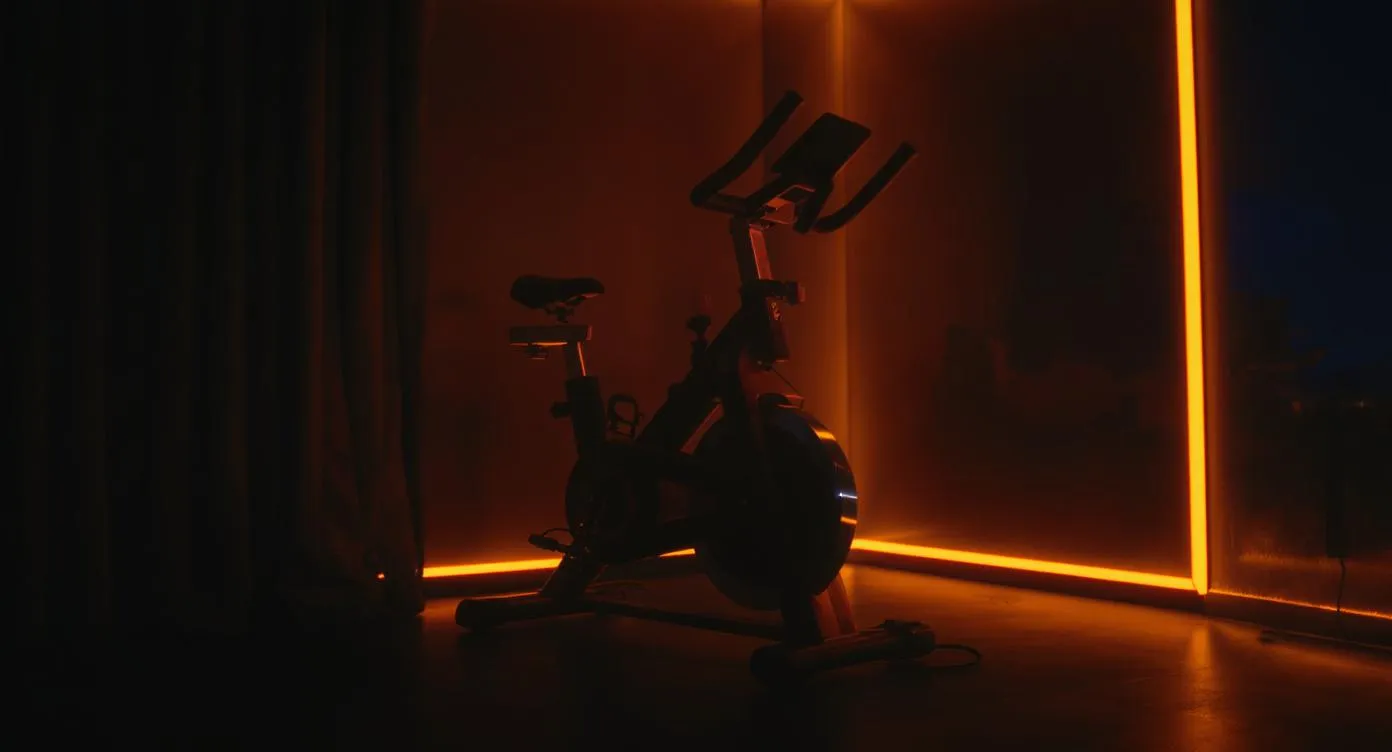
Sunny Health SF-B1805 Indoor Cycling Bike Review: The Best Mid-Range Spin Bike?
After 4 months of daily rides on the Sunny SF-B1805 magnetic spin bike, here is our honest take on ride quality, noise levels, and durability at $699.99.
There is a wasteland of cheap spin bikes on Amazon between $100 and $250. They use friction-pad resistance, plasticky cranks, and flywheels light enough to throw across the room. Then there is the Peloton at $1,445 or the Bowflex VeloCore at $1,699 — bikes that cost more than most people spend outfitting an entire garage gym. The Sunny Health & Fitness SF-B1805 sits right in the gap at $699.99, and after four months of riding it five to six days per week, I can tell you exactly who it is for and who should look elsewhere.
The headline feature is magnetic resistance. Instead of a felt pad grinding against the flywheel, the SF-B1805 uses magnets that never make physical contact. No friction, no pad replacement, no noise. Paired with a 44 lb chrome flywheel and a belt drive system, this bike delivers a ride that genuinely surprised me given the price. It is not a Peloton. But it might be 85 percent of one at half the cost.

Sunny Health & Fitness Magnetic Exercise Bike, 44LB Flywheel & 300LB Weight Capacity for Intensive Home Workout, Indoor Cardio Training w/4-Way Adjustable Seat, Optional Free SunnyFit App Connection
Capacity
300 lbs user weight
Steel
Steel Frame / 44 lb Flywheel
Footprint
44" L x 22" W x 45" H
Price
$699.99
- 4.5+ star rating on Amazon
- Heavy 44 lb chrome flywheel for smooth ride
- Magnetic resistance — whisper quiet
- Adjustable seat and handlebars for all heights
- Supports Bluetooth cadence sensors
- Best mid-range spin bike for home use
- No built-in screen (use tablet holder)
- Seat can be uncomfortable — upgrade recommended
- Heavy at 115 lbs — hard to move
Price and availability may change
At a Glance
Quick Specs · Sunny Health & Fitness Magnetic Exercise Bike, 44LB Flywheel & 300LB Weight Capacity for Intensive Home Workout, Indoor Cardio Training w/4-Way Adjustable Seat, Optional Free SunnyFit App Connection
First Impressions and Assembly
The box arrived at 127 lbs and I needed my neighbor to help wrestle it into the garage. Inside, the main frame comes pre-assembled — the flywheel, crank, and bottom bracket are already in place. You are attaching the handlebars, seat post, pedals, stabilizer bars, and the small console holder. I had everything together in about 50 minutes using the included Allen keys and wrench, though a proper socket set would cut that time in half.
A few assembly notes worth mentioning. The handlebar stem bolts need to be torqued firmly — I had a slight creak during standing climbs until I went back and tightened them an extra quarter turn. The leveling feet on the stabilizer bars are critical if your garage floor has any slope. I needed about three full turns on the rear left foot to eliminate rocking. The included instructions are adequate, but watching one of the many YouTube assembly walkthroughs while you work saves time deciphering the diagrams.
Once assembled, the bike occupies a footprint of roughly 44 inches long by 20 inches wide. That is compact enough to tuck against a wall beside a power rack without dominating floor space. If you are working with a tight layout, check our guide on setting up a home gym in small spaces for placement ideas that keep your training flow intact.
The Ride Feel — 44 Pounds of Flywheel Momentum
The 44 lb chrome flywheel is the defining feature of this bike, and it is what separates the SF-B1805 from the sub-$250 competition. Heavier flywheels store more rotational energy, which translates directly into smoother pedal strokes. You feel this immediately. There are no dead spots at the top or bottom of the rotation, no stuttering through the transition points, and no sense that you are fighting the bike rather than flowing with it.
I have ridden commercial Keiser M3i bikes at gyms that retail for over $2,000, and while those are undeniably smoother, the SF-B1805 is closer to that feel than it has any right to be at this price. The momentum carries you through the full 360-degree rotation in a way that rewards consistent cadence rather than choppy pedaling.
Standing climbs are where cheaper bikes reveal their flaws — frame flex, lateral rocking, creaking joints. The SF-B1805 handles them well. At 200 lbs, I can get out of the saddle and push hard without the frame swaying or the stabilizers lifting. Riders above 230 lbs might notice slight lateral movement during aggressive out-of-saddle sprints, but nothing that feels unsafe.
The magnetic resistance dial offers a continuous range from featherlight spinning to a grind that will bury your heart rate in seconds. Turning the dial clockwise moves the magnets closer to the flywheel, progressively increasing resistance without any physical contact. The transition is seamless — there are no steps or clicks, just a smooth gradient from easy to brutal.
Here is the catch: there are no numbered markings on the resistance dial. You cannot set it to "level 7" and know you are matching last Tuesday's interval session. You learn positions by feel — a quarter turn past the start, halfway, three-quarters — and develop your own mental map over a few weeks. This is the single biggest functional compromise versus bikes like the Peloton, which offers 100 precise digital resistance levels. If you follow structured training programs with specific resistance targets, this limitation matters.
Programming Your Training on the SF-B1805
Since the resistance dial lacks numbered settings, you need a different approach to progressive overload. Here is what works after four months of daily riding.
Heart rate zones are your best friend. Strap on a chest monitor or wrist sensor and train by heart rate rather than resistance level. Zone 2 endurance rides at 60-70 percent of max HR, tempo work at 75-85 percent, and VO2max intervals at 90-95 percent. The resistance level becomes irrelevant — what matters is the physiological output.
Cadence tracking fills in the gaps. Pair a Bluetooth cadence sensor (the Wahoo RPM sensor is $40 and works perfectly) with your phone or tablet. Now you have two objective metrics — heart rate and cadence — that let you structure repeatable workouts. A session might look like: 5 min warmup at 85 RPM easy spin, then 8 x 30-second sprints at 110+ RPM with 90 seconds recovery at 70 RPM, then 10 minutes of steady-state at 90 RPM in zone 3. You adjust the resistance dial by feel to hit the target cadence and heart rate simultaneously.
The app ecosystem is your coach. The SF-B1805 works with Zwift, the Peloton app ($13/month without a Peloton bike), Apple Fitness+, and Kinetic Fit. You prop a tablet on the included holder, follow the instructor, and adjust your resistance to match the cues. This replicates 90 percent of the connected-bike experience at a fraction of the hardware cost. I alternate between Peloton app rides on Tuesdays and Thursdays for instructor-led motivation and self-programmed interval sessions on Mondays, Wednesdays, and Fridays.
Sample weekly structure I have used successfully:
- Monday: 45 min steady-state zone 2 ride (recovery emphasis)
- Tuesday: 30 min Peloton app HIIT class
- Wednesday: 40 min tempo intervals (4 x 8 min at zone 3-4, 2 min recovery)
- Thursday: 30 min Peloton app climb ride
- Friday: 20 min Tabata-style sprints (20 sec on / 10 sec off, 8 rounds, 3 sets)
- Saturday: Optional 60 min easy endurance ride
- Sunday: Rest or active recovery
This kind of structured programming is what turns a budget spin bike into an actual training tool. If you are building a broader cardio rotation, our roundup of the best cardio machines under $500 covers how to pair a spin bike with complementary equipment like rowers and air bikes.
What We Love
- 44 lb chrome flywheel delivers one of the smoothest rides under $700 — no dead spots, no stuttering through pedal rotation
- Magnetic resistance is whisper quiet at roughly 45 dB — you can ride at 5 AM in an apartment without disturbing anyone in the next room
- Adjustable seat (4-way) and handlebars (2-way) fit riders from roughly 5'0" to 6'4" with proper knee extension
- Belt drive eliminates chain maintenance, lubrication, and the grinding noise of chain-drive bikes
- Supports Bluetooth cadence sensors for Zwift, Peloton app, Apple Fitness+, and other cycling platforms
- Transport wheels let you tilt and roll the bike despite the 115 lb frame weight — essential for shared garage spaces
- Emergency brake stops the flywheel instantly by pressing down on the resistance knob — a genuine safety feature at this price
- Steel frame with clean welds and thick powder coating has shown zero rust after 4 months of sweat-heavy sessions
What Could Be Better
- No built-in screen or console — you need your own tablet and must rely on the basic plastic holder included with the bike
- Stock seat is hard molded plastic that becomes genuinely painful past 25-30 minutes — budget $15-25 for a gel seat cover or full saddle replacement on day one
- At 115 lbs assembled, this is a two-person carry up or down stairs and awkward to maneuver through narrow doorways
- Resistance dial has no numbered markings, making it impossible to replicate exact resistance settings between workouts without external metrics
- Pedal toe cages are basic plastic — serious cyclists will want to swap for SPD-compatible clipless pedals ($25-35 upgrade) for proper power transfer
- Water bottle holder placement is awkward and slightly too far back to reach comfortably during high-intensity efforts
- The included tablet holder is flimsy and wobbles with larger tablets (anything over 10 inches feels precarious)
- No built-in power meter or wattage readout — you are estimating effort rather than measuring it objectively
Build Quality and Long-Term Durability
I approach equipment reviews with a simple question: will this thing still work properly in two years of regular use? After four months of riding the SF-B1805 five to six days per week — roughly 480 rides and counting — I can report the following.
Frame integrity: Zero flex, zero creaking, zero loosening of the main structural joints. The steel frame is overbuilt for a bike at this price. Welds are clean and consistent, and the powder coat finish has held up without chipping despite occasional contact with a barbell stored nearby.
Flywheel and resistance system: This is where magnetic resistance pays for itself over time. Friction-pad bikes need pad replacements every 6-12 months with daily use. The SF-B1805 magnets have no wearing parts — they do not degrade, they do not need adjustment, and they perform identically on day 120 as they did on day one. This alone justifies the price premium over friction-pad alternatives.
Crank and bottom bracket: No play, no clicking, no looseness. The crank arms are solid steel, not the hollow aluminum found on cheaper bikes. I torque-check the pedals monthly and they have not backed out.
Belt drive: Silent and maintenance-free. No stretching, no slipping, no adjustment needed. Belt drives on spin bikes typically last 3,000+ hours before showing wear. At five hours per week, that is over 11 years.
Corrosion resistance: I ride in an unconditioned garage in the Northeast, which means humidity swings from 30 percent in winter to 85 percent in summer. The chrome flywheel shows zero surface rust. I wipe it down with a dry cloth after every session and spray it with a light silicone lubricant once a month. The rest of the frame has been fine with just a post-ride sweat wipe. If your garage lacks climate control, our guide on keeping your garage gym cool in summer includes ventilation tips that protect all your equipment, not just the bike.
Noise Levels — The Real-World Test
Sunny markets this bike as quiet, and for once, the marketing is not exaggerated. I measured noise levels with a decibel meter app (NIOSH SLM) at three intensities.
- Easy spin (zone 1-2): 38-42 dB — barely louder than ambient room noise
- Moderate tempo (zone 3): 43-47 dB — softer than a normal conversation from 3 feet away
- All-out sprint: 50-55 dB — about the same as a quiet office with background HVAC
For context, a friction-pad spin bike at moderate intensity typically sits at 55-65 dB, and a fan-based air bike like the Sunny Health SF-B223018 or Schwinn Airdyne can hit 75-80 dB at full send. The SF-B1805 is in a completely different category for noise. I regularly ride at 5:15 AM with my wife asleep one floor directly above the garage. She has never heard it. Not once.
If noise is a primary concern because of apartment living, shared walls, or early-morning training, this is one of the strongest arguments for the SF-B1805 over virtually every other bike in its price range.
Seat, Handlebars, and Fit Adjustments
The bike fits riders from approximately 5' 0" to 6' 4" based on the seat and handlebar adjustment range. At 5' 11", I run the seat at the third-from-top position with a slight forward offset, which gives me proper knee extension (25-30 degree bend at the bottom of the pedal stroke). A 6' 3" friend tested it at the maximum seat height and reported acceptable but not ideal knee extension — taller riders may feel slightly cramped.
The seat adjusts four ways: up/down and fore/aft. The handlebars adjust up/down only — there is no fore/aft handlebar adjustment, which limits reach tuning for riders with longer torsos. You can compensate somewhat with seat fore/aft positioning, but it is a compromise.
Now, the seat itself. This needs to be said plainly: the stock seat is bad. It is a hard, narrow, molded plastic saddle that becomes painful within 20-25 minutes for most riders. By the 30-minute mark, you are shifting constantly. By 45 minutes, you are considering ending the ride early. This is the single most common complaint in user reviews across every platform, and it is completely valid.
The fix is cheap and straightforward. A $15 gel seat cover from Amazon transforms the experience. Even better, a $25 replacement saddle with proper padding and a wider profile turns 45-60 minute rides from endurance tests in pain tolerance to genuinely comfortable sessions. Consider this a mandatory day-one purchase. Factor it into your budget alongside the bike itself.
SF-B1805 vs the Competition
Sunny SF-B1805 ($699.99) vs Peloton Original ($1,445): The Peloton gives you a 22-inch integrated touchscreen, live and on-demand classes with leaderboard ranking, auto-follow resistance adjustment, and precise 0-100 digital resistance control. The Sunny gives you roughly 85 percent of the ride feel at about half the price, plus zero monthly subscription requirement for the hardware to function. If you already subscribe to a cycling app on your tablet, the practical experience gap narrows significantly. The Peloton is objectively better. The question is whether it is $745 better.
Sunny SF-B1805 ($699.99) vs Schwinn IC4 ($799): The IC4 adds Bluetooth resistance broadcasting (the bike sends resistance data to apps), 100 levels of magnetic resistance with a digital display, a USB charging port, and a dual water bottle holder. The ride quality is comparable — both use magnetic resistance with similar flywheel weights. The IC4 is the better bike, but the SF-B1805 is competitively priced. If numbered resistance levels and app integration matter to you, the IC4 is worth considering. If you train by heart rate and cadence anyway, save the $99.
Sunny SF-B1805 ($699.99) vs Budget Friction Bikes ($100-200): This is not close. Friction bikes are louder, require brake pad replacement, deliver choppy pedal feel with lighter flywheels, and deteriorate noticeably within 6-12 months of regular use. The SF-B1805 costs $500-600 more and is categorically better in every measurable way. If you plan to ride more than twice a week, the upgrade is non-negotiable.
For a detailed side-by-side breakdown with the Schwinn upright alternative, see our Sunny Spin Bike vs Schwinn comparison.
Recommended Upgrades
Not every accessory is worth buying, but a few upgrades turn the SF-B1805 from good to genuinely great.
Must-have (day one):
- Gel seat cover or replacement saddle — $15-25. Non-negotiable for rides over 25 minutes.
- Bluetooth cadence sensor (Wahoo RPM or similar) — $40. Gives you objective, trackable data for every ride.
- 8mm exercise mat underneath — $20-30. Catches sweat, prevents floor scratches, and dampens the already-minimal vibration.
Nice-to-have:
- SPD clipless pedals — $25-35 for the pedals, plus cycling shoes. Proper foot connection improves power transfer and pedaling efficiency by roughly 10-15 percent. If you ride five or more days per week, this pays for itself in workout quality.
- Tablet mount upgrade — $15-20. The included tablet holder works for phones and small tablets but is flimsy with larger devices. A clamp-style mount is more secure.
- Heart rate chest strap — $35-50. More accurate than wrist-based optical sensors, especially at high intensities where wrist sensors tend to lag or misread.
Skip it:
- Aftermarket console/computer units for spin bikes. They add cost and complexity for data you can get better from your phone or tablet with a cadence sensor.
Who Should Buy the Sunny SF-B1805
This bike is ideal for:
- Riders who want magnetic-resistance smoothness and silence without spending $1,000+
- App-based training followers using Peloton app, Zwift, Apple Fitness+, or similar platforms with a tablet
- Apartment dwellers or early-morning trainers who need sub-50 dB noise levels
- Consistent riders (3-7 days per week) who need a bike that holds up without maintenance
- Garage gym owners looking to add efficient cardio without breaking the budget — pair it with a rower or air bike from our best cardio machines roundup for a complete conditioning setup
Look elsewhere if:
- You want a built-in touchscreen with integrated live classes and leaderboard features
- You weigh over 275 lbs (the rated maximum capacity)
- You need precise, numbered resistance levels for coach-prescribed training programs
- You are under 5' 0" or over 6' 5" — the adjustment range may not accommodate you properly
- You train exclusively for competitive cycling and need power meter accuracy (wattage data)
Final Verdict
The quietest, smoothest spin bike under $700. The 44 lb magnetic resistance flywheel outperforms every friction-pad bike in its price range and most bikes up to $800. Swap the seat on day one, add a cadence sensor, and you have a legitimate daily training tool that will last years without maintenance. The lack of numbered resistance is the only meaningful drawback — and heart rate training solves it.
Price and availability may change
Sunny Health & Fitness
Sunny Health & Fitness Magnetic Exercise Bike, 44LB Flywheel & 300LB Weight Capacity for Intensive Home Workout, Indoor Cardio Training w/4-Way Adjustable Seat, Optional Free SunnyFit App Connection
4.5+ star rating on Amazon
Heavy 44 lb chrome flywheel for smooth ride
Price and availability may change
Related Content
- Sunny Spin Bike vs Schwinn Upright: Which Cardio Bike Should You Buy?
- Best Cardio Machines Under $500 for Home Gyms
- Best Cardio Machines for Home Gyms (All Budgets)
- Schwinn 130 Upright Bike Review
- Home Gym for Cyclists: Equipment and Programming
Frequently Asked Questions
Is the Sunny SF-B1805 compatible with Peloton classes?
How quiet is the SF-B1805 compared to a friction spin bike?
Should I upgrade the seat on the Sunny SF-B1805?
What is the weight limit on the Sunny SF-B1805?
Does the Sunny SF-B1805 need maintenance?
Can I use cycling shoes with the Sunny SF-B1805?
How does the SF-B1805 compare to air bikes like the Sunny Health SF-B223018 or Schwinn Airdyne?
What size space do I need for the Sunny SF-B1805?
Additional Resources
Derek Walsh
Strongman competitor and former commercial gym equipment salesman. Knows what survives heavy daily use.
Read full bioMore in Reviews
Yes4All Kettlebell Set Review: Best Budget Kettlebells on Amazon?
Our review of the Yes4All Cast Iron Kettlebell Set. Are these the best budget kettlebells for home gym training on Amazon?
TRX Bandit Resistance Band Handles Review: Worth the Money?
Hands-on review of the TRX Bandit Resistance Band Handles. Is $49.95 worth it for your home gym?
POWER GUIDANCE Battle Rope Review: CrossFit Standard for $40
Hands-on review of the POWER GUIDANCE 30 ft Battle Rope. Best budget battle rope on Amazon for HIIT, CrossFit, and brutal conditioning.
You Might Also Like
Best Cardio Machines for Home Gyms in 2026
Air bikes, spin bikes, rowers, treadmills, and compact striders — we tested the 6 best cardio machines for home gyms ranked by calorie burn, space, noise, and value.
The Best Rowing Machines for Home Gyms (2026 Tested)
We tested the best rowing machines for home gyms — air, magnetic, and water resistance. Our picks for budget, mid-range, and premium.
Sunny SF-RW522016 vs Concept2 RowErg: Which Rower Should You Buy?
The ultimate budget vs premium rowing machine comparison. Sunny Health magnetic vs Concept2 air resistance — which one wins for home gyms?