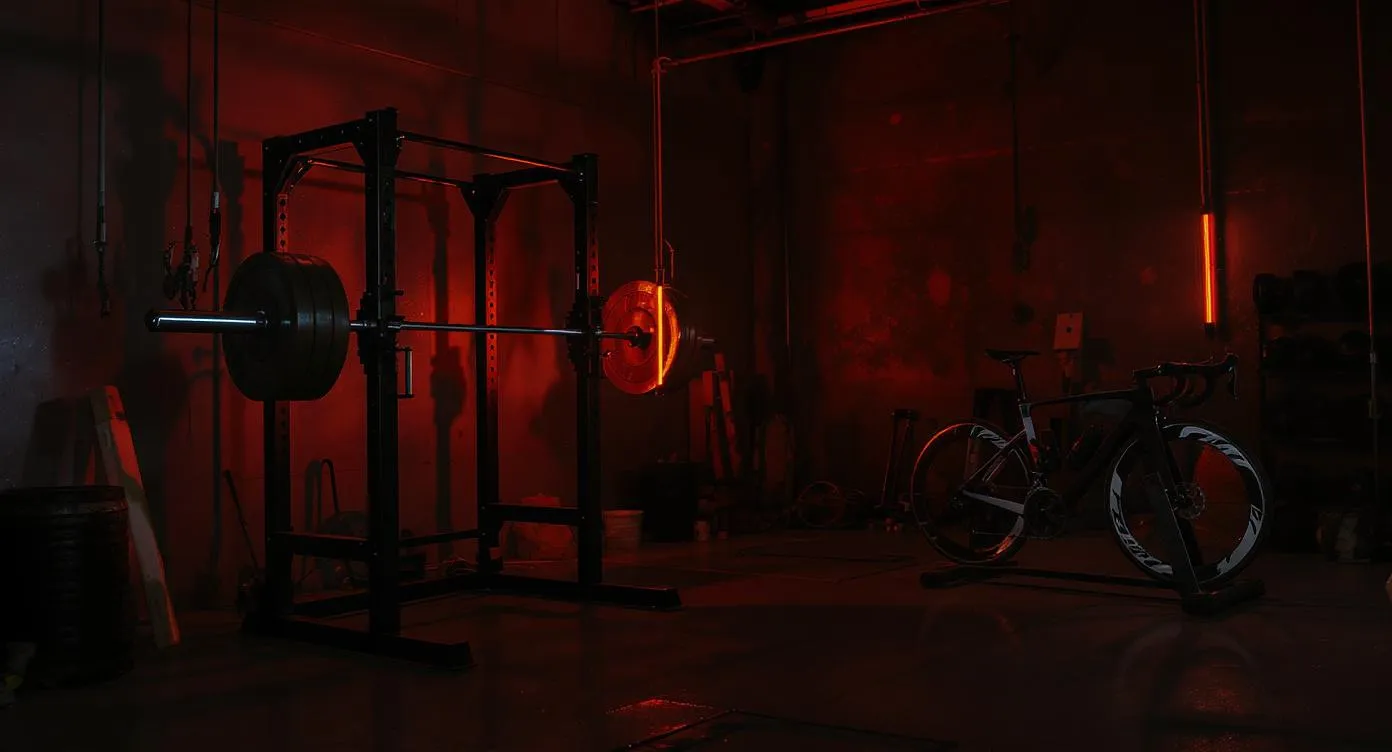
Home Gym for Cyclists: Strength Training to Ride Faster (2026)
How cyclists can use a home gym to ride faster and prevent injuries. Strength training equipment, programs, and recovery for road, gravel, and MTB riders.
Cyclists who skip strength training are leaving watts on the table. A 2019 meta-analysis in the British Journal of Sports Medicine confirmed what coaches have known for years: concurrent strength and endurance training improves time-trial performance by 3-5%, increases cycling economy by up to 5%, and delays fatigue at threshold power. Yet most recreational cyclists still avoid the weight room, fearing bulk, lost flexibility, or wasted recovery capacity.
A home gym eliminates every excuse. No commute to a commercial gym, no waiting for squat racks, no scheduling conflicts with early-morning rides. For under $1,000, you can build a cyclist-specific strength setup that fits in a single-car garage bay and delivers measurable performance gains within 8-12 weeks.
This guide covers everything: the science behind why lifting makes you faster, exactly which equipment to buy, periodized programming for road, gravel, and mountain bike disciplines, recovery protocols, and the mistakes that sabotage most cyclist-lifters.
The Science: Why Strength Training Makes Cyclists Faster
Improved Neuromuscular Efficiency
Heavy resistance training (above 80% of your one-rep max) recruits high-threshold motor units that cycling alone cannot activate. These motor units control Type IIA muscle fibers — the ones responsible for sustained high-power efforts like climbing, breakaways, and time trials. Training them in the gym means more fibers fire during each pedal stroke, producing more force with less perceived effort.
Enhanced Cycling Economy
Cycling economy measures how much oxygen you consume at a given power output. Research from the Norwegian School of Sport Sciences showed that cyclists who added heavy squats (4 sets of 4 reps at 85% 1RM) for 8 weeks improved their cycling economy by 5% without any change in VO2max. That translates to maintaining the same speed at a lower heart rate — or going faster at the same effort.
Bone Density Preservation
Cycling is non-weight-bearing. Long-term cyclists frequently develop osteopenia (low bone density), particularly in the spine and hips. A 2020 study in Medicine & Science in Sports & Exercise found that competitive road cyclists had bone density comparable to sedentary individuals. Resistance training with axial loading (squats, deadlifts, standing presses) is the most effective countermeasure.
Injury Prevention
The repetitive, single-plane nature of cycling creates predictable imbalances: tight hip flexors, weak glutes, underdeveloped lateral stabilizers, and poor thoracic mobility. These imbalances manifest as IT band syndrome, patellar tendinopathy, and lower back pain. Targeted strength work corrects these asymmetries before they become injuries.
Sprint and Climbing Power
Maximum force production determines your peak sprint wattage. A rider who can back squat 1.5x bodyweight will typically produce 15-20% more peak power in a 15-second sprint than an equivalent rider who only squats bodyweight. For climbers, the strength-to-weight ratio improvements from heavy lifting (neural gains without hypertrophy) directly translate to faster ascents.
Essential Equipment for the Cyclist's Home Gym
You do not need a full powerlifting setup. Cyclists need specific tools for specific movements. Here is the priority order, from most to least essential.
1. Power Rack with Safety Bars

ULTRA FUEGO Power Cage, Multi-Functional Power Rack
Capacity
800 lbs
Steel
2x2" 14-Gauge Steel
Footprint
50.5" L x 46.5" W x 83.5" H
Price
$389.98
- 4.5+ star rating on Amazon with 5,000+ reviews
- Excellent value under $350
- 800 lb weight capacity
- Includes multi-grip pull-up bar
- Standard 2x2 hole spacing for attachments
- Optional lat pulldown attachment available
- 14-gauge steel is thinner than premium racks
- Plastic J-cup liners can wear over time
- Not ideal for lifters squatting 600+ lbs
Price and availability may change
The back squat is the single most impactful exercise for cycling performance. A power rack with adjustable safety bars lets you squat heavy without a spotter — critical for early-morning sessions before dawn rides. The ULTRA FUEGO Power Cage ($389.99) offers 800 lb capacity, pull-up bars, and a compact 50.5" x 46.5" footprint that fits alongside your bike trainer. Read our ULTRA FUEGO Power Cage review for the full breakdown.
Key features to prioritize:
- Westside hole spacing in the bench zone (1" apart) for precise safety bar positioning
- Pull-up bar for upper body and core work
- J-hooks with UHMW lining to protect your barbell knurling
- Minimum 500 lb weight capacity (you will eventually squat heavy)
2. Barbell and Plates ($200-$400)
A 45 lb Olympic barbell with 300 lb of iron plates covers everything a cyclist needs for years. You will rarely squat above 225 lb as a cyclist focused on neural adaptation over hypertrophy, but having headroom for deadlifts and progressive overload matters. Look for a barbell with 190K PSI tensile strength and moderate knurling — you do not need an aggressive powerlifting bar. Check our best budget barbells guide for specific recommendations.
3. Adjustable Dumbbells

BowFlex Results Series SelectTech Dumbbells
Capacity
5-52.5 lbs each
Steel
Steel Plates / Nylon Dial Mechanism
Footprint
16.9" L x 8.3" W x 9" H each
Price
$429.00
- 4.7+ star rating on Amazon with 15,000+ reviews
- Replaces 15 sets of dumbbells (5-52.5 lbs)
- Fastest weight change system on the market (2 seconds)
- 2.5 lb increments up to 25 lbs
- Compact cradle storage footprint
- Sold as a pair
- Cannot be dropped — internal mechanism is fragile
- Length at 52.5 lbs feels awkward on some exercises
- Price has increased from original $349 MSRP
- 5 lb increments above 25 lbs
Price and availability may change
Single-leg work is non-negotiable for cyclists. Bulgarian split squats, single-leg Romanian deadlifts, and step-ups all require dumbbells. The Bowflex SelectTech 552 ($430) adjusts from 5 to 52.5 lb in 2.5 lb increments, replacing 15 pairs of dumbbells in a single footprint. Read our Bowflex 552 review for durability testing results.
4. Adjustable Bench

FLYBIRD WB2 Weight Bench, Utility Adjustable Weight Bench
Capacity
800 lbs (ASTM Certified)
Steel
Commercial-Grade Steel Frame
Footprint
48.4" L x 16.5" W x 17" H (folded)
Price
$109.99
- 4.6+ star rating on Amazon with 25,000+ reviews
- Unbeatable value under $120
- ASTM-certified 800 lb weight capacity
- 8 backrest angles (90° to -30° FID)
- Folds flat for easy storage in small spaces
- Quick 10-minute assembly
- Gap between seat and backrest at steep inclines
- No decline position on some variants
- Pad is narrower (10.2") than premium benches (12")
- Feet can slide on smooth concrete without rubber mats
Price and availability may change
A flat-to-incline bench enables Bulgarian split squats, dumbbell rows, hip thrusts, and chest-supported work that protects the lower back. The FLYBIRD Adjustable Bench ($110) folds flat for storage — essential when sharing garage space with bikes, trainers, and tools. Read our FLYBIRD Bench review.
5. Foam Roller, Lacrosse Ball, and Resistance Bands ($40 total)
Recovery tools are not optional for cyclists who lift. A high-density foam roller (36" length, 6" diameter) addresses IT band and quad tightness. A lacrosse ball targets piriformis, hip flexor, and thoracic spine trigger points. Loop resistance bands (41" length, 15-35 lb tension) serve double duty: warm-up activation for glutes and hip external rotators, plus band-assisted pull-ups for riders building upper body strength.
6. Plyo Box ($60-$120)
A 20/24/30-inch adjustable plyo box enables box jumps, step-ups, and elevated split squats. Foam-covered boxes reduce shin-scrape risk during fatigued sets. Essential for the power development phase.
Total Investment: $1,170-$1,430
This setup covers every exercise in the programs below. Compare that to a cycling power meter ($500-$1,200), a smart trainer ($800-$1,400), or a single race weekend with entry, travel, and lodging. Strength equipment pays for itself in performance gains and injury prevention within one season. For more budget options, see our home gym under $1,000 build guide.
Periodized Strength Program for Cyclists
The key principle: strength training volume and intensity must inversely correlate with cycling training load. When riding volume is low (off-season), lifting volume is high. When racing or peak-riding season arrives, lifting drops to maintenance levels that preserve gains without compromising recovery.
Phase 1: Anatomical Adaptation (4 weeks, October-November)
Goal: Prepare tendons, ligaments, and connective tissue for heavier loading. Build movement proficiency.
Frequency: 3 sessions per week (Monday, Wednesday, Friday)
Session A — Lower Body Foundation
- Goblet Squat: 3x12 @ RPE 6
- Romanian Deadlift (dumbbell): 3x12 @ RPE 6
- Walking Lunge: 3x10 each leg
- Glute Bridge: 3x15
- Calf Raises: 3x20
Session B — Upper Body + Core
- Dumbbell Bench Press: 3x12 @ RPE 6
- Dumbbell Row: 3x12 each arm
- Overhead Press: 3x10
- Pull-Ups (band-assisted if needed): 3x8
- Dead Bug: 3x10 each side
- Pallof Press (band): 3x10 each side
Session C — Single-Leg + Power Intro
- Step-Ups: 3x10 each leg
- Single-Leg Romanian Deadlift: 3x10 each leg
- Lateral Lunge: 3x8 each leg
- Box Jump (low height): 3x5
- Plank: 3x45 seconds
- Side Plank: 3x30 seconds each side
Phase 2: Maximum Strength (8 weeks, November-January)
Goal: Build peak force production through heavy compound lifts. This is where cycling economy improvements originate.
Frequency: 3 sessions per week
Day 1 — Heavy Lower Body
- Back Squat: 4x4-6 @ 82-88% 1RM
- Romanian Deadlift (barbell): 3x6 @ 80% 1RM
- Bulgarian Split Squat: 3x6 each leg (weighted)
- Calf Raises: 3x12 (weighted)
Day 2 — Upper Body + Anti-Rotation Core
- Bench Press: 4x5 @ 80% 1RM
- Bent-Over Barbell Row: 4x5
- Overhead Press: 3x6
- Weighted Pull-Ups: 3x5
- Pallof Press: 3x10 each side
- Turkish Get-Up: 2x3 each side
Day 3 — Power + Unilateral
- Box Jumps: 5x3 (focus on explosive intent, full recovery between sets)
- Trap Bar Deadlift (or conventional): 4x4 @ 85% 1RM
- Single-Leg Hip Thrust: 3x8 each leg
- Copenhagen Plank: 3x20 seconds each side
- Ab Wheel Rollout: 3x8
Progressive Overload Protocol: Add 5 lb to squats and deadlifts every 2 weeks. Add 2.5 lb to presses. If you fail to complete all prescribed reps, hold weight constant for the next session before attempting to progress.
Phase 3: Power Conversion (4 weeks, February-March)
Goal: Convert maximum strength into cycling-specific power by increasing movement velocity.
Frequency: 2 sessions per week (reduce as riding volume increases)
Day 1 — Explosive Lower Body
- Jump Squat: 4x5 @ 40% 1RM (maximum bar speed)
- Back Squat: 3x3 @ 85% 1RM
- Single-Leg Box Jump: 3x4 each leg
- Nordic Hamstring Curl: 3x5 (eccentric focus)
Day 2 — Maintenance + Core
- Deadlift: 3x3 @ 85% 1RM
- Bulgarian Split Squat: 3x6 each leg
- Dumbbell Row: 3x8
- Plank Variations: 3 sets of 45 seconds
- Lateral Band Walk: 3x15 each direction
Phase 4: In-Season Maintenance (March-September)
Goal: Preserve strength gains with minimal volume. Never skip this phase — detraining begins within 2-3 weeks of cessation.
Frequency: 1-2 sessions per week, 30-40 minutes maximum
Session A — Full Body (Monday)
- Back Squat: 2x5 @ 75-80% 1RM
- Romanian Deadlift: 2x6
- Bench Press or Push-Ups: 2x8
- Pull-Ups: 2x6
- Plank: 2x30 seconds
Session B — Single-Leg Focus (Thursday, optional)
- Bulgarian Split Squat: 2x8 each leg
- Single-Leg Hip Thrust: 2x10 each leg
- Side Plank: 2x30 seconds each side
- Band Pull-Aparts: 2x15
Critical Rule: Schedule lifting 48+ hours before key rides (intervals, races, long endurance rides). A Monday lift works perfectly before a Wednesday interval session.
Discipline-Specific Modifications
Road Cyclists and Time Trialists
Prioritize cycling economy work: heavy squats at low reps (3-5), single-leg exercises to correct bilateral deficits, and extensive core work for aero position stability. Add hip flexor stretching post-session since the aggressive road position shortens these muscles chronically.
Gravel and Endurance Riders
Add more upper body volume (riding rough terrain for hours demands grip, shoulder, and tricep endurance). Include farmer's carries (3x40m with heavy dumbbells) for grip and core co-contraction. Emphasize single-leg stability work since uneven surfaces challenge balance constantly.
Mountain Bikers
Prioritize power development — box jumps, jump squats, and explosive hip extension exercises translate directly to technical climbing punches and sprint efforts. Add lateral stability work (lateral lunges, Cossack squats) for cornering forces. Include more upper body pulling volume for bike-body separation and manual techniques.
Recovery Protocol for Cyclist-Lifters
Combining endurance and strength training demands deliberate recovery management. Follow these evidence-based protocols:
Post-Lift Recovery (within 30 minutes)
- Foam roll quads, IT band, hip flexors, and thoracic spine (2 minutes per area)
- Static stretch hip flexors and hamstrings (60 seconds per side)
- Consume 25-40g protein + 40-60g carbohydrates within 30 minutes
Between Sessions
- Minimum 8 hours between a ride and a lift (ideally 24 hours)
- Never lift heavy the day before intervals, race-pace efforts, or group rides
- Sleep 7.5-9 hours — strength gains and endurance adaptation both occur during deep sleep
- If legs feel heavy or power is dropping on the bike, skip the next lifting session entirely
Weekly Structure Example (In-Season)
- Monday: Strength Session A (AM)
- Tuesday: Easy spin or rest
- Wednesday: Interval ride
- Thursday: Strength Session B (optional, light)
- Friday: Rest or easy spin
- Saturday: Long ride or race
- Sunday: Recovery ride
For more on integrating recovery and programming, read our home gym programming guide.
The 5 Biggest Mistakes Cyclists Make in the Gym
Mistake 1: Training Like a Bodybuilder
Cyclists do not need 4 sets of leg extensions, hamstring curls, and calf raises in the same session. Isolation work has its place (prehab, correcting specific weaknesses), but the foundation must be compound movements: squats, deadlifts, presses, rows, and pull-ups. These movements train multiple joints simultaneously, mimicking the coordinated muscle recruitment patterns of pedaling.
Mistake 2: Avoiding Heavy Loads
The adaptation cyclists need — improved neural drive and rate of force development — only occurs at loads above 75% of 1RM. Sets of 15-20 reps build muscular endurance you already have from riding. Sets of 3-6 reps at heavy loads build the force production capacity that makes you faster. Do not be afraid of heavy weights at low reps.
Mistake 3: Neglecting Single-Leg Work
Pedaling is a unilateral activity. Most cyclists have a 5-15% power imbalance between legs (visible on dual-sided power meters). Bulgarian split squats, single-leg deadlifts, and step-ups correct this imbalance directly. Include at least one single-leg exercise in every lower body session.
Mistake 4: Ignoring the Posterior Chain
Cyclists are quad-dominant by nature. The forward-leaning position and pushing mechanics of pedaling preferentially develop the quadriceps while the glutes, hamstrings, and spinal erectors weaken. Romanian deadlifts, hip thrusts, and Nordic curls build the posterior chain that prevents knee pain, lower back issues, and power leaks at the bottom of the pedal stroke.
Mistake 5: Stopping Completely in Race Season
Detraining happens fast. Within 3 weeks of stopping strength training, neural adaptations begin declining. Within 6-8 weeks, you lose most strength gains. Maintaining with just 1-2 brief sessions per week preserves 85-95% of your off-season gains through the entire race calendar. The volume is so low it does not impair recovery.
Mobility Work for Cyclists Who Lift
Cycling creates specific restrictions that must be addressed before lifting heavy. Perform this 10-minute routine before every strength session:
- Hip flexor stretch with rear foot elevated — 90 seconds each side (addresses chronic shortening from pedaling position)
- World's Greatest Stretch — 5 reps each side (opens hips, thoracic spine, and ankles simultaneously)
- Goblet squat hold — 30 seconds at bottom position with light weight (grooves proper squat depth)
- Band pull-aparts — 2x15 (activates rear delts and scapular retractors, countering forward-rounded cycling posture)
- Glute activation circuit — Clamshells, fire hydrants, 10 reps each (ensures glutes fire during squats and deadlifts)
For comprehensive guidance on avoiding injury, see our garage gym safety guide.
Equipment Maintenance for Dual-Use Spaces
Most cyclist home gyms share space with bike storage, trainers, and workshop tools. Keep equipment performing well with these practices:
- Barbell care: Wipe down after every session with a dry rag. Apply 3-in-1 oil to sleeves monthly. Store horizontally on J-hooks, never leaning against a wall.
- Plate storage: Use weight tree or rack-mounted plate storage to keep floor space clear for bike maintenance. Iron plates rust in humid garages — coat lightly with WD-40 in summer months.
- Floor protection: 3/4" rubber horse stall mats (4x6 foot sections, ~$45 each) protect concrete from dropped weights and provide grip for standing exercises. You need 2-3 mats for a complete lifting area.
- Temperature management: Extreme garage temperatures affect both equipment and performance. Cold barbells can shock hands; heat causes excessive sweating. Review our garage gym ventilation guide for climate control solutions.
Common Questions
Will lifting weights make me too bulky to ride fast?
How often should cyclists lift weights?
What is the single best exercise for cycling performance?
Should I lift before or after riding?
How much does a basic cyclist home gym cost?
When will I see performance improvements on the bike?
Should cyclists do upper body training?
What about plyometrics for cyclists?
Additional Resources
Related Content
- Home Gym for Runners
- How to Choose a Power Rack
- Home Gym Under $1,000
- ULTRA FUEGO Power Cage Review
- Home Gym Programming Guide
- Home Gym for Kids & Teens: Safe Strength Training Guide
- Garage Gym Safety Guide
- Best Budget Barbells
The Bottom Line
Strength training is the highest-ROI investment a cyclist can make outside of actual saddle time. Two to three sessions per week in the off-season, dropping to one to two during race season, delivers measurable improvements in power output, cycling economy, injury resilience, and bone health. The equipment costs less than a mid-range wheelset, lasts decades, and eliminates every logistical barrier to consistency.
Start with squats. Add deadlifts and single-leg work. Maintain through race season. The riders who do this consistently — not perfectly, just consistently — ride faster, hurt less, and race longer into their careers than those who only pedal.
Lena Park
Former NCAA Division I rower and USA Weightlifting coach. Specializes in conditioning equipment and women's training.
Read full bioMore in Guides
Strength vs Hypertrophy: How to Program for Your Goals (2026)
The definitive guide to programming for strength vs size in your home gym. Rep ranges, volume, intensity, and complete programs for both goals.
The Complete Home Gym Warm-Up Guide (2026)
Stop skipping your warm-up. Complete warm-up protocols for every training style, plus the equipment that makes preparation effortless at home.
Home Gym Deload Guide: When and How to Back Off (2026)
Learn when and how to deload in your home gym. Science-backed protocols, recovery strategies, and signs you need a rest week.