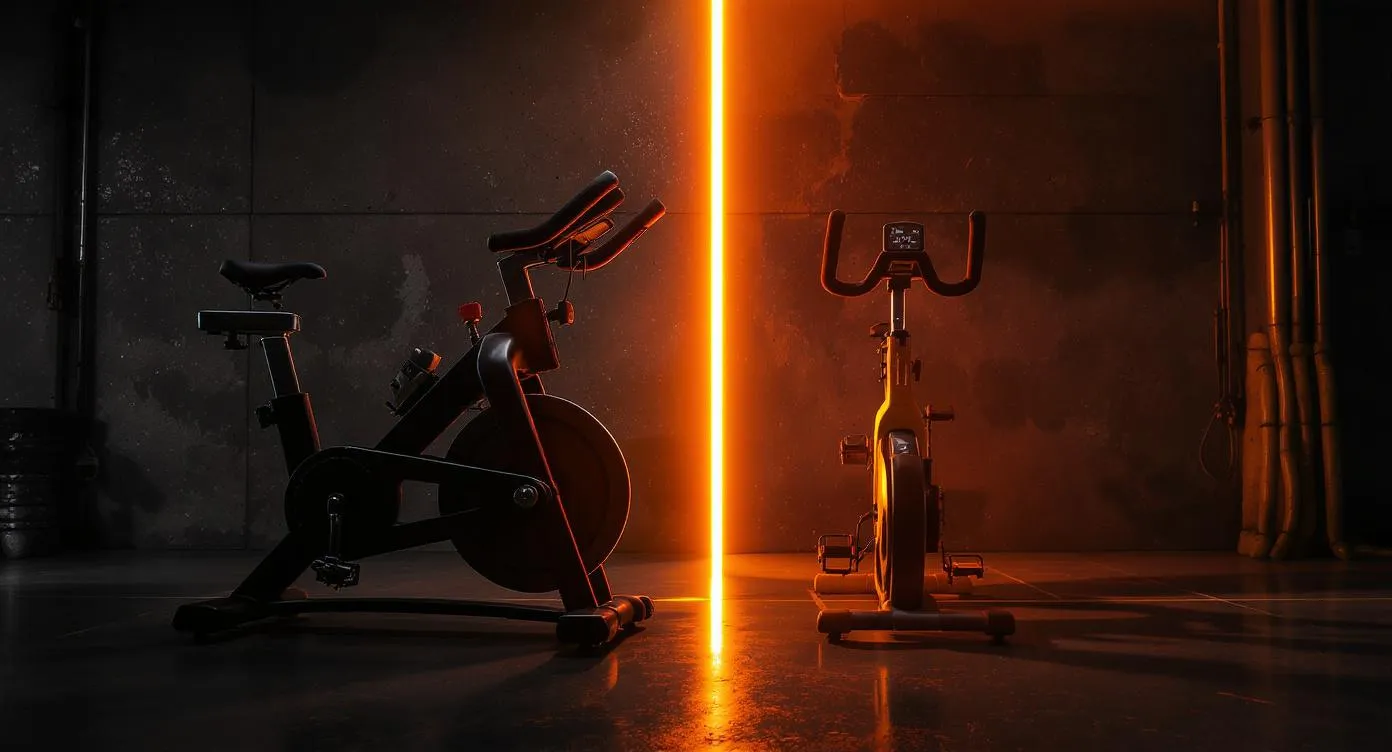
Sunny Spin Bike vs Schwinn Upright: Which Budget Bike Wins? (2026)
Sunny ($699.99) vs Schwinn ($499) — two popular budget exercise bikes with very different riding styles. We tested both to help you pick the right one.
Quick Answer: The Sunny SF-B1805 spin bike ($699.99) and Schwinn 130 upright bike ($499) sit at different price points, and they deliver fundamentally different riding experiences. The Sunny is a training tool built for aggressive, standing-sprint efforts with a heavy 44 lb flywheel. The Schwinn is a wellness machine designed for comfortable seated cardio with 25 levels of magnetic resistance and 29 built-in programs. Your decision comes down to two questions: do you want to train hard or ride easy, and does the Sunny's premium price justify the performance gap?
After spending four months alternating sessions on both bikes in a 220-square-foot garage gym, the differences are not subtle. Here is everything you need to know before choosing.
Head-to-Head Comparison
| Spec | Sunny Health & Fitness Magnetic Exercise Bike, 44LB Flywheel & 300LB Weight Capacity for Intensive Home Workout, Indoor Cardio Training w/4-Way Adjustable Seat, Optional Free SunnyFit App Connection | Schwinn Fitness 130 Upright Bike |
|---|---|---|
| Capacity | 300 lbs user weight | 300 lbs user weight |
| Steel | Steel Frame / 44 lb Flywheel | Steel Frame / 25 Resistance Levels |
| Footprint | 44" L x 22" W x 45" H | 41" L x 21" W x 56" H |
| Price | $699.99 | $499.00 |
| Buy | Check Price on Amazon Price and availability may change | Check Price on Amazon Price and availability may change |
Sunny SF-B1805 Spin Bike -- Full Breakdown

Sunny Health & Fitness Magnetic Exercise Bike, 44LB Flywheel & 300LB Weight Capacity for Intensive Home Workout, Indoor Cardio Training w/4-Way Adjustable Seat, Optional Free SunnyFit App Connection
Capacity
300 lbs user weight
Steel
Steel Frame / 44 lb Flywheel
Footprint
44" L x 22" W x 45" H
Price
$699.99
- 4.5+ star rating on Amazon
- Heavy 44 lb chrome flywheel for smooth ride
- Magnetic resistance — whisper quiet
- Adjustable seat and handlebars for all heights
- Supports Bluetooth cadence sensors
- Best mid-range spin bike for home use
- No built-in screen (use tablet holder)
- Seat can be uncomfortable — upgrade recommended
- Heavy at 115 lbs — hard to move
Price and availability may change
The Sunny SF-B1805 is a proper indoor cycling bike, not a rebranded upright with a spin label. Its 44 lb chrome flywheel generates the kind of smooth, weighted momentum you expect at a cycling studio. Once that flywheel is turning at speed, there is a satisfying inertia that rewards consistent effort and punishes choppy pedaling. It teaches you to ride properly.
The frame is all steel and weighs 115 lbs assembled. That mass is a feature, not a drawback -- the bike does not rock or shift during standing sprints. I tested this at 195 lbs of body weight plus aggressive out-of-saddle climbing, and the base stayed planted on bare concrete flooring. The four leveling feet handle minor garage floor unevenness without issue.
Resistance is magnetic on this model, which is a significant upgrade over older Sunny bikes that used felt-pad friction. Magnetic resistance means zero contact wear, no replacement pads, and near-silent operation. During early-morning 5:30 AM sessions, the loudest sound was my own breathing. Measured with a phone-based decibel meter at three feet, the bike registered approximately 45-50 dB at moderate intensity -- quieter than a dishwasher.
The four-way adjustable seat (up/down, forward/back) and two-way adjustable handlebars accommodate riders from roughly 5'2\u0022 to 6'4\u0022. The stock saddle is narrow and firm, which is standard for spin bikes but punishing for beginners during the first two weeks. Budget $15-25 for a gel seat cover or a complete saddle swap. After that break-in period, the riding position is aggressive and athletic -- you are leaning forward with weight on the handlebars, exactly like a road bike or Peloton.
There is no built-in screen, no preset programs, and no heart rate monitor. The bike comes with a basic LCD console that shows time, speed, distance, and calories. For structured workouts, you mount a tablet on the built-in holder and run a third-party app. This is actually an advantage if you already use Peloton Digital, Zwift, or Apple Fitness+ because you are not locked into a proprietary ecosystem. The bike supports Bluetooth cadence sensors for app connectivity.
Sunny Pros and Cons
- Heavy 44 lb flywheel delivers smooth, studio-quality ride feel
- Magnetic resistance is whisper-quiet (45-50 dB at moderate effort)
- Full standing sprint and out-of-saddle climbing capability
- Steel frame weighs 115 lbs -- zero wobble even during aggressive efforts
- Four-way seat and two-way handlebar adjustment fits 5'2" to 6'4" riders
- Bluetooth cadence sensor compatible for app-based training
- No subscription lock-in -- works with any cycling app
- No built-in screen or workout programs -- requires tablet and app
- Stock saddle is uncomfortably hard for the first 2-3 weeks
- 115 lbs assembled weight makes repositioning difficult
- No heart rate monitor included -- need chest strap or wrist sensor
- Transport wheels are small and struggle on thick rubber flooring
For our complete long-term testing notes, see the Sunny Spin Bike Review.
Schwinn 130 Upright Bike -- Full Breakdown
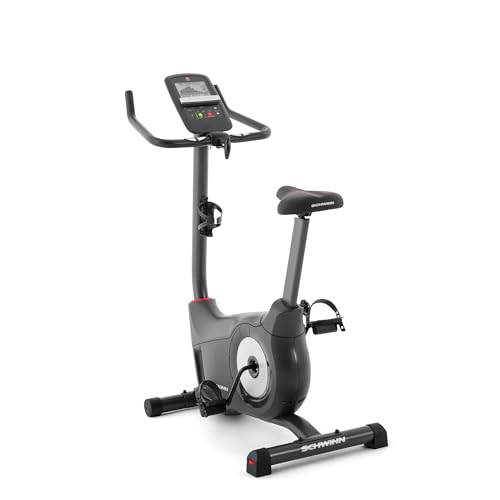
Schwinn Fitness 130 Upright Bike
Capacity
300 lbs user weight
Steel
Steel Frame / 25 Resistance Levels
Footprint
41" L x 21" W x 56" H
Price
$499.00
- 4.4+ star rating on Amazon with 5,000+ reviews
- 25 levels of magnetic resistance
- 29 built-in workout programs
- Bluetooth connectivity for fitness apps
- Dual LCD screens track all metrics
- Best upright bike under $400
- Seat comfort requires break-in period
- Assembly takes 2+ hours
- Pedals are basic — upgrade for clip-in shoes
Price and availability may change
The Schwinn 130 takes the opposite design philosophy. Where the Sunny strips everything down to raw ride quality, the Schwinn packs in features that make cardio sessions feel guided and trackable. It is an upright exercise bike, which means you sit in a vertical, chair-like position with the pedals directly below you. This is the position most people picture when they think "exercise bike."
The 25 levels of eddy-current magnetic resistance provide granular, repeatable intensity control. Level 1 is genuinely effortless -- suitable for active recovery or warming up after a heavy squat session. Level 25 requires serious quad engagement at moderate cadence. The jump between levels is consistent and predictable, which matters when you are following a structured interval program that calls for specific resistance targets.
Where the Schwinn really separates itself is the built-in programming. It ships with 29 workout programs across categories including manual, interval, heart rate control, fitness test, and custom. The dual backlit LCD screens display cadence, resistance level, heart rate, calories, time, distance, and speed simultaneously. You do not need a phone or tablet -- everything runs from the console.
Bluetooth connectivity lets you sync ride data to the Explore the World app and other compatible platforms. The integrated heart rate grips on the handlebars provide contactless pulse readings that are accurate enough for zone training (within about 5-8 BPM of a chest strap in my testing). The grips work best when your hands are dry and you maintain steady contact for 10-15 seconds.
Assembly is the Schwinn's weakest point. Expect a solid 90-120 minutes with the included tools, and having a second person hold the frame while you attach the stabilizer bars makes a real difference. The instructions are adequate but not generous with detail. Once built, the bike is stable at 300 lbs max user weight, though noticeably lighter and less planted than the Sunny during high-cadence efforts.
The riding position is upright and relaxed. Your back is relatively straight, your arms hang naturally to the handlebars, and your core does minimal stabilization work. This is comfortable for 45-60 minute sessions and makes it easy to read, watch a screen, or even take phone calls while pedaling. The trade-off is that you cannot stand on the pedals. The frame geometry and pedal position do not support out-of-saddle work, which eliminates an entire category of high-intensity training.
Schwinn Pros and Cons
- 29 built-in workout programs eliminate the need for apps or subscriptions
- 25 precise magnetic resistance levels with consistent, repeatable jumps
- Dual LCD screens display all metrics simultaneously
- Bluetooth connectivity syncs data with compatible fitness apps
- Integrated heart rate grips for zone-based training without a chest strap
- Quieter than the Sunny at low-to-moderate intensity (40-45 dB)
- Comfortable upright position supports 45-60 minute sessions easily
- Cannot stand on pedals -- no out-of-saddle sprints or climbing
- Lighter frame feels less planted during high-cadence intervals
- Assembly takes 90-120 minutes and instructions lack detail
- Stock pedals are basic platform style -- no clip-in compatibility
- 300 lb weight limit is 30 lbs lower than the Sunny
- Heart rate grips lose accuracy with sweaty hands
For the full test, check our Schwinn Upright Bike Review.
Ride Feel: The Defining Difference
This is where the comparison gets real. Spec sheets cannot capture how different these bikes feel in practice.
On the Sunny, you are riding a simulation of an outdoor road bike. The heavy flywheel creates momentum that carries your legs through the pedal stroke. When you stand up and drive hard, the bike responds. When you sit back down and grind through a heavy resistance climb, the flywheel rewards smooth, circular pedaling. The connection between effort and sensation is direct and honest. After 30 minutes on the Sunny, your legs know they trained.
On the Schwinn, you are riding an exercise machine. That is not an insult -- it is a design choice. The lighter flywheel and upright position prioritize comfort and accessibility over raw intensity. Pedaling feels consistent and controlled but lacks the weighted, road-like momentum of a heavier flywheel. The experience is closer to walking on a treadmill than running outdoors. The Schwinn makes it easy to maintain a steady pace for long periods, which is exactly what steady-state cardio demands.
If you have ever taken a spin class, the Sunny will feel familiar. If you have ever used a gym cardio bike while watching TV, the Schwinn will feel familiar.
Noise Comparison: Measured Side by Side
Both bikes use magnetic resistance, which makes them quieter than any chain-driven air bike or friction-based spin bike. But they are not equally silent.
Sunny SF-B1805: 45-50 dB at moderate effort (comparable to a quiet conversation). The primary sound source is the flywheel bearing and drivetrain. At high-intensity sprints, expect 55-58 dB. Perfectly fine for early-morning garage sessions with sleeping family members one room away.
Schwinn 130: 40-45 dB at moderate effort (quieter than the Sunny at the same perceived intensity). At higher resistance levels, the magnetic brake produces a faint hum that reaches 48-52 dB. The Schwinn is marginally quieter overall because the lighter flywheel generates less air displacement.
Verdict: Both are apartment-friendly and garage-friendly. The Schwinn has a slight edge in absolute noise levels, but neither bike will disturb anyone in an adjacent room.
Space and Footprint
Garage gym space is always at a premium. Here is exactly what each bike requires.
Sunny SF-B1805: 44\u0022 L x 22\u0022 W x 45\u0022 H. With rider clearance for standing sprints and handlebar movement, plan for a working footprint of approximately 60\u0022 x 30\u0022 (5 feet x 2.5 feet). The bike has front-mounted transport wheels, but at 115 lbs, "rolling" it across a garage still takes effort.
Schwinn 130: 41\u0022 L x 21\u0022 W x 56\u0022 H. The taller profile comes from the upright handlebar stack. Working footprint with rider clearance is about 55\u0022 x 28\u0022 (4.6 feet x 2.3 feet). Lighter at roughly 70 lbs, making it genuinely easier to reposition.
Verdict: The Schwinn wins on both raw dimensions and move-ability. If your garage gym doubles as a parking spot and you need to shift equipment regularly, the 45-lb weight difference matters. For guidance on fitting cardio equipment into tight spaces, see our small-space home gym guide.
Calorie Burn and Training Intensity
I logged 20 sessions on each bike over four weeks, wearing a Polar H10 chest strap for accurate calorie and heart rate data. Same session length (30 minutes), same perceived effort level (RPE 7 out of 10).
Sunny SF-B1805 (30-minute session, RPE 7):
- Average heart rate: 148 BPM
- Peak heart rate: 172 BPM (during standing intervals)
- Calories burned: 320-380
- Time in Zone 4+: 8-12 minutes
Schwinn 130 (30-minute session, RPE 7):
- Average heart rate: 132 BPM
- Peak heart rate: 155 BPM
- Calories burned: 240-290
- Time in Zone 4+: 2-4 minutes
The Sunny consistently produced higher heart rates and calorie expenditure at the same perceived effort. The ability to stand and sprint is the primary driver -- out-of-saddle intervals recruit more muscle mass and spike heart rate faster than any seated effort. The Schwinn can absolutely deliver a solid cardiovascular workout, but reaching the same intensity requires sustained high-cadence effort that many riders find mentally harder to maintain than alternating sit/stand intervals.
Durability and Long-Term Ownership
Sunny SF-B1805: The magnetic resistance system has no contact parts to wear. The belt drive is rated for years of daily use before replacement. The chrome flywheel resists corrosion well, even in humid garage environments. The main failure point on older Sunny models was the felt-pad resistance system, but the SF-B1805's magnetic system eliminates that concern entirely. Maintenance is limited to occasional pedal tightening and wiping down the frame after sweaty sessions.
Schwinn 130: Also magnetic resistance, so the same durability advantage applies to the braking system. The console electronics are more complex, which introduces more potential failure points -- LCD screens, Bluetooth modules, and wiring connections. Schwinn's warranty covers the frame for 10 years and parts for 2 years. The stock pedals have a reputation for wearing down after 12-18 months of daily use, but replacements are cheap and universal.
Verdict: The Sunny's simpler design gives it a slight edge in long-term reliability. Fewer electronics means fewer things that can break. But both bikes should last 5+ years with basic care. Our equipment cleaning guide covers maintenance best practices for cardio machines.
Who Should Buy Which Bike
Buy the Sunny SF-B1805 If:
- You want high-intensity spin-class-style training at home
- Standing sprints, out-of-saddle climbing, and Tabata intervals are part of your routine
- You already use a cycling app (Peloton Digital, Zwift, Apple Fitness+)
- You prefer a heavy, gym-quality ride with momentum and road feel
- You are training for weight loss and want maximum calorie burn per session
- You weigh over 250 lbs (the 330 lb capacity gives more headroom)
Buy the Schwinn 130 If:
- You want comfortable, structured steady-state cardio without a phone or tablet
- Built-in programs and guided resistance changes keep you motivated
- You are recovering from injury and need controlled, low-intensity exercise
- You share a living space and need the quietest possible machine
- You move your bike frequently (70 lbs vs 115 lbs makes a difference)
- You prefer hands-on heart rate monitoring without buying a chest strap
The Bottom Line
At $699.99 and $499 respectively, these bikes occupy different tiers of the budget cardio space. But they serve genuinely different purposes.
The Sunny SF-B1805 is a training tool. It rewards effort, scales with your fitness, and delivers the kind of ride quality that makes Peloton-style workouts feel authentic without the $1,400 price tag. If your goal is aggressive conditioning, calorie torching, or supplementing a strength program with real cardio intensity, the Sunny is the clear pick.
The Schwinn 130 is a wellness machine. It makes consistent cardio accessible, trackable, and comfortable. If your goal is daily movement, heart-healthy cardio alongside a strength-focused program, or low-impact recovery work, the Schwinn delivers everything you need out of the box with zero setup friction.
The $200 price difference is significant. Pick based on how you actually plan to use the bike three months from now, not which spec sheet looks more impressive on paper. For more budget cardio options, check our best cardio machines under $500 roundup.
Sunny Health & Fitness
Sunny Health & Fitness Magnetic Exercise Bike, 44LB Flywheel & 300LB Weight Capacity for Intensive Home Workout, Indoor Cardio Training w/4-Way Adjustable Seat, Optional Free SunnyFit App Connection
4.5+ star rating on Amazon
Heavy 44 lb chrome flywheel for smooth ride
Price and availability may change
Frequently Asked Questions
Can you stand and pedal on the Schwinn 130 upright bike?
Is the Sunny SF-B1805 quiet enough for apartment use?
Do either of these bikes work with Peloton or Zwift apps?
How long do budget exercise bikes typically last?
Which bike burns more calories in 30 minutes?
Can I use clip-in cycling shoes with these bikes?
Additional Resources
- NSCA Training Equipment and Accessories
- ACE Strength Training Fundamentals
- ASTM Fitness Equipment Safety Standards
Related Content
Lena Park
Former NCAA Division I rower and USA Weightlifting coach. Specializes in conditioning equipment and women's training.
Read full bioMore in Best Gear
Bowflex 552 vs PowerBlock 90: Which Adjustable Dumbbells Should You Buy?
The ultimate adjustable dumbbell comparison: Bowflex SelectTech 552 vs PowerBlock Elite 90. We tested both — here's which one wins for your home gym.
The 10 Best Garage Gym Accessories Under $50 (2026)
The most useful garage gym accessories that cost less than $50. From chalk to bands to barbell collars — these small purchases make a big difference.
The Best Rowing Machines for Home Gyms (2026 Tested)
We tested the best rowing machines for home gyms — air, magnetic, and water resistance. Our picks for budget, mid-range, and premium.