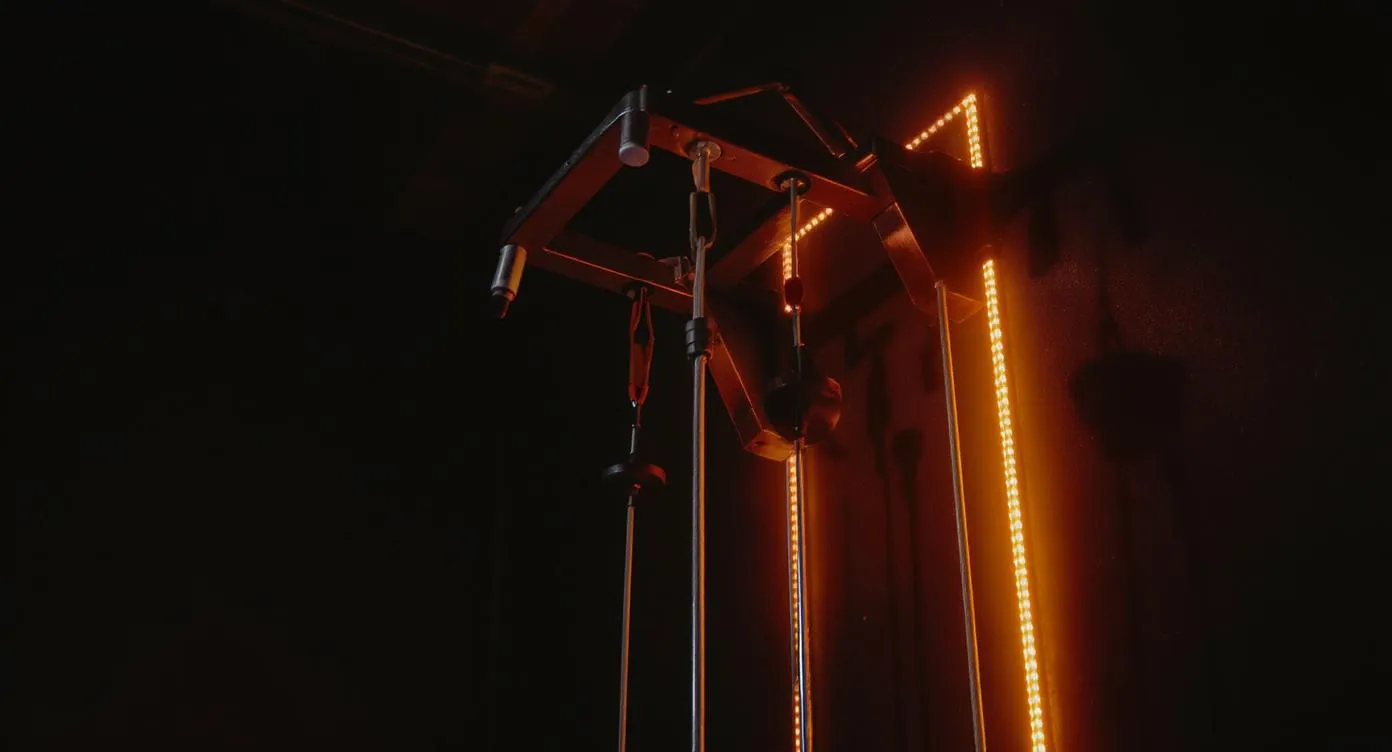
Valor Fitness Wall Mount Cable Machine Review: Best Wall-Mount Cable Machine?
30-day hands-on review of the Valor Fitness Wall Mount Cable Machine wall-mounted cable station. Is a $329.98 cable machine worth it for home gyms? We tested every exercise.
Cable machines are the most versatile equipment in any gym. The problem is that most home gym cable setups either cost $2,000+ or require a massive footprint. The Valor Fitness Wall Mount Cable Machine promises a wall-mounted cable station with a 150 lb weight stack for under $329.98.
We mounted one to a garage wall, trained on it daily for 30 days, and tested every exercise we could think of. Here's the honest review.
What Makes the Wall Mount Cable Machine Different
The Wall Mount Cable Machine is wall-mounted, meaning it takes zero floor space. The entire unit hangs on your wall, with a 150 lb weight stack built in. You don't need plates, you don't need a stand — bolt it to wall studs and start pulling.
Quick Specs · Valor Fitness Wall Mounted Cable Machine, Dual Adjustable Pulley System with 16 Height Positions, Space-Saving Home Gym Strength Training Equipment
The Case for Wall-Mount Cable Machines
Before diving into the Wall Mount Cable Machine specifically, it's worth understanding why wall-mounted cable systems represent a genuinely different category of home gym equipment — not just a cheaper version of a full cable machine.
A traditional freestanding cable station like a functional trainer or cable crossover requires 4 to 6 feet of floor depth, another 4 to 8 feet of width, and often ceiling clearance of 7.5 feet or more. In a garage gym that also houses a power rack, a bench, and barbell storage, that kind of real estate is simply not available for most people. A wall-mounted unit changes the math entirely.
The Wall Mount Cable Machine projects roughly 14 inches from the wall when the weight stack is loaded and the cable is unloaded. That's it. You can mount it on the wall directly behind your power rack and use the same square footage for two entirely different training modalities. When you're not doing cable work, the machine is visually flush with the wall. It doesn't obstruct walkways. It doesn't collect dust in a corner you never walk past. It is always there, always ready, requiring nothing but a step forward and a pin adjustment.
For garage gym athletes operating in a single-car or 1.5-car garage — which describes most home gym owners — this spatial efficiency is not a luxury, it's a requirement. The wall-mount format is what makes cable training accessible at that price point and in that footprint.
Assembly Experience
Time: 2 hours with one person, 90 minutes with two.
The mounting is the hardest part. You need to hit wall studs (minimum 16" spacing) or use concrete anchors for a garage wall. We used four 3/8" lag bolts into studs and the unit felt absolutely solid — zero flex or rattle under heavy loading.
Before you purchase, assess your wall. Drywall-over-studs in a finished garage is ideal. Bare concrete or cinder block requires masonry anchors rated for the load, and you'll want to use a hammer drill. Thin panel walls or single-layer OSB sheathing alone are not suitable mounting surfaces for a loaded cable station. The Wall Mount Cable Machine puts significant shear force on those mounting points the moment you sit down and pull, so this step deserves genuine attention.
The cable routing is straightforward. The instructions are mediocre — if you've assembled gym equipment before, you'll be fine. If this is your first build, give yourself extra time and watch the Valor Fitness YouTube walkthrough before you open the box. There are several cable routing steps where a wrong turn costs you 20 minutes of backtracking.
One practical note: the included hardware bag is organized well, and every fastener is labeled. That's a better experience than you get from many budget fitness brands.
Cable System Analysis
The Wall Mount Cable Machine uses a single-pulley cable system with an adjustable anchor point that slides on a vertical track. This is a fundamentally different architecture from the dual-pulley functional trainer design, and understanding that difference matters when evaluating whether this machine fits your training needs.
In a functional trainer, two independent weight stacks feed two independent pulleys — one on each side of a wide vertical frame. You can perform crossover movements, unilateral cable flyes, and cable exercises that require two simultaneous cable loads. The Wall Mount Cable Machine does not do this. It is a single-cable system. You get one pulley position at a time, and you use a single attachment point.
What the Wall Mount Cable Machine does well within that architecture is the smooth pulley transition and minimal cable friction. The cable runs over a sealed nylon bushing at the top pulley and a second bushing at the weight stack pin, then back to the attachment. Under load, the feel is fluid. There is no stick-slip behavior that plagues some budget cable machines, where the cable grabs slightly at the beginning of each rep and releases inconsistently. The Wall Mount Cable Machine cable action is consistent from rep one to rep twenty.
The adjustable pulley height is the defining feature of the Wall Mount Cable Machine's cable system. The pulley anchor moves from a low position (approximately knee height) all the way to an overhead position, covering a range of roughly 60 inches of vertical travel. This range is what enables the exercise variety that makes this machine genuinely useful rather than a novelty purchase. A fixed-high-pulley cable station can only train downward-pull exercises. A fixed-low-pulley cable station can only train upward-pull exercises. The Wall Mount Cable Machine covers both ends of the spectrum and everything in between.
Plate-Loaded vs. Stack-Loaded: Which Is Right for You?
The Wall Mount Cable Machine uses a weight stack — a tower of steel plates housed within the unit's frame, selected by a pin. This is the same loading mechanism used on commercial gym cable stations. You do not need to own any weight plates to use this machine.
The primary alternative in the wall-mounted cable category is the plate-loaded format, best represented by the Titan Fitness Wall Mounted Pulley Tower. In a plate-loaded design, you load standard 1-inch or 2-inch Olympic plates onto a loading peg, and those plates provide the resistance. There is no built-in stack.
Each approach has specific advantages:
Stack-loaded advantages (Wall Mount Cable Machine):
- No additional equipment needed. Out of the box, you have everything required.
- Fine-increment adjustments (within the 10 lb stack increment limitation).
- Faster weight changes between sets — pull the pin, reinsert, done. No loading or unloading plates.
- Cleaner aesthetic. No plates hanging off the wall next to the machine.
Plate-loaded advantages (Titan Wall Pulley):
- Theoretically unlimited resistance — you load whatever plates you own.
- If you already own a substantial plate collection, your investment in the pulley hardware alone is lower.
- No upper weight limit means strong lifters are never bottlenecked.
- Useful for heavy pulling movements like lat pulldowns at 200+ lbs.
The right choice depends on your training profile. If you're using the cable machine primarily for hypertrophy-focused isolation work — tricep pushdowns, cable curls, face pulls, cable flyes, straight-arm pulldowns — the 150 lb stack of the Wall Mount Cable Machine is genuinely sufficient for the overwhelming majority of people for years of training. If your cable use is centered around heavy lat pulldowns and seated rows where you're already moving 140 to 160+ lbs, the plate-loaded format gives you room to grow without hitting a ceiling.
A full breakdown of these tradeoffs across the entire category is available in our guide to the best cable machines for home gyms.
What We Love
- Zero floor space — mounts flat on any wall
- 150 lb weight stack eliminates need for plates
- Smooth cable action with minimal friction
- Adjustable pulley height covers everything from lat pulldowns to cable curls
- Built-in lat bar + straight bar + V-handle + ankle strap
- Steel construction feels durable — no plastic parts on the load path
- Weight stack is faster to adjust than loading and unloading plates
- Clean installation with no loose equipment cluttering the floor
The cable action is surprisingly smooth for a $329.98 machine. Commercial gym cable stations feel slightly better, but the Wall Mount Cable Machine is 90% as good at 10% of the price.
The versatility is the real selling point. In 30 days, we trained:
- Lat pulldowns (wide, close, underhand)
- Tricep pushdowns (rope, bar, single-arm)
- Cable curls (straight bar, EZ, single-arm)
- Face pulls
- Cable flyes (standing, from various heights)
- Seated cable rows
- Straight-arm pulldowns
- Ab crunches (kneeling)
- Cable woodchops (rotational core)
- Cable lateral raises
- Cable rear delt flyes
- Standing cable crunches
- Hip abduction and adduction (with ankle strap)
That's a wider exercise menu than a $500 set of dumbbells provides, and it covers movement patterns — horizontal pulls, vertical pulls, rotational core, flye movements — that free weights replicate poorly or not at all.
What Could Be Better
- 150 lb stack limits heavy lat pulldowns for strong lifters
- Wall mounting requires tools and construction confidence
- Pulley height adjustment is manual (pin-based, not quick-adjust)
- Cable has slight friction at the highest pulley position
- Weight stack increments are 10 lbs (no 2.5 or 5 lb jumps)
- Single-cable system cannot perform cable crossover movements
- Included attachments are functional but not premium quality
The 150 lb limit is the biggest real-world issue. For lat pulldowns and seated rows, strong lifters will max out the stack within 6 to 12 months of serious training. For triceps, curls, face pulls, and flyes, 150 lbs is more than enough for 99% of people. But if you're the person who reads this review having already pulled 160 lbs on lat pulldowns in a commercial gym, the Wall Mount Cable Machine will feel constraining within weeks.
The 10 lb jump between stack increments is the other legitimate limitation. Progressing from 60 lbs to 70 lbs is a 16% load increase — far larger than the standard 2.5 to 5 lb progression you'd use with dumbbells or a barbell for similar muscles. For exercises like cable curls or face pulls where the working muscles are relatively small, this can make clean progressive overload difficult. A micro-plate or technique like rest-pause sets can work around this, but it's a design limitation worth knowing before you buy.
The pulley adjustment is manual and pin-based. You release a locking mechanism, slide the pulley carriage to the desired height, and lock it again. This takes 15 to 30 seconds and requires both hands. On a commercial machine with a weight stack and adjustable pulley, the adjustment is often tool-free with a quick-release lever. The Wall Mount Cable Machine's system works fine but is slower if you're doing supersets that require height changes mid-session.
Exercise Variety: What You Can and Cannot Train
One of the most common misunderstandings about wall-mounted cable stations is where their exercise ceiling is. Let's be precise.
What the Wall Mount Cable Machine does excellently:
Vertical pull pattern (pulley high): Lat pulldowns in every grip variation — wide overhand, close neutral, underhand supinated, single-arm. Straight-arm pulldowns. Kneeling cable crunches with a rope attachment.
Horizontal pull pattern (pulley low-to-mid): Seated cable rows using a bench pulled in front of the machine. Face pulls with a rope. Band-assisted or cable-assisted horizontal pulling at various heights.
Push pattern (pulley high): Tricep pushdowns — bar, rope, single-arm, reverse grip. This is where the Wall Mount Cable Machine gets serious use in a hypertrophy-focused program.
Curl pattern (pulley low): Cable curls in every grip. The cable provides constant tension throughout the entire range of motion, which dumbbells do not. The Wall Mount Cable Machine is genuinely excellent for bicep hypertrophy work.
Shoulder work (pulley various heights): Face pulls (mid height), lateral raises (low pulley), front raises, rear delt flyes.
Core and rotational: Cable woodchops require adjusting the pulley to high and low positions across sets — the Wall Mount Cable Machine handles this. Pallof press variations, standing cable crunches, cable oblique twists.
What the Wall Mount Cable Machine cannot do:
Cable crossover movements require two independent cable sources. The Wall Mount Cable Machine cannot replicate these. If cable flyes with a crossover finish or standing cable pec flyes from two sides are central to your program, you need a functional trainer — see our best cable machines guide for recommendations.
Lower body cable work is also limited. The ankle strap attachment enables cable kickbacks and hip abduction with the low pulley, but cable leg press or standing cable Romanian deadlifts are awkward to set up against a wall mount versus a freestanding unit.
Installation Requirements
The wall mounting process is the single most common point of buyer regret for this category of equipment — not because it's technically difficult, but because people discover mid-installation that their wall is not suitable.
What you need for a successful Wall Mount Cable Machine installation:
Wall studs: The mounting bracket spans approximately 24 inches. You need to anchor into at least two studs spaced at 16" or 24" centers. Use a quality stud finder and verify with a finish nail before committing. Drywall anchors alone are not sufficient for the shear load of a loaded cable station.
Fastener specification: Valor recommends 3/8" lag bolts. Use lag bolts that penetrate at least 2.5 inches into the stud beyond the drywall surface — typically 3.5 to 4 inch total length for standard 1/2" drywall. Pre-drilling a pilot hole prevents stud splitting.
Concrete or masonry walls: A hammer drill and masonry bit are required. Use sleeve anchors or wedge anchors rated for 200+ lbs shear load each. This is a more secure installation than wood stud mounting, but the drilling takes more time and equipment.
Ceiling clearance: The Wall Mount Cable Machine mounted at standard installation height positions the top pulley approximately 7 to 7.5 feet from the floor. For lat pulldowns, you'll need at least 8 feet of ceiling clearance to avoid the cable running at an awkward angle. In a standard 8-foot garage, mount the unit as high as your ceiling permits — the top mounting bracket should be within 6 to 8 inches of the ceiling for optimal pulley geometry.
Floor anchor: Some configurations include a low-row floor attachment. If you plan to use seated cable rows as a primary exercise, ensure there is enough floor clearance in front of the machine to sit with legs extended and a bench positioned at the appropriate distance.
Wall Mount Cable Machine vs. Titan Wall Pulley: Side-by-Side Comparison
The Titan Fitness Wall Mounted Pulley Tower is the most direct competitor to the Wall Mount Cable Machine. We trained on both and can offer a genuine direct comparison.
Price: The Wall Mount Cable Machine runs approximately $240 to $260. The Titan Wall Pulley runs approximately $200 to $329.98 depending on configuration. Pricing is comparable, though the Titan unit does not include a weight stack — you must own plates.
Cable feel: The Titan Wall Pulley has a slightly more refined cable feel at the top of the movement. The Wall Mount Cable Machine develops minor additional friction at maximum pulley height. In day-to-day training, this difference is minor and unlikely to affect results.
Weight capacity: The Titan is plate-loaded, meaning the ceiling is whatever you can load. If you own 300 lbs of plates, you can theoretically load 300 lbs. The Wall Mount Cable Machine caps at 150 lbs — that is a hard ceiling.
Ease of use: The Wall Mount Cable Machine wins on workout experience. Changing from 80 lbs to 100 lbs takes 3 seconds with a stack pin. On the plate-loaded Titan, you're physically loading and unloading plates, which adds friction to your between-set transitions.
Required equipment: If you don't own weight plates, the Wall Mount Cable Machine is the obvious choice. If you already have a full plate collection from a barbell setup, the plate-loaded Titan may represent better value.
Exercise variety: Both units offer a comparable exercise menu through adjustable pulley height. Neither performs cable crossovers. Edge: essentially equal.
Installation complexity: Both require proper stud or masonry installation. The Wall Mount Cable Machine is slightly heavier due to the integrated weight stack and therefore requires a more careful two-person installation. The Titan unit is lighter to mount, with weight added afterward via plates.
Verdict on the comparison: Buy the Wall Mount Cable Machine if you don't own plates and want the convenience of a stack-loaded system. Buy the Titan Wall Pulley if you already have a substantial plate collection and you pull over 140 lbs on lat pulldowns. Both are better than the $1,500-plus functional trainers for most home gym programs — the difference is meaningful only if you're at the heavy end of cable pulling strength.
Wall Mount Cable Machine vs. Full Cable Machines
If you're evaluating the Wall Mount Cable Machine against a full commercial-style cable machine — a functional trainer, a cable crossover, or a multi-station home gym unit — the comparison requires honesty about what you're trading.
What the Wall Mount Cable Machine gives up:
- Crossover capability (requires two stacks and two independent pulleys)
- Higher weight capacity (most functional trainers offer 200+ lbs per side)
- Freestanding stability that doesn't depend on your wall structure
- Aesthetic of a professional-grade machine in the space
What the Wall Mount Cable Machine wins on:
- Price (roughly 10 to 20% the cost of a quality functional trainer)
- Space (zero floor footprint vs. 15-25 square feet for a freestanding unit)
- Simplicity (one cable, one stack, one set of attachments)
- Durability in context (nothing to rust, no electrical components, no weight selector cable to fray)
For the athlete whose training plan is built primarily around compound barbell lifts with cable work serving as accessory volume — a few sets of tricep pushdowns, face pulls, cable curls, and lat pulldowns — the Wall Mount Cable Machine covers that role completely. You don't need a $3,000 functional trainer to do 4 sets of rope pushdowns after your bench session.
For the athlete building a cable-centric physique program where every training session is structured around cable movements across multiple planes, angles, and resistance levels, the Wall Mount Cable Machine will feel limiting within a year. That athlete should look at the full cable machine category, detailed in our best cable machines for home gyms guide.
Who Should Buy This
Buy the Wall Mount Cable Machine if:
- You have wall space but limited or no floor space available
- You want cable exercises without buying weight plates
- Your training focuses on isolation and hypertrophy accessory work
- You pull under 150 lbs on lat pulldowns
- You want the fastest between-set weight changes of any wall-mounted cable option
- This is your first cable machine and you want maximum simplicity
Skip the Wall Mount Cable Machine if:
- You already pull over 150 lbs on lat pulldowns
- You don't have solid wall studs or concrete walls to mount into
- You want a plate-loaded system with no weight ceiling (consider the Titan Wall Pulley)
- Cable crossovers are a core part of your training program
- You're willing to spend $800 to $1,500 for a proper functional trainer
Final Verdict
A wall-mounted cable station with a built-in 150 lb weight stack that takes zero floor space — the most practical way to add cable training to a tight garage gym. The cable action is smooth, the included attachments cover all standard movements, and installation is straightforward if you have solid wall studs. The 150 lb stack limits heavy lat pulldowns and seated rows for stronger lifters, but handles tricep pushdowns, face pulls, cable curls, and most isolation work without issue.
Price and availability may change
The Valor Fitness Wall Mount Cable Machine earns its rating not because it's perfect, but because it delivers what it promises for the athlete it's designed for. A wall-mounted cable station with a built-in stack, reliable cable action, and a complete attachment kit — for under $329.98 — is genuinely difficult to criticize at that price point. It is not a functional trainer. It is not trying to be. What it is, is the most space-efficient way to add cable training to a garage gym that doesn't have room for anything else.
If your ceiling is 150 lbs on lat pulldowns and you have suitable wall studs, buy this machine. You will use it on every training day, and you will not run out of exercises to try for a long time.

Valor Fitness
Valor Fitness Wall Mounted Cable Machine, Dual Adjustable Pulley System with 16 Height Positions, Space-Saving Home Gym Strength Training Equipment
4.5+ star rating on Amazon with 1,500+ reviews
Wall-mounted — saves floor space
Price and availability may change
Frequently Asked Questions
Does the Valor Fitness Wall Mount Cable Machine come with a weight stack, or do I need to buy plates?
What wall types are compatible with the Wall Mount Cable Machine installation?
How high do the ceilings need to be for the Wall Mount Cable Machine?
Can I do cable crossovers with the Wall Mount Cable Machine?
How does the Wall Mount Cable Machine compare to the Titan Fitness Wall Pulley?
What attachments are included with the Wall Mount Cable Machine?
Is the Wall Mount Cable Machine suitable for heavy lifters?
Additional Resources
- ACE Cable Machine Exercise Guide
- NSCA Cable Training Techniques
- ASTM Fitness Equipment Safety Standards
Related Content
Marcus Reid
Powerlifter and mechanical engineer who has been building and breaking home gym equipment for 15 years.
Read full bioMore in Reviews
Yes4All Kettlebell Set Review: Best Budget Kettlebells on Amazon?
Our review of the Yes4All Cast Iron Kettlebell Set. Are these the best budget kettlebells for home gym training on Amazon?
TRX Bandit Resistance Band Handles Review: Worth the Money?
Hands-on review of the TRX Bandit Resistance Band Handles. Is $49.95 worth it for your home gym?
POWER GUIDANCE Battle Rope Review: CrossFit Standard for $40
Hands-on review of the POWER GUIDANCE 30 ft Battle Rope. Best budget battle rope on Amazon for HIIT, CrossFit, and brutal conditioning.
You Might Also Like
Best Cable Machines for Home Gyms in 2026
We tested wall-mounted pulleys, functional trainers, and cable crossovers for home gyms. Here are the 5 best cable machines ranked by value, space efficiency, and build quality.
Best Cardio Machines for Home Gyms in 2026
Air bikes, spin bikes, rowers, treadmills, and compact striders — we tested the 6 best cardio machines for home gyms ranked by calorie burn, space, noise, and value.
How to Build a Complete Home Gym on Any Budget (2026 Guide)
A no-BS guide to building a home gym from $300 to $3,000. Exact products, exact costs, and the order to buy them. We've built 12 gyms — here's what we learned.