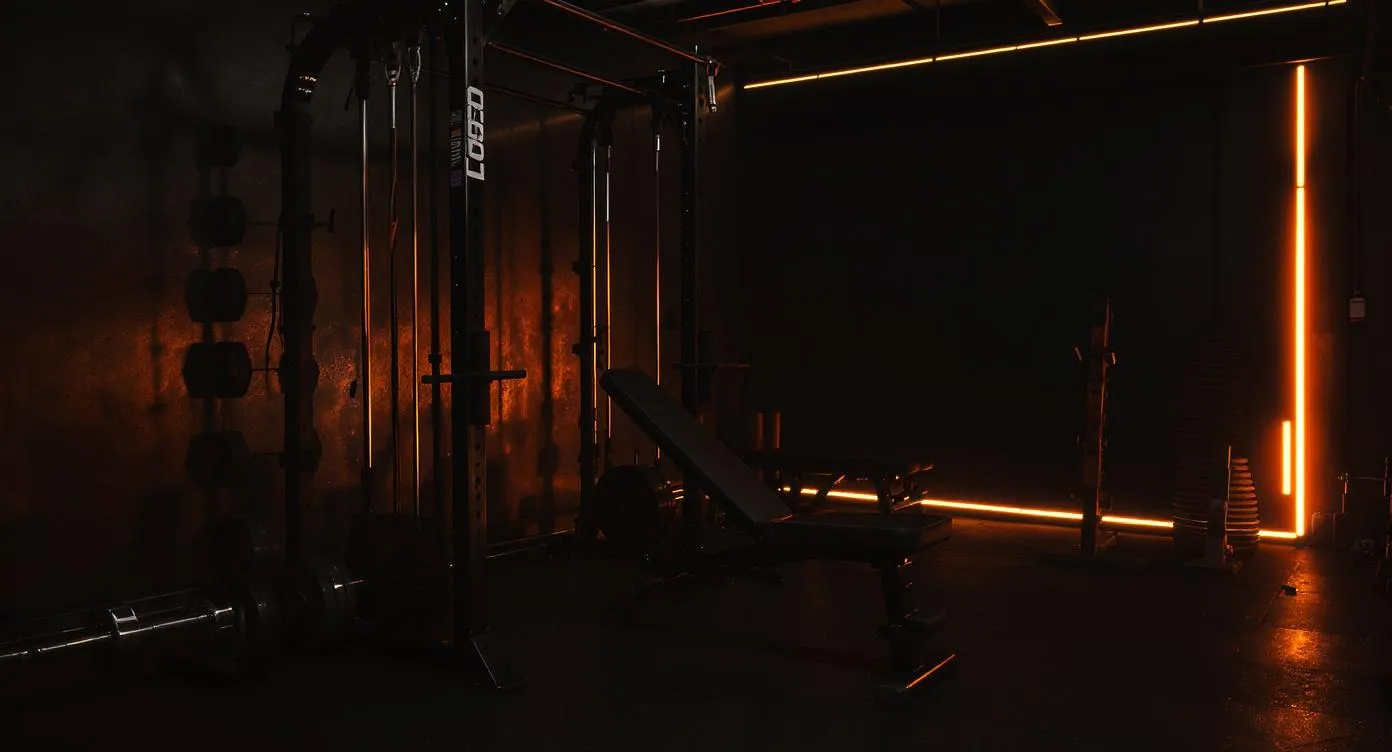
Bodybuilding Home Gym Setup: Equipment & Training Guide (2026)
How to build the perfect bodybuilding home gym. Equipment priorities, essential machines, and the setup for serious muscle building.
You need a power rack with a cable attachment, adjustable dumbbells (5-90 lbs), an adjustable bench, and a barbell with 300+ lbs of plates. Budget $1,500-$2,500 for a setup that covers 90% of bodybuilding exercises.
Bodybuilding is the hardest training discipline to replicate at home. Powerlifting needs a rack, bar, bench, and plates. CrossFit needs an air bike and bumper plates. Bodybuilding needs all of it — plus cable systems, multiple dumbbell increments, angle-adjustable benches, and enough exercise variety to stimulate every muscle fiber from every angle. A competitive bodybuilder might rotate through 50 to 80 distinct exercises across a training block. That is a lot to ask from a garage.
But here is what most people get wrong: you do not need a commercial gym to build a world-class physique. You need the right equipment purchased in the right order, a training approach designed around your setup, and the discipline to push intensity without machines doing the work for you. Some of the best natural bodybuilders in the world train in home gyms — and many will tell you the lack of distractions actually accelerates their progress.
This guide covers everything: equipment priorities and the exact order to buy them, budget tiers from $1,500 to $4,500+, a complete exercise library organized by muscle group, sample programming splits, training techniques adapted for home equipment, safety protocols for solo training, maintenance, and the most common mistakes that waste money and stall progress.
Why Bodybuilding Demands More Equipment Than Other Disciplines
Understanding why bodybuilding is equipment-intensive helps you make smarter purchasing decisions. There are four demands that separate bodybuilding from powerlifting and functional fitness training.
Exercise Variety and Muscle Isolation
Powerlifting revolves around three lifts. CrossFit uses 15 to 20 core movements. Bodybuilding benefits from 50+ exercises because each muscle group responds to different angles, resistance curves, and movement patterns. Chest development alone might require flat press, incline press, decline press, flyes at multiple angles, cable crossovers, and push-up variations. You cannot achieve that variety with a barbell alone — you need dumbbells, cables, and angle adjustability.
High Training Volume
Bodybuilders typically accumulate 15 to 25+ working sets per muscle group per week, spread across two or more sessions. That volume means equipment takes sustained abuse: knurling wears, cables stretch, bench padding compresses, and adjustment mechanisms loosen. Budget equipment that survives casual training may fail under bodybuilding volume. Buy quality where it contacts your body — barbell knurling, bench padding, cable smoothness.
Incremental Progressive Overload
In powerlifting, a 10 lb PR on squat is a meaningful jump. In bodybuilding, progress is measured in 2.5 to 5 lb increments on isolation lifts. A 2.5 lb increase on lateral raises represents serious strength gain. This means you need precise weight adjustments — fractional plates for barbell work and adjustable dumbbells with small increments for isolation movements. Standard plate sets that jump from 25 to 45 lbs are inadequate.
Mind-Muscle Connection and Controlled Tempo
Bodybuilding emphasizes slow eccentrics, peak contractions, and constant tension. Cables provide continuous resistance through the entire range of motion, which is why every serious bodybuilding gym in the world has a cable station. Free weights alone create dead spots at the top of curls, the lockout of presses, and the bottom of flyes where gravity reduces tension to near zero. Cables eliminate those dead spots.
Bodybuilding Equipment Priority List
Buy these in this order. Each piece builds on the previous one, and the first five items are non-negotiable for a functional bodybuilding home gym.
- Power rack with integrated cable system — unlocks squats, bench press, overhead press, plus all cable isolation work
- Adjustable dumbbells (5-52 lb or 5-90 lb) — required for unilateral work, flyes, raises, curls, and rows
- Adjustable bench (7+ positions) — flat, incline, and decline angles for pressing and isolation movements
- Olympic barbell and plates (300+ lbs) — foundation for compound lifts and heavy loading
- Gym flooring (3/4 inch rubber) — protects your floor and provides stable footing
- Resistance bands (multiple tensions) — add accommodating resistance and handle leg isolation work
- Cable attachments — rope, straight bar, V-bar, D-handles for full cable exercise library
Everything after item seven — specialty bars, a dip belt, additional plate pairs, a preacher curl pad — is optional until the core setup is dialed in. For a broader perspective on building your gym from scratch, read our how to build a garage gym guide.
The Power Rack: Your Most Important Purchase
Why Cables Are Non-Negotiable for Bodybuilding
A power rack without cables is a powerlifting rack. A power rack with cables is a bodybuilding station. The cable system is what separates a bodybuilding home gym from a general strength setup. Cables unlock tricep pushdowns, cable curls, face pulls, cable flyes, lat pulldowns, cable lateral raises, straight-arm pulldowns, cable crunches, and dozens more isolation movements that are difficult or impossible with free weights alone.
When selecting a rack, evaluate cable smoothness above almost everything else. A jerky, friction-heavy cable system makes isolation work miserable and reduces the effectiveness of controlled tempo training. Nylon-coated cables running through sealed bearings provide the smoothest feel. Steel-on-steel pulleys will corrode and bind within a year in a garage environment.
Top Pick: Sportsroyals Power Cage

SPORTSROYALS Power Rack, Multi-Functional Power Cage with Pulley System & LAT Pull Down
Capacity
1,600 lbs
Steel
2x2" Heavy-Duty Steel
Footprint
52" L x 49" W x 84" H
Price
$319.99
- 4.7+ star rating on Amazon
- Massive 1,600 lb weight capacity
- Full adjustable cable crossover system included
- Multiple attachment points (LAT, low row, landmine)
- Comes with complete attachment package
- Best value all-in-one home gym rack
- Large footprint requires dedicated space
- Assembly requires 4-5 hours with two people
- Cable system adjustments take practice
Price and availability may change
The Sportsroyals Power Cage is purpose-built for bodybuilding home gyms. It includes a full cable crossover system with high and low pulley stations, a multi-grip pull-up bar, plate-loaded cable weight stacks, and safety spotter arms. The dual cable columns allow independent arm work — cable flyes, single-arm pushdowns, and unilateral lat pulldowns — which is critical for symmetry-focused bodybuilding training.
The cable system uses a 2:1 pulley ratio, meaning the weight you load on the pin is halved at the handle. This is standard for home gym cable systems and actually works in your favor for isolation work because it allows smoother transitions between weights using standard plates. Load two 10 lb plates for 10 lbs of effective resistance at the handle, perfect for lateral raise and rear delt work where light weights are appropriate.
Key specifications: 800 lb rack capacity, 14-gauge steel construction, 45-inch depth interior, compatible with standard Olympic plates. Read our full Sportsroyals review for load testing results and long-term durability notes.
- Full cable crossover system unlocks 30+ isolation exercises impossible with free weights alone
- Dual independent pulleys enable unilateral work critical for symmetry
- Plate-loaded design means no expensive weight stack upgrades — use your existing plates
- Multi-grip pull-up bar handles wide-grip, neutral-grip, and chin-up variations
- 800 lb capacity handles any reasonable home gym loading scenario
- Requires significant floor space — 7 feet wide by 5 feet deep minimum footprint
- Assembly takes 3-4 hours and ideally requires two people
- Cable smoothness is adequate but not commercial-gym quality out of the box — upgrade pulleys after 6 months if needed
- Plate storage pegs are positioned low, making loading and unloading plates for cable work slightly awkward
- Weight capacity on the cable system is limited by plate horn length — approximately 200 lbs effective resistance maximum
Budget Alternative: Mikolo F4 Power Cage

Mikolo F4 2.0 Power Cage with Dual-Track Smooth Pulley System
Capacity
1,200 lbs
Steel
2x2" 12-Gauge Steel
Footprint
49" L x 49" W x 86" H
Price
$399.99
- 4.6+ star rating on Amazon with 3,000+ reviews
- 1,200 lb weight capacity — rare at this price
- Includes LAT pulldown and low row cable system
- 27 height adjustments with 2" hole spacing
- Dual-track pulley system
- Comes with multiple attachments included
- Assembly takes 3-4 hours
- Heavier than budget racks — needs two people to move
- Plate storage pegs sold separately
Price and availability may change
If your budget is tighter, the Mikolo F4 offers a single lat pulldown and low row cable station at a lower price point. You lose the dual crossover capability — no cable flyes, no independent single-arm high pulley work — but you gain a functional lat pulldown that handles pulldowns, tricep pushdowns, seated rows, and cable curls effectively. For bodybuilders who rely more heavily on dumbbell work for isolation, the F4 is a legitimate starting point.
Read our Mikolo F4 review or see how both racks compare in our Mikolo vs Sportsroyals head-to-head.
Adjustable Dumbbells: The Bodybuilding Workhorse
Dumbbells are arguably more important for bodybuilding than for any other training discipline. Bodybuilding relies on dumbbell flyes, incline presses, lateral raises, concentration curls, hammer curls, dumbbell rows, dumbbell pullovers, goblet squats, Romanian deadlifts, and shrugs — movements that demand a wide range of weights accessible quickly for techniques like drop sets and supersets.
Top Pick: Bowflex SelectTech 552

BowFlex Results Series SelectTech Dumbbells
Capacity
5-52.5 lbs each
Steel
Steel Plates / Nylon Dial Mechanism
Footprint
16.9" L x 8.3" W x 9" H each
Price
$429.00
- 4.7+ star rating on Amazon with 15,000+ reviews
- Replaces 15 sets of dumbbells (5-52.5 lbs)
- Fastest weight change system on the market (2 seconds)
- 2.5 lb increments up to 25 lbs
- Compact cradle storage footprint
- Sold as a pair
- Cannot be dropped — internal mechanism is fragile
- Length at 52.5 lbs feels awkward on some exercises
- Price has increased from original $349 MSRP
- 5 lb increments above 25 lbs
Price and availability may change
The Bowflex 552 adjusts from 5 to 52.5 lbs in 2.5 lb increments up to 25 lbs, then 5 lb increments to 52.5 lbs. That granularity is critical for bodybuilding. When your lateral raise strength increases from 15 to 17.5 lbs, you can make that jump. With a standard dumbbell set, you would be forced from 15 to 20 lbs — a 33% increase that often leads to form breakdown and shoulder impingement.
The dial-adjustment mechanism changes weights in under 3 seconds, which matters enormously for drop sets. A traditional bodybuilding drop set might involve four weight reductions in 60 seconds. With plate-loaded dumbbells, that is physically impossible. With SelectTech, you turn the dial and go.
Durability note: The SelectTech mechanism is plastic-internal and will not survive being dropped from height. Bodybuilders who train to failure need to control the eccentric and set the dumbbells down rather than dropping them. This is actually better training practice — the eccentric phase drives hypertrophy — but it is a real consideration for heavy pressing sets. Read our detailed Bowflex 552 review.
Upgrade Pick: PowerBlock Elite 90

PowerBlock Elite USA 90 EXP Adjustable Dumbbells
Capacity
5-90 lbs each (with expansions)
Steel
Steel Plates / Urethane Coating
Footprint
12" L x 6" W x 9" H each
Price
$869.00
- 4.8+ star rating on Amazon with 2,000+ reviews
- Expandable from 50 lbs to 90 lbs per dumbbell
- Rated for drops from lifting height (unlike Bowflex)
- 2.5 lb increments for precise progression
- More compact than Bowflex at top weights
- USA-made with lifetime warranty
- Expensive compared to 52.5 lb alternatives
- Wider cage can feel awkward on curls
- Pin selection is slower than Bowflex dial
- Requires expansion kits to reach 90 lbs
Price and availability may change
Once your dumbbell pressing exceeds 50 lbs per hand, the Bowflex 552 runs out of room. The PowerBlock Elite 90 extends to 90 lbs per hand with add-on kits, uses a magnetic pin adjustment system, and survives more aggressive handling than the SelectTech design. The compact rectangular shape also sits more securely on your thighs during the "kick-up" into pressing position — a practical detail that matters at heavy weights.
The tradeoff is slower weight changes (approximately 8-10 seconds vs 3 seconds for Bowflex) and a blockier feel that some lifters find less natural for movements like flyes. For our full analysis, read the PowerBlock 90 review or see the Bowflex vs PowerBlock comparison for a side-by-side breakdown.
The Adjustable Bench: Angle Control Matters
For bodybuilding, bench angle is not a convenience feature — it is a training variable. A flat-only bench limits you to one pressing angle. An adjustable bench with 7+ positions lets you hit flat, 15-degree incline, 30-degree incline, 45-degree incline, 60-degree military press angle, and decline — each angle shifting emphasis to different portions of the pectoral and deltoid muscles. Research consistently shows that incline pressing between 30 and 45 degrees preferentially activates the clavicular (upper) head of the pectoralis major, which is the area most bodybuilders underdevelop.

FLYBIRD WB2 Weight Bench, Utility Adjustable Weight Bench
Capacity
800 lbs (ASTM Certified)
Steel
Commercial-Grade Steel Frame
Footprint
48.4" L x 16.5" W x 17" H (folded)
Price
$109.99
- 4.6+ star rating on Amazon with 25,000+ reviews
- Unbeatable value under $120
- ASTM-certified 800 lb weight capacity
- 8 backrest angles (90° to -30° FID)
- Folds flat for easy storage in small spaces
- Quick 10-minute assembly
- Gap between seat and backrest at steep inclines
- No decline position on some variants
- Pad is narrower (10.2") than premium benches (12")
- Feet can slide on smooth concrete without rubber mats
Price and availability may change
The FLYBIRD adjustable bench offers 8 back positions and 3 seat positions at a price point under $120. The 600 lb weight capacity handles any realistic dumbbell or barbell pressing scenario, and the 3-inch high-density foam padding provides the right balance between comfort and stability. Thinner padding lets you feel the frame under your shoulder blades during heavy presses. Thicker padding sinks and shifts under load. Three inches is the sweet spot.
Read our FLYBIRD review for long-term durability testing, or browse our complete best weight bench rankings for alternatives. For help choosing the right bench for your training style, our how to choose a weight bench guide covers every decision factor.
Barbell and Plates: The Compound Foundation
Bodybuilding may emphasize isolation work, but compound lifts are still the primary drivers of overall muscle mass. Squats, barbell rows, overhead presses, Romanian deadlifts, and barbell curls form the backbone of any serious hypertrophy program.

Synergee Games 15kg and 20kg Colored Ceramic Coated Barbells
Capacity
1,500 lbs rated capacity
Steel
Ceramic Coated Steel / Needle Bearings
Footprint
28.5mm Shaft, 7ft Olympic Bar
Price
$149.95
- 4.7+ star rating on Amazon
- 1,000 lb capacity at mid-range price
- Needle bearings provide smooth spin for Olympic lifts
- 190K PSI tensile strength
- Dual knurling marks for powerlifting and Olympic lifts
- Best Amazon-available upgrade from budget bars
- Black phosphate finish requires regular oiling
- Not made in the USA
- Knurling is slightly less aggressive than premium bars
Price and availability may change
The Synergee Games Barbell is an excellent bodybuilding bar at the $200 price point. Its moderate knurling provides grip without tearing your hands during high-rep sets (bodybuilders regularly perform 10-15 rep sets on rows and curls, and aggressive powerlifting knurling will shred your palms). The 28.5mm shaft diameter is comfortable for pressing and curling, and the needle bearing sleeves provide smooth rotation for any Olympic variations you incorporate. Read our Synergee barbell review.
Plate Strategy for Bodybuilding
Bodybuilding plate needs differ from powerlifting. You need more mid-range plates (10s, 25s) and less total weight, but you also need fractional plates for micro-loading isolation barbell work like curls and skull crushers.
Recommended starting configuration:
- CAP 300 lb Olympic set (includes bar and 255 lbs of plates) — approximately $340
- Additional pair of Yes4All 45 lb plates — $90
- Additional pair of 25 lb plates — $50
- Two pairs of 10 lb plates — $40
- Fractional plates: 2.5 lb and 1.25 lb pairs — $25
That gives you roughly 350 lbs of total plate weight with precise loading options from 47.5 lbs up. Most home gym bodybuilders will never need more than 405 lbs on a barbell, which this configuration covers comfortably. Read our Yes4All Olympic Plates review for quality assessment.
Budget Tiers for a Bodybuilding Home Gym
Beginner Bodybuilder: $1,500
This tier covers the essentials for someone in their first 1-3 years of training. You will have enough equipment to run a full push/pull/legs program with compound and basic isolation work.
- ULTRA FUEGO Power Cage: $390
- CAP 300 lb barbell and plate set: $340
- Bowflex SelectTech 552 dumbbells: $429
- FLYBIRD adjustable bench: $110
- Yes4All 45 lb plate pair: $90
- Horse stall mat flooring (6 mats): $200
- Resistance band set: $40
- Total: ~$1,599
Intermediate Bodybuilder: $3,000
This is the sweet spot where your home gym begins to rival a commercial facility for bodybuilding. Cable access is the key unlock at this tier. See our Home Gym Under $3,000 build guide for the complete setup walkthrough.
- Sportsroyals Power Cage with cables: $550
- Synergee Games Barbell: $200
- CAP plate set (255 lbs): $280
- Yes4All 45 lb plates x2 pairs: $180
- Additional 25 lb and 10 lb plate pairs: $90
- Bowflex SelectTech 552 dumbbells: $429
- FLYBIRD adjustable bench: $110
- Cable attachment set (rope, V-bar, D-handles): $80
- Horse stall mat flooring (8 mats): $280
- Fractional plates: $25
- Resistance band set: $40
- Total: ~$2,264 (leaves substantial headroom for accessories)
Advanced Bodybuilder: $4,500+
At this tier, you are building a gym that exceeds most commercial facilities for targeted bodybuilding work. The PowerBlock 90 dumbbells replace the Bowflex for heavier pressing, additional plate pairs ensure you never run out of loading options, and accessory equipment fills in the gaps. See our Home Gym Under $4,000 build for a similar configuration.
- Sportsroyals Power Cage with cables: $550
- Synergee Games Barbell: $200
- CAP plate set (255 lbs): $280
- Yes4All 45 lb plates x4 pairs: $360
- Additional 25 lb, 10 lb, and 5 lb plate pairs: $225.26
- PowerBlock Elite 90 dumbbells: $869
- FLYBIRD adjustable bench: $110
- Cable attachment full set: $120
- Dip belt for weighted pull-ups and dips: $40
- Horse stall mat flooring (10 mats): $350
- Fractional plates: $25
- Resistance band set (5 tensions): $50
- Gym mirror (wall-mounted): $80
- Total: ~$3,164 (leaves room for specialty items)
Sample Bodybuilding Programming for Home Gyms
The following push/pull/legs split is designed specifically for home gym equipment — a power rack with cables, adjustable dumbbells, an adjustable bench, and a barbell. Run the cycle twice per week (6 training days, 1 rest day). Each session should take 60 to 75 minutes.
Push Day (Chest, Shoulders, Triceps)
| Exercise | Sets x Reps | Tempo | Rest |
|---|---|---|---|
| Barbell Bench Press (flat) | 4 x 8-10 | 3-1-1 | 2 min |
| Incline Dumbbell Press (30 degrees) | 3 x 10-12 | 3-1-2 | 90 sec |
| Cable Flye (high to low) | 3 x 12-15 | 2-1-2 | 60 sec |
| Barbell Overhead Press | 3 x 8-10 | 2-1-1 | 2 min |
| Dumbbell Lateral Raise | 4 x 12-15 | 2-1-2 | 60 sec |
| Cable Tricep Pushdown (rope) | 3 x 12-15 | 2-1-2 | 60 sec |
| Overhead Dumbbell Tricep Extension | 3 x 10-12 | 3-1-1 | 60 sec |
Tempo notation: Eccentric seconds - pause seconds - concentric seconds. A "3-1-2" tempo on cable flyes means 3 seconds lowering, 1 second pause at the stretch, 2 seconds squeezing back to the start. Controlled tempos are the single most effective technique for building muscle in a home gym because they increase time under tension without requiring heavier weights.
Pull Day (Back, Biceps, Rear Delts)
| Exercise | Sets x Reps | Tempo | Rest |
|---|---|---|---|
| Barbell Bent-Over Row | 4 x 8-10 | 2-1-1 | 2 min |
| Lat Pulldown (wide grip) | 4 x 10-12 | 3-1-2 | 90 sec |
| Single-Arm Dumbbell Row | 3 x 10-12 each | 2-1-1 | 60 sec |
| Cable Face Pull | 3 x 15-20 | 2-2-1 | 60 sec |
| Barbell Curl | 3 x 10-12 | 3-1-2 | 60 sec |
| Incline Dumbbell Curl | 3 x 10-12 | 3-1-2 | 60 sec |
| Cable Hammer Curl (rope) | 3 x 12-15 | 2-1-2 | 45 sec |
Leg Day (Quads, Hamstrings, Glutes, Calves)
| Exercise | Sets x Reps | Tempo | Rest |
|---|---|---|---|
| Barbell Back Squat | 4 x 8-10 | 3-1-1 | 3 min |
| Romanian Deadlift | 3 x 10-12 | 3-1-1 | 2 min |
| Bulgarian Split Squat (dumbbell) | 3 x 10-12 each | 2-1-1 | 90 sec |
| Leg Extension (band or cable) | 4 x 15-20 | 2-1-2 | 60 sec |
| Leg Curl (band or cable) | 4 x 12-15 | 2-1-2 | 60 sec |
| Standing Calf Raise (barbell on back) | 4 x 15-20 | 2-2-1 | 60 sec |
Programming Notes
Progressive overload protocol: Aim to add 2.5 to 5 lbs to compound lifts every 2 weeks and 2.5 lbs to isolation lifts every 3-4 weeks. When you hit the top of a rep range for all prescribed sets, increase weight on the next session and drop to the bottom of the rep range. Example: when you complete 4 x 10 on bench press, add 5 lbs next session and target 4 x 8.
Deload every 5th week. Reduce all working weights by 40% and cut volume in half. This is non-negotiable for bodybuilding longevity. The high volume and controlled tempos accumulate more fatigue than most lifters realize, and chronic fatigue masks progress. Many home gym bodybuilders report their best growth spurts in the week following a deload.
Advanced Home Gym Bodybuilding Techniques
Training at home means no machines with built-in resistance curves. These techniques compensate by increasing mechanical tension, time under tension, and metabolic stress using the equipment you have.
Drop Sets with Adjustable Dumbbells
Drop sets are bodybuilding gold, and adjustable dumbbells make them practical at home. Perform a set to near-failure, immediately reduce weight by 20-30%, and continue repping. With Bowflex SelectTech, you can execute a triple drop set in under 90 seconds: 40 lbs to failure, dial to 30 lbs, rep to failure, dial to 20 lbs, rep to failure. Apply this technique to lateral raises, dumbbell curls, and dumbbell flyes for extreme muscle fiber recruitment.
Cable Mechanical Drop Sets
A mechanical drop set changes the exercise angle or grip rather than the weight. On a cable station: start with straight-arm pulldowns (hardest leverage), immediately switch to close-grip pulldowns (moderate leverage), then finish with underhand pulldowns (easiest leverage) — all at the same weight. This technique is devastating for back development and only possible with a cable system.
Band-Enhanced Compound Lifts
Loop resistance bands over the barbell and anchor them to the rack base. This adds accommodating resistance that increases through the range of motion, matching your natural strength curve. Band-enhanced bench press and squat recruit more fast-twitch muscle fibers at lockout and overload the portion of the lift where you are strongest. Use medium-tension bands (40-80 lbs at full stretch) and reduce barbell weight by 20% to compensate.
1.5 Rep Training
Perform the full concentric, lower halfway down, press back up to lockout, then lower fully. That is one rep. This technique doubles the time under tension in the weakest portion of the range of motion. Apply it to squats (devastating for quads), incline dumbbell press (upper chest emphasis), and cable curls (peak contraction emphasis).
Essential Bodybuilding Exercises by Muscle Group (Home Gym Edition)
Chest
- Barbell bench press (flat, 30-degree incline, 45-degree incline)
- Dumbbell bench press (flat, incline, decline)
- Dumbbell flye (flat, incline)
- Cable flye (high-to-low, low-to-high, mid-height)
- Weighted push-ups (plates on back or band resistance)
- Dip (on rack dip handles or between two sturdy surfaces)
Back
- Barbell bent-over row (overhand and underhand)
- Lat pulldown (wide, close, neutral grip)
- Single-arm dumbbell row
- Straight-arm cable pulldown
- Pull-up and chin-up (weighted with dip belt)
- Cable face pull
- Barbell shrug and dumbbell shrug
Shoulders
- Barbell overhead press (standing and seated)
- Dumbbell shoulder press (seated)
- Dumbbell lateral raise (standing and seated)
- Cable lateral raise
- Dumbbell rear delt flye (bent-over)
- Cable rear delt flye
- Dumbbell front raise
- Barbell upright row (wide grip for deltoid emphasis)
Biceps
- Barbell curl (straight bar, EZ-curl if available)
- Dumbbell curl (standing, seated, incline bench)
- Hammer curl (dumbbell or cable rope)
- Cable curl (low pulley, various grips)
- Concentration curl (seated, dumbbell)
Triceps
- Close-grip barbell bench press
- Skull crusher (barbell or dumbbell)
- Cable tricep pushdown (rope, straight bar, V-bar)
- Overhead cable extension
- Dumbbell overhead tricep extension (single-arm and two-arm)
- Dip (weighted, tricep emphasis with upright torso)
Legs
- Barbell squat (back squat, front squat, pause squat)
- Romanian deadlift (barbell and dumbbell)
- Bulgarian split squat (dumbbell loaded)
- Walking lunge (dumbbell loaded)
- Leg extension (cable or band)
- Leg curl (cable, band, or Nordic curl bodyweight)
- Standing calf raise (barbell on back, single-leg dumbbell)
- Seated calf raise (dumbbell on knees)
- Hip thrust (barbell, back against bench)
What to Skip for Bodybuilding (Save Your Money)
Not every piece of gym equipment earns its space in a bodybuilding home gym. These are common purchases that provide minimal return for hypertrophy-focused training.
- Air bike or rower — useful for general health but does nothing for muscle growth. If you want cardio, walk outside. Spend the $300-700 on more plates or better dumbbells.
- Trap bar — designed for deadlift variations that reduce lower back stress, but bodybuilders already use Romanian deadlifts and rows for posterior chain work. The trap bar is redundant.
- Kettlebells — excellent for conditioning and functional fitness, poor for targeted hypertrophy. A single kettlebell costs what a pair of fractional plates plus a cable attachment set costs.
- Deadlift jack — bodybuilders rarely pull heavy singles. If you need to load and unload the bar, roll one side onto a 10 lb plate.
- Specialty curl bars — an EZ-curl bar is nice for wrist comfort, but a straight barbell and dumbbells cover every curl variation adequately.
Focus your budget on cable accessories, additional plate pairs, and dumbbell upgrades. Those purchases directly increase exercise variety, which is the currency of bodybuilding progress.
Safety Protocols for Solo Bodybuilding Training
Training alone is one of the biggest advantages of a home gym — no waiting, no small talk, no schedule compromises. But it requires safety awareness, especially when pushing to failure on heavy compound lifts.
Always set safety bars before barbell pressing. Position them 1 inch below your chest touch point for bench press and just above parallel depth for squats. Test the safety height with an empty bar before every session if you have changed the pins. A failed rep should land the bar on the safeties, not on your chest or neck.
Use the roll of shame as a backup for bench press. If you misposition safeties, you can roll a failed bench press down your torso to your hips, sit up, and stand. Practice this with moderate weight so the movement is instinctive under fatigue.
Control dumbbells at all times. Dropping Bowflex SelectTech dumbbells from height will destroy the adjustment mechanism. More importantly, an uncontrolled dumbbell drop can bounce unpredictably and strike your foot, face, or other equipment. Lower dumbbells to your thighs, then to the floor — every rep, every set, no exceptions.
Keep your training area clear. Plates on the floor, bands draped over equipment, and water bottles in the walkway create trip hazards that become dangerous when you are fatigued and carrying heavy dumbbells. Rerack plates between exercises. It takes 30 seconds and prevents injuries that could cost months of training.
For a comprehensive look at home gym safety, read our garage gym safety guide.
Maintenance for Bodybuilding Equipment
Bodybuilding generates less impact than powerlifting or CrossFit — you are not dropping barbells or slamming wall balls — but the high volume means moving parts wear faster. Cable systems and adjustable dumbbells require particular attention.
Cable maintenance (monthly): Inspect cables for fraying, especially where they contact pulleys. Apply silicone-based lubricant to pulley wheels. Tighten all cable termination bolts. A snapped cable under load can whip back and cause serious injury. Replace cables at the first sign of visible strand separation.
Barbell maintenance (biweekly): Wipe down the shaft with a nylon brush to remove chalk and skin oil from the knurling. Apply a thin coat of 3-in-1 oil to the sleeves. Store horizontally on J-hooks. For detailed care instructions, see our barbell maintenance guide.
Adjustable dumbbell maintenance (weekly): Wipe the selector mechanisms with a dry cloth. Check that weight plates seat properly and do not wobble. For Bowflex SelectTech, periodically remove each plate and clean the selector track of debris. For PowerBlock, ensure the magnetic pin engages firmly at each weight setting.
Bench maintenance (quarterly): Check all adjustment pins and bolts for tightness. Inspect vinyl upholstery for tears that allow moisture absorption (which leads to foam degradation and bacterial growth). Wipe with a mild disinfectant after every session to prevent sweat damage.
Rack maintenance (every 6 months): Tighten all bolts, especially on bolt-together racks that vibrate during heavy use. Inspect J-hooks and safety bar contact surfaces for metal fatigue or deformation. Apply touch-up paint to any bare metal exposed by plate or barbell contact to prevent rust.
Common Bodybuilding Home Gym Questions
Frequently Asked Questions
Can you build a competitive bodybuilding physique with just a home gym?
Do I need a cable machine for bodybuilding at home?
Bowflex 552 vs PowerBlock 90 for bodybuilding — which should I buy?
How much space does a bodybuilding home gym need?
How much flooring do I need for a bodybuilding gym?
Is barbell or dumbbell training better for bodybuilding?
Can I build bigger legs at home without a leg press or leg curl machine?
How do I progressive overload isolation exercises with limited weight?
Additional Resources
Related Content
- Home Gym Under $3,000 (Ideal Bodybuilding Setup)
- Home Gym Under $4,000 (Advanced Bodybuilding)
- Best Adjustable Dumbbells
- Bowflex vs PowerBlock Comparison
- Mikolo F4 Power Cage Review
- Sportsroyals Power Cage Review
- Home Gym Programming Guide
- Home Gym Nutrition Basics
- Teclor Parallettes Review
- Home Gym for Postpartum Recovery: Safe Return to Training (2026)
- All Bodybuilding Content
The Bottom Line
A bodybuilding home gym is the most equipment-intensive discipline-specific setup you can build — but it does not need to be the most expensive. The key insight is that cables and dumbbell variety matter more than raw weight capacity. A $2,500 home gym with a Sportsroyals cable rack, Bowflex SelectTech 552 dumbbells, a FLYBIRD adjustable bench, and 300+ lbs of plates provides a training environment that matches or exceeds most commercial gyms for pure hypertrophy work. You will have zero wait times, full control over your training environment, and equipment that is always set up exactly the way you left it. Start with the essentials, master the programming, add equipment as your training advances, and you will build the physique you want without ever stepping foot in a commercial gym again.
Marcus Reid
Powerlifter and mechanical engineer who has been building and breaking home gym equipment for 15 years.
Read full bioMore in Guides
Strength vs Hypertrophy: How to Program for Your Goals (2026)
The definitive guide to programming for strength vs size in your home gym. Rep ranges, volume, intensity, and complete programs for both goals.
The Complete Home Gym Warm-Up Guide (2026)
Stop skipping your warm-up. Complete warm-up protocols for every training style, plus the equipment that makes preparation effortless at home.
Home Gym Deload Guide: When and How to Back Off (2026)
Learn when and how to deload in your home gym. Science-backed protocols, recovery strategies, and signs you need a rest week.