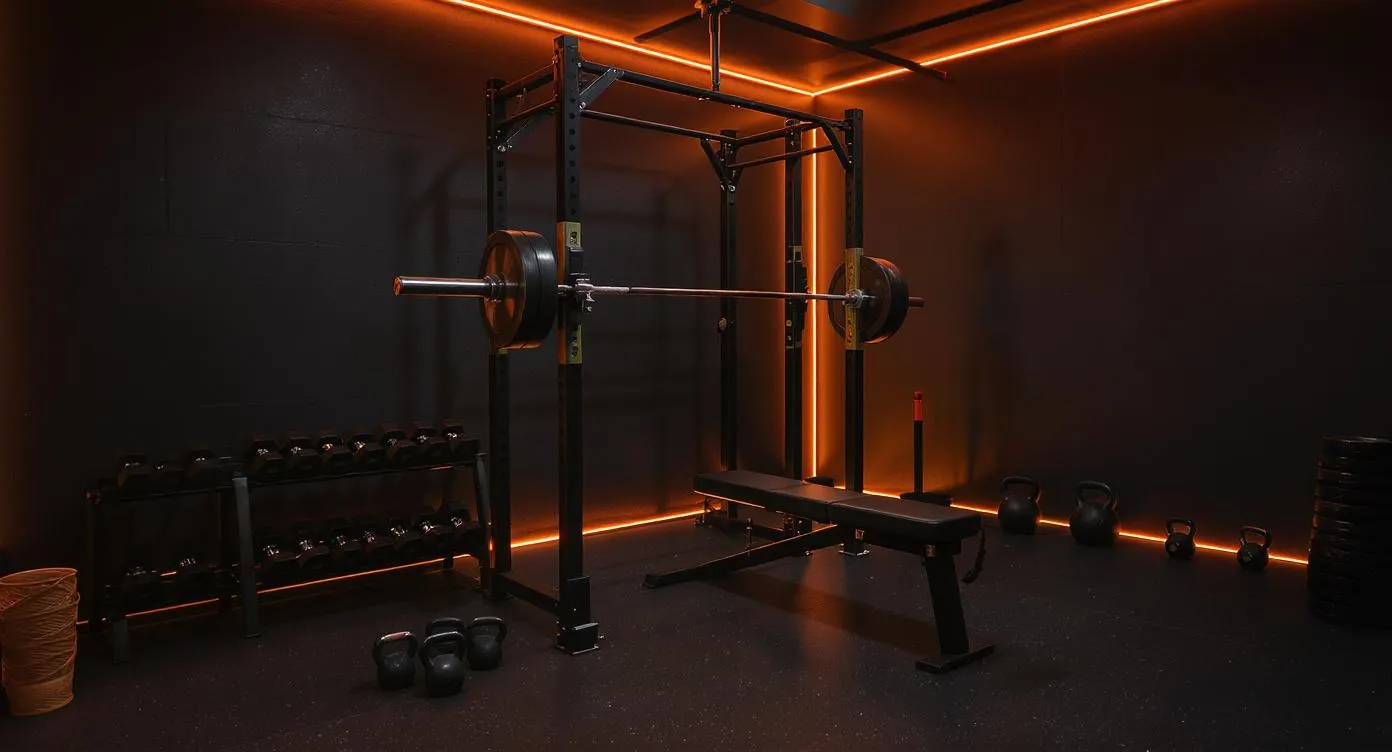
Home Gym for Women: Complete Equipment & Training Guide (2026)
How to build and use a home gym designed for women. Equipment recommendations, starter weight ranges, and training tips for female lifters.
Building a home gym is one of the best investments a woman can make for long-term health, strength, and body composition. You get complete control over your environment, your schedule, and your programming — no waiting for equipment, no unsolicited coaching from strangers, and no monthly fees draining your bank account. Whether you are a total beginner who has never touched a barbell or an experienced lifter ready to move your training home, this guide covers everything you need to know about selecting equipment, setting up your space, programming your workouts, and progressing safely for years to come.
Why a Home Gym Is a Game-Changer for Women
The commercial gym experience can be complicated for women. Between crowded free weight sections, uncomfortable attention, and limited scheduling flexibility, too many women either avoid the gym entirely or stick to cardio machines because the weight room feels unwelcoming. A home gym eliminates every one of those barriers.
Privacy and confidence. Training at home means you can learn new movements, fail reps, and experiment with programming without anyone watching. This matters enormously for beginners who feel self-conscious about their form or the amount of weight on the bar. Privacy accelerates learning because you take more risks, try harder exercises, and push closer to failure — all of which drive faster progress.
Total schedule control. Early morning before kids wake up, during nap time, late at night after work — your gym is always open. This flexibility is the single biggest factor in long-term consistency, and consistency is the only thing that produces results. Women who juggle careers, families, and social obligations benefit enormously from eliminating the commute and rigid class schedules of commercial gyms.
Long-term cost savings. A quality home gym setup runs $1,000 to $3,000 depending on your goals. A commercial gym membership averages $40 to $80 per month, which means your home gym pays for itself within 18 to 36 months — and then you train for free forever. The equipment holds resale value too, so even if your situation changes, you recover most of your investment.
Training quality. No waiting for the squat rack. No rushing through sets because someone is hovering. No compromising your program because equipment is taken. You follow your plan exactly as written, rest as long as you need, and superset whatever you want. This alone can shave 15 to 20 minutes off every session.

FLYBIRD WB2 Weight Bench, Utility Adjustable Weight Bench
Capacity
800 lbs (ASTM Certified)
Steel
Commercial-Grade Steel Frame
Footprint
48.4" L x 16.5" W x 17" H (folded)
Price
$109.99
- 4.6+ star rating on Amazon with 25,000+ reviews
- Unbeatable value under $120
- ASTM-certified 800 lb weight capacity
- 8 backrest angles (90° to -30° FID)
- Folds flat for easy storage in small spaces
- Quick 10-minute assembly
- Gap between seat and backrest at steep inclines
- No decline position on some variants
- Pad is narrower (10.2") than premium benches (12")
- Feet can slide on smooth concrete without rubber mats
Price and availability may change

Bodylastics PRO Series Resistance Band Set (6 Bands, 280 lbs)
Capacity
6 bands stackable to 280 lbs
Steel
Anti-Snap Natural Latex Tubing
Footprint
Handles, ankle straps, door anchor + carry bag
Price
$61.97
- 4.6 star rating on Amazon with 2,600+ reviews
- Patented anti-snap inner cord for safety
- 6 bands stackable up to 280 lbs total resistance
- Includes handles, ankle straps, and door anchor
- Lifetime replacement on bands
- Travel-friendly storage bag
- Resistance feels different than free weights
- Door anchor requires an inward-opening door
- Handles wear faster than the bands
Price and availability may change
Essential Equipment for a Women's Home Gym
The core equipment for women is identical to what men need — a barbell, plates, rack, and bench. The differences come down to starting weights, grip sizing, and a few accessory choices that align with common training goals for female lifters.
Choosing the Right Barbell
You have two main options: a standard Olympic barbell (20 kg / 44 lb) or a women's Olympic barbell (15 kg / 33 lb). Here is how they compare.
Standard Olympic barbell (20 kg / 44 lb):
- 28 to 29 mm shaft diameter
- 7 feet 2 inches total length
- Universal compatibility with all plate sizes
- Better resale value and versatility
Women's Olympic barbell (15 kg / 33 lb):
- 25 mm shaft diameter (significantly easier to grip for smaller hands)
- 6 feet 6 inches total length (fits tighter spaces)
- 5 kg lighter starting weight for pressing movements
- Required for women's competitive powerlifting and Olympic lifting
Our recommendation: If you have average or larger hands, start with a standard 20 kg bar. It is more versatile, compatible with more accessories, and you will never outgrow it. If you have notably small hands (cannot comfortably wrap around a 28 mm shaft) or plan to compete in women's divisions, the 15 kg bar is the better choice. Either way, spend at least $150 to $200 on a bar with good knurling and decent steel — cheap barbells develop permanent bend quickly.
Plates and Weight Selection
One of the most common mistakes women make is buying too little weight. Your squat and deadlift will progress faster than you expect, and buying plates incrementally costs more due to shipping. Here is a realistic breakdown by training level.
Beginner (first 6 to 12 months): 155 to 205 lbs total plate weight. This covers beginner squats up to 135 lbs, deadlifts up to 185 lbs, and all upper body work. A set like the CAP Barbell 300 lb set includes a barbell plus 255 lbs of plates, which gives you room to grow well beyond the beginner stage.
Intermediate (1 to 3 years of training): 225 to 315 lbs total. Most intermediate women squat 135 to 225 lbs and deadlift 185 to 275 lbs. You want enough plates to load your heaviest lift plus have change plates for fine-tuning working sets.
Advanced (3+ years): 315 to 405 lbs total. Strong women regularly squat 225+ and deadlift 315+. If you are on this track, invest in quality bumper plates from brands like Rogue or Fringe Sport — they protect your floor and barbell during heavy deadlifts.
- A 300 lb plate set covers most women through intermediate level
- Bumper plates protect floors and reduce noise for garage and apartment setups
- Olympic change plates (2.5 lb and 1.25 lb) enable microloading for upper body progression
- Iron plates are cheapest per pound and last forever
- Buying plates in small increments costs more due to repeated shipping fees
- Cheap plates have inconsistent sizing that can wobble on the bar
- Very heavy plate sets take up significant floor space when not loaded
- Bumper plates cost 2 to 3 times more per pound than cast iron
Power Rack vs. Squat Stands
A power rack is non-negotiable for solo training. The safety bars catch failed squats and bench presses, eliminating the need for a spotter entirely. The ULTRA FUEGO Power Cage is a proven budget option at around $389.99 that holds up to 800 lbs and fits in most garages and spare rooms. Read our detailed ULTRA FUEGO Power Cage review for the full breakdown.
Squat stands are cheaper and take less space, but they lack integrated safety bars. For women training alone — which is the entire point of a home gym — the rack is the smart long-term purchase. You will also use the rack for pull-ups, band work, and hanging accessories like dip attachments.
Adjustable Bench
A good adjustable bench supports flat, incline, and decline positions for pressing variations. The FLYBIRD Adjustable Bench at around $110 is the best budget option — it is lighter and easier to move than commercial benches, which matters if you are repositioning it frequently in a small space. For heavier lifting, look for a bench rated to at least 600 lbs with a wide, stable pad.
Dumbbells
Adjustable dumbbells are the most space-efficient option for a home gym. For women, the practical weight ranges break down like this:
- Beginner: 5 to 25 lbs per dumbbell handles all accessory work for the first 6 months
- Intermediate: 5 to 40 lbs covers dumbbell bench press, rows, lunges, and shoulder work
- Advanced: 5 to 52.5 lbs (Bowflex SelectTech 552 range) is sufficient for nearly all women's dumbbell training
The Bowflex SelectTech 552 remains the gold standard for adjustable dumbbells. The dial system is fast, the weight range is generous, and they take up about the same space as a single pair of fixed dumbbells. Check our adjustable dumbbell buying guide for a full comparison of options at every price point.
Flooring
Rubber flooring protects your subfloor, reduces noise, and provides stable footing for heavy lifts. Horse stall mats from Tractor Supply (3/4 inch thick, 4x6 feet) cost about $50 each and are the most cost-effective solution. Four mats create an 8x12 foot lifting platform for around $200. For a complete breakdown of options, read our garage gym flooring guide.
Accessories That Make a Real Difference
Beyond the core equipment, a few accessories significantly expand your training options:
- Resistance bands ($20 to $40): Essential for warm-ups, pull-up assistance, banded hip thrusts, and face pulls. A set of 3 to 4 resistance levels covers everything.
- Kettlebells ($50 to $120): A single 25 to 35 lb kettlebell opens up swings, Turkish get-ups, goblet squats, and conditioning circuits. Yes4All and CAP make solid budget options.
- Pull-up assistance band or lat pulldown attachment: Until you can do strict pull-ups, a heavy resistance band looped over the rack provides assistance. This is cheaper and more effective than a lat pulldown machine for most home gyms.
- Fractional plates (1.25 lb pair): Upper body lifts progress slowly for women. Microloading with 1.25 lb plates (2.5 lb total per session) prevents stalling on bench press and overhead press.
- Ab roller ($10 to $15): The single most effective core training tool per dollar spent.
Budget Builds: What to Buy at Every Price Point
Starter Setup — Under $1,000
This build covers barbell training, the foundation of any serious strength program:
- ULTRA FUEGO Power Cage — $389.99
- CAP Barbell 300 lb Olympic Set (bar + plates) — $340
- FLYBIRD Adjustable Bench — $110
- Horse Stall Mats (4 mats) — $200
- Resistance band set — $30
Total: approximately $1,070
This setup supports squats, bench press, overhead press, deadlifts, barbell rows, and dozens of variations. It is everything you need to run a legitimate strength program for years. See the full home gym under $1,000 build guide for detailed setup instructions.
Complete Setup — Under $2,000
Add these to the starter build for significantly more training variety:
- Bowflex SelectTech 552 Dumbbells — $429
- Yes4All Kettlebell (30 lb) — $45
- Extra pair of 45 lb plates — $90
- Fractional plate set (1.25 lb pair) — $25
- Jump rope — $15
- Ab roller — $12
Total: approximately $1,626
The dumbbells alone transform your training options. Single-arm work, isolation exercises, and dumbbell-specific movements like flies, lateral raises, and concentration curls all become available.
Advanced Setup — Under $3,000
At this budget, you can build a genuinely elite training facility:
- Everything from the $2,000 build
- Concept2 RowErg — $990
- Dip attachment for rack — $60
- Landmine attachment — $40
- Extra bumper plates (pair of 25s and 10s) — $180
Total: approximately $2,896
The Concept2 RowErg is the best piece of cardio equipment you can own — it trains the entire posterior chain while providing world-class conditioning. See the complete home gym under $3,000 build for the full equipment list.
Space Requirements and Setup
Minimum Space
A barbell-based home gym requires a minimum footprint of approximately 8 by 10 feet. This accommodates a power rack, bench, and enough clearance for deadlifts and overhead pressing. A standard two-car garage easily fits a full gym in one bay while leaving the other for parking.
Garage Setup Considerations
Garages are the most common location for home gyms and they work well with a few modifications. Ensure your garage door can close fully with the rack inside — measure ceiling height carefully before purchasing. Most power racks need 7.5 to 8 feet of clearance. For climate control, a box fan provides sufficient airflow in summer, and a space heater handles winter training in most climates. Check our garage gym ventilation guide for detailed climate management strategies.
Apartment and Spare Room Options
If you live in an apartment or do not have garage access, a spare bedroom or living room corner can work. Focus on dumbbells, resistance bands, a foldable bench, and a doorway pull-up bar. Skip the barbell and plates unless you have ground-floor space and rubber flooring. Our apartment gym under $300 build is designed specifically for this situation.
Training Programs for Every Level
Beginner: 3-Day Full Body Program (Months 1 to 6)
Full body training three times per week is optimal for beginners. You hit every muscle group with sufficient frequency while allowing ample recovery between sessions.
Day 1 (Monday):
- Barbell Back Squat: 3 sets of 8 reps
- Barbell Bench Press: 3 sets of 8 reps
- Barbell Bent-Over Row: 3 sets of 8 reps
- Dumbbell Shoulder Press: 2 sets of 12 reps
- Plank Hold: 3 sets of 30 seconds
Day 2 (Wednesday):
- Barbell Deadlift: 3 sets of 5 reps
- Barbell Overhead Press: 3 sets of 8 reps
- Pull-Ups (band-assisted if needed): 3 sets of max reps
- Dumbbell Walking Lunge: 2 sets of 12 reps per leg
- Ab Roller: 3 sets of 8 reps
Day 3 (Friday):
- Barbell Back Squat: 3 sets of 8 reps (add 5 lbs vs. Monday)
- Barbell Incline Bench Press: 3 sets of 8 reps
- Dumbbell Single-Arm Row: 3 sets of 10 reps per arm
- Barbell Hip Thrust: 3 sets of 10 reps
- Dead Bug: 3 sets of 10 reps per side
Progression protocol: Add 5 lbs to squat and deadlift each week. Add 2.5 lbs to bench press and overhead press each week (this is where fractional plates become essential). When you stall on a lift — meaning you fail to complete all prescribed reps for two consecutive sessions — deload that lift by 10 percent and rebuild. Run this program for 3 to 6 months before moving to an intermediate split.
Intermediate: 4-Day Upper/Lower Split (Months 6 to 24)
Once linear progression slows, switching to an upper/lower split increases volume per muscle group while maintaining recovery.
Day 1 — Lower Body (Quad and Glute Emphasis):
- Barbell Back Squat: 4 sets of 6 reps
- Bulgarian Split Squat: 3 sets of 10 reps per leg
- Barbell Hip Thrust: 3 sets of 10 reps
- Banded Leg Extension: 3 sets of 15 reps
- Standing Calf Raise: 3 sets of 15 reps
Day 2 — Upper Body (Push Emphasis):
- Barbell Bench Press: 4 sets of 6 reps
- Barbell Overhead Press: 3 sets of 8 reps
- Incline Dumbbell Press: 3 sets of 10 reps
- Dumbbell Lateral Raise: 4 sets of 12 reps
- Tricep Overhead Extension: 3 sets of 12 reps
Day 3 — Rest or Light Cardio
Day 4 — Lower Body (Posterior Chain Emphasis):
- Barbell Deadlift: 4 sets of 5 reps
- Barbell Romanian Deadlift: 3 sets of 10 reps
- Barbell Hip Thrust: 4 sets of 8 reps
- Glute Bridge (single leg): 3 sets of 12 reps per leg
- Hanging Knee Raise: 3 sets of 12 reps
Day 5 — Upper Body (Pull Emphasis):
- Pull-Ups (weighted if possible): 4 sets of 6 reps
- Barbell Bent-Over Row: 4 sets of 8 reps
- Dumbbell Single-Arm Row: 3 sets of 10 reps per arm
- Band Face Pull: 3 sets of 15 reps
- Dumbbell Bicep Curl: 3 sets of 12 reps
Progression protocol: Use double progression — once you can complete all prescribed sets and reps, increase weight by 5 lbs for lower body lifts and 2.5 lbs for upper body lifts. For isolation exercises, increase reps within a range (e.g., 3 sets of 10 to 12) before adding weight.
Advanced: Periodized Programming (Year 2+)
Advanced lifters benefit from structured periodization. A simple block periodization approach cycles through three phases:
Hypertrophy block (4 weeks): Higher reps (8 to 12), moderate weight (65 to 75 percent of 1RM), higher total volume. Focus on muscle growth and work capacity.
Strength block (4 weeks): Lower reps (3 to 6), heavier weight (80 to 90 percent of 1RM), lower volume. Focus on maximal strength development.
Peaking block (2 weeks): Very low reps (1 to 3), near-maximal weight (90 to 100 percent of 1RM). Test new maxes and set PRs.
Deload (1 week): Half the volume at 60 percent intensity. Full recovery before the next training cycle.
This 11-week cycle repeats indefinitely with progressive overload applied each cycle. For detailed programming strategies, read our home gym programming guide.
Training Tips Specific to Women
Embrace Heavy Compound Lifts
The fear of getting "bulky" from lifting heavy is the most persistent myth in women's fitness. Women produce approximately one-tenth the testosterone of men, which means building significant muscle mass requires years of dedicated training, caloric surplus, and often pharmaceutical assistance. Heavy compound lifts — squats, deadlifts, bench press, overhead press, and rows — build the strength, bone density, and body composition that most women want. You will look lean and athletic, not bulky.
Prioritize Progressive Overload
Your body adapts to training stress. If you lift the same weights for the same reps indefinitely, you stop progressing. Track every workout in a notebook or app. Record the weight, sets, and reps for every exercise. Your goal every session is to do slightly more than last time — one more rep, five more pounds, or one additional set. This is the fundamental driver of all physical adaptation.
Manage Your Training Around Your Menstrual Cycle
Research consistently shows that hormonal fluctuations affect training performance. During the follicular phase (days 1 to 14, starting from the first day of menstruation), estrogen rises and most women feel stronger, recover faster, and tolerate higher training volumes. During the luteal phase (days 15 to 28), progesterone rises and many women experience reduced strength, slower recovery, and lower motivation.
A practical approach: schedule your heaviest, most demanding sessions during the follicular phase and dial back intensity slightly during the luteal phase. This is not about training less — it is about training smarter. Listen to your body and adjust as needed.
Do Not Neglect Upper Body
Many women naturally gravitate toward lower body training because glute and leg development are common aesthetic goals. However, neglecting upper body creates muscle imbalances, limits overall strength, and increases injury risk. A well-developed back, shoulders, and arms complement lower body development and improve posture. Aim for at least two dedicated upper body sessions per week.
Nutrition Fundamentals
Training drives the stimulus, but nutrition drives the results. Women need adequate protein — a minimum of 0.7 grams per pound of bodyweight daily, ideally 0.8 to 1.0 grams per pound. For a 140 lb woman, that means 100 to 140 grams of protein per day. Spread intake across 3 to 4 meals for optimal muscle protein synthesis. For a deeper dive, read our home gym nutrition basics guide.
Caloric intake depends on goals. For muscle building, eat at a slight surplus (200 to 300 calories above maintenance). For fat loss, eat at a moderate deficit (300 to 500 calories below maintenance) while keeping protein high to preserve muscle. Avoid extreme deficits — they crush training performance and promote muscle loss.
Safety Essentials for Solo Training
Training alone means you are your own spotter. This makes safety equipment and smart training practices absolutely critical.
Always use rack safeties. Set the safety bars in your power rack at the correct height for squats (just below the bottom of your squat) and bench press (just above your chest when your back is flat). Test with an empty bar before every session. Never bench press heavy without safeties — failed bench reps without a spotter can be fatal.
Learn the roll of shame. Even with safeties, know how to bail from a failed bench press by rolling the bar down your torso to your hips and sitting up. Practice this with light weight.
Leave 1 to 2 reps in reserve on heavy sets. Training to absolute failure on heavy compound lifts increases injury risk when training alone. Save true failure for machine and isolation exercises where getting stuck under a heavy bar is not a concern.
Warm up properly. Start every session with 5 minutes of light cardio (jump rope, rowing, or brisk walking) followed by dynamic stretches targeting the muscles you will train. Then perform 2 to 3 warm-up sets with progressively heavier weight before your working sets. Cold muscles and joints are injury-prone muscles and joints.
For a comprehensive safety guide, see our garage gym safety resource.
Equipment Maintenance
Your home gym equipment will last decades with minimal maintenance:
- Barbell: Wipe down with a nylon brush and 3-in-1 oil monthly. Keep the sleeves lubricated so plates slide freely. Store horizontally on the rack, never leaning against a wall.
- Plates: Inspect for cracks annually (bumper plates) and wipe down with a damp cloth. Iron plates need no maintenance beyond keeping them dry to prevent rust.
- Rack: Check all bolts quarterly and retighten as needed. Inspect safety pins and J-cups for wear.
- Bench: Wipe the pad with a mild cleaner after every session to prevent bacteria buildup. Check adjustment mechanisms monthly for smooth operation.
- Flooring: Sweep rubber mats weekly and mop monthly with warm water and mild soap. Stall mats may off-gas initially — leave garage doors open for the first week after installation.
For a detailed maintenance schedule, see our barbell maintenance guide.
Postpartum Considerations
If you are returning to training after pregnancy, a home gym is especially valuable because it lets you train on your own timeline, take breaks for feeding or childcare, and gradually rebuild without pressure. Start with bodyweight exercises and light resistance bands before returning to barbell work. Always get clearance from your healthcare provider before resuming heavy lifting. Our dedicated postpartum home gym guide covers return-to-training timelines, pelvic floor considerations, and modified programming in detail.
Equipment Checklist
12 itemsFrequently Asked Questions
Is a home gym worth it for women?
Can women use a standard 20 kg men's Olympic barbell?
How much weight should a beginner woman start with?
Do women need a power rack for home training?
Will lifting heavy weights make women look bulky?
What is the best cardio equipment for a women's home gym?
Can I build an effective home gym in an apartment?
How do I progress when I can't add 5 lbs to upper body lifts?
Additional Resources
Related Content
- Home Gym Under $1,000
- Apartment Home Gym Under $300
- Bowflex 552 Review
- How to Choose Adjustable Dumbbells
- Home Gym Programming Guide
- Home Gym Nutrition Basics
- Home Gym for Postpartum Recovery: Safe Return to Training
- Garage Gym Safety Guide
- Barbell Maintenance Guide
- Garage Gym Flooring Guide
The Bottom Line
A home gym between $1,000 and $3,000 is the smartest fitness investment a woman can make. It removes the barriers that keep women from training consistently — intimidation, schedule conflicts, commute time, and equipment availability. Start with the essentials: a power rack, barbell, plates, and bench. Add dumbbells and accessories as your training evolves. Lift heavy, eat adequate protein, track your progress relentlessly, and give yourself permission to train seriously. The strength you build in your garage or spare room will carry over into every other area of your life.
Lena Park
Former NCAA Division I rower and USA Weightlifting coach. Specializes in conditioning equipment and women's training.
Read full bioMore in Guides
Strength vs Hypertrophy: How to Program for Your Goals (2026)
The definitive guide to programming for strength vs size in your home gym. Rep ranges, volume, intensity, and complete programs for both goals.
The Complete Home Gym Warm-Up Guide (2026)
Stop skipping your warm-up. Complete warm-up protocols for every training style, plus the equipment that makes preparation effortless at home.
Home Gym Deload Guide: When and How to Back Off (2026)
Learn when and how to deload in your home gym. Science-backed protocols, recovery strategies, and signs you need a rest week.