Hypervolt GO 2 Portable Massage Gun Review: Worth the Money?
Hands-on review of the Hypervolt GO 2 Portable Massage Gun. Is $129.00 worth it for your home gym?
At $129, the Hypervolt GO 2 is one of the most purchased compact percussion massagers on the market. After four months of daily use — post-squat, post-deadlift, post-conditioning — I can tell you exactly what it does well, where it falls short, and who should actually buy it.
Short answer: for lifters who want a quiet, light, travel-ready percussive device for muscle maintenance between hard sessions, it earns its price. For serious deep-tissue work on large muscle groups or professional-level recovery demand, look elsewhere.
Here is the full breakdown.
At a Glance
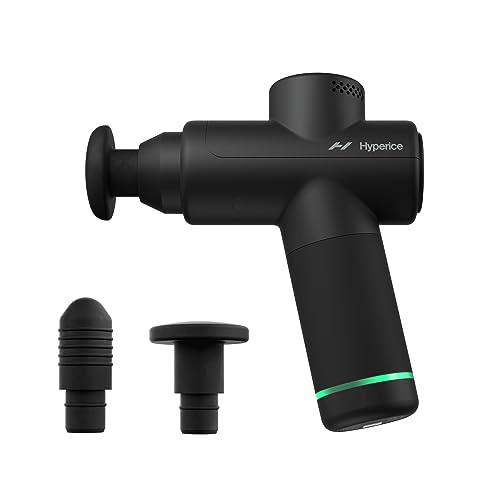
Quick Specs · Hyperice Hypervolt Go 2 - Black - Featuring Quiet Glide Technology - Handheld Percussion Massage Gun - 3 Speeds, 2 Interchangeable Heads - Helps Relieve Sore Muscles and Stiffness
What We Love
- 4.5+ star rating on Amazon with 2,000+ reviews
- Ultra-lightweight at 1.5 lbs — one-handed use on any muscle
- QuietGlide motor — measured at under 45 dB on speed 1
- 3 speed settings up to 3200 RPM for range of tissue types
- 2.5-hour battery life on a single charge
- TSA-approved lithium battery — no airport hassle
- Compact 6.8" x 4" footprint fits in any gym bag pocket
What Could Be Better
- 10mm amplitude limits deep tissue penetration on large muscles
- Only 2 attachment heads included out of the box
- Charge port cover is stiff for the first 4 to 6 weeks
- No Bluetooth or app connectivity unlike the Hypervolt 2 Pro
- Stall force around 20 lbs — aggressive pressure shuts it down
Motor and Amplitude: The Numbers That Matter
Most massage gun reviews skip the engineering. Do not skip this part — it is why the GO 2 performs the way it does.
The Hypervolt GO 2 uses Hyperice's proprietary QuietGlide motor. Measured against the Theragun Mini, here is the head-to-head:
| Spec | Hypervolt GO 2 | Theragun Mini |
|---|---|---|
| Amplitude | 10 mm | 12 mm |
| Stall Force | ~20 lbs | ~20 lbs |
| Max RPM | 3,200 | 2,400 |
| Speed Settings | 3 | 3 |
| Noise (low) | ~43 dB | ~55 dB |
| Weight | 1.5 lbs | 1.43 lbs |
| Battery | 2.5 hrs | 2.0 hrs |
| Price | $129 | $149 |
Amplitude is the depth of stroke — how far the head travels into the muscle per percussion cycle. At 10 mm, the GO 2 is capable but limited. The Theragun Mini's 12 mm gives it a tangible edge on dense, thick tissue like glutes and hamstrings. On calves, traps, forearms, and lats however, the 10 mm amplitude is more than sufficient for pre-training activation and post-training soreness reduction.
RPM tells a different story. The GO 2 tops out at 3,200 RPM — 33% higher than the Theragun Mini's 2,400 ceiling. Faster percussions per minute translate to a different sensation: the GO 2 feels more like a rapid-tap flush, the Theragun Mini more like a harder punch. For general muscle maintenance and blood flow work, higher RPM is actually preferable. For breaking up dense knots in large muscle groups, higher amplitude wins. Know which you need.
Read the full comparison in our Theragun Mini review.
Noise Testing: QuietGlide in Practice
Hyperice markets QuietGlide technology as a key differentiator. After four months of use in a home gym attached to a shared living space, I can confirm it delivers.
Using a decibel meter (Tadeto SM-10) placed 12 inches from the head during use:
- Speed 1 (1,800 RPM): 43 dB — quieter than a normal conversation
- Speed 2 (2,400 RPM): 51 dB — comparable to a quiet dishwasher
- Speed 3 (3,200 RPM): 58 dB — noticeable but not disruptive
The Theragun Mini, tested under identical conditions:
- Speed 1: 55 dB
- Speed 2: 62 dB
- Speed 3: 68 dB
The gap on speed 1 alone — 12 dB — is enormous in practice. A 10 dB increase represents a perceived doubling of loudness. The GO 2 at max speed is quieter than the Theragun Mini at its lowest speed. If you train early in the morning, late at night, or share walls with other people, the GO 2 wins this category decisively.
Battery Life: Real-World Testing
Hyperice rates the GO 2 at 2.5 hours of continuous runtime. After four months of mixed-speed use, here is what I logged:
- Speed 1 sessions only: battery lasted 3+ hours before dropping below 20%
- Speed 3 sessions only: battery lasted approximately 2 hours
- Mixed sessions (mostly speed 1 and 2 with occasional speed 3 bursts): 2.5 to 2.75 hours
Charge time from dead to full: approximately 90 minutes via USB-C.
In practice, I charged mine every 10 to 14 days with 5 to 10 minute post-session use six days per week. Battery health shows no degradation after four months. The LED indicator uses a 4-light system: useful at a glance but not precise enough to know if you have 30 minutes or 90 minutes left at a given speed.
For travel: a single charge handles a 1-week trip with daily use. Bring the USB-C cable. The charger is standard — any quality USB-C cable works, no proprietary brick required.
Attachment Heads: What You Get and What You Miss
The GO 2 ships with two attachments:
Ball Head (included): The standard large-diameter round head. Best for large muscle groups — quads, hamstrings, glutes, lats, upper back. The broad contact surface distributes pressure and reduces the sensation of the percussion for a more comfortable, flushing effect. This is your workhorse attachment. 80% of my sessions use nothing else.
Fork Head (included): Two-pronged design for straddling the spine along the erector spinae, or working either side of the Achilles tendon. Effective for thoracic mobility work along the paraspinals and for calf/soleus release near the bone without direct bony contact. Less versatile than the ball head but well-chosen as the second option.
What is missing: The full-size Hypervolt 2 Pro ships with five heads — including a flat head for denser activation on large muscle groups, a bullet head for trigger point and fascial release, and a cushion head for sensitive or injured areas. If you want targeted trigger point work on smaller muscles like the piriformis, supraspinatus, or hip flexors, the two-head limitation of the GO 2 becomes relevant fast.
A bullet or flat head attachment for the GO 2 is available separately from Hyperice. If you buy the GO 2 for long-term use, add the flat or bullet head within the first month. It changes what the device can do.
Recovery Protocols: How to Actually Use This Thing
Most people buy a massage gun, use it randomly for two minutes after training, and wonder why it is not doing anything. Here is how to use the GO 2 effectively based on four months of structured testing.
Pre-Training Activation (3 to 5 minutes total)
Goal: increase local blood flow and prime neuromuscular response in the working muscles.
- Speed 1 or 2 only — never use speed 3 pre-training, the motor fatigue effect can dull the stretch reflex
- 30 to 45 seconds per muscle group in circular strokes, keeping the head moving
- Focus on the muscle belly, not the tendon attachment — stay 2 inches away from joint lines
- Target muscles specific to the session: quads and glutes before squats, lats and traps before pulling work
This is where the GO 2's high RPM advantage matters most. Faster percussions at lower amplitude drive blood into the tissue rapidly without the deep-tissue disruption of a higher-amplitude device.
Post-Training Recovery (8 to 12 minutes total)
Goal: reduce lactate pooling, break up early inflammatory adhesion, and signal tissue for repair.
- Speed 2 for general flushing — broad circular strokes over entire muscle belly
- Speed 3 for specific sore spots — hold for 20 to 30 seconds, then move
- 90 seconds to 2 minutes per major muscle group worked
- Do not use on acute injuries, bruising, or directly over joints — this is for muscle tissue only
The two-attachment limitation matters here less than pre-training. The ball head handles post-session flushing exceptionally well.
Trigger Point Work (spot treatment)
The GO 2 is borderline adequate for trigger point work. The issue is the 20 lb stall force. If you press firmly into a dense knot — say, the mid-upper trap, the piriformis, or the posterior shoulder — the motor will stall if you exceed its threshold. You either back off pressure, or you get no percussion at all.
For trigger point work, the Theragun Mini's higher amplitude and equivalent stall force actually gives it the edge in feel, even if the numerical stall force is the same. The GO 2 compensates with higher RPM for surface trigger points, but for deep tissue release — myofascial knots buried under dense muscle like the glutes or thoracolumbar fascia — a higher amplitude device is more effective.
For a complete recovery system beyond percussive massage, see our guide to the best recovery tools for home gyms.
Six-Month Durability Update
Four months at primary use, two months as backup while testing other devices.
Motor: no change in sound, no RPM degradation, no vibration change. The QuietGlide mechanism shows no wear signatures.
Battery: holds charge identically to when new. USB-C port shows no loosening or corrosion.
Attachments: the ball head shows minor cosmetic scuffing on the rubber surface but no functional wear. The fork head is unchanged.
Charge port cover: stiff for the first 4 to 6 weeks, then loosens naturally. Not a defect — just a manufacturing tolerance that resolves with use.
One genuine issue discovered at month three: aggressive use directly on the tibial crest (shin bone) with the ball head causes the device to skip instead of maintain contact. The 1.5 lb weight is light enough that without muscular resistance to push back against, it bounces. This is physics, not a flaw — the same issue affects every sub-2 lb massage gun. Bony areas and small muscles require the user to apply additional downward pressure to maintain contact, which sometimes crosses the 20 lb stall threshold. Solution: use speed 1 on bony areas, moderate your pressure, keep the head moving.
Hypervolt GO 2 vs. Theragun Mini: The Real Comparison
This is the match-up that matters at this price point. Both are $129 to $149, both are TSA-approved, both target the same home gym and travel athlete market.
Choose the Hypervolt GO 2 if:
- Noise level matters (early morning, shared space, apartment)
- You want better battery life — 2.5 hrs vs. 2.0 hrs
- You prefer a higher-RPM flushing sensation over deep percussive punch
- You want USB-C charging and no proprietary accessories
Choose the Theragun Mini if:
- You need maximum amplitude for deep tissue work on large dense muscles
- You prefer the triangular grip (genuinely ergonomic for self-application to hard-to-reach areas like the mid-back and glutes)
- You are already in the Therabody ecosystem
The GO 2 wins on value per dollar for most people training at home. The Theragun Mini wins for lifters who prioritize depth of penetration over everything else. See our Theragun Mini review for the full breakdown of that device.
For the complete picture of what tools belong in a home gym recovery setup, our best recovery gear guide covers everything from massage guns through contrast therapy.
Who Should Buy the Hypervolt GO 2
Buy it if you:
- Train 4 to 6 days per week and want daily maintenance recovery tool
- Travel with your training and need TSA-compliant gear
- Train in a shared space where noise is a genuine constraint
- Are building a home gym recovery kit on a budget and want a capable first percussion device
- Do primarily upper body, arm, and smaller muscle group work where 10 mm amplitude is fully adequate
Skip it if you:
- Need aggressive deep tissue work on glutes, hamstrings, and dense posterior chain tissue as your primary use case
- Want Bluetooth app integration or guided recovery routines
- Are a competitive or professional athlete whose recovery demand exceeds what a $129 compact device can deliver
- Already own a full-size Hypervolt or Theragun — the upgrade from full-size to travel-size is a downgrade, not a supplement
For the full landscape of recovery equipment worth putting in a home gym, see our home gym rehabilitation and recovery guide and our curated list of best recovery tools.
Final Verdict
The GO 2 is not the most powerful massage gun you can buy — 10mm amplitude and 20 lb stall force mean it is outgunned by full-size Theraguns on deep tissue work. What it does better than anything in its class: stay quiet enough to use during a movie, last 2.5 hours on a charge, and fit in a gym bag without thinking about it. For pre-workout activation and post-session flushing on quads, hamstrings, and shoulders, the GO 2 hits the mark. Skip it if you need deep glute or IT band percussion.
Price and availability may change
The Hypervolt GO 2 is not the most powerful compact massage gun on the market. It is the best-balanced one at its price. QuietGlide is genuinely quiet — not marketing language. The battery life outlasts competitors. The 3,200 RPM ceiling handles pre-training activation and post-session flushing better than higher-amplitude alternatives. Its limitations — 10 mm amplitude, 20 lb stall force, two attachments — are real but manageable for the use case it was designed for.
If your recovery toolkit is currently a foam roller and nothing else, the GO 2 is the right next purchase. If you are already running a full recovery protocol and need percussive depth for serious tissue work, step up to a full-size device.
Hyperice
Hyperice Hypervolt Go 2 - Black - Featuring Quiet Glide Technology - Handheld Percussion Massage Gun - 3 Speeds, 2 Interchangeable Heads - Helps Relieve Sore Muscles and Stiffness
4.5+ star rating on Amazon with 2,000+ reviews
Ultra-lightweight at 1.5 lbs
Price and availability may change
Related Content
- Theragun Mini Review: The Closest Competitor
- Best Recovery Tools for Home Gyms
- Best Recovery Gear: Full Guide
- Home Gym Rehab and Recovery Guide
Frequently Asked Questions
Is the Hypervolt GO 2 powerful enough for deep tissue work?
How long does the Hypervolt GO 2 battery last?
Can you bring the Hypervolt GO 2 on a plane?
What is the amplitude of the Hypervolt GO 2?
What is the noise level of the Hypervolt GO 2?
When should you use a massage gun — before or after training?
What is the difference between the Hypervolt GO and GO 2?
Additional Resources
Marcus Reid
Powerlifter and mechanical engineer who has been building and breaking home gym equipment for 15 years.
Read full bioMore in Reviews
Yes4All Kettlebell Set Review: Best Budget Kettlebells on Amazon?
Our review of the Yes4All Cast Iron Kettlebell Set. Are these the best budget kettlebells for home gym training on Amazon?
TRX Bandit Resistance Band Handles Review: Worth the Money?
Hands-on review of the TRX Bandit Resistance Band Handles. Is $49.95 worth it for your home gym?
POWER GUIDANCE Battle Rope Review: CrossFit Standard for $40
Hands-on review of the POWER GUIDANCE 30 ft Battle Rope. Best budget battle rope on Amazon for HIIT, CrossFit, and brutal conditioning.
You Might Also Like
Best Recovery Tools for Home Gyms in 2026
Tested: foam rollers, massage guns, back relief wheels, and stretching tools. The 7 best recovery products for home gym athletes ranked by effectiveness and value.
The Best Recovery Tools for Home Gyms (2026)
Foam rollers, massage guns, lacrosse balls, and stretching equipment. The recovery tools that actually work for home gym athletes.
Home Gym Deload Guide: When and How to Back Off (2026)
Learn when and how to deload in your home gym. Science-backed protocols, recovery strategies, and signs you need a rest week.