Gaiam Essentials Thick Yoga Mat (10mm) Review: Worth the Money?
Hands-on review of the Gaiam Essentials Thick Yoga Mat (10mm). Is $21.98 worth it for your home gym?
At $21.98, the Gaiam Essentials Thick Yoga Mat does not look revolutionary on paper. It is a rectangle of foam with a carry strap. But in a garage gym context — where you are kneeling on concrete for ab work, doing hip flexor stretches after deadlifts, and grinding through floor-based mobility circuits — the mat you choose matters more than most people think.
We have been using this mat daily for over three months: ab circuits, post-lift stretching, yoga flows, and mobility work. Here is everything you need to know before you buy.
At a Glance
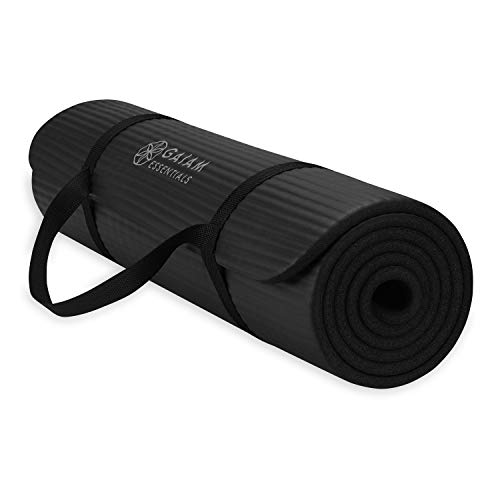
Quick Specs · Gaiam Yoga Mat, Pilates & Exercise Mat, Thick 2/5" (10mm) Workout Mat with Easy-Cinch Carrying Strap for Home & Gym Workouts
What We Love
- 4.5+ star rating on Amazon with 50,000+ reviews
- Extra thick 10mm NBR foam cushions joints on hard floors
- Non-slip textured surface grips concrete and hardwood
- Lightweight at 2.5 lbs with carry strap included
- Ideal for stretching, ab work, and yoga in a home gym
- Best-value exercise mat under $25 on Amazon
- 72 inches long — fits athletes up to 6'2" comfortably
- Available in 30+ color options
What Could Be Better
- Absorbs sweat — needs wiping down after intense sessions
- 10mm softness makes standing balance poses wobblier
- Faint NBR off-gassing smell for 2-3 days out of packaging
- Not durable enough for heavy equipment contact or dragging
- Thinner than rubber gym flooring for high-impact work
What Is NBR Foam — And Why It Matters
The Gaiam Essentials is made from NBR foam — nitrile butadiene rubber. This is a closed-cell synthetic rubber compound that is softer and more compressible than natural rubber or TPE (thermoplastic elastomer). Understanding NBR is essential to understanding what this mat does well and where it falls short.
NBR foam properties:
- High cushion, low density — NBR compresses under weight and springs back. At 10mm, it provides meaningful joint protection on hard surfaces.
- Moisture absorption — Unlike natural rubber mats, NBR is slightly porous on the surface. Sweat pools on it rather than beading off. This means the mat gets slippery during intense floor work and needs to be wiped down between exercises.
- Odor on opening — NBR off-gasses a light chemical smell fresh out of packaging. It is not toxic, but if you are sensitive to smells, leave the mat unrolled in a ventilated garage or outdoors for 24 hours before your first session.
- Cold-weather performance — NBR stays flexible in cold garages. Natural rubber mats can stiffen noticeably in winter. If your garage drops below 40°F in the mornings, NBR holds up better during warm-up stretches.
- Cost — NBR foam is cheaper to produce than natural rubber or TPE. This is why Gaiam can sell a 10mm mat for under $22.
For a home gym setting where you are not doing hot yoga or standing on one leg for 90 seconds, NBR is a completely adequate material. The cushioning performance is the priority, and NBR delivers it at a price that makes sense.
NBR vs TPE: TPE mats (like those from Lululemon and Manduka eKO) are lighter, less absorbent, and more eco-friendly. They are also thinner — typically 4-6mm — and significantly more expensive. For a garage gym athlete who needs a dedicated floor station for stretching and ab work, NBR at 10mm beats TPE at 6mm for joint comfort on concrete every time.
NBR vs Natural Rubber: Natural rubber mats are heavier, denser, and provide better grip when wet. They are the gold standard for serious yoga practitioners. They are also 3-5x more expensive. For home gym use, the extra grip of natural rubber matters far less than it does in a yoga studio — you are not doing a continuous 60-minute flow where sweat accumulates for an hour without wiping down.
The 10mm Thickness: What It Does for Your Joints
The standard yoga mat thickness is 3-4mm. Premium studio mats are 5-6mm. At 10mm, the Gaiam Essentials is approximately twice the thickness of a studio mat. That difference is immediately noticeable the first time you drop to your knees on concrete.
Where 10mm genuinely helps:
- Kneeling exercises on concrete — Kneeling lunges, ab rollouts, Turkish get-up work, and cable pull-through hip hinges all require sustained knee contact with the floor. On 6mm, even with good padding, you feel the concrete under an extended set. On 10mm, you do not.
- Spinal rolling and bridge work — Rolling the spine across the floor — ab crunches, bridges, hip thrusts with a bodyweight hold — presses vertebrae into the mat repeatedly. At 10mm, the mat absorbs enough shock that you can do a full ab circuit without your tailbone bruising.
- Forearm planks and push-up holds — Extended time in a plank concentrates pressure on the elbows and wrists. The 10mm foam gives both contact points enough relief to hold longer without discomfort.
- Child's pose and hip flexor stretches post-deadlift — After heavy lower-body work, floor stretches feel significantly better with real cushioning underneath. A 4mm mat on concrete is barely better than nothing for a 5-minute hip stretch.
Where 10mm works against you:
- Standing balance poses — Warrior III, tree pose, single-leg balance work. The compressible foam creates micro-instability at the ankle and foot. Your stabilizer muscles have to work harder. For some this is a training benefit. For most people attempting balance work, it is distracting and potentially compromises form.
- Heavy lifts — Do not deadlift or squat on this mat. The compressible foam creates an unstable base under load. This is a floor station for mobility and bodyweight work only. Your lifting platform or rubber gym flooring handles the heavy lifting.
- Jump training — Plyometric landings on a 10mm NBR mat feel oddly soft. The foam does not return energy the way rubber does, and landing mechanics feel compromised. Use firm rubber flooring or a wood platform for box jumps.
Grip Performance: Dry vs. Sweaty
Out of the box, the Gaiam mat has a textured surface on both sides. The underside has a slightly coarser texture for floor grip; the top has a subtler pattern for foot and hand placement.
Dry grip (most home gym sessions): Very good. On concrete, hardwood, or rubber flooring, the underside does not migrate during normal use. A downward dog, push-up, or plank does not pull the mat across the floor. The top surface is grippy enough for bare feet doing yoga flows or stretching circuits.
Sweaty grip (after cardio or intense ab work): This is where the NBR material's absorbency becomes a factor. Once you are sweating — particularly during a high-rep ab circuit or after cardio — the mat surface becomes noticeably slippery. Hands and feet do not stick. Poses that require stable hand placement (like pike push-ups or inchworm stretches) become less secure.
The fix: Keep a small gym towel next to the mat. A single wipe of the hands and a quick pass over the surface with the towel restores grip completely. This is a routine adjustment, not a product failure. It is simply the cost of owning an NBR mat versus a natural rubber mat with a more hydrophilic surface.
If you run cardio before your stretching session and plan to go straight from the treadmill to the mat, wipe down before starting floor work. Thirty seconds of maintenance keeps the surface functional throughout the session.
Home Gym Use Cases: Where This Mat Fits In Your Training
The Gaiam mat is not your gym flooring. It is a dedicated floor station that sits inside your larger flooring setup. Here is how it integrates with the most common home gym configurations.
Garage Gym on Concrete
This is where the 10mm thickness earns its price most directly. Raw concrete is unforgiving. Even with EVA puzzle mats across the main training area — like the BalanceFrom Puzzle Mat — you often want a dedicated stretching station separate from the main floor. The Gaiam mat placed over concrete or over puzzle mats creates a comfortable, defined space for mobility work.
The concrete setup is also where you appreciate the mat's portability. It rolls up in under 20 seconds, the carry strap holds it tight, and it stores vertically against a wall or in a corner without taking up floor space when not in use.
Rubber Flooring Setups
Rubber gym flooring — horse stall mats, interlocked rubber tiles — is the gold standard for home gym surfaces. But rubber flooring at 3/4 inch provides excellent durability and shock absorption for lifting; it does not provide the soft cushioning for sustained kneeling or spinal contact. Placing the Gaiam mat over rubber flooring gives you the best of both: a firm, stable base under the mat with a cushioned surface on top.
See our Garage Gym Flooring Guide for a complete breakdown of how to layer different flooring materials in a home gym.
Basement or Carpeted Room Gym
On carpet, the mat helps define your training space and prevents you from sliding on carpet pile during yoga flows. The Gaiam is slightly overkill for cushioning on carpet — carpet already softens the floor — but the non-slip texture on the underside and the clean surface (versus carpet fiber contact) make it worth using.
Stretching and Yoga Flows in a Home Gym Context
Most garage gym athletes are not yogis. The typical use case here is 10-15 minutes of mobility work before or after a lifting session. The Gaiam handles this extremely well.
Hip flexor stretches: A runner's lunge with the rear knee on the mat for 2-3 minutes per side is the single most common use in a home gym. The 10mm mat handles this with zero discomfort. This alone justifies the purchase if your hip flexors are tight from sitting.
Thoracic mobility: Lying on your back and using the mat for bridge rolls, thoracic rotations, and supine spinal twists — the mat keeps your vertebrae off the hard floor during dynamic movement patterns.
Ab work: Crunches, leg raises, hollow holds, and dead bugs all require sustained spinal contact with the floor. The 10mm mat turns these from grinding sessions into comfortable ones. For anyone with a history of lower back sensitivity, the extra cushion under the lumbar during ab circuits is legitimately useful.
Yoga flows: Sun salutations, warrior sequences, and beginner yoga routines work well on this mat. The limitation is balance poses in sock or bare feet once sweating starts — wipe down between sequences. For a 15-minute yoga flow as gym recovery, the mat performs without issue.
Cleaning and Long-Term Durability
Cleaning routine: After any sweaty session, wipe the mat with a damp cloth. Once a week, clean with a diluted mild soap solution (a few drops of dish soap in a cup of water) and wipe dry. Do not submerge the mat in water — NBR foam will absorb moisture and take hours to dry. Do not machine wash. Do not use alcohol-based cleaners, which will degrade the foam over time.
Drying: After cleaning, hang the mat over a rack or railing for 30-60 minutes before rolling. Storing a wet mat rolled tight creates a humid interior environment that causes odor and, over months, foam breakdown.
Durability observations: After three months of daily use — one ab and stretching session per day, approximately 20-30 minutes — the mat surface shows no tearing or peeling. The edges have not frayed. The foam has not visibly compressed. The carry strap has held up without stitching failure.
The one area to watch: the mat corners. If you frequently unroll and reroll the mat on rough concrete, the corners will show wear marks first. This is cosmetic, not structural. To extend mat life, roll it out on rubber flooring rather than directly on concrete if possible.
Expected lifespan: With daily use and proper care, expect 2-3 years before the foam shows significant compression. This is consistent with the price point. A $22 NBR mat is not a lifetime purchase — it is a consumable that you replace every few years. The Manduka PRO, at $120+, will last a decade. The Gaiam is the budget consumable that performs well until it does not.
Compared to Alternatives
Gaiam Essentials (10mm) vs BalanceFrom 1/2-inch Yoga Mat: Nearly identical products. The BalanceFrom has a slightly tackier surface out of the box. The Gaiam has a more consistent foam density edge-to-edge and a wider color selection. Both are solid NBR mats at the same price. Check the BalanceFrom Puzzle Mat review if you are considering the BalanceFrom ecosystem for your full flooring setup.
Gaiam Essentials (10mm) vs Manduka PRO (6mm): The Manduka PRO at $80-$120 is a different category of product. It is denser closed-cell PVC foam, 6mm thick, with a lifetime warranty. It provides superior ground feel for balance poses and lasts significantly longer. But for home gym owners whose primary use is stretching, ab work, and light yoga — not a daily 90-minute Bikram class — the Gaiam does 90% of the job at 20% of the price.
Gaiam Essentials vs Rubber Gym Flooring: This is not an either/or comparison. See our best gym flooring roundup for a full breakdown of rubber flooring options. The Gaiam is a portable mat for floor stations; rubber flooring is permanent surface protection for your whole training area. Use both.
Gaiam 10mm vs Gaiam 6mm: Gaiam also sells thinner versions of this mat. For a home gym on hard floors, the 10mm is the right choice. The 6mm saves about $5 and is adequate for yoga studios with hardwood or sprung floors. On concrete, the 6mm feels like a thin compromise.
Who Should Buy This
Buy the Gaiam Essentials 10mm if:
- Your home gym is on concrete or bare hardwood
- Your primary use is stretching, ab work, and post-lift mobility
- You want the highest cushion-to-dollar ratio available
- You want a portable, storable mat that does not take up permanent floor space
- You are new to yoga and want a forgiving, thick surface
Skip it if:
- You practice yoga seriously — invest in a Manduka or Liforme
- You need gym flooring coverage — get horse stall mats or EVA puzzle mats instead
- You train heavily in your garage and need permanent, durable surface protection — see our garage gym flooring guide
- You do intense hot yoga sessions where grip when wet is critical
Final Verdict
The 10mm thickness genuinely cushions knees and elbows on hard garage floors — something thinner mats cannot do. The NBR foam does compress over time and gets slick with heavy sweat, so this is not a hot-yoga mat. But for stretching, ab work, and cool-down routines in a home gym, nothing under $25 matches the comfort. Solid buy if you treat it as a training pad, not a yoga studio upgrade.
Price and availability may change
Gaiam
Gaiam Yoga Mat, Pilates & Exercise Mat, Thick 2/5" (10mm) Workout Mat with Easy-Cinch Carrying Strap for Home & Gym Workouts
4.5+ star rating on Amazon with 50,000+ reviews
Extra thick 10mm cushioning for joint protection
Price and availability may change
Related Content
Frequently Asked Questions
Is 10mm too thick for yoga?
Can you use the Gaiam yoga mat on concrete or garage floors?
How do you clean the Gaiam Essentials mat?
Does the Gaiam mat smell when new?
What is the difference between NBR foam and TPE yoga mats?
Is the Gaiam yoga mat good for ab workouts?
How does the Gaiam 10mm compare to horse stall mats for a home gym floor?
Additional Resources
Lena Park
Former NCAA Division I rower and USA Weightlifting coach. Specializes in conditioning equipment and women's training.
Read full bioMore in Reviews
Yes4All Kettlebell Set Review: Best Budget Kettlebells on Amazon?
Our review of the Yes4All Cast Iron Kettlebell Set. Are these the best budget kettlebells for home gym training on Amazon?
TRX Bandit Resistance Band Handles Review: Worth the Money?
Hands-on review of the TRX Bandit Resistance Band Handles. Is $49.95 worth it for your home gym?
POWER GUIDANCE Battle Rope Review: CrossFit Standard for $40
Hands-on review of the POWER GUIDANCE 30 ft Battle Rope. Best budget battle rope on Amazon for HIIT, CrossFit, and brutal conditioning.