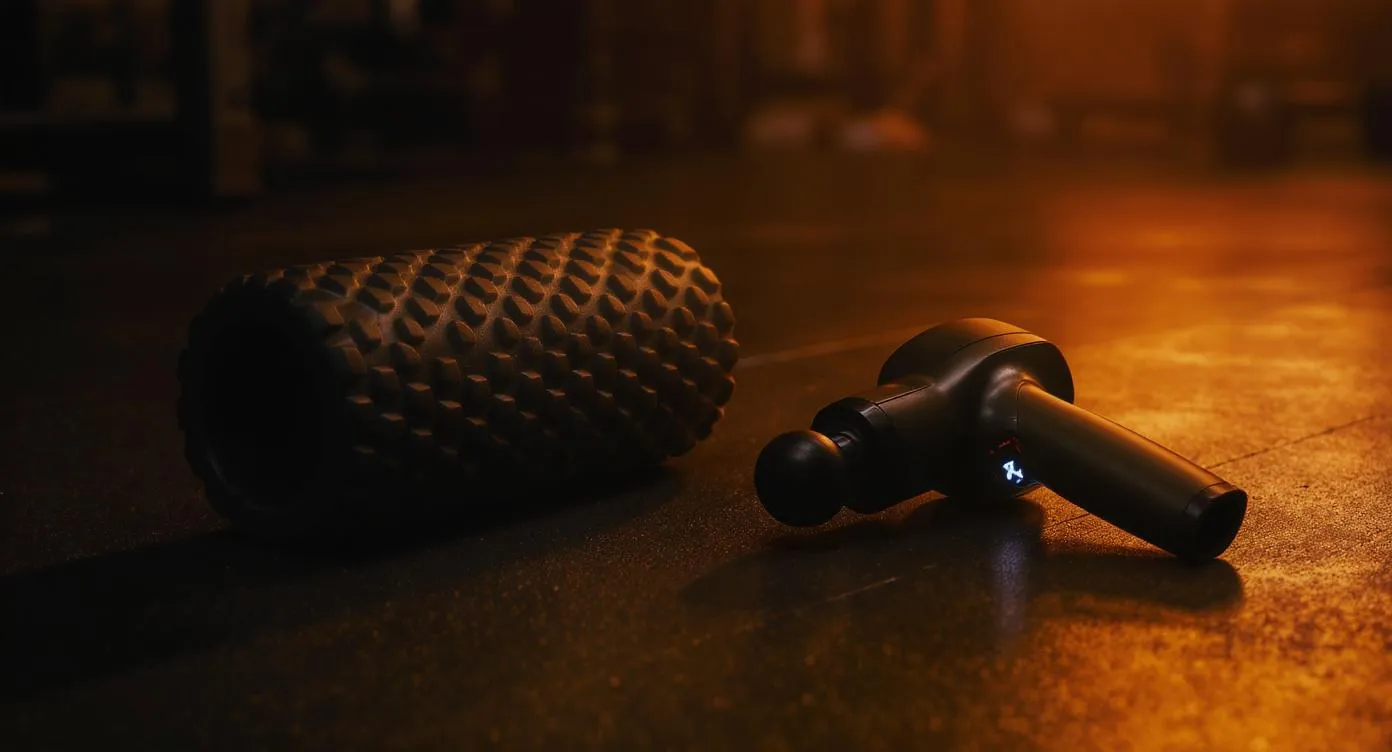
TriggerPoint GRID Foam Roller Review: Worth the Money?
Hands-on review of the TriggerPoint GRID Foam Roller. Is $36.99 worth it for your home gym?
The TriggerPoint GRID is the foam roller physical therapists keep in their clinics and serious garage gym athletes keep beside their squat racks. At $36.99 it costs more than a smooth EPP cylinder from Amazon — but the performance difference is real, measurable, and worth every dollar above that baseline.
We have been rolling on the GRID for six months: pre-workout, post-workout, active recovery days, and morning mobility sessions. This review breaks down exactly what makes the GRID different, who it is right for, and where it falls short against competing rollers at every price point.
At a Glance
Quick Specs · TriggerPoint Grid 1.0 Foam Roller - 13" Multi-Density Massage Roller for Deep Tissue & Muscle Recovery - Relieves Tight, Sore Muscles & Kinks, Improves Mobility & Circulation - Targets Key Body Parts
What We Love
- 4.7+ star rating on Amazon with 20,000+ reviews
- Multi-density GRID surface targets muscles differently
- Rigid hollow core won't flatten over time
- 500 lb weight capacity — built to last
- Compact 13" size for travel
- The gold standard in foam rollers
What Could Be Better
- Pricier than basic smooth rollers
- 13 inches too short for full-back rolling
- Firm surface may be intense for beginners
The GRID Pattern: What It Actually Does
Most people treat the GRID's surface texture as a marketing feature. It is not. The three-zone grid pattern is the engineering core of this roller and the main reason it outperforms smooth foam rollers on muscle tissue.
The outer surface is divided into three distinct zone types arranged in a repeating geometric pattern:
Flat Wide Zones (the "fingers"): These mimic the broad surface contact of an open hand. They provide distributed pressure across large surface areas — ideal for sweeping passes over the quadriceps, hamstrings, and upper trapezius where you want to cover muscle belly without pinching.
Raised Narrow Ridges (the "knuckles"): These simulate the knuckle pressure a massage therapist applies when working along the length of a muscle. On the IT band and tensor fasciae latae, the narrow ridges dig into the fascial sleeve around the muscle in a way flat foam never can.
Hollow Channel Zones (the "fingertips"): The recessed grid channels simulate fingertip compression — the focused pressure used to find and hold trigger points. When you locate a hot spot in your piriformis or a knotted section of your calf and hold position, the channel zones allow blood to continue circulating around the compressed tissue. This is physiologically important: sustained compression on solid foam completely occludes blood flow, which limits the recovery effect.
The combined pattern means a single slow pass over the IT band is doing three types of work simultaneously: broad myofascial release, targeted fascial ridge work, and localized trigger-point compression. A smooth roller does only the first. A lacrosse ball does only the third. The GRID does all three in one tool.
EVA Foam vs EPP: The Material Science
TriggerPoint covers the GRID's hollow ABS plastic core with EVA (ethylene-vinyl acetate) foam. Most budget rollers use EPP (expanded polypropylene). The difference matters.
EPP foam is molded in large pellets fused together under heat. It is dense, uniform, and extremely durable. EPP is why budget high-density rollers can last 3 to 5 years without compressing. The downside is that EPP is rigid at the surface — the pellet structure gives it a slightly granular texture but no meaningful surface variation. It is the same hardness everywhere.
EVA foam is softer and more elastic at the cell level. A given EVA surface can be engineered to compress at different rates across different zones by varying thickness and cell density. This is how TriggerPoint creates a multi-density surface: the raised ridges use firmer EVA, the flat zones use medium EVA, and the channel walls use a thinner layer over the plastic core that provides near-bone hardness when fully compressed. The result is a foam surface that changes feel depending on how you position your body weight.
The trade-off: EVA is less durable than EPP under sustained compression. If you leave the GRID lying flat under heavy equipment storage or kneel on it repeatedly for non-rolling use, the raised ridges will eventually compress and lose their definition. With normal rolling use only, EVA holds up well — our test unit shows zero ridge compression after six months of daily sessions.
The hollow core is the GRID's other key engineering decision. Where solid foam rollers rely entirely on foam compression for their rolling feel, the GRID's rigid hollow ABS tube provides structural integrity that cannot compress. That 500 lb weight rating is not foam strength — it is the plastic core. The EVA foam layer provides the rolling feel; the plastic core ensures the tool never flattens under any human body weight. Solid EPP rollers rated at 250 to 300 lbs will eventually deform under daily use from a 220 lb athlete. The GRID will not.
Build Quality and Durability
The 13-inch length and 5.5-inch diameter are intentional. TriggerPoint designed the GRID for portability and targeted work, not full-spine rolling. The compact dimensions keep it under one pound, making it genuinely pocketable in a gym bag.
The EVA foam is vulcanized onto the plastic core with no visible seams or adhesive joints. After six months of use including outdoor sessions, gym bag transport, and rolling on concrete floor surfaces, the foam has not separated from the core at any point. Cheaper hollow-core rollers from no-name brands often use foam sleeves that slip or split at the seam — not an issue with the GRID.
The end caps are solid plastic, flush with the roller surface, with no sharp edges. If you store the GRID on its end (recommended to prevent any long-term surface flattening), the end caps provide stable footing.
Color fastness: We tested the black version. No dye transfer to clothing or floor surfaces after six months. Some cheaper foam rollers leave color on workout mats — the GRID does not.
Rolling Protocols: Muscle Group by Muscle Group
The GRID performs differently on each muscle group because of its geometry. Here are tested protocols for each major area:
Quadriceps
Position: Face down, roller under both thighs, weight on forearms.
Start at mid-thigh and roll toward the hip crease. The GRID ridges running parallel to your femur will dig into the rectus femoris along its length — this is the deep pressure that triggers the nervous system relaxation response. Pause any time you hit a tender zone, hold for 10 to 15 seconds, then exhale and let the tissue release before continuing.
For the vastus lateralis (outer quad), rotate slightly to the outside. For the VMO (inner quad near the knee), rotate inward. Total time: 60 to 90 seconds per leg.
The GRID's ridge geometry works well here because the quad is a long, parallel-fiber muscle — the ridges track naturally along the muscle grain.
IT Band and TFL
Position: Side-lying, roller under the outer thigh just below the hip. Top leg bent with foot flat on floor for support.
The IT band is fascia, not muscle — you cannot stretch it, but you can mobilize the tissues adjacent to it. The GRID's narrow ridges work along the fascial boundary between the IT band and the lateral quad, which is where adhesions form in runners and cyclists.
Roll from just below the hip to just above the knee. Do not roll directly over the lateral knee — there is no muscle tissue there and it causes nerve irritation. Spend 90 seconds per side. The IT band is typically the most painful area in your first week; daily rolling reduces this dramatically within 10 days.
Hamstrings
Position: Seated, roller under one hamstring, hands behind you for support.
The hamstring protocol benefits from the GRID's channel zones. Position the roller so the biceps femoris (outer hamstring) sits over a raised ridge. Apply pressure, pause, and rotate your leg slightly inward to move the tissue over the ridge. This technique — load, rotate, release — is more effective for isolated knots than simple rolling passes.
Total time: 60 seconds per leg. Cross one ankle over the other to increase pressure if needed.
Calves (Gastrocnemius and Soleus)
Position: Seated, roller under one calf, other leg crossed on top for added weight.
The gastrocnemius is a two-headed muscle with a natural separation along the midline. Use the GRID's ridges to work along each head separately by rotating your foot inward and outward while rolling. For the soleus (deeper calf, under the gastrocnemius), bend the knee slightly while rolling — this takes the gastrocnemius slack and allows pressure to reach the soleus.
The GRID's multi-density surface is noticeably more effective on calves than a smooth roller because calf knots tend to be small and localized. The ridges locate them; the channel zones hold them.
Thoracic Spine (Upper Back)
Position: Supine, roller perpendicular to the spine at mid-back level, arms crossed over chest or hands behind head.
This is where the GRID's 13-inch length becomes a limitation. You cannot lie lengthwise on a 13-inch roller the way you can on a 36-inch OPTP for full thoracic extension. What you can do is segment-by-segment thoracic mobilization: position the roller at one spinal segment, lift your hips slightly to apply pressure, and gently extend backward. Move up one segment at a time from T12 to T4.
The raised ridges on either side of the roller create a natural paraspinal channel — pressure goes into the erector spinae and rhomboids on either side of the spine while the spine itself sits in the lower-pressure channel zone. This is better for the thoracic spine than a smooth roller, which presses uniformly on bony prominences. Stay off the lumbar spine entirely.
Total time: 60 to 90 seconds working up from mid-back to shoulder blades.
Glutes and Piriformis
Position: Seated on the roller, one ankle crossed over the opposite knee, leaning into the crossed-leg side.
The piriformis — the deep hip external rotator that compresses the sciatic nerve when chronically tight — responds extremely well to the GRID's focused pressure. With your foot crossed, lean onto the glute of that leg and rotate your hip to move the piriformis over the raised ridges. This mimics the thumb-pressure technique physical therapists use for piriformis release.
Spend 60 to 90 seconds per side. For athletes with sciatica symptoms from piriformis tightness, daily rolling on this protocol is clinically effective. The GRID outperforms smooth rollers here because the piriformis is small and deep — you need focused pressure to reach it, and smooth foam distributes pressure too broadly.
Lats and Thoracic Rotation
Position: Side-lying, roller positioned in the armpit area under the lat.
Roll from the armpit to mid-rib. Rotate slightly forward and backward to hit different portions of the latissimus dorsi. The lat is a large flat muscle — the GRID's wide flat zones work well here for broad coverage, with the occasional ridge finding the fibrous attachment at the posterior iliac crest.
Comparison to Competing Rollers
TriggerPoint GRID vs OPTP PRO-ROLLER
The OPTP PRO-ROLLER is the foam roller most physical therapists prescribe for at-home use. At $27.95 for 36 inches, it costs less than the GRID and provides more surface area for thoracic extension and full-spine work.
The OPTP wins on length and gentleness. Its standard-density EPP foam is the right tool for post-surgical rehabilitation, early-stage recovery, elderly users, and anyone who finds the GRID's firmness too aggressive. The smooth surface provides even pressure that does not overwhelm sensitive tissue.
The GRID wins on targeted pressure and trigger point work. If you are a healthy athlete trying to break up adhesions, recover from high-volume training, or manage chronic tightness from sport, the GRID's multi-density surface provides a qualitatively different experience. The OPTP feels like a firm mattress. The GRID feels like a massage therapist's hands.
Recommendation: If you have to choose one, healthy athletes with 6+ months of training experience should take the GRID. Rehabilitation patients, beginners, or anyone over 60 should take the OPTP. If budget allows, own both — use the OPTP for thoracic extension and the GRID for IT band, calves, and glutes.
TriggerPoint GRID vs Budget High-Density Rollers
Budget high-density EPP foam rollers offer 36 inches of rolling surface for under $35. They are the right answer for athletes who want maximum surface coverage at minimum cost.
High-density EPP foam is firmer than EVA and will outlast the GRID under sustained daily use. A 36-inch length handles thoracic extension the GRID cannot. At a lower price point, a budget roller is the obvious answer for budget-constrained home gym setups.
The GRID's advantage is specificity. The GRID's surface geometry targets trigger points and fascial boundaries in ways a smooth roller cannot. After six months of testing both, a smooth roller is more appropriate as the first foam roller in any home gym; the GRID is the upgrade you want after you've been rolling consistently for 3 to 6 months and want to go deeper.
Recommendation: Start with a budget high-density roller or the OPTP PRO-ROLLER. Upgrade to the GRID when the smooth surface stops being enough.
TriggerPoint GRID vs Basic Smooth Rollers
Cheap smooth rollers in the $10 to $15 range use open-cell foam that compresses and flattens within 60 to 90 days of regular use. They are false economy. The GRID costs $36.99 and will outlast ten cycles of cheap roller replacement. For anyone rolling more than twice a week, the GRID is cheaper over three years.
Beyond durability, the performance gap between the GRID and cheap smooth foam is dramatic. Smooth soft foam cannot generate enough pressure to reach fascial adhesions or trigger points in well-developed muscle. The GRID's rigid core and EVA surface do. This is not marketing — it is the mechanical reason why the GRID has 20,000+ reviews at 4.7 stars.
Who Should Buy This
Buy the TriggerPoint GRID Foam Roller if:
- You train 3 or more days per week and roll regularly
- You have chronic tightness in the IT band, calves, or glutes
- You want a travel-friendly recovery tool under 1 lb
- You are upgrading from a smooth or soft foam roller
- You want the recovery tool backed by more than 20,000 verified reviews
Skip it if:
- You are new to foam rolling and want a beginner-friendly tool (start with the OPTP)
- You need full-spine thoracic extension rolling (you need a 36-inch roller for that)
- You are in active rehabilitation from surgery (consult your PT first)
- Budget is the primary constraint (the OPTP at $27.95 is the better entry point)
6-Month Durability Update
Six months of daily rolling across every major muscle group, including outdoor sessions on concrete garage floor surfaces and regular transport in a gym bag. The EVA foam ridges show no measurable compression or deformation. The hollow ABS core has produced no creaking, cracking, or structural noise under full body weight. The end caps remain flush and tight.
The only observable wear after six months is minor surface scuffing on the EVA foam from concrete floor contact — purely cosmetic and with no effect on rolling performance. For context, we weigh the roller under approximately 185 lbs of body weight during use, well within the 500 lb rated capacity.
Final Verdict
The GRID's multi-density surface pattern is not marketing — the different zones genuinely mimic fingertip, palm, and finger-strip pressure in a way that flat rollers cannot. The hollow ABS core means this roller will never go soft, even after years of daily use. At 13 inches it is shorter than a full-size roller, which limits some upper-back work but makes it easy to store and travel with. For targeted trigger point release on calves, quads, and thoracic spine, it is the best foam roller under $40.
Price and availability may change

TriggerPoint
TriggerPoint Grid 1.0 Foam Roller - 13" Multi-Density Massage Roller for Deep Tissue & Muscle Recovery - Relieves Tight, Sore Muscles & Kinks, Improves Mobility & Circulation - Targets Key Body Parts
4.7+ star rating on Amazon with 20,000+ reviews
Multi-density GRID surface targets muscles differently
Price and availability may change
Related Content
- Best Recovery Tools for Home Gyms
- Home Gym Rehab and Recovery Guide
- OPTP PRO-ROLLER Review
- OPTP PRO-ROLLER Review
Frequently Asked Questions
Is the TriggerPoint GRID Foam Roller worth $36.99?
What is the difference between EVA foam and EPP foam in rollers?
How long does the TriggerPoint GRID Foam Roller last?
Is the TriggerPoint GRID too short for back rolling?
TriggerPoint GRID vs OPTP: which is better?
Should you foam roll before or after working out?
What muscles should you not foam roll?
Additional Resources
Lena Park
Former NCAA Division I rower and USA Weightlifting coach. Specializes in conditioning equipment and women's training.
Read full bioMore in Reviews
Yes4All Kettlebell Set Review: Best Budget Kettlebells on Amazon?
Our review of the Yes4All Cast Iron Kettlebell Set. Are these the best budget kettlebells for home gym training on Amazon?
TRX Bandit Resistance Band Handles Review: Worth the Money?
Hands-on review of the TRX Bandit Resistance Band Handles. Is $49.95 worth it for your home gym?
POWER GUIDANCE Battle Rope Review: CrossFit Standard for $40
Hands-on review of the POWER GUIDANCE 30 ft Battle Rope. Best budget battle rope on Amazon for HIIT, CrossFit, and brutal conditioning.
You Might Also Like
Best Recovery Tools for Home Gyms in 2026
Tested: foam rollers, massage guns, back relief wheels, and stretching tools. The 7 best recovery products for home gym athletes ranked by effectiveness and value.
The Best Recovery Tools for Home Gyms (2026)
Foam rollers, massage guns, lacrosse balls, and stretching equipment. The recovery tools that actually work for home gym athletes.
Home Gym Deload Guide: When and How to Back Off (2026)
Learn when and how to deload in your home gym. Science-backed protocols, recovery strategies, and signs you need a rest week.