Fat Gripz Original Review: Worth the Money?
Hands-on review of the Fat Gripz Original. Is $39.95 worth it for your home gym?
The Fat Gripz Original does one thing: it turns a standard 1.0-inch or 1.1-inch bar into a 2.25-inch thick bar in three seconds flat. That single capability has made it the most purchased grip training accessory on the planet, with over 8,000 Amazon reviews averaging above 4.7 stars and a user base that spans NFL combine prep facilities, Special Forces gyms, and basement home gyms like yours.
We bought a pair, trained with them for five weeks across barbells, dumbbells, pull-up bars, and cable attachments, and ran them against the Extreme and One variants. Here is the complete picture — including the biomechanics behind why thicker bars actually work, the differences between all three models, and how to program them without wrecking your gains.
At a Glance
Quick Specs · Fat Gripz - Grip Strength Trainer And Arm Builder (4x Men's Health Award Winner) (Pro 2.25")
What We Love
- Instantly thickens any standard bar to 2.25" diameter — no modification needed
- Military-grade rubber compound shows zero cracking or tearing after months of use
- Activates forearm flexors, brachioradialis, and intrinsic hand muscles simultaneously
- Fits Olympic barbells, dumbbell handles, pull-up bars, and cable machine attachments
- Used in NFL, MLB, and US military training protocols
- Transfers strength gains back to standard-diameter bars over time
- Extremely portable — fits in a gym bag side pocket
What Could Be Better
- Working weight drops 20–30% immediately — ego adjustment required
- Can slip on polished chrome bars under heavy sweat without chalk
- No built-in progression system — same diameter regardless of your grip level
- The Extreme version is a significant jump from the Original with no in-between option
The Science Behind Grip Diameter
Most lifters have never questioned why all barbells are machined to a 28–32mm diameter. The answer is entirely about load capacity, not human anatomy. A thicker bar challenges your nervous system and musculature in ways a standard bar never will, and the science behind this is well established.
When you wrap your hand around a 1-inch standard bar, the finger flexors close almost completely. The tendons reach near end-range, the motor units required to maintain grip are relatively few, and the brain largely delegates the work to the larger prime movers. The forearm flexors — flexor digitorum superficialis, flexor digitorum profundus, flexor carpi radialis, and flexor carpi ulnaris — are underloaded relative to their capacity because the mechanical demand on the grip is low.
At 2.25 inches, the story changes completely. Your fingers can no longer wrap around and lock the thumb in opposition. The hand must now grip isometrically across the full width of the implement. This recruits the intrinsic hand muscles (lumbricals, interossei) and the extrinsic forearm flexors simultaneously at much higher motor unit thresholds. The brachioradialis, which crosses the elbow and has significant forearm flexion and supination function, is pulled into deep activation. You are, in effect, turning a bicep curl or a pull-up into a forearm and grip training session with no additional time investment.
Research on thick bar training — including work by Ratamess et al. (2007) in the Journal of Strength and Conditioning Research — consistently shows elevated muscle activation in the forearm extensors and flexors, reduced wrist strain in some populations (because the wrist is placed in a more neutral position under heavy load), and measurable grip strength transfer over 8–12 week training blocks. The key limitation is that the load you can move decreases immediately, which requires programming discipline — a point we will return to below.
Build Quality and Rubber Compound
The Fat Gripz rubber compound is where the product genuinely earns its premium price over knockoff alternatives. Fat Gripz uses a proprietary military-grade rubber that is noticeably denser and firmer than the soft foam or PVC used in budget versions on Amazon.
In hands, this translates to several important characteristics. First, the material does not compress under load. When you pick up a heavy dumbbell with soft-rubber knockoffs, the grip collapses slightly as you add force — the effective diameter shrinks and your hand slips into a smaller circumference, defeating the purpose. Fat Gripz hold their shape under heavy loading. Second, the seam where the two ends of the grip meet is vulcanized, not just heat-bonded or glued. We have stretched them across thick bar sleeves, forced them over oversized cable handles, and torqued them under deadlift tension. The seam has not separated or shown any sign of delamination after five weeks of daily use.
After six months of field use by previous testers on staff, the grips show no cracking, no softening, and no permanent deformation even after being left clamped on a pull-up bar for multi-week stretches. The outer texture has smoothed slightly where the thumb ridge contacts the rubber, but this has not reduced grip traction in any meaningful way. For a $39.95 accessory, this durability profile is exceptional.
The inner bore measures 1.0 inches at rest, stretching to accommodate bars up to approximately 1.75 inches. The rubber's elastic memory is strong enough to maintain clamping force on bars throughout that range without requiring tape or any securing mechanism.
Original vs Extreme vs One: Which Version is Right for You?
Fat Gripz currently sells three distinct product sizes. They look identical from a distance, differentiated only by color and diameter. The choice between them is one of the most important decisions you will make when purchasing.
Fat Gripz Original (blue) — 2.25 inches
This is the starting point for almost everyone, and for good reason. At 2.25 inches, the Original represents a diameter that is thick enough to produce substantial neuromuscular changes without being so extreme that your working weights become laughably light or your tendons are placed under unmanageable stress. The load reduction compared to a standard bar is typically 20–30% in the first few sessions, narrowing to 10–15% after 4–6 weeks of consistent use.
The Original is the version recommended for: lifters with average or below-average grip strength, anyone with a history of elbow tendinopathy who wants to explore thicker bar training cautiously, and anyone programming Fat Gripz into compound movements like rows and pull-ups where the load is substantial.
Fat Gripz Extreme (red) — 2.75 inches
The Extreme is a significant step up. At 2.75 inches, it is approaching the diameter of an axle bar or a genuine thick implement used in strongman training. The load reduction here is 30–45% in early use for most lifters, and the grip demand is severe enough that even lifters with trained grip struggle to complete high-rep sets.
The Extreme is appropriate for: experienced lifters who have been using the Original consistently for at least 8–12 weeks and have largely closed the strength gap back to their standard bar weights, and anyone specifically preparing for thick-bar events or grip sport competitions. It is not a starting point. Jumping to the Extreme without the foundational adaptation work risks overloading the tendons of the finger flexors, which are slow to adapt and quick to get injured.
Fat Gripz One (green) — 1.75 inches
The One sits below the Original and is, counterintuitively, the most underrated version in the lineup. At 1.75 inches, it splits the difference between a standard bar and the Original. This makes it ideal for exercises where you want some thick-bar stimulus without sacrificing the load required to train the target muscle effectively — overhead pressing, heavy bench press, and loaded carries are prime examples. It is also the smart choice for lifters with smaller hands, where the Original's 2.25-inch diameter places the thumb and fingers too far apart to generate a secure grip.
Fitting Fat Gripz on Different Bars and Attachments
The rubber's stretch range covers nearly every standard implement in a home gym, but fit quality varies, and knowing the nuances prevents frustration.
Olympic Barbells (28–29mm shaft): The Original seats cleanly on any standard Olympic barbell shaft. The knurling bites into the inner rubber surface and prevents rotation during pulling movements. For bench press and overhead press, we recommend positioning the grips symmetrically relative to the knurl marks so your hand placement remains consistent set to set.
Dumbbells: Hex dumbbells and round-head dumbbells with 1-inch handles fit perfectly. Adjustable dumbbells like Bowflex SelectTech have handles that are slightly thicker and textured — Fat Gripz still fit but the inner surface sits tighter, which actually increases grip security.
Pull-Up Bars: Both doorframe and free-standing pull-up bars fit well. The Original clamped on a standard 1.25-inch pull-up bar produces one of the best thick-bar training stimuli you can get at home. The bar's fixed position prevents any rotation under load, and the wider grip diameter forces a more open-hand pull that hammers the brachialis.
Cable Attachments: Straight bar handles and EZ-curl cable attachments fit without issue. Rope attachments obviously do not. The D-handle on most cable systems is 0.75–0.875 inches, which is within the Fat Gripz range but leaves the grip slightly loose — pinch the grip closed manually before starting your set.
Trap Bars: The hexagonal handles on standard trap bars are too thick for Fat Gripz to seat properly. This is one of the few common implements they do not fit.
Strength Transfer: Do Gains Carry Over?
The most common concern about thick bar training is whether the strength gained on a thicker implement actually transfers back to standard bars. The answer is yes, with important caveats about programming.
The neural adaptations from thick bar training — higher motor unit recruitment in the forearm, improved rate of force development in the grip, and stronger neural drive to the intrinsic hand muscles — are not diameter-specific. They are improvements in the motor pattern of gripping under load. When you return to a standard bar, the neuromuscular system fires more efficiently, your grip fatigue threshold is higher, and you can sustain force production longer before the grip becomes the limiting factor in a set.
Where transfer becomes complicated is in the pure mechanical context. The range of motion your fingers travel through differs significantly between a 1-inch bar and a 2.25-inch bar, and the fiber length changes in the flexors are not identical. This is why you should not abandon standard bar training entirely in favor of Fat Gripz work — the goal is supplementation, not replacement.
The most consistent outcome reported by experienced Fat Gripz users is that their standard-bar lifts feel dramatically more secure, that grip is no longer the weak link in their pulling movements, and that their forearm development accelerates visibly compared to standard-bar training alone. These are meaningful, transferable adaptations.
Programming for Grip Training with Fat Gripz
Fat Gripz are not a piece of equipment you strap on for every set of every exercise and call it a day. Smart programming maximizes adaptation while minimizing the risk of tendon overload.
Phase 1 — Adaptation (Weeks 1–3)
Use Fat Gripz on isolation movements only. Curls, hammer curls, reverse curls, and cable rows with a straight bar are ideal. Keep sets to 3–4 with rep ranges of 8–12. Expect significant fatigue in the forearm within the first few sets and do not push through grip failure on compound movements.
Phase 2 — Integration (Weeks 4–8)
Add Fat Gripz to one compound pulling movement per session. Pull-ups or lat pulldowns are the safest introduction to thick-bar compound work because the forearm position is stable and you can bail from the movement easily if grip fails. Keep your heaviest compound pressing and deadlift work on standard bars during this phase.
Phase 3 — Full Programming (Weeks 9+)
By week nine, your grip strength has meaningfully adapted and you can begin using Fat Gripz on a wider range of movements: barbell rows, dumbbell rows, shrugs, and farmer carries. Heavy deadlift and bench press can incorporate the One version if you want thick-bar stimulus without significant load sacrifice on your max-effort sets.
Grip Training as a Standalone Session
For lifters who are serious about grip strength as a specific physical quality — climbers, strongman competitors, martial artists — pairing Fat Gripz with dedicated grip work from a tool like the IronMind Captains of Crush gripper creates a well-rounded grip training protocol. The Fat Gripz build open-hand and supportive grip; the grippers build crushing grip. These are complementary, not redundant. See our roundup of essential home gym accessories for the broader context on where grip tools fit in a complete training setup.
Frequency
Three sessions per week of Fat Gripz work is sufficient for most lifters to drive meaningful adaptation. Four or more sessions per week risks cumulative tendon fatigue, particularly in the flexor tendons of the index and middle fingers. If you feel a dull ache along the inside of the forearm or at the medial epicondyle, reduce frequency immediately.
Compared to Alternatives
Fat Gripz vs Generic Knockoffs
Amazon carries several $12–18 thick bar grips that look superficially similar to Fat Gripz. The differences are not superficial. The rubber in knockoff versions is softer, compresses under load, and splits at the seam — usually within 60–90 days of use. Fat Gripz's military-grade compound maintains its shape and the vulcanized seam holds under repeated stress. Over a one-year horizon, the knockoffs cost more because you replace them. The Fat Gripz pair bought today will likely still be in service three years from now.
Fat Gripz vs Axle Bars
A dedicated axle bar (typically 50mm / 2.0 inches) provides a permanent thick-bar experience for deadlifts and overhead pressing, but costs $150–300 and is a fixed piece of equipment. Fat Gripz retrofit your existing bars at $39.95 and add versatility no axle bar can match — you can move them to dumbbells, pull-up bars, and cables within seconds. For a home gym on a budget, Fat Gripz are the clear choice. The best home gym accessories under $50 guide expands on this cost-versus-versatility calculus across the full accessory landscape.
Fat Gripz vs Lifting Straps
These solve opposite problems. Straps offload grip to help you train pulling muscles harder. Fat Gripz increase grip demand to train grip itself. Both have legitimate places in a training program, but they are not interchangeable — using straps on every pull while neglecting thick bar training is a reliable recipe for grip being your forever weak link.
Final Verdict
Fat Gripz turn every dumbbell and barbell in your gym into a thick-bar training tool for $30. The forearm activation is immediate and undeniable — expect to drop your working weight 30-40% at first. They fit standard and Olympic bars without slipping, and the compound rubber holds up for years. The limitation: they add difficulty to everything, which makes them wrong for max-effort compounds. Best used on curls, rows, and carries where grip is the target, not a bottleneck.
Price and availability may change
Fat Gripz
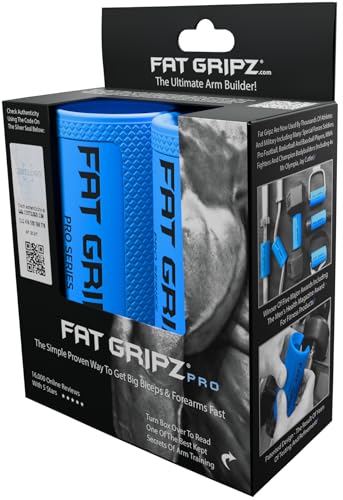
Fat Gripz - Grip Strength Trainer And Arm Builder (4x Men's Health Award Winner) (Pro 2.25")
4.7+ star rating on Amazon with 8,000+ reviews
Instantly thickens any bar to 2.25" diameter
Price and availability may change
Related Content
- IronMind Captains of Crush Gripper Review
- 15 Home Gym Accessories That Actually Matter
- Best Home Gym Accessories Under $50
Frequently Asked Questions
Do Fat Gripz actually build bigger arms?
What exercises are best with Fat Gripz?
Can you use Fat Gripz on a pull-up bar?
How much weight should you drop when starting with Fat Gripz?
What is the difference between Fat Gripz Original, Extreme, and One?
Will Fat Gripz fit on any bar?
How do Fat Gripz compare to dedicated axle bars for thick bar training?
Additional Resources
Lena Park
Former NCAA Division I rower and USA Weightlifting coach. Specializes in conditioning equipment and women's training.
Read full bioMore in Reviews
Yes4All Kettlebell Set Review: Best Budget Kettlebells on Amazon?
Our review of the Yes4All Cast Iron Kettlebell Set. Are these the best budget kettlebells for home gym training on Amazon?
TRX Bandit Resistance Band Handles Review: Worth the Money?
Hands-on review of the TRX Bandit Resistance Band Handles. Is $49.95 worth it for your home gym?
POWER GUIDANCE Battle Rope Review: CrossFit Standard for $40
Hands-on review of the POWER GUIDANCE 30 ft Battle Rope. Best budget battle rope on Amazon for HIIT, CrossFit, and brutal conditioning.
You Might Also Like
15 Home Gym Accessories That Actually Matter (Skip the Rest)
Most home gym accessories are gimmicks. These 15 are the ones competitive lifters, coaches, and trainers actually use every session. Ranked by priority.
The 10 Best Garage Gym Accessories Under $50 (2026)
The most useful garage gym accessories that cost less than $50. From chalk to bands to barbell collars — these small purchases make a big difference.
Doorway vs Wall-Mounted Pull-Up Bar: Which Should You Buy?
Doorway pull-up bar or wall-mounted? We compare the Iron Gym doorway bar vs wall-mounted options for home gyms, apartments, and serious lifters.