Titan Fitness Deadlift Jack Review: Save Your Back When Loading Plates
Our hands-on review of the Titan Fitness Full Deadlift Bar Jack. Is it worth $190 to save your back during plate changes?
Every deadlift session follows the same script: you finish a top set, peel off plates while hunched over a loaded barbell, re-load for your back-off work, and repeat until the session is done. By the time you have pulled 20 working reps, you have probably spent more cumulative energy wrestling plates on and off the bar than actually training your posterior chain. The Titan Fitness Full Deadlift Bar Jack exists to eliminate that entire problem, and after six months of near-daily use in my garage gym, I can say with confidence that it does exactly what it promises. Whether it is worth $190 depends entirely on how you train.

Titan Fitness Mini Deadlift Barbell Jack Stand, 600 LB Capacity, Elevated Lift for Easy Loading and Unloading Barbell Weight Plates, Weight Training, Deadlift Exercises, Powerlifting, Home Gym
Capacity
600 lbs lift capacity
Steel
Powder-Coated Steel
Footprint
Compact mini jack
Price
$89.99
- 4.6+ star rating on Amazon
- Lifts entire loaded barbell with one handle
- 2,000 lb lift capacity handles anything
- Saves your back when loading deadlift plates
- Fits standard Olympic bars
- Sturdy powder-coated construction
- Bulky to store (38" x 26" footprint)
- Premium price for a simple accessory
- Only useful for deadlifts and loading plates
Price and availability may change
Why Plate Loading Is a Bigger Deal Than You Think
Newer lifters tend to dismiss the plate-loading problem because it does not exist below a certain threshold. When the bar holds 225 lbs, you can easily tilt one end up with a single hand, slide a 45 on, and move to the other side. The process takes maybe 30 seconds per weight change.
But once you cross the 400 lb mark, everything changes. A barbell loaded to 455 lbs cannot be casually tilted with one hand. You either need a training partner to hold one end, or you resort to the "small plate wedge" technique: jamming a 2.5 or 5 lb plate under the innermost plate and rolling the bar onto it to create enough gap for the next plate. This works, but it is tedious, noisy, and rough on your flooring. At 500+ lbs, it becomes genuinely dangerous. I have seen loaded barbells roll off improvised wedges and slam onto the platform with enough force to crack rubber tiles.
The real cost is not the inconvenience. It is the cumulative low-back fatigue from bending over, lifting one end of a heavy barbell repeatedly, and then trying to perform high-quality deadlift reps with a pre-fatigued lumbar spine. If your program calls for something like 5x5 at 80% with a drop set afterward, you may be performing 8 to 10 plate changes per session. That is 8 to 10 rounds of bending, lifting, and wrestling iron plates while your grip is already compromised from the working sets.
A full-size deadlift jack turns all of that into a single lever pull.
How the Titan Deadlift Jack Works
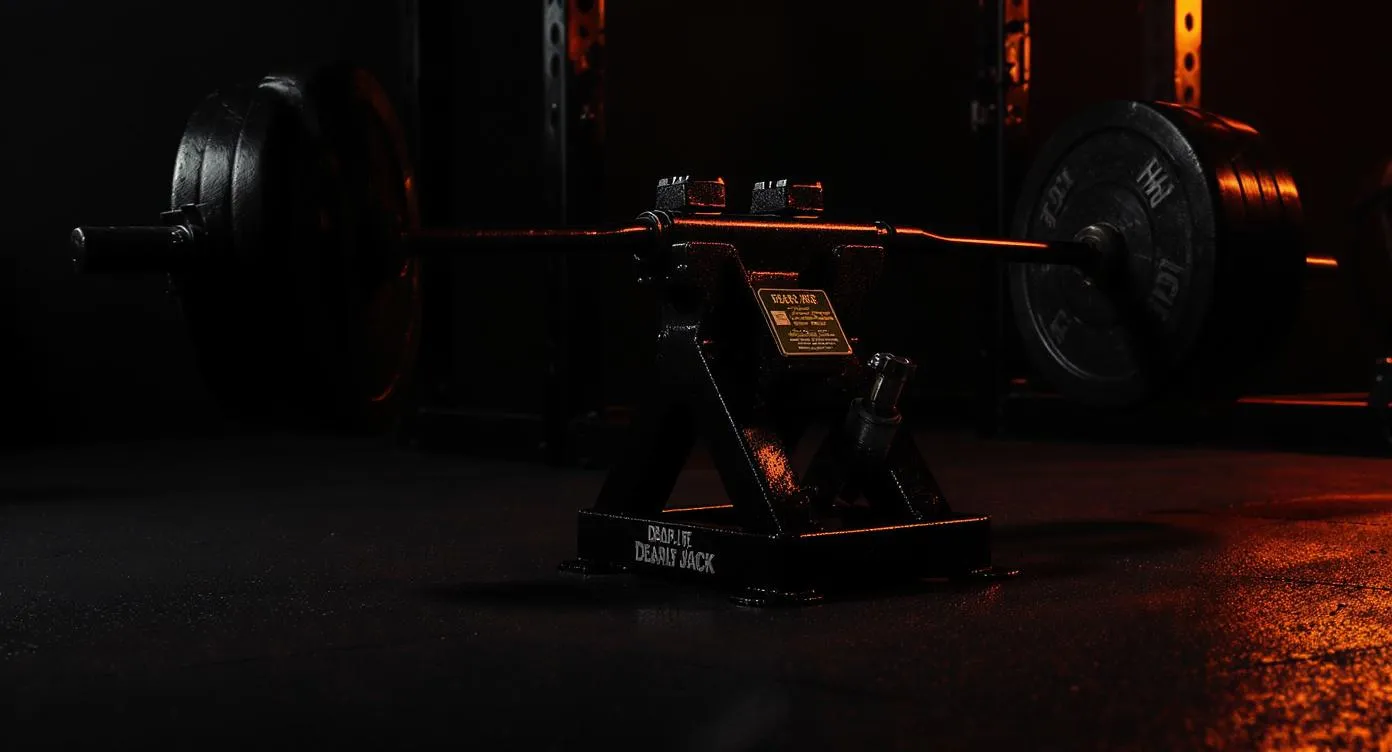
The mechanism is dead simple. You position the jack so that the curved cradle sits under the center knurl of your loaded barbell. You step on the base plate for stability, then pull the long handle downward toward the floor. The lever action lifts the barbell 4 to 6 inches straight up, clearing the floor by more than enough to slide 45 lb plates on or off from either side simultaneously.
When you release the handle, the bar lowers smoothly back to the floor under its own weight. There is no slamming, no bouncing, and no lateral movement if the bar is centered properly in the cradle. The entire load-unload cycle takes roughly 3 to 5 seconds, compared to 30 to 90 seconds with the manual wedge method.
One detail that matters more than you might expect: the cradle is wide enough to catch the bar without precision placement. You do not need to carefully align things. Just roll the bar roughly into the cradle area and pull the handle. The curved steel guides the bar into the correct position as it lifts. This is a small design detail that makes a big difference during high-fatigue sessions when your coordination and patience are both diminished.
Quick Specs · Titan Fitness Mini Deadlift Barbell Jack Stand, 600 LB Capacity, Elevated Lift for Easy Loading and Unloading Barbell Weight Plates, Weight Training, Deadlift Exercises, Powerlifting, Home Gym
Build Quality and Construction Details
The Titan Deadlift Jack is built from heavy-gauge steel tubing with a black powder-coat finish. At approximately 65 lbs, it is not a piece of equipment you casually toss into a corner. The weight is actually a feature, though, because it keeps the jack stable under load. A lighter jack would slide or tip when you lever up 500+ lbs, which would be both useless and dangerous.
The handle is a solid steel tube roughly 40 inches long. The length provides excellent mechanical advantage, so the lever action requires surprisingly little force even with very heavy loads. Lifting a 600 lb barbell requires about the same effort as performing a single-arm dumbbell row with a 50 lb dumbbell. It is not effortless, but it is nothing compared to manually tilting the bar.
The pivot point uses a simple pin-through-tube design. There are no bearings, bushings, or complex moving parts that could fail or need maintenance. After six months of use with loads ranging from 315 to 635 lbs, the pivot shows zero play, zero squeaking, and zero signs of wear. The simplicity of the mechanism is its greatest strength from a durability standpoint.
The powder coat has held up well with one caveat: where the cradle contacts the barbell knurling, you will see wear marks within the first few uses. This is purely cosmetic and happens with every deadlift jack regardless of brand. The structural integrity of the finish is fine everywhere else.
The base footprint measures approximately 38 inches long by 26 inches wide. This is the single biggest drawback of a full-size deadlift jack. It takes up meaningful floor space, and unlike a barbell or plates, it cannot be leaned against a wall or stacked. More on storage solutions below.
What We Love
- Lifts the entire loaded barbell in one smooth lever motion — both sides accessible simultaneously
- 2,000 lb rated lift capacity handles any realistic home gym load with a massive safety margin
- No precision placement needed — the curved cradle self-centers the bar as it lifts
- Minimal effort required even at 600+ lbs thanks to the long handle and mechanical advantage
- Simple pin-and-tube pivot mechanism means zero maintenance and virtually no failure points
- Heavy 65 lb base provides excellent stability under load — no sliding or tipping
- Dramatically reduces cumulative low-back fatigue during high-volume deadlift sessions
- Makes drop sets and wave-loading protocols practical for solo training
What Could Be Better
- 38 x 26 inch footprint is genuinely bulky — dedicated storage space is required
- $190 is a premium price for a single-purpose accessory
- Heavy at 65 lbs — not something you casually move between training stations
- Only useful for deadlift-style movements pulled from the floor
- Handle swing arc requires roughly 4 feet of clearance behind the jack
- First few uses feel awkward until you develop a feel for the lever timing
- No rubber or UHMW lining on the cradle — minor cosmetic wear on barbell finish over time
Real-World Performance: How I Actually Use It
My current deadlift program runs a conjugate-inspired rotation: one max-effort day per week with singles or doubles at 90%+ and one dynamic-effort day with speed pulls at 60 to 70% for 8 to 10 singles on the minute. On max-effort day, I typically work up through 315, 405, 455, 495, and 525 before my top set, then strip back down. That is 10 plate changes minimum.
Before the Titan jack, that warm-up sequence alone added 10 to 15 minutes of bending, lifting, and wrestling plates. With the jack, the same sequence takes under 3 minutes total. I roll the bar into the cradle, pull the handle, slide plates on, release, pull the bar out, and lift. The time savings compound across a training week, and the energy savings compound across a training block.
Where the jack truly earns its price is during back-off work and drop sets. After a heavy top set at 545 lbs, stripping to 455 for a set of 5 used to require an awkward manual process that took long enough to cool down my nervous system. Now I strip the weight in under 10 seconds and hit my back-off set while my CNS is still primed. The training quality improvement is real and measurable — my back-off sets feel stronger and more consistent since I started using the jack.
I have also found it invaluable for barbell maintenance. When you need to clean sleeves, check for bent shafts, or apply oil to sleeve bearings, having the bar elevated and both ends accessible makes everything easier. It is an unintended secondary use case that adds genuine value.
Who Actually Needs a Deadlift Jack?
This is where I want to be honest, because $190 is not an insignificant investment for a home gym accessory. Here is my practical framework:
You will get significant value if:
- You regularly pull 405 lbs or more and train deadlifts at least twice per week
- Your programming includes wave loading, drop sets, or extended warm-up progressions
- You train alone with no partner to assist with plate changes
- You have existing low-back issues that make repeated bending painful or risky
- You pull from the floor frequently (conventional, sumo, deficit, Romanian variations)
You can probably skip it if:
- Your max deadlift is under 315 lbs — at this weight, manual plate changes are trivial
- You only deadlift once per week with straight sets (e.g., 3x5 at one weight)
- You train primarily with bumper plates, which are easier to load manually due to their width
- Your garage gym budget is better spent on foundational equipment you still need
If you are building a powerlifting home gym and you pull 4 plates or more, this goes on the "buy in year two" list right after you have your rack, bar, bench, and plates sorted. It is not essential equipment, but it is one of the highest-impact quality-of-life upgrades you can make.
Storage Solutions for a Bulky Jack
The 38 x 26 inch footprint is the most common complaint about full-size deadlift jacks, and it is legitimate. Here are the approaches I have seen work in real garage gyms:
Wall-lean method: Stand the jack on its end and lean it against a wall behind your rack. This reduces the footprint to roughly 26 x 10 inches but requires a wall that can handle occasional contact with a 65 lb steel object. A small rubber bumper or mat scrap behind the contact point protects your drywall.
Under-platform storage: If you have a lifting platform, some lifters slide the jack under the platform when not in use. This only works if your platform has enough ground clearance, which depends on how you built it.
Dedicated corner: In larger garages (3-car or deep 2-car), the simplest solution is a dedicated corner. The jack sits there permanently, and you roll your loaded barbell to it when you need to change plates. This is my current setup, and the 15-second walk to the jack is a non-issue.
Titan vs. Rogue vs. Mini Jacks: Which Style Is Right for You?
Full-Size Titan Deadlift Jack (~$190)
This is what we are reviewing here. The best value proposition in the full-size deadlift jack market. The 2,000 lb capacity exceeds what any home gym athlete will ever need, the build quality is genuinely excellent, and the price is roughly $50 to $75 less than competing full-size jacks from premium brands. If you want a full-size jack, this is the one to buy.
Mini Deadlift Jacks (~$40 to $80)
Mini jacks lift one end of the bar at a time. You load one side, walk to the other end, position the mini jack, load that side, and repeat. They work, but they eliminate only about half the inconvenience of manual plate loading because you still need to perform two separate lifting operations per weight change. For lifters who deadlift under 500 lbs and want some help but cannot justify $190, a mini jack is a reasonable compromise.
Rogue Dead Bar Jack (~$250+)
Functionally identical to the Titan. The build quality is marginally better in terms of powder coat smoothness and weld consistency, and it carries the Rogue brand premium. If your entire gym is Rogue and aesthetic consistency matters to you, go for it. Otherwise, the Titan does the same job for $60 less. The performance difference is zero.
The DIY Small-Plate Wedge ($0)
Jam a 2.5 or 5 lb plate under your loaded bar and roll onto it. This creates a small gap for loading. It works for moderate weights but becomes unreliable and potentially dangerous above 400 lbs, especially on smooth concrete or rubber flooring where the wedge plate can slip. I used this method for years before buying the Titan jack, and it works. It just gets old fast when you are doing high-volume work.
6-Month Durability Report
After approximately 150 training sessions using the Titan Deadlift Jack with loads ranging from 315 to 635 lbs, here is the current condition:
- Lever mechanism: Smooth and tight. Zero play in the pivot, no stiffness, no squeaking. Functions identically to day one.
- Cradle: Minor paint wear where the barbell knurling contacts the steel. Structurally perfect with no deformation, denting, or warping despite regular use with heavy loads.
- Base frame: No visible signs of stress, bending, or weld cracking at any joint. The heavy-gauge steel tubing is clearly overbuilt for the application.
- Powder coat (body): 95% intact. Minor chips at a few edges where I have bumped it moving equipment around. No rust on exposed steel.
- Handle: Straight and true. No bending despite thousands of lever pulls. The handle diameter is comfortable for bare hands but can get slippery with chalked palms.
- Overall assessment: This will last 10+ years with zero maintenance. There are no bearings to replace, no cables to fray, no pads to wear out. It is a slab of steel with one moving part.
Programming Tips for Solo Deadlift Training
Having a deadlift jack changes what is practical in your solo programming. Here are approaches that become viable once plate changes take seconds instead of minutes:
Wave loading: Pull 85% x 2, strip to 75% x 4, reload to 87% x 2, strip to 77% x 4. This potentiation method requires four plate changes in rapid succession. Without a jack, the rest periods between waves become so long that you lose the neurological potentiation effect. With a jack, you can execute waves with 60 to 90 second transitions, keeping the potentiation window open.
Ascending drop sets: After your top set, immediately strip 20% and pull another set, then strip another 20% and pull again. This is brutal for hypertrophy but requires fast plate changes to maintain the metabolic stress. A deadlift jack makes this a realistic solo protocol.
Speed work with accommodating resistance: If you run bands or chains on your dynamic-effort pulls, the setup and breakdown between sets is already complex. Adding manual plate changes on top of band management turns a focused speed session into a logistics exercise. The jack simplifies the plate side of the equation so you can focus on band tension management.
For more ideas on structuring your home gym training, check out our home gym programming guide.
Safety Considerations
A few important notes on using any deadlift jack safely:
Always step on the base. The jack is designed so you step on the base plate to anchor it before pulling the handle. Skipping this step means the jack can slide toward you under load, which is startling at best and ankle-crushing at worst.
Center the bar in the cradle. An off-center bar can roll out of the cradle when lifted, sending several hundred pounds of iron crashing to one side. The cradle is forgiving, but do not test its limits by placing the bar at the extreme edge.
Clear your feet. When you release the handle, the bar descends to the floor. Make sure your feet and any loose collars, clips, or small plates are clear of the landing zone.
Watch the handle swing. The handle arcs upward when you release it. If you are standing close or have low overhead clearance, the handle can catch you or your equipment. Keep approximately 4 feet of clearance behind the jack.
For a comprehensive overview of solo training safety protocols, read our garage gym safety guide.
Final Verdict
The accessory serious deadlifters wish they bought sooner. 2,000 lb lift capacity, saves your back on heavy loading sessions. Worth $190 if you pull 400+ lbs regularly.
Price and availability may change
The Titan Fitness Full Deadlift Bar Jack is not essential equipment. It does not make you stronger, it does not improve your technique, and it does not add variety to your training. What it does is remove a persistent source of low-grade fatigue, frustration, and injury risk from every deadlift session. For lifters pulling 400+ lbs who train alone and run any kind of varied loading scheme, that removal is worth far more than $190 over the lifespan of this tool.
The build quality is excellent, the mechanism is effectively indestructible, and the price undercuts competing full-size jacks by a meaningful margin. The only real negatives are the storage footprint and the fact that it serves a single purpose. If you have the space and you deadlift seriously, buy it. You will wonder why you waited.
Rating: 4.4/5 -- Half a point lost for the bulky footprint and single-purpose nature. Everything else is exactly what a deadlift jack should be.
Titan Fitness
Titan Fitness Mini Deadlift Barbell Jack Stand, 600 LB Capacity, Elevated Lift for Easy Loading and Unloading Barbell Weight Plates, Weight Training, Deadlift Exercises, Powerlifting, Home Gym
4.6+ star rating on Amazon
Lifts entire loaded barbell with one handle
Price and availability may change
Frequently Asked Questions
How much weight can the Titan Deadlift Jack lift?
Will a deadlift jack damage my barbell?
Can I use the Titan Deadlift Jack on rubber flooring?
Is a full-size deadlift jack worth it over a mini jack?
How much floor space does the Titan Deadlift Jack need?
Do I need a deadlift jack if I use bumper plates?
How long does the Titan Deadlift Jack last?
Additional Resources
Marcus Reid
Powerlifter and mechanical engineer who has been building and breaking home gym equipment for 15 years.
Read full bioMore in Reviews
Yes4All Kettlebell Set Review: Best Budget Kettlebells on Amazon?
Our review of the Yes4All Cast Iron Kettlebell Set. Are these the best budget kettlebells for home gym training on Amazon?
TRX Bandit Resistance Band Handles Review: Worth the Money?
Hands-on review of the TRX Bandit Resistance Band Handles. Is $49.95 worth it for your home gym?
POWER GUIDANCE Battle Rope Review: CrossFit Standard for $40
Hands-on review of the POWER GUIDANCE 30 ft Battle Rope. Best budget battle rope on Amazon for HIIT, CrossFit, and brutal conditioning.
You Might Also Like
The 10 Best Garage Gym Accessories Under $50 (2026)
The most useful garage gym accessories that cost less than $50. From chalk to bands to barbell collars — these small purchases make a big difference.
Doorway vs Wall-Mounted Pull-Up Bar: Which Should You Buy?
Doorway pull-up bar or wall-mounted? We compare the Iron Gym doorway bar vs wall-mounted options for home gyms, apartments, and serious lifters.
15 Best Home Gym Accessories Under $50 (2026)
We tested the top budget gym accessories on Amazon. Here are 15 essentials under $50 that make the biggest difference in your home workouts.