Perfect Fitness Ab Carver Pro Review (2026)
Hands-on review of the Perfect Fitness Ab Carver Pro Wheel. Best ab wheel on Amazon with carbon steel spring assistance and wide stable design.
The ab wheel is the cheapest, most effective core training tool ever built. No machine, no cable stack, no fancy crunch apparatus comes close to what a ten-dollar wheel can do to your midsection — when you actually know how to use it. The Perfect Fitness Ab Carver Pro is the most purchased ab wheel on Amazon, sitting at 4.6 stars across more than 25,000 verified reviews. That is not an accident. This review breaks down exactly why it outperforms every competitor in its price bracket, covers the biomechanics and core activation science behind rollouts, and explains how to progress from your first shaky kneeling rep all the way to standing rollouts that will humble experienced lifters.

Perfect Fitness Ab Carver Roller Wheel With Built In Spring Resistance, At Home Core Workout Equipment
Capacity
All user weights
Steel
Carbon Steel Spring / Foam Handles
Footprint
10" wide wheel
Price
$44.99
- 4.6+ star rating on Amazon with 25,000+ reviews
- Carbon steel spring assists on the way back
- Wide 10-inch wheel improves stability
- Includes knee pad
- Best ab wheel for beginners
- Most popular ab wheel on Amazon
- Spring assistance can be too much for advanced users
- Large wheel takes more storage space than basic ab wheels
- Foam handles wear over years of use
Price and availability may change
The Science of Anti-Extension Core Training
Before discussing the Ab Carver Pro specifically, it is worth understanding why the ab wheel works at a level that most gym-goers have never thought about. The crunch is a spinal flexion movement — you shorten the distance between your sternum and your pelvis by curling your spine. This trains the rectus abdominis in its shortened range and generates significant lumbar compression, which is one of the reasons back pain researchers have moved away from recommending high-volume crunches.
The ab wheel rollout is the opposite. It is an anti-extension movement. Your job is not to curl; your job is to resist extension. As you push the wheel away from your body, gravity and your bodyweight pull your hips toward the floor and your lumbar spine toward hyperextension. Every muscle in your core — rectus abdominis, transverse abdominis, obliques, erector spinae, hip flexors — has to fire simultaneously and hold your spine in a neutral position. This is the exact same demand your core faces when you deadlift, squat, carry a heavy load, or throw a punch.
Electromyography studies consistently show that the rollout generates significantly higher muscle activation in the rectus abdominis and the external obliques compared to the crunch, the sit-up, and even the hanging leg raise. The transverse abdominis — the deepest layer of abdominal muscle and the one most responsible for true core stability — is maximally recruited during rollouts because it has to brace the entire spine against the collapsing force of the movement. A hanging leg raise trains flexion strength but requires a pull-up bar and demands hip flexor dominance, meaning many lifters end up training their hip flexors more than their abs. The rollout bypasses that problem entirely. You are on all fours, fully loaded, with no room to cheat the movement.
This is why the ab wheel is to core training what the squat is to leg training. It is the most complete, most functional single movement available, and it scales from complete beginner to elite athlete without ever getting easy.
The Kinetic Engine: How the Spring Mechanism Changes Everything
The defining feature that separates the Ab Carver Pro from every $8 basic ab wheel is its internal carbon steel spring — what Perfect Fitness calls the Kinetic Engine. Understanding what this mechanism actually does explains why it is worth spending the extra money.
A standard ab wheel is passive. You push it away from your body using your upper body drive, and then you fight every inch of the return journey using nothing but raw core and lat strength. For an intermediate or advanced lifter, this is fine. For a beginner — someone who has never done a rollout before — it creates an insurmountable problem: the concentric phase (rolling out) is moderately difficult, but the eccentric-to-concentric transition at full extension is so demanding that most people cannot pull themselves back. They collapse face-down on the floor, push back with their hands, and walk away convinced the ab wheel is not for them.
The Kinetic Engine solves this. The carbon steel spring inside the axle is pre-loaded under compression. As you roll out, you are compressing the spring further against its tension. When you reach full extension and begin the return, the spring releases that stored energy and contributes roughly 10 to 20 percent of the pulling force needed to bring you back. This is not a dramatic mechanical advantage — you are still doing 80 to 90 percent of the work — but that 10 to 20 percent is precisely the margin that separates a completed rep from a failed one for a newer lifter.
The spring also changes the feedback of the movement. On a standard wheel, the transition from outward roll to return feels like hitting a wall. On the Ab Carver Pro, that transition has a slight elastic bounce to it, which teaches proper form by signaling the exact moment you should initiate your pull-back. Experienced lifters notice this immediately: the wheel coaches you into the right timing in a way that no basic wheel can.
For advanced users, the spring eventually becomes a minor limitation. Once you are comfortably hitting sets of 15 to 20 full kneeling rollouts or starting to work on standing rollouts, the 10 to 20 percent assist means you cannot load the movement quite as brutally as you could on a pure friction wheel. This is an honest tradeoff. But by that point, you have built the foundational strength that the Ab Carver Pro was designed to develop, and you can make the call about whether to graduate to a basic wheel or keep using this one.
Wide Wheel Design: Why It Matters More Than You Think
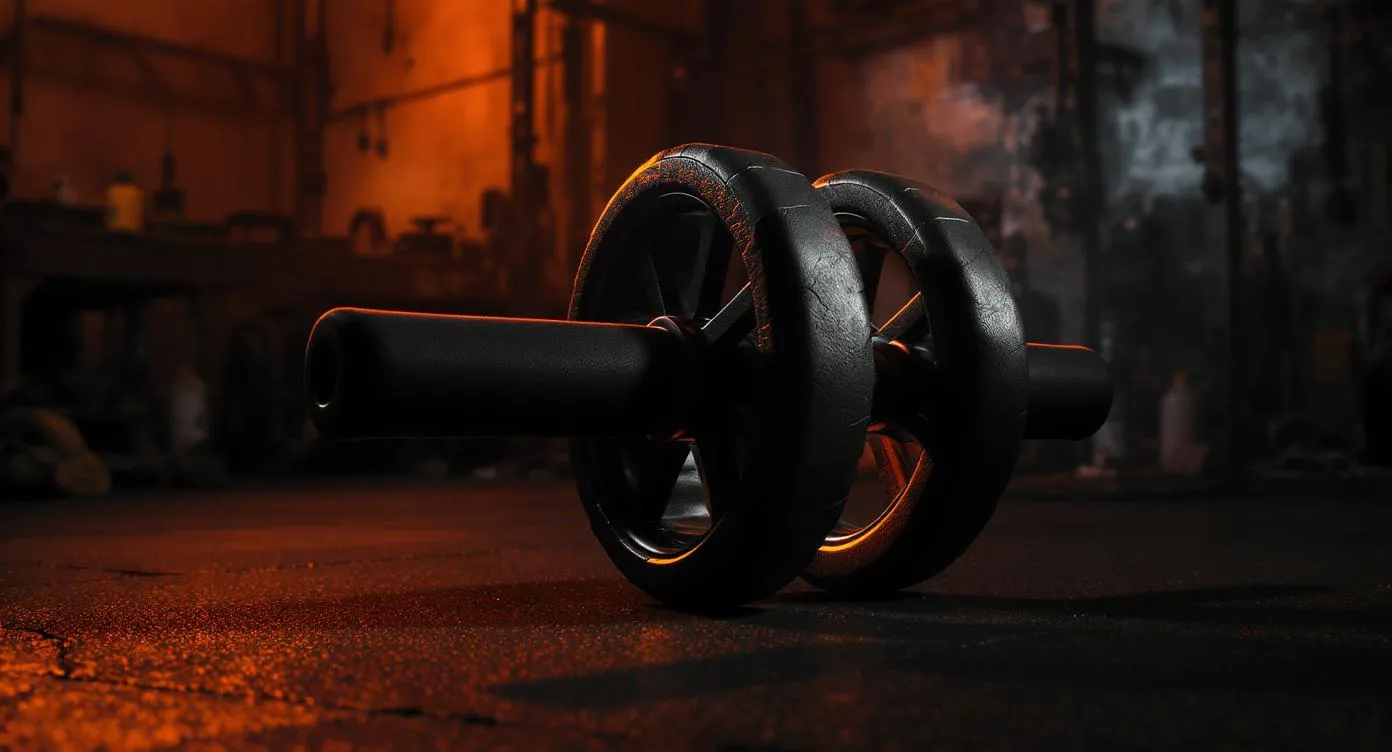
The Ab Carver Pro uses a wide, single-tire design roughly 10 inches in total width. Most basic ab wheels use either a narrow single wheel (2 to 3 inches wide) or a dual-wheel design with two narrow tires side by side. The wide design is not cosmetic.
A narrow wheel creates an inherently unstable platform. When you roll out, any slight unevenness in your push or any fatigue-induced asymmetry in your lat engagement causes the wheel to drift left or right. You end up training yourself to compensate for the wheel rather than training your core. Beginners on narrow wheels typically develop lateral movement patterns that look like ab work but are actually just stabilizing a wobbly tool.
The dual-wheel design on cheaper ab wheels is slightly more stable than a single narrow wheel, but it introduces a different problem: the two wheels rotate independently on most budget models, which means you can perform a rollout where one side of your body does significantly more work than the other without even noticing. Bilateral compensation patterns in ab training are common and typically go undetected until someone pays attention.
The wide single wheel of the Ab Carver Pro forces symmetrical engagement. The wheel wants to track in a straight line, and the only way to make it do so is to drive through both arms and both sides of your core with equal force. It also allows for intentional lateral rollouts — rolling out at a 30 to 45 degree angle to target the obliques — which is much harder to do cleanly on a narrow or dual-wheel design without the tool folding or skidding.
The width does have one practical drawback: the Ab Carver Pro takes up more floor space and does not tuck into a corner quite as invisibly as a thin basic wheel. For a home gym where storage is at a premium, this is worth noting. The actual footprint difference is modest — a few inches — but it is a real consideration. For a broader look at compact accessories that solve storage problems, our home gym accessories essentials guide covers the full picture.
Handle Ergonomics and Grip Analysis
The handles on the Ab Carver Pro are contoured, foam-covered grips that angle slightly inward relative to the wheel axle. This matters biomechanically. A straight handle perpendicular to the axle places your wrists in a neutral but mechanically inefficient position for the rollout movement. The slight inward angle of the Ab Carver Pro grips puts your wrists in a position closer to a neutral hammer grip, which reduces wrist strain and allows your lats to drive more powerfully through the return phase.
The foam covering is dense enough to provide cushioning without creating a soft, unstable surface. Cheap foam grips compress too much and start to feel wobbly during heavy sets; the Ab Carver Pro foam is firmer than it looks. Over years of consistent use the foam will show wear — there is no getting around that — and some users report the outer foam layer separating from the handle core after 18 to 24 months of daily training. This is the most common long-term complaint in the Amazon reviews and it is legitimate. The handles do not fail catastrophically; they just look rougher over time. Replacement is not available as a standalone part, but the wheel itself typically lasts well beyond the handles in terms of structural integrity.
The diameter of the handles is appropriate for most hand sizes, though lifters with very large hands may find the grip slightly thin. Chalk or a lifting glove improves the connection for high-rep sets.
The included knee pad is a genuine value-add. It is a small foam rectangle that straps or slides under the knees during kneeling rollouts. On a hard concrete or rubber gym floor, unpadded kneeling ab work becomes uncomfortable within a few sets. The pad is not thick enough to significantly change your body positioning, which means it does not compromise form — it just eliminates the distraction of joint discomfort so you can focus on the muscle work.
The Specs
Quick Specs · Perfect Fitness Ab Carver Roller Wheel With Built In Spring Resistance, At Home Core Workout Equipment
What We Love
- 4.6+ star rating on Amazon with 25,000+ verified reviews
- Carbon steel Kinetic Engine spring assists the return phase by 10-20%, enabling full-range reps for beginners
- Wide 10-inch wheel forces bilateral symmetry and supports lateral oblique rollouts
- Contoured inward-angled handles reduce wrist strain and improve lat engagement
- Includes foam knee pad for comfortable kneeling rollouts on hard floors
- Durable steel axle construction lasts years under consistent heavy use
- Best entry point for learning the ab rollout pattern before progressing to standing
What Could Be Better
- Spring assistance becomes a limitation for advanced lifters who want maximum loading
- Wide wheel takes more storage space than narrow basic wheels
- Foam handles show visible wear after 18-24 months of heavy daily use
- Priced higher than basic $8-12 wheels — the premium is justified but real
- No standalone handle replacement available if foam degrades before wheel
Progression System: Kneeling to Standing
This is where most people go wrong with the ab wheel. They see standing rollouts on social media, try them on day one, tweak their lower back, and conclude the tool is dangerous. The ab wheel is not dangerous. Skipping the progression is dangerous. Here is the full sequence.
Phase 1 — Wall Rollouts (Week 1 to 2)
Stand facing a wall two to three feet away. Place the wheel against the baseboard and roll it up the wall to about shoulder height while letting your torso lean forward. Your hips drive back as your arms extend. Return by pulling the wheel back down. This teaches the arm-and-lat coordination required for rollouts without any ground contact or full bodyweight loading. It is also an excellent diagnostic: if you cannot control the wheel on the wall, you have no business being on the floor.
Phase 2 — Kneeling Half-Range Rollouts (Week 3 to 4)
Knees on the pad, hands on the wheel directly below your shoulders, back neutral. Roll forward until your body is at approximately 45 degrees from the floor — arms extended in front of you, hips pushed forward, core tight. Hold for one second. Pull back to the start. The 45-degree endpoint is critical here; it is the range where most beginners have some chance of returning without the spring doing too much work. This builds the neuromuscular pattern and initial core strength.
Phase 3 — Kneeling Full-Range Rollouts (Week 5 to 8)
Same setup, but now you extend until your chest is two to three inches above the floor. Full extension. Your body is nearly parallel to the ground. This is where the Kinetic Engine spring earns its money — without it, most beginners cannot return from this position. With it, the spring provides just enough assistance for the return to be a grinding, muscular effort rather than an impossible one. This phase builds the bulk of the foundational core strength.
Phase 4 — Standing Rollouts (Month 3 and Beyond)
Start from standing with feet hip-width apart. Roll forward until your chest is close to the floor — full hip extension, spine neutral, arms fully extended overhead. Pull back. This is one of the hardest bodyweight core movements in existence. Your entire anterior chain is loaded eccentrically on the way out and concentrically on the way back. Ten controlled standing rollouts are more demanding than most people's entire ab routine. Add them incrementally: start with two or three per set and build over weeks.
A note on lower back safety across all phases: the most common injury vector is failing to maintain posterior pelvic tilt at the bottom of the extension. When the hips drop and the lumbar spine hyperextends at full stretch, the mechanical advantage of the core muscles collapses and the lower back absorbs the load. Keep the glutes lightly engaged throughout every rollout to prevent the hips from sagging. The Kinetic Engine spring actually helps with this by shortening the time you spend at peak extension — the spring begins its return assist before you have the chance to dump your hips into hyperextension.
Ab Wheel vs. Basic Ab Wheels: Honest Comparison
The $8 basic ab wheel has exactly one part: a wheel, an axle, and two handles. It does the job. If you are already an experienced lifter with solid core strength and body control, a basic wheel gives you everything you need for more money in your pocket.
For everyone else — which is the overwhelming majority of the people reading this review — the gap between the Ab Carver Pro and a basic wheel is significant. The spring mechanism is not a gimmick; it is an engineered solution to a real problem. The wide wheel design eliminates a major form error. The handle ergonomics reduce injury risk in a movement that already places high demands on the wrists and shoulders. The knee pad removes a source of discomfort that causes people to cut sessions short.
At roughly $30 to $35, the Ab Carver Pro costs three to four times more than the cheapest basic wheels. But it costs less than one month of a gym membership and will outlast most equipment in a home setup. From a pure cost-per-use standpoint, it is among the best values in the accessory category. You can compare it alongside other high-value compact tools in our best home gym accessories under $50 roundup.
Ab Wheel vs. Hanging Leg Raises: The Real Debate
Hanging leg raises are often cited as the superior core exercise because they require a pull-up bar, look more athletic, and have strong gym-culture credibility. Here is an honest comparison.
Hanging leg raises are a hip flexion movement with an anti-gravity component. The rectus abdominis contracts hard in the top portion of the movement — especially when you curl the pelvis toward the chest — but the hip flexors (primarily the iliopsoas) are the primary movers throughout the entire range. Lifters with dominant hip flexors often complete hanging leg raises without meaningful ab activation. Additionally, performing hanging leg raises correctly requires a pull-up bar, grip strength to hang, and enough shoulder stability to control a swinging body under load. These requirements disqualify a significant portion of home gym trainees.
The rollout has none of those prerequisites. It requires only the wheel and the floor. The core activation profile favors the deep stabilizers — transverse abdominis, obliques — more than the hanging leg raise does. The hanging leg raise is a better hip flexor movement; the rollout is a better core stability movement. Both have value, and neither replaces the other. But if you can only do one, and your goal is functional core strength, the rollout is the better choice.
For a home gym without a dedicated pull-up bar, the rollout is not even a contest — it wins by default, and wins decisively.
Practical Training Protocols
Beginner Protocol (3 Days Per Week)
- Phase 1 or 2 rollouts: 3 sets of 6 to 8 reps
- Rest 90 seconds between sets
- Progress range of motion by roughly 10 percent each week
- Total time: 10 minutes
Intermediate Protocol (3 Days Per Week)
- Phase 3 rollouts: 4 sets of 8 to 12 reps
- Add a 2-second pause at full extension on the last two reps of each set
- Follow with side rollouts at 30 degrees: 2 sets of 6 per side
- Rest 2 minutes between sets
- Total time: 15 to 20 minutes
Advanced Protocol (3 Days Per Week)
- Standing rollouts: 5 sets of 5 to 8 reps
- Full extension, 1-second pause, controlled return
- Follow with kneeling side rollouts: 3 sets of 10 per side
- Optional finisher: max-rep kneeling rollouts after the standing sets
- Rest 3 minutes between standing sets, 90 seconds between accessory sets
- Total time: 20 to 25 minutes
The Ab Carver Pro handles all three of these protocols without limitation. The spring is present but not intrusive at the intermediate and advanced levels — once you have the core strength to control the return independently, you stop relying on the spring and it becomes background noise.
Who Should Buy the Ab Carver Pro
The right fit:
- Anyone new to ab wheel training who needs spring assistance to complete full-range reps
- Lifters who want one tool that trains the entire core without spinal flexion
- Home gym trainees without a pull-up bar who want an alternative to hanging leg raises
- People with lower back sensitivities who have been told crunches are contraindicated
- Intermediate lifters who want to develop the kneeling-to-standing rollout progression
- Anyone looking for a compact, portable core tool that costs less than a month's gym membership
Probably not the right fit:
- Advanced lifters already doing 15 to 20 standing rollouts per set with zero spring assistance (a basic wheel is the better tool at that level)
- Trainees whose primary goal is isolated rectus abdominis hypertrophy for aesthetics above function (direct crunch variations isolate the muscle belly more effectively for pure cosmetic purposes)
- Anyone expecting the tool to be a substitute for dietary discipline — core strength and visible abs are different goals
Final Verdict
The internal carbon steel spring provides real assistance on the return phase — enough to let beginners complete full-range rollouts before they have the raw core strength for an unassisted wheel. The wide dual-wheel base prevents the lateral wobble that makes standard ab wheels feel unstable. Once you are strong enough to do 15+ unassisted rollouts, you will outgrow the spring assistance. At that point, a $12 basic wheel is all you need. But for building rollout strength from zero, this is the right starting tool.
Price and availability may change
Rating: 4.5/5. The Perfect Fitness Ab Carver Pro is not just the best-selling ab wheel on Amazon — it is the right ab wheel for the majority of home gym trainees. The Kinetic Engine carbon steel spring solves the single biggest failure point of standard ab wheels by giving beginners the margin they need to complete full-range reps before they have built raw rollout strength. The wide wheel design enforces bilateral symmetry and opens up lateral oblique work that narrow wheels cannot handle cleanly. The handle ergonomics are genuinely engineered rather than an afterthought. And the included knee pad is a thoughtful detail that makes the difference between a comfortable session and a miserable one on a hard floor.
The only meaningful knock against it is longevity of the foam handles and the eventual ceiling on spring assistance for advanced lifters — neither of which changes the calculus for its target user. At its price point, competing against the ab training category as a whole rather than just other wheels, it is one of the strongest value propositions in the entire home gym accessory market.
Frequently Asked Questions
Are ab wheels bad for your back?
How often should I use an ab wheel?
Is the spring assistance cheating?
Can ab wheels give you a six-pack?
What's better: ab wheel or planks?
How does the Ab Carver Pro compare to a basic ab wheel?
When should I progress from kneeling to standing rollouts?
Additional Resources
- NSCA Training Equipment and Accessories
- ACE Strength Training Fundamentals
- ASTM Fitness Equipment Safety Standards
Related Content
Derek Walsh
Strongman competitor and former commercial gym equipment salesman. Knows what survives heavy daily use.
Read full bioMore in Reviews
Yes4All Kettlebell Set Review: Best Budget Kettlebells on Amazon?
Our review of the Yes4All Cast Iron Kettlebell Set. Are these the best budget kettlebells for home gym training on Amazon?
TRX Bandit Resistance Band Handles Review: Worth the Money?
Hands-on review of the TRX Bandit Resistance Band Handles. Is $49.95 worth it for your home gym?
POWER GUIDANCE Battle Rope Review: CrossFit Standard for $40
Hands-on review of the POWER GUIDANCE 30 ft Battle Rope. Best budget battle rope on Amazon for HIIT, CrossFit, and brutal conditioning.
You Might Also Like
The 10 Best Garage Gym Accessories Under $50 (2026)
The most useful garage gym accessories that cost less than $50. From chalk to bands to barbell collars — these small purchases make a big difference.
Doorway vs Wall-Mounted Pull-Up Bar: Which Should You Buy?
Doorway pull-up bar or wall-mounted? We compare the Iron Gym doorway bar vs wall-mounted options for home gyms, apartments, and serious lifters.
15 Best Home Gym Accessories Under $50 (2026)
We tested the top budget gym accessories on Amazon. Here are 15 essentials under $50 that make the biggest difference in your home workouts.