The Best Pull-Up Bars for Home Gyms (2026 Tested)
Doorway, wall-mounted, ceiling-mounted, and freestanding pull-up bars compared. We tested them all to find the best options for every setup.
If you could only pick one piece of upper-body equipment for your home gym, a pull-up bar would be the smartest choice. The pull-up trains your lats, rhomboids, biceps, rear delts, and core in a single compound movement that requires nothing more than a solid bar overhead. Whether you are building a full garage gym from scratch or looking for an affordable upgrade, the right pull-up bar turns any doorway, wall, or ceiling into a complete back-training station.
Over the past twelve months we have installed and tested dozens of doorway, wall-mounted, ceiling-mounted, rack-integrated, and freestanding pull-up bars in real garage and home gym environments. Below you will find our honest breakdown of which types work best for different spaces, budgets, and training goals in 2026.
Quick Recommendations
| Setup | Best Option | Price Range | Weight Limit |
|---|---|---|---|
| Apartment / rental | Doorway bar | $25-40 | 250-300 lbs |
| Garage with rack | Rack-mounted (included) | $0 (with rack) | 500+ lbs |
| Garage without rack | Wall-mounted | $40-100 | 400-500 lbs |
| High ceiling | Ceiling-mounted | $50-120 | 400-500 lbs |
| No mounting possible | Freestanding tower | $100-250 | 250-450 lbs |

Iron Gym Pull-Up Bar, Total Upper Body Workout Bar for Doorway
Capacity
300 lbs user weight
Steel
Steel / Foam Grips
Footprint
Fits doorways 24-32 inches wide
Price
$26.00
- 4.5+ star rating on Amazon with 60,000+ reviews
- No screws or installation required
- Multiple grip positions (wide, narrow, neutral)
- Removable for door access
- Best-selling doorway pull-up bar on Amazon
- Cheapest entry into upper body training
- Limited to 300 lb user weight
- Cannot be used for kipping or muscle-ups
- Can damage doorframe trim with heavy use
- Width restricted to standard doorways
Price and availability may change
How We Tested
Every bar went through three weeks of real-world use. We evaluated each across six criteria:
- Stability under load -- static hangs at 200 lbs and dynamic kipping attempts
- Grip variety -- wide overhand, close underhand, neutral, and angled grips available
- Installation difficulty -- tools required, time to mount, skill level needed
- Build quality -- weld integrity, powder coat finish, knurling or foam durability
- Weight capacity -- tested up to advertised max plus a 10 percent overload
- Value -- price relative to stability, capacity, and longevity
Type 1: Doorway Pull-Up Bars ($25-40)
Doorway bars are the entry point for most home gym owners. They use leverage and friction to lock into a standard door frame without drilling, screwing, or making any permanent changes to your home.
The Iron Gym Total Upper Body Workout Bar is the category benchmark. With over 60,000 Amazon reviews and a 4.5-star average, it remains the best-selling doorway pull-up bar in 2026 for good reason: it costs under $30, installs in seconds, and offers multiple grip positions.
Pros
- Zero tools required and no drilling — installs in under 30 seconds
- Portable: remove it instantly when you need full door access
- Under $30 for a proven, high-quality option like the Iron Gym
- Multiple grip positions including wide overhand, narrow, and neutral
- Perfect for renters who cannot modify walls or ceilings
Cons
- Limited to standard doorway width (24-32 inches max)
- Can dent or chip paint on wood door trim over time
- Weight limits cap at 250-300 lbs — not ideal for heavy weighted pull-ups
- Less stable than permanently mounted options — slight flex under load
- Cannot safely perform kipping or muscle-up movements
- Clearance above the bar is limited by the doorway header
Best for: Apartment dwellers, renters, beginners testing commitment, or anyone wanting a secondary pull-up bar in a bedroom or office. Not sure which mounting style suits your situation? Read our detailed doorway vs wall-mounted pull-up bar comparison for a head-to-head breakdown.
Skip if: You weigh over 250 lbs, plan to add a weight belt for progressive overload, or need dynamic movement capability.
Doorway Bar Installation Tips
- Confirm your door frame is solid wood (not hollow MDF) and at least 1 inch thick on each side
- Place rubber pads or a folded towel between the bar contact points and the trim to prevent cosmetic damage
- Check for level -- if the frame is slightly warped, the bar may not seat evenly
- Test with a gentle hang before committing your full body weight
Type 2: Wall-Mounted Pull-Up Bars ($40-100)
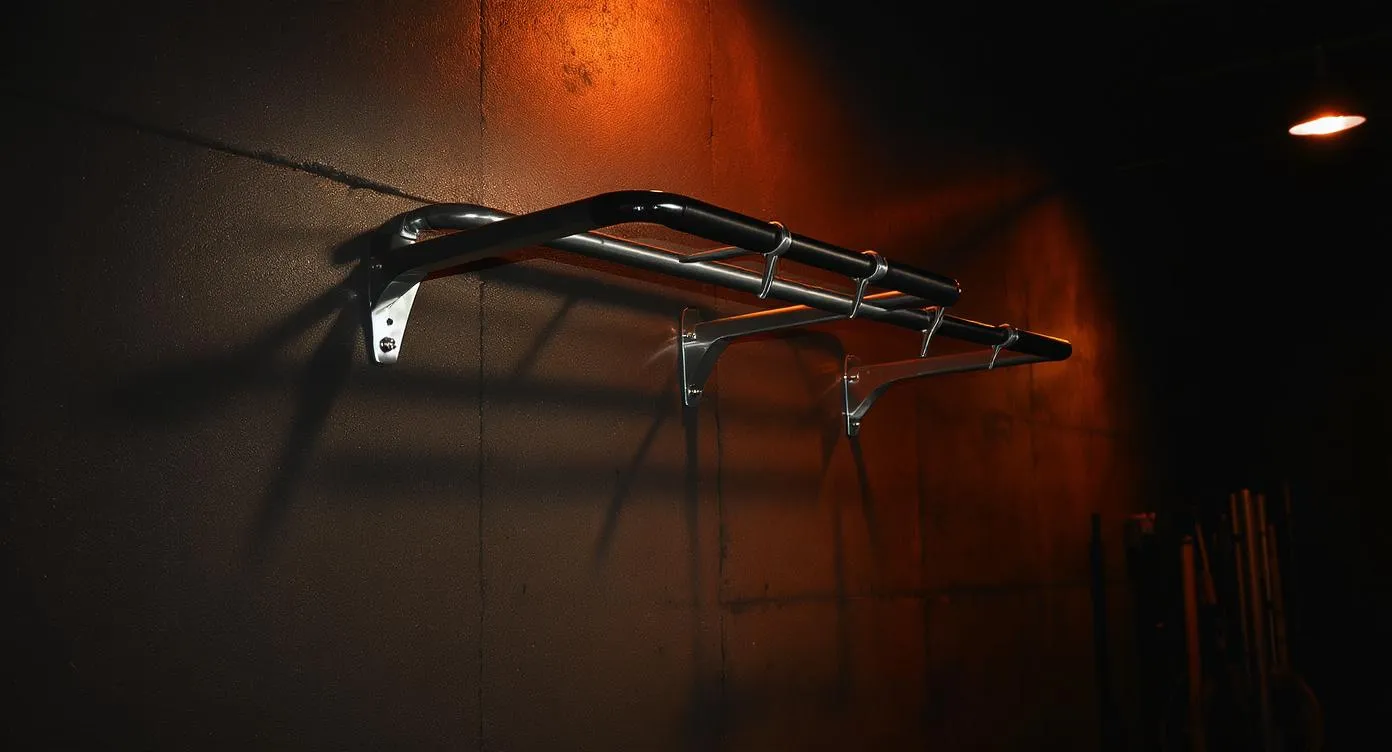
Wall-mounted bars bolt directly into structural studs and deliver commercial-gym stability in a compact footprint. For most garage gym owners without a power rack, this is the best investment you can make in upper-body training.
Pros
- Rock-solid stability when lag-bolted into studs — zero flex or movement
- 400-500 lb weight limits make weighted pull-ups and muscle-ups safe
- Multi-grip designs available with wide, neutral, and angled handles
- Many models fold flat against the wall when not in use to save space
- Long-term durability — heavy steel construction lasts decades
- Can be positioned at ideal height for your body
Cons
- Requires drilling 3/8-inch or larger lag bolts into wall studs
- Permanent installation leaves holes if you ever remove it
- Limited by standard 16-inch or 24-inch wall stud spacing
- Need at least 18 inches of clearance in front of the bar and 12 inches above your head
- Not suitable for rental properties without landlord approval
Best for: Garage gyms without a power rack. A wall-mounted multi-grip bar is the single best standalone pull-up solution for long-term training. If you are building a budget home gym, a $50 wall-mounted bar gives you more exercise variety than any other single piece of equipment at that price.
Wall-Mount Installation Checklist
- Use a stud finder to locate at least two studs (three is better for multi-grip bars)
- Pre-drill pilot holes slightly smaller than your lag bolt diameter
- Use 3/8-inch x 3-inch lag bolts minimum -- longer for thicker drywall
- Apply thread-locking compound to prevent loosening over months of use
- Test with a gradual load increase before performing dynamic movements
Type 3: Ceiling-Mounted Pull-Up Bars ($50-120)
Ceiling-mounted bars bolt into overhead joists and are ideal for garages with high ceilings and limited wall real estate. They provide a "hanging from a gym rig" feel that wall-mounted bars cannot replicate.
Pros
- Frees up wall space entirely for mirrors, storage, or other equipment
- Replicates the feel of commercial gym pull-up rigs
- High weight capacity (400-500 lbs) when properly anchored to joists
- Available in multi-grip and globe-grip configurations
- Allows full range of motion without wall interference
- Ideal for garages that double as parking spaces — bar stays overhead
Cons
- Requires solid ceiling joists — will not hold in drywall or thin rafters alone
- Installation is more difficult than wall mounting due to overhead drilling
- Need minimum 7.5 ft ceiling clearance for full-extension hang without bent knees
- Cannot easily adjust height once installed
- May need joist-bridging hardware if joist spacing does not match bar width
- Higher injury risk if hardware fails — bar is directly above your head
Best for: Garages with 9+ ft ceilings and limited wall space, or garages that must still function as a vehicle parking area where wall bars would interfere.
Skip if: Your ceiling is below 8 feet, you have engineered trusses instead of solid joists, or you are uncomfortable working overhead with a drill.
Ceiling Height Considerations
| Ceiling Height | Suitability | Notes |
|---|---|---|
| Under 8 ft | Poor | Most users will hit their head at the top of the rep |
| 8-9 ft | Acceptable | Shorter users fine; tall users may need to bend knees |
| 9-10 ft | Ideal | Full range of motion for most body heights |
| Over 10 ft | Good but high | May need extension brackets to bring bar lower |
Type 4: Rack-Mounted (Best Overall Option)
If you already own or plan to buy a power rack, you do not need a separate pull-up bar. Every quality power cage includes at least one integrated pull-up bar, and many offer multi-grip attachments as upgrades. The bar is welded or bolted to the rack frame, rated for the full capacity of the cage (typically 500-1,000 lbs), and positioned at the ideal height.
All three of these popular racks in our catalog include pull-up bars as standard:
Head-to-Head Comparison
| Spec | ULTRA FUEGO Power Cage, Multi-Functional Power Rack | Mikolo F4 2.0 Power Cage with Dual-Track Smooth Pulley System | SPORTSROYALS Power Rack, Multi-Functional Power Cage with Pulley System & LAT Pull Down |
|---|---|---|---|
| Capacity | 800 lbs | 1,200 lbs | 1,600 lbs |
| Steel | 2x2" 14-Gauge Steel | 2x2" 12-Gauge Steel | 2x2" Heavy-Duty Steel |
| Footprint | 50.5" L x 46.5" W x 83.5" H | 49" L x 49" W x 86" H | 52" L x 49" W x 84" H |
| Price | $389.98 | $399.99 | $319.99 |
| Buy | Check Price on Amazon Price and availability may change | Check Price on Amazon Price and availability may change | Check Price on Amazon Price and availability may change |
Best for: Anyone who owns or plans to own a power rack. The pull-up bar is essentially free, maximally stable, and rated for massive loads. If you are still deciding on a rack, our power rack buying guide covers everything you need to know.
Why Rack-Mounted Bars Win
- Zero additional cost -- included with your rack purchase
- Highest weight capacity -- 500 to 1,000 lbs depending on rack model
- Multiple grip options -- most racks include straight bar plus multi-grip attachment points
- Dynamic movement safe -- kipping pull-ups, muscle-ups, and weighted movements are all supported
- No additional installation -- the bar is part of the rack structure
Type 5: Freestanding Pull-Up Towers ($100-250)
Freestanding power towers are standalone frames that require no wall or ceiling mounting. They typically combine a pull-up bar, dip handles, vertical knee raise pads, and push-up grips in one station. These are the last resort when you genuinely cannot drill into any surface.
The Sportsroyals Power Tower leads this category with a 450-lb capacity, 4.5-star rating on Amazon, and a compact-ish footprint of 40 by 35 inches.
Pros
- No installation — assemble it and start training immediately
- Portable and repositionable for cleaning or rearranging your gym
- Often includes dip bars, leg raise station, and push-up handles
- Some models like the Sportsroyals rate up to 450 lbs
- Adjustable height accommodates multiple family members
- Good option for basements or spaces with concrete walls that are hard to drill
Cons
- Occupies 10-15 square feet of permanent floor space
- Most budget models limited to 250-350 lbs capacity
- Can rock or wobble during kipping or explosive movements
- Most expensive option per feature compared to a simple wall-mounted bar
- Assembly required — typically 1-2 hours with basic tools
- Base must sit on level ground to prevent instability
Best for: Only recommended when wall and ceiling mounting are genuinely impossible -- basements with all-concrete walls, rented spaces with strict modification policies, or temporary setups. Check out our full best power towers roundup for detailed reviews.
Grip Variations Every Lifter Needs
Regardless of which bar type you choose, make sure your setup allows you to perform these four fundamental grip positions:
- Wide overhand grip (pronated) -- primary lat width builder, targets outer back and teres major
- Shoulder-width overhand grip -- balanced lat and mid-back development with moderate bicep involvement
- Close underhand grip (supinated / chin-up) -- maximal bicep recruitment plus lower lat emphasis
- Neutral grip (palms facing each other) -- easiest on the shoulder joint, excellent for forearm and brachialis development
Multi-grip pull-up bars ($40-70) deliver all four positions in one unit. If your current bar only offers a straight overhand grip, adding a set of rotating pull-up handles or fat grips can expand your training options for under $20.
Progressive Overload on Pull-Ups
Once you can perform 3 sets of 10-12 strict pull-ups with bodyweight, add external load progressively:
- 5-10 lbs -- hang a dumbbell between your feet or use a quality dip belt
- 10-25 lbs -- dip belt is essential at this stage for consistent loading
- 25-50+ lbs -- ensure your bar is rated for your body weight plus the added load combined
This is where doorway bars fall short. If you plan to progress beyond bodyweight, invest in a wall-mounted or rack-mounted solution from the start.
Pull-Up Bar Buyer's Checklist
Before purchasing, confirm:
- Your body weight plus intended added weight falls within the bar's rated capacity (with 20% margin)
- Ceiling clearance allows a full dead hang without feet touching the floor (minimum 7 ft for most users)
- Grip diameter is comfortable -- standard is 1.25 inches; fat bars are 2+ inches
- Material quality -- look for 14-gauge or thicker steel tubing and welded (not press-fit) joints
- Mounting surface integrity -- studs for wall mounts, joists for ceiling mounts, solid trim for doorway bars
- Knurling or grip texture -- bare steel knurling outlasts foam padding which degrades within 1-2 years
Frequently Asked Questions
Will a doorway pull-up bar damage my door frame?
What is the best pull-up bar for a garage gym?
Can I do kipping pull-ups on a doorway bar?
How high should a pull-up bar be mounted?
Are pull-up bars worth it if I already have a lat pulldown machine?
What is the weight limit of most doorway pull-up bars?
Can I install a pull-up bar in a rental apartment?
Additional Resources
- ACE Bodyweight Training Guide
- NSCA Bodyweight Training Progressions
- PubMed: Bodyweight Training for Strength and Hypertrophy
The Bottom Line
If you have a power rack, you already own the best pull-up bar available -- use it. If you do not have a rack, a wall-mounted multi-grip bar in the $50-80 range is the single best investment for upper-body training in a garage or home gym. It gives you commercial-gym stability at a fraction of the cost and lasts essentially forever.
Use doorway bars only as a temporary starter option or a secondary bar in another room. And skip freestanding towers unless you genuinely cannot drill into walls or ceiling -- a $50 wall-mounted bar outperforms a $200 tower in every metric except portability.
Whatever you choose, consistency matters more than equipment. A $30 doorway bar used five days per week builds more muscle than a $300 tower gathering dust. Get the bar that fits your space, mount it properly, and start pulling.
Related Content
Derek Walsh
Strongman competitor and former commercial gym equipment salesman. Knows what survives heavy daily use.
Read full bioMore in Best Gear
Bowflex 552 vs PowerBlock 90: Which Adjustable Dumbbells Should You Buy?
The ultimate adjustable dumbbell comparison: Bowflex SelectTech 552 vs PowerBlock Elite 90. We tested both — here's which one wins for your home gym.
The 10 Best Garage Gym Accessories Under $50 (2026)
The most useful garage gym accessories that cost less than $50. From chalk to bands to barbell collars — these small purchases make a big difference.
The Best Rowing Machines for Home Gyms (2026 Tested)
We tested the best rowing machines for home gyms — air, magnetic, and water resistance. Our picks for budget, mid-range, and premium.