SPRI Xerball Medicine Ball (12 lb) Review: Worth the Money?
Hands-on review of the SPRI Xerball Medicine Ball (12 lb). Is $44.99 worth it for your home gym?
Medicine balls are one of the oldest and most versatile training tools you can own, and in a garage gym they pull triple duty as a core tool, a conditioning weapon, and a partner drill staple. I have been training with the SPRI Xerball Medicine Ball in the 12 lb size for over four months now, logging hundreds of throws, slams, rotational passes, and carries. After putting it through everything from wall-ball sets to Turkish get-up progressions, here is my honest assessment of whether the $44.99 price tag is justified.
At a Glance
Quick Specs · SPRI Medicine Ball with Handles
First Impressions and Unboxing
The Xerball arrived double-boxed with a thin foam wrap around the ball itself. No damage, no scuffs, no packaging complaints. Right out of the box, the first thing you notice is the rubber smell. It is strong. Not eye-watering chemical off-gassing, but a distinct rubber odor that persisted for about 5 to 7 days in my garage gym. I left it outside in the shade for 48 hours and the smell dropped significantly. By the end of the first week of training, it was a non-issue.
The ball measures roughly 9.1 inches in diameter, which is consistent across the SPRI Xerball line for the 12 lb model. It fits comfortably in two hands and is small enough to hold in one hand for single-arm work if you have average or larger hands. Weight on my calibrated scale came in at 12.05 lbs, which is about as accurate as you will find in this price bracket. For reference, I have seen budget medicine balls come in a full half-pound off their stated weight.
Build Quality and Materials
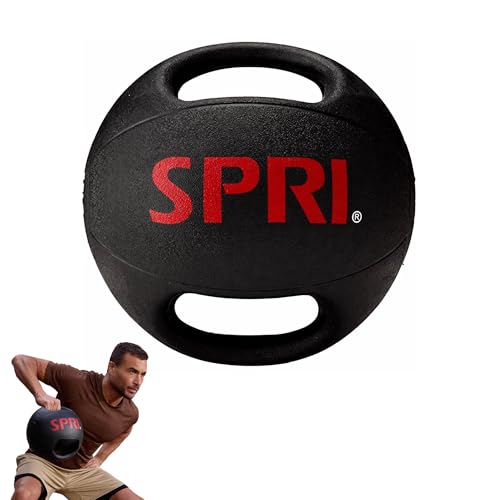
SPRI has been making fitness accessories since the 1980s, and their experience shows in the Xerball construction. The outer shell is a textured rubber compound with a cross-hatch pattern molded into the surface. This is not a smooth, slippery ball that will fly out of sweaty hands during a conditioning circuit. The texture bites into your palms and fingers, giving you confident purchase even at rep 15 of a wall-ball set when your grip is compromised.
The rubber has a consistent thickness around the entire circumference. I have not found any thin spots, seams pulling apart, or air bubbles in the shell after four months of regular use. The fill material inside is a sand-and-rubber composite that gives the ball a predictable, slightly dead feel on impact. Unlike a basketball-style bounce, the Xerball returns about 40 to 50 percent of the energy when dropped from chest height onto a rubber floor. This matters because a fully dead slam ball and a fully live wall ball are different tools. The Xerball sits in a useful middle ground.
One detail worth calling out: the SPRI logo and weight markings are printed directly into the rubber, not applied as a sticker or paint overlay. After four months of ground contact and wall throws, the markings are still fully legible. Cheap medicine balls often lose their weight labels within weeks, which becomes a real annoyance when you own multiple sizes.
How It Performs in Training
Wall Balls and Chest Passes
This is where the Xerball really earns its keep. A 12 lb wall ball thrown to a 10-foot target is a brutally effective conditioning tool. I programmed 3 sets of 20 wall balls twice a week as a finisher, and the Xerball handled every session without issue. The moderate bounce off a concrete wall means it returns to your hands at a predictable trajectory, letting you establish a rhythm without chasing the ball around the gym. If you are doing wall balls for CrossFit-style workouts, you will want a dedicated 14 or 20 lb soft wall ball for competition prep, but for general conditioning at home, the Xerball is more than adequate.
Chest passes against a wall or with a partner are smooth and controlled. The textured rubber gives you a clean release, and the ball does not slip or rotate unpredictably during the throw. At 12 lbs, you can generate meaningful force without compromising your throwing mechanics.
Rotational Work
This is the exercise category where a medicine ball truly separates itself from other free weights. Russian twists, seated rotational throws, Pallof-press style anti-rotation holds, and standing wood chops all benefit from a compact weighted implement that you can move explosively through transverse plane patterns.
With the 12 lb Xerball, I programmed rotational throws against a concrete wall for 4 sets of 8 per side, twice a week. The weight is heavy enough to develop real rotational power without being so heavy that you compensate with your lower back. For most men training at an intermediate level, 12 lbs is an excellent starting point for rotational work. Women and beginners would likely benefit from the 6 or 8 lb version for rotational throwing drills. If you are coming from a sports background like baseball, tennis, or golf and want to build rotational power in your garage gym, the Xerball paired with a solid wall is one of the simplest and most effective setups you can build. For more ideas on structuring workouts with limited equipment, check out our home gym programming guide.
Carries and Loaded Movement
Bear-hug carries with the 12 lb Xerball are more of a warm-up than a challenge for anyone with a reasonable strength base, but they work well as active recovery between heavier sets. Where the Xerball gets more interesting is in overhead carries. Walking 40 yards with a 12 lb medicine ball locked out overhead with both hands forces shoulder stabilization and midline bracing that translates directly to pressing strength. I added 3 sets of 40-yard overhead carries to my warm-up on pressing days and noticed a genuine improvement in my lockout stability within 3 weeks.
Core Training
Medicine ball sit-ups, V-ups with a hand-to-foot pass, and overhead slams (done carefully with this ball) are all solid options. The Xerball is particularly good for partner drills where you sit back-to-back and rotate the ball around your bodies, or face each other for seated chest passes. If you train with a partner at home, a medicine ball opens up an entire category of exercises that dumbbells and barbells simply cannot replicate.
For weighted planks, I place the Xerball on my upper back during standard and side planks. The round shape makes it slightly unstable, which forces more engagement from the stabilizers compared to a flat plate. At 12 lbs, it adds meaningful load without turning the plank into a strength exercise that compromises your position.
Medicine Ball vs. Slam Ball: Which Do You Actually Need?
This is one of the most common questions I get, and the answer depends entirely on how you plan to train. A slam ball like the Yes4All Slam Ball is built with a dead-bounce shell designed to absorb repeated overhead slams into the ground. The shell is thick, the fill is heavy sand, and the ball does not bounce back at all. This makes it perfect for high-intensity slam workouts but useless for wall balls, partner drills, or any exercise where you need the ball to return to your hands.
The SPRI Xerball is not a slam ball. If you throw it overhead with full force into a concrete floor, the bounce-back could hit you in the face or damage the ball over time. SPRI does not market this as a slam ball, and you should not use it as one. However, controlled medicine ball slams at moderate intensity, where you are catching the ball on the bounce, work fine with the Xerball. I have done hundreds of moderate-intensity slams with it and the ball shows no signs of damage.
If you can only buy one, get a medicine ball. It covers more exercise variations than a slam ball. If you can get both, use the slam ball for max-effort conditioning slams and the medicine ball for everything else.
The 12 lb Weight: Who Is It For?
Choosing the right medicine ball weight trips up a lot of people. Here is my framework after years of training with various sizes:
12 lb is ideal if you are: an intermediate to advanced male trainee who wants a single ball for general conditioning, rotational work, and wall balls. It is also appropriate for advanced female trainees who have a solid strength base and want a challenging medicine ball for power development.
12 lb is too heavy if you are: a true beginner with no strength training background, recovering from an upper body injury, or primarily using the ball for rehabilitation exercises. In those cases, start with 6 or 8 lbs and work up.
12 lb is too light if you are: using the ball exclusively for weighted carries or wall balls and you already have a strong conditioning base. For dedicated wall ball training, most intermediate-to-advanced males will want 14 to 20 lbs. For heavy rotational throws, 14 to 16 lbs may be more appropriate once you have mastered the movement pattern at 12 lbs.
The beauty of the SPRI Xerball line is that it ranges from 2 lbs all the way to 30 lbs, so you can add sizes over time. I personally own the 8, 12, and 20 lb versions and use all three regularly for different purposes.
What We Love
- Textured rubber surface provides a secure, confident grip even with sweaty hands
- Moderate bounce makes it versatile for wall balls, partner drills, and controlled slams
- Weight accuracy is excellent at 12.05 lbs on a calibrated scale
- Durable molded-in markings that don't wear off after months of use
- Compact 9.1-inch diameter fits one-hand drills and doesn't roll excessively on the floor
- Available in 2 to 30 lb sizes so you can build a complete medicine ball set over time
- 4.6+ star Amazon rating with 3,000+ verified reviews confirms broad reliability
What Could Be Better
- Strong rubber smell out of the box takes 5 to 7 days to fully dissipate
- Not a slam ball: full-force overhead slams into hard floors risk damage and bounce-back
- 12 lb may be too heavy for beginners or anyone rehabbing an upper body injury
- No color coding between weight sizes, so you have to read the printed weight marking
- Slightly more expensive per pound than some budget competitors like CAP or Amazon Basics
How It Compares to the Competition
At the $44.99 price point, the SPRI Xerball competes with the AmazonBasics Medicine Ball, the CAP Barbell Rubber Medicine Ball, and the Titan Fitness Medicine Ball. Having handled all four, the SPRI wins on grip texture and build consistency. The AmazonBasics version has a smoother rubber compound that gets slippery faster. The CAP ball is slightly cheaper but the seam quality is hit-or-miss based on user reports. The Titan ball is comparable in quality but less widely available.
If you are willing to spend more, Dynamax and Rogue make premium wall balls in the $80 to $120 range that are purpose-built for high-rep wall ball work with softer shells and larger diameters. But for a garage gym athlete who wants one medicine ball that handles multiple training modalities, the Xerball hits the value sweet spot.
Programming Suggestions
Here are three ways I have successfully integrated the 12 lb Xerball into my training:
Conditioning Finisher (twice per week): 5 rounds of 15 wall balls, 10 rotational throws per side, and 10 medicine ball sit-ups. Rest 60 seconds between rounds. This takes about 12 to 15 minutes and will leave you gasping. It pairs well after a strength session as your only conditioning work for the day.
Warm-Up Complex (before upper body days): 10 chest passes against a wall, 10 overhead throws, 10 Russian twists per side, and a 40-yard overhead carry. One round through, no rest between movements. This takes about 3 minutes and primes your shoulders, core, and upper back for pressing or pulling work.
Partner Circuit (weekend sessions): If you have a training partner, set up 5 stations: seated chest passes (20 reps), standing rotational passes (10 per side), overhead toss and catch (10 reps), bear-hug relay (40 yards each), and a plank hold with the ball on your back (30 seconds). Run through twice with no rest between stations. This kind of work is exactly what makes a CrossFit-style home gym so effective. Pair the medicine ball with a kettlebell set and you have enough equipment for months of varied conditioning work.
Durability After Four Months
After roughly 100 training sessions over four months, the Xerball shows minimal wear. There are superficial scuff marks on the rubber from wall impacts and floor contact, but no structural damage, no peeling, no cracks, and no loss of shape. The ball has maintained its air pressure and the fill material has not shifted or settled. I store it on a shelf in my garage gym where temperatures range from 35 to 95 degrees Fahrenheit depending on the season, and the rubber has not become brittle in the cold or sticky in the heat.
Based on this trajectory, I expect the Xerball to last 5 to 8 years of regular home gym use with zero maintenance. That works out to roughly $5.60 to $9 per year, which is exceptional value for a piece of equipment you will use multiple times per week.
Who Should Buy This
Buy the SPRI Xerball Medicine Ball (12 lb) if:
- You want a versatile, do-everything medicine ball for your home or garage gym
- You train with a partner and want access to throwing and passing drills
- You program rotational work, wall balls, or medicine ball conditioning circuits
- You want a ball with a proven track record backed by thousands of user reviews
- You need a compact training tool that stores easily and takes up almost no floor space
Skip it if:
- You need a dedicated slam ball for max-effort overhead slams (get a proper dead-bounce slam ball instead)
- You exclusively do wall balls at high volume and want a softer, larger diameter wall ball
- You are rehabbing an injury and need a lighter weight (get the 4 to 8 lb version instead)
Final Verdict
The SPRI Xerball Medicine Ball in 12 lbs is one of the best all-around medicine balls you can buy for a garage gym. The textured grip, accurate weight, durable construction, and moderate bounce make it genuinely versatile across wall balls, rotational throws, core work, and partner drills. At $44.99, it is not the cheapest option, but the build quality and longevity justify the small premium over budget competitors. If you are buying your first medicine ball for home training, this is the one I recommend.
Price and availability may change
SPRI
SPRI Medicine Ball with Handles
4.6+ star rating on Amazon with 3,000+ reviews
Textured rubber surface for secure grip
Price and availability may change
Related Content
- Yes4All Slam Ball Review: Best HIIT Tool Under $30
- CrossFit Home Gym Setup: Complete Equipment Guide
- Home Gym Training Programs: What to Run With Limited Equipment
- 15 Home Gym Accessories That Actually Matter
- How to Build a Home Gym on Any Budget
Frequently Asked Questions
Is the SPRI Xerball Medicine Ball worth $44.99?
Can you use the SPRI Xerball as a slam ball?
What weight SPRI Xerball should a beginner get?
How does the SPRI Xerball compare to Dynamax or Rogue medicine balls?
Does the SPRI Xerball bounce?
How long does the rubber smell last on a new SPRI Xerball?
Additional Resources
Marcus Reid
Powerlifter and mechanical engineer who has been building and breaking home gym equipment for 15 years.
Read full bioMore in Reviews
Yes4All Kettlebell Set Review: Best Budget Kettlebells on Amazon?
Our review of the Yes4All Cast Iron Kettlebell Set. Are these the best budget kettlebells for home gym training on Amazon?
TRX Bandit Resistance Band Handles Review: Worth the Money?
Hands-on review of the TRX Bandit Resistance Band Handles. Is $49.95 worth it for your home gym?
POWER GUIDANCE Battle Rope Review: CrossFit Standard for $40
Hands-on review of the POWER GUIDANCE 30 ft Battle Rope. Best budget battle rope on Amazon for HIIT, CrossFit, and brutal conditioning.