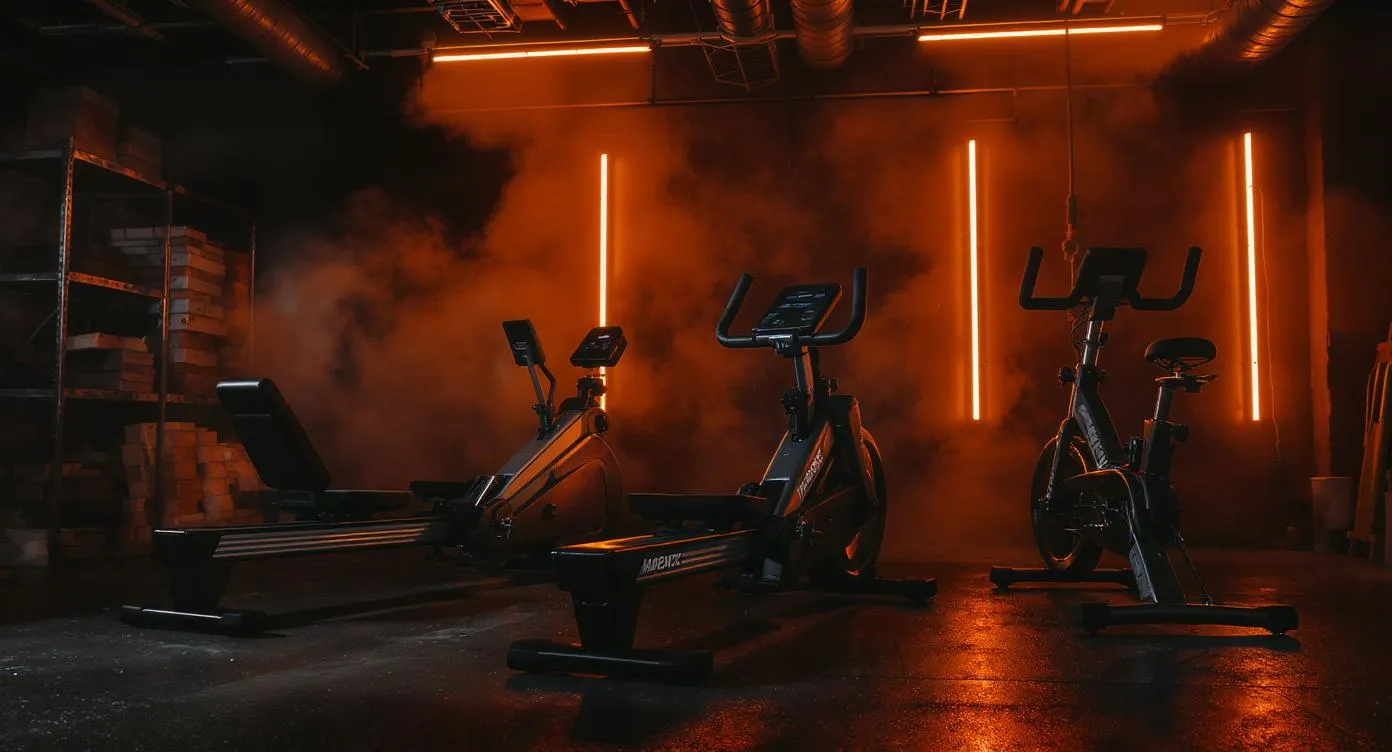
How to Choose a Cardio Machine for Home: Buyer's Guide (2026)
How to choose the right cardio machine for your home gym. Treadmills, rowers, bikes, and ellipticals compared with pros, cons, and recommendations.
GarageGymBuilders is reader-supported. We may earn a commission through links on this page. Learn more.
A cardio machine is the second-biggest purchase in most home gyms, behind only the rack. They take up significant floor space, cost $300-3,000, and last (or break) over decades of use. Choose wrong and you've got an expensive coat rack. Choose right and you've got a tool you'll use daily for years.
This guide helps you choose the right one.
The Five Cardio Options
1. Treadmill ($500-3,000)
Best for: Runners who want to train indoors, weather-restricted athletes, walking incline workouts.
Pros:
- Most natural for runners
- Adjustable incline for variety
- Easiest to follow guided programs
- Best for walking workouts (incline walking is incredibly effective)
Cons:
- LARGEST footprint (75-85" x 35")
- LOUDEST option
- High maintenance (belts, motors, electronics)
- Most expensive long-term (motors die)
- Higher injury rate than any other cardio
Avoid if: You live in an apartment, you have limited space, you don't already run.
2. Rowing Machine ($250-2,000)
Best for: Most home gym users. Full-body, low-impact, effective.
Pros:
- Full-body workout (not just legs)
- Low impact (no joint stress)
- Builds strength endurance (carries over to lifting)
- Folds vertically for storage
- Quiet (magnetic models)
- Long lifespan with minimal maintenance
Cons:
- Learning curve for proper form
- Doesn't translate to running
- Seat comfort on long sessions
Best choice for 80% of home gym users.

Sunny Health & Fitness SF-RW5515 Magnetic Rower
Capacity
250 lbs user weight
Steel
Steel Frame / Magnetic Resistance
Footprint
82" L x 19" W x 23" H
Price
$249.99
- 4.5+ star rating on Amazon with 25,000+ reviews
- 8 levels of magnetic resistance
- Whisper-quiet vs. air rowers
- Folds vertically for storage
- LCD monitor tracks time, distance, calories, strokes
- Best budget rower on Amazon under $300
- Magnetic resistance maxes out for advanced rowers
- Seat padding is thin on long sessions
- Not as smooth as Concept2 air resistance
The Sunny Health SF-RW5515 is the best budget rower under $300. Read our full review.
3. Air Bike ($400-1,000)
Best for: HIIT training, CrossFit-style conditioning, brutal workouts.
Pros:
- Resistance scales with effort (unlimited)
- Brutal cardio in short sessions
- Tracks calories and watts
- Doesn't break easily
- Compact footprint vs treadmill
Cons:
- LOUD (fan noise)
- Boring for steady-state cardio
- Uncomfortable for sessions over 20 min
Assault AirBike Classic
Capacity
350 lbs user weight
Steel
Steel Frame (98 lbs)
Footprint
50.95" L x 23.34" W x 50" H
Price
$749.00
- 4.5+ star rating on Amazon with 3,000+ reviews
- The original and most iconic air bike
- Programmable workouts (Tabata, HIIT, custom)
- LCD console with chest strap heart rate support
- Proven durability over a decade
- Great for CrossFit-style conditioning
- Chain-driven (louder than belt-driven competitors)
- Requires occasional chain lubrication
- Heavy at 98 lbs — hard to relocate
- Premium price vs. budget air bikes
The Assault AirBike Classic is the original and best air bike. Read our full review.
4. Stationary Bike ($300-2,000)
Best for: Cyclists, low-impact cardio, joint-friendly long sessions.
Pros:
- Very low impact (joint-friendly)
- Long sessions are comfortable
- Can read or watch TV while training
- Compact footprint
- Quiet (magnetic models)
Cons:
- Lower-body only (no upper-body workout)
- Less calorie burn than rowing or running
- Can become monotonous
5. Elliptical ($500-2,000)
Best for: Joint-injured users, walkers who want more intensity.
Pros:
- Very low impact
- Easy to use (low learning curve)
- Some upper-body engagement (with handles)
Cons:
- Lower calorie burn than other options
- Large footprint
- Doesn't carry over to other sports
- Often becomes a coat rack
Generally the worst choice for serious training. Better options exist for almost every use case.
What to Look For
1. Footprint
Measure your space. Rowers need ~9 ft x 3 ft. Treadmills need ~8 ft x 3 ft. Bikes need ~5 ft x 3 ft. Ellipticals need ~7 ft x 3 ft.
2. Storage
Vertical fold rowers (Sunny, Concept2) save 5+ feet of floor space. Treadmills with fold-up decks are common but most don't fully eliminate footprint.
3. Weight Capacity
Most home cardio is rated 250-300 lbs. Heavier users need 350+ lb rated machines. Check before buying.
4. Resistance Type
- Magnetic: Quiet, smooth, manual settings (rowers, bikes, ellipticals)
- Air: Loud, scales with effort, unlimited (rowers, air bikes)
- Belt: Standard for treadmills (motor-driven)
- Manual: No motor, you provide all the power (cheapest option)
5. Console Features
Basic: time, distance, calories, heart rate. Premium: programs, app connectivity, heart rate monitoring. For most users, basic is enough — fancy consoles break first.
6. Noise Level
If you train early or late, noise matters:
- Quietest: Magnetic rowers, magnetic bikes (silent)
- Medium: Treadmills, ellipticals
- Loudest: Air bikes, air rowers
7. Build Quality
Cheap cardio breaks fast. Look for:
- Steel frame (not aluminum)
- Sealed bearings
- Reputable brand with parts availability
- 2+ year warranty on parts
Programming Different Machines
Treadmill
- Walking: 30-45 min at 3.5-4.0 mph, 5-15% incline
- Running: 30-45 min at conversational pace
- Intervals: 8 x 1 min hard / 1 min easy
Rower
- Steady state: 30-45 min at moderate pace
- Intervals: 5 x 500m at 80% effort
- Strength conditioning: 5 rounds of 500m row + 10 push-ups + 10 squats
Air Bike
- Tabata: 8 x 20 sec hard / 10 sec easy
- Calorie sprints: 10 x 10 calories as fast as possible
- EMOM: Every minute on the minute, 12 calories x 10 rounds
Stationary Bike
- Steady state: 45-60 min at moderate effort
- Hills: 30 min with simulated hill intervals
- Recovery: 20 min easy spin between hard training days
Common Buyer Mistakes
Mistake 1: Buying a Treadmill First
For most home gyms, a treadmill is the wrong first cardio purchase. It's the largest, loudest, most expensive, and highest-injury option. A rower or bike is almost always better.
Mistake 2: Underestimating Footprint
Cardio machines are bigger than you think. Measure twice. Add 2 feet of clearance around the machine for safety.
Mistake 3: Ignoring Noise
The quietest workout you'll do is no workout. If you train early/late or share walls, prioritize a quiet machine.
Mistake 4: Buying for Goals You Don't Have
Don't buy a treadmill because "running is healthy" — buy one because you'll actually run. Be honest.
Mistake 5: Skipping the Cheap Option
Sunny Health rowers and bikes are 80% as good as $1,000 alternatives at 25% of the price. Most users never need the premium option.
Common Questions
Related Content
- Sunny Health SF-RW5515 Review
- Best Rowing Machines
- Concept2 vs Assault Bike
- Assault AirBike Review
- Home Gym for Runners
The Bottom Line
For most home gym users, a magnetic rower is the right cardio machine. It's full-body, low-impact, quiet, folds for storage, and costs as little as $250. Air bikes are second for HIIT-focused training. Treadmills are last on the list — only buy one if you're a dedicated runner who needs to train indoors. Buy the cardio you'll actually use, not the one that "should" work.
Gym Builder Team
Our team tests every product hands-on before recommending it. We buy the equipment with our own money and train with it daily. No sponsored reviews, no pay-to-play rankings. Meet the team →
More in Guides
Bodybuilding Home Gym Setup: Equipment & Training Guide (2026)
How to build the perfect bodybuilding home gym. Equipment priorities, essential machines, and the setup for serious muscle building.
CrossFit Home Gym Setup: Complete Equipment Guide (2026)
How to build a complete CrossFit home gym. Equipment list, budget options, and programming for garage gym CrossFit training.
Garage Gym Summer Cooling: Train Through the Heat (2026)
How to keep your garage gym cool in summer. Fans, AC, ventilation, and timing strategies for hot weather training.