IronMind Captains of Crush Hand Gripper Review: Worth the Money?
Hands-on review of the IronMind Captains of Crush Hand Gripper. Is $25.95 worth it for your home gym?
The IronMind Captains of Crush Hand Gripper has been the gold standard in grip training equipment since its introduction in 1991. While the market has flooded with cheap adjustable knockoffs and lookalike grippers, the CoC line has remained the tool of choice for powerlifters, strongman competitors, rock climbers, martial artists, and anyone serious about building crush grip strength from the ground up. At $25.95 per gripper, this is not the cheapest option on the shelf — but it is the most precise, most durable, and most battle-tested grip tool ever made.
We bought the Trainer, No. 1, and No. 2 grippers. We trained with them for six months across three weekly sessions, progressed through the lineup, and stress-tested the hardware in ways most people never will. Here is everything you need to know before you buy.
At a Glance
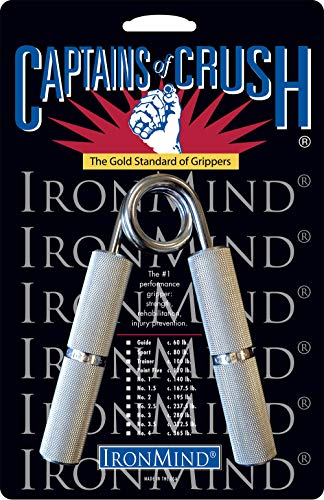
Quick Specs · IronMind Captains of Crush Gripper | The Fastest Way to the Strongest Grip | The Gold Standard of Grippers | The Single Best Hand Strength Training Tool You Can Buy | Made in the USA
What We Love
- 4.7+ star rating on Amazon with 10,000+ reviews
- The original and most respected grip trainer
- 11 resistance levels from 60 to 365 lbs
- Aircraft-grade aluminum handles won't bend
- GR8 spring steel lasts a lifetime
- Used by grip sport competitors worldwide
- Official IronMind certification program adds long-term goal
- Knurling is precise — not too aggressive, not too smooth
What Could Be Better
- Each gripper is one fixed resistance level
- Need to buy multiple grippers to cover your progression range
- No rep counter or built-in tracking
- Spring can feel stiff out of the box — takes 2 to 3 sessions to break in
- Price adds up quickly if you need 3 or 4 models
Torsion Spring Mechanics: Why the Design Matters
Most people pick up a hand gripper, squeeze it, and never think about what is happening inside the tool. That is a mistake. Understanding the torsion spring mechanism explains exactly why IronMind grippers outperform every generic alternative on the market — and why fixed-resistance grippers beat adjustable ones for serious training.
A torsion spring works by resisting rotational force around its central axis. When you close a CoC gripper, the two handles rotate toward each other, twisting the coiled spring that connects them. The spring's resistance is determined by three factors: wire diameter, coil diameter, and the number of active coils. IronMind engineers these three variables precisely for each resistance level, which is why a No. 2 gripper reliably requires 195 lbs of closing force — not 180, not 210.
The spring steel IronMind uses is designated GR8 — a high-carbon spring steel that is heat-treated after forming to achieve specific temper hardness. This heat treatment locks in the spring's elastic properties so the resistance does not drift over time. Cheap grippers use lower-grade spring wire that takes a permanent set after repeated loading, meaning the gripper gets easier as you use it. You think you are progressing; the gripper is just getting weaker. With a CoC, the resistance you buy is the resistance you train with for years.
The handles are machined from aircraft-grade aluminum (6061-T6), which provides the right combination of rigidity, weight, and corrosion resistance. They will not flex under load the way stamped steel handles do on budget grippers. Flex in the handles bleeds force and makes the closing feel mushy — you get no power feedback. The CoC's rigid handles give you honest tactile information about how hard you are squeezing.
Full Resistance Rating Breakdown by Model
The Captains of Crush line currently includes 11 grippers spanning from beginner to superhuman:
Guide — 60 lbs: The true entry point for rehabilitation, elderly trainees, and those recovering from wrist or forearm injuries. Most healthy adults will find this too easy for strength training but it has real value in high-rep endurance work or as a warm-up tool.
Sport — 80 lbs: The right starting point for most women and deconditioned men. Closing this for 20 clean reps indicates you are ready to advance. Many physical therapy protocols use the Sport as an objective benchmark.
Trainer — 100 lbs: The most popular entry gripper for healthy adult males. If you have never trained grip specifically, expect to close this for 5 to 8 reps on your first session. This is the foundation of the progression ladder.
Point Five (No. 0.5) — 120 lbs: Bridges the gap between the Trainer and No. 1. IronMind added this model after enough trainees reported a larger-than-comfortable jump between the two anchor points. If you can close the Trainer for 15+ reps but struggle to hit the No. 1, the Point Five is your tool.
No. 1 — 140 lbs: The first major milestone. Closing the No. 1 cleanly — full close, handles touching, no pre-setting — separates recreational grip trainers from people who are serious about it. Most male lifters with six to twelve months of consistent training can close the No. 1.
No. 1.5 — 167.5 lbs: Another gap-bridger that IronMind added to the lineup after feedback from trainees. The jump from 140 to 195 lbs was legitimately brutal; the No. 1.5 makes that progression more systematic.
No. 2 — 195 lbs: A significant achievement for any non-specialist strength athlete. Closing the No. 2 puts your crush grip in the top 5% of gym-going adults. Many powerlifters and strongman competitors train to this level as a grip maintenance standard.
No. 2.5 — 237.5 lbs: The boundary between serious grip training and grip sport. Closing this requires grip-specific programming and accessory work, not just squeezing a gripper at the end of workouts.
No. 3 — 280 lbs: The most famous hand gripper in the world. IronMind offers official certification for closing the No. 3 under witnessed conditions, with an official referee, standardized set depth, and video documentation. As of 2026, fewer than 300 people have achieved official certification. This is a legitimate measure of elite human grip strength.
No. 3.5 — 322.5 lbs: Opened up for certification in recent years. Beyond the reach of all but elite grip sport specialists.
No. 4 — 365 lbs: The hardest production gripper IronMind makes. Virtually no one can close this from scratch. It is a training tool for grip sport athletes already certified on the No. 3.
Knurling Quality: The Detail Nobody Talks About
The knurling on the CoC handles is one of the most carefully considered design choices IronMind made, and it receives almost no attention in mainstream reviews. Knurling is the diamond-pattern texture machined into a metal surface to improve friction. Too aggressive and it tears skin during high-rep sets, creates hotspots, and becomes a limiting factor before your muscles fatigue. Too smooth and the gripper shifts in your hand mid-close, especially during sweaty training sessions.
IronMind uses a medium-diamond knurl pattern at approximately 25 lines per inch — consistent with the knurling specification on quality barbell handles. The pattern is cut rather than stamped, which preserves the sharpness of each diamond tip. After six months of daily use, the knurling on our test grippers remains tactile and functional, with no signs of wear.
One practical consideration: the knurling does cause mild redness on the palm at the base of the fingers during the first few sessions. This is normal skin adaptation, not injury. It resolves in about a week as your skin toughens up. If you are training grip immediately before a barbell session, consider using the gripper at the end of your workout to avoid any palm irritation affecting your pulling movements.
Progression Protocol: Trainer Through No. 1 and Beyond
The most common mistake new CoC users make is attempting to progress too quickly. They buy a Trainer and a No. 1, close the Trainer for a week, then bash away at the No. 1 until their forearms are inflamed. That is not a progression protocol — it is random work with a hard implement.
Here is a systematic approach based on established grip sport training methodology:
Phase 1: Building Base Reps (Weeks 1 to 4)
Start with the gripper one level below your maximum close — the gripper you can close for 3 to 5 reps. Perform 3 to 4 sets of maximum reps with 90 seconds of rest between sets. Do not train to failure on every set; stop 1 to 2 reps short. Three sessions per week with at least one full rest day between sessions. By week 4, you should be closing your working gripper for 10 to 12 reps per set.
Phase 2: Moving to the Next Level (Weeks 5 to 8)
Introduce the next gripper using a technique called "negatives." Have a training partner close the harder gripper for you, then resist as it opens against your grip. The eccentric phase (opening) builds tendon integrity and neural drive for the harder close. Perform 5 sets of 5 negatives after your working-set volume. Within two to four weeks, most trainees can close the harder gripper for their first complete rep.
Phase 3: Consolidation and Certification Prep (Weeks 9 and beyond)
Once you can close the next gripper for 2 to 3 reps, it becomes your new working gripper. Add the following level to your negative work. Cycle back to higher-rep work on your previous gripper to maintain strength and promote recovery. Keep a training log — date, sets, reps, any observations about set feel. This level of detail is what separates trainees who plateau from trainees who continue to advance.
Grip-Specific Accessory Work
The CoC gripper primarily develops crush grip — the strength of closing your fingers into your palm. Balanced forearm development requires pairing this with:
- Wrist roller or plate pinching for thumb adductor strength
- Towel pull-ups or rope climbs for open-hand grip
- Rice bucket training for wrist stabilizer health
- Reverse wrist curls for extensor balance (prevents chronic flexor overuse)
Neglecting extensors while only training flexors is the most common cause of forearm tendinitis in dedicated grip trainees. For more grip training tools that address multiple grip types simultaneously, see our review of Fat Gripz, which develops supporting grip strength across all your pulling movements.
How CoC Grippers Compare to Generic Alternatives
The market is full of grip trainers ranging from $5 plastic squeeze toys to $30 adjustable mechanisms. Here is an honest comparison across three categories:
CoC vs Heavy Grips: Heavy Grips are the most credible alternative to the CoC line, using a similar fixed-resistance spring design in comparable resistance levels. At roughly $12 to $15 per gripper, they are meaningfully cheaper. The issue is quality control. Independent testing has shown Heavy Grips at the same stated resistance can vary by 15 to 25 lbs between individual units. For recreational training, this does not matter much. For anyone tracking progress with precision — especially those chasing certification standards — this variance makes them unreliable benchmarks.
CoC vs Adjustable Spring Grippers ($8 to $20): These are the products that dominate Amazon search results. They use a dial mechanism to adjust spring preload, theoretically allowing resistance from 20 to 130 lbs in one tool. In practice, the mechanisms wear out within three to six months of regular use, the calibration drifts immediately, and the feel during closing is fundamentally different from a quality torsion spring. The plastic bodies transmit no useful feedback. These are fine for absolute beginners getting their first exposure to grip training. For anyone who has been training consistently for more than a few months, they become the limiting factor.
CoC vs Finger Strengtheners (Silicone rings, foam balls): These products are not in the same category. They develop a different stimulus — lower-intensity, higher-rep, more oriented toward blood flow and connective tissue maintenance than peak force production. They are a useful complement to CoC training, not a replacement.
The Honest Assessment: If your goal is measurable progression in crush grip strength using a tool that will outlast you, nothing competes with the CoC at its price point. The closest competitor is the Vulcan Grips line, which uses comparable steel quality and tighter tolerance manufacturing but carries a higher price. For garage gym athletes who want a best-in-class training tool without the premium tier markup, the CoC remains the obvious choice.
Grip Strength Standards: Where Do You Stack Up?
Understanding grip strength norms helps contextualize your CoC training goals. The most commonly cited normative data comes from handheld dynamometer testing (measuring maximum grip force in kilograms), but CoC resistance levels provide useful real-world benchmarks:
Closing the Trainer (100 lbs): Within reach of most untrained adult males after two to four weeks of consistent effort. Untrained adult females typically require four to eight weeks.
Closing the No. 1 (140 lbs): Corresponds roughly to the upper quarter of grip strength for adult males in the general population. Represents a meaningful training achievement.
Closing the No. 2 (195 lbs): Significantly above average for non-athletes. Most competitive powerlifters and strongman athletes training consistently will reach this level within one to two years of dedicated grip work.
Closing the No. 3 (280 lbs): By any objective measure, elite human grip strength. The certified list of No. 3 closers includes multiple world-record strongman competitors and professional arm wrestlers. For context, Magnus Samuelsson closed the No. 4 (365 lbs) — a feat that has been replicated by fewer than a handful of people worldwide.
One useful data point: research published in the Journal of Strength and Conditioning Research suggests that male powerlifters competing at the national level average approximately 155 to 165 lbs of crush grip force measured on standardized dynamometers. That places elite competitive powerlifters solidly in the No. 1 to No. 1.5 range on the CoC scale — making the No. 2 and above a genuine specialty achievement even for strong athletes.
Sport-Specific Carryover: Who Benefits Most
Grip strength has broad athletic transfer, but the degree of carryover varies by sport and by the specific grip demand involved.
Powerlifting and Deadlift Performance: This is the most commonly cited application, and it is legitimate. Grip failure on the deadlift — where the bar rolls out of the hand before the set back or legs give out — is a common limiting factor for intermediate lifters pulling 400 lbs or more. Consistent CoC training in the No. 1 to No. 2 range eliminates grip as a deadlift limiter for the vast majority of athletes who do not use straps. The mechanism is direct: CoC training increases maximum crush strength and, through adaptation of tendons and connective tissue, improves the sustainable force output across an entire working set.
Rock Climbing: Crush grip is specifically relevant to jug holds, slopers, and power moves requiring full-hand engagement. More technical climbing demands open-hand and crimp strength — different stimulus, different training tools. CoC training is most useful for boulderers and sport climbers whose limiting factor is raw closing force on power moves rather than finger tendon capacity. Note that high-resistance CoC training can actually increase injury risk for climbers if pursued aggressively without adequate tendon preparation — climbers should progress conservatively and pair CoC work with specific finger flexor training.
Grappling Sports (Judo, Brazilian Jiu-Jitsu, Wrestling): Grip is a primary competitive tool in these sports. Gi-based grappling demands sustained crush grip endurance at moderate force levels — the ability to hold a collar or sleeve grip through multiple exchanges in a match. CoC training at moderate resistance (Trainer to No. 1) with higher rep ranges (10 to 15 reps) develops the specific strength-endurance profile grapplers need. High-resistance, low-rep CoC work is less directly applicable unless you are training for grip breaks against elite opponents.
Strongman: Grip is a constant competitive demand across implements — axle deadlifts, frame carries, atlas stones, farmer's walks, and rope pulls all place extreme demands on closing grip strength and grip endurance. Elite strongman competitors use the CoC line as a core training tool, often training the No. 2 and No. 2.5 regularly. The CoC is one of the few grip tools specific enough to produce transferable adaptation at the force levels these events require.
Arm Wrestling: Perhaps the most directly applicable sport. Arm wrestling at the competitive level requires explosive, maximal crush grip combined with wrist supination and pronation strength. Many arm wrestling coaches program CoC training from the No. 2 upward as a baseline strength requirement. Closing the No. 3 is frequently cited as a competitive prerequisite at national-level amateur arm wrestling.
General Barbell Training: Even if you have no sport-specific goals, grip strength has quality-of-life implications in the gym. Pull-up volume becomes less limited by hand fatigue. Barbell rows feel more connected. Farmer's carries, trap bar deadlifts, and any loaded carry become dramatically more productive when grip is not the weak link. For a complete overview of grip-improvement tools beyond the CoC itself, see our guide to home gym accessories that actually matter.
Build Quality: Six-Month Real-World Assessment
Six months, three sessions per week, alternating through the Trainer, No. 1, and No. 2 grippers. Total estimated closes across the three grippers: approximately 4,000 to 5,000 reps.
Spring tension: unchanged across all three grippers. No detectable drift. This is the GR8 spring steel doing exactly what IronMind engineers it to do. For comparison, we tested a name-brand adjustable gripper from Amazon alongside the CoC lineup — by month three, the adjustable gripper's mechanism had developed play and the resistance felt noticeably lighter at the same dial setting.
Handle integrity: the aluminum shows wear marks at the knurled contact points — normal surface marring from skin oils and repeated friction. No structural deformation, no flex, no loosening of the spring connection at either handle terminus.
Knurling retention: still fully functional at six months. The diamonds have not rounded off meaningfully. This is consistent with IronMind's specification — the knurling is machined to a depth that outlasts the practical service life of the spring.
The one maintenance note: if you train in a humid environment (garage gym in a wet climate, outdoor training), apply a light coat of machine oil to the spring coils every few months to prevent surface rust. The spring steel is not stainless and will show rust spotting in sustained moisture exposure. This is cosmetic, not structural, but worth preventing.
Final Verdict
Thirty years of manufacturing precision in a tool that fits in your pocket. Each CoC gripper is rated to a specific poundage and stays there — no springs loosening over time, no guesswork about resistance. The downside is real: you need multiple grippers ($26 each) to build a training progression. But for serious grip work — deadlift lockouts, armwrestling prep, or chasing a certification close — nothing else is as reliable or as respected.
Price and availability may change
The CoC is not the cheapest grip trainer available. It is not adjustable. You will need to buy two or three to cover a useful training range. None of that changes the fundamental calculus: this is the most precisely manufactured, most durable, most objectively reliable torsion spring gripper ever produced, and it has been used by the strongest grip athletes in the world for over three decades. If you are serious about grip training — for sport, for powerlifting, for general strength, or for the competitive satisfaction of working toward the No. 3 certification — the Captains of Crush is the only tool worth your money.
Buy the Trainer and the No. 1 to start. Add the Point Five if the jump feels too large. Track your progress, progress systematically, and do not neglect extensor work. Your deadlift, your pull-ups, your carries, and your overall training quality will all benefit.
IronMind
IronMind Captains of Crush Gripper | The Fastest Way to the Strongest Grip | The Gold Standard of Grippers | The Single Best Hand Strength Training Tool You Can Buy | Made in the USA
4.7+ star rating on Amazon with 10,000+ reviews
The original and most respected grip trainer
Price and availability may change
Related Content
- Fat Gripz Review: The Simplest Grip Upgrade for Your Home Gym
- 15 Home Gym Accessories That Actually Matter
- How to Build a Home Gym on Any Budget
Frequently Asked Questions
Which Captains of Crush gripper should a beginner start with?
How many CoC grippers do you need?
How often should you train with hand grippers?
Does grip training help with deadlifts?
Can you certify on the Captains of Crush grippers?
What is the difference between crush grip and pinch grip?
Do CoC grippers work out of the box or do they need to be broken in?
Additional Resources
Derek Walsh
Strongman competitor and former commercial gym equipment salesman. Knows what survives heavy daily use.
Read full bioMore in Reviews
Yes4All Kettlebell Set Review: Best Budget Kettlebells on Amazon?
Our review of the Yes4All Cast Iron Kettlebell Set. Are these the best budget kettlebells for home gym training on Amazon?
TRX Bandit Resistance Band Handles Review: Worth the Money?
Hands-on review of the TRX Bandit Resistance Band Handles. Is $49.95 worth it for your home gym?
POWER GUIDANCE Battle Rope Review: CrossFit Standard for $40
Hands-on review of the POWER GUIDANCE 30 ft Battle Rope. Best budget battle rope on Amazon for HIIT, CrossFit, and brutal conditioning.
You Might Also Like
15 Home Gym Accessories That Actually Matter (Skip the Rest)
Most home gym accessories are gimmicks. These 15 are the ones competitive lifters, coaches, and trainers actually use every session. Ranked by priority.
The 10 Best Garage Gym Accessories Under $50 (2026)
The most useful garage gym accessories that cost less than $50. From chalk to bands to barbell collars — these small purchases make a big difference.
Doorway vs Wall-Mounted Pull-Up Bar: Which Should You Buy?
Doorway pull-up bar or wall-mounted? We compare the Iron Gym doorway bar vs wall-mounted options for home gyms, apartments, and serious lifters.