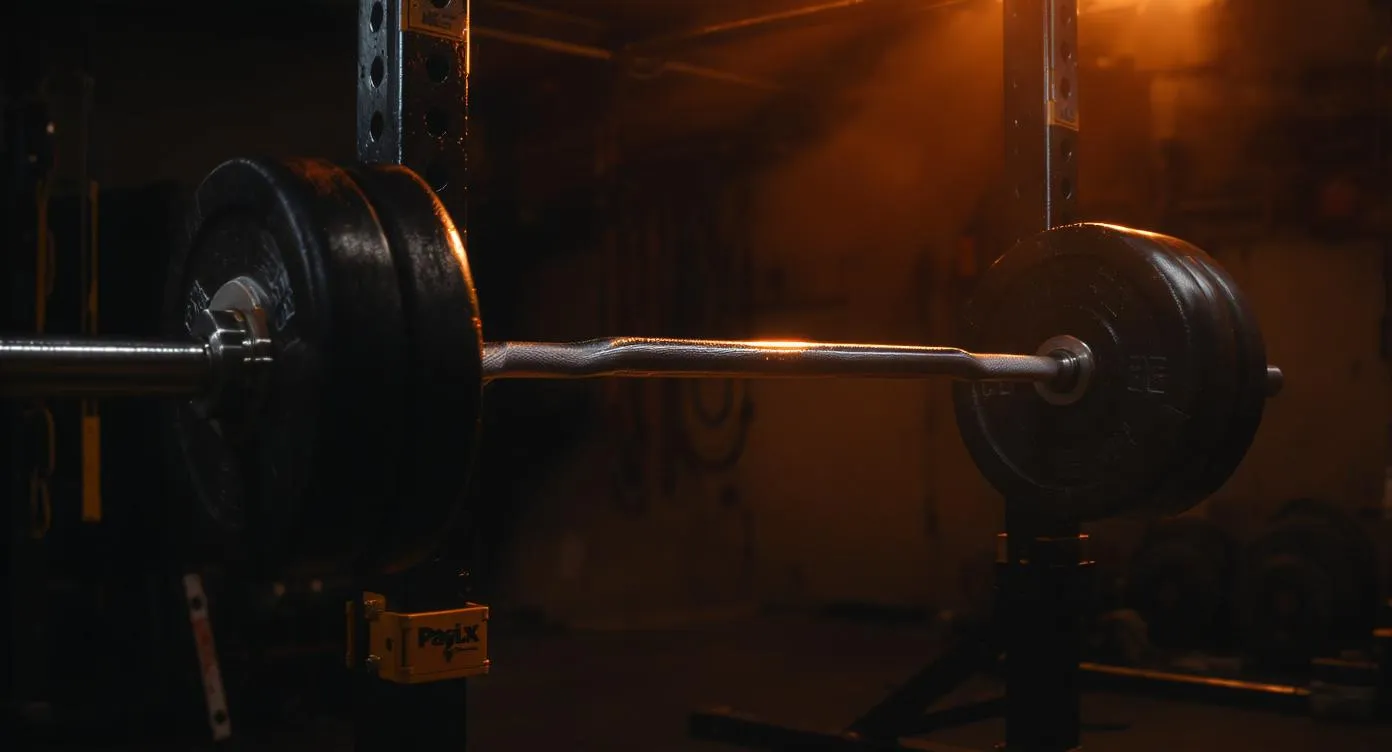
Titan Safety Squat Bar V2 Review: Your Shoulders Will Thank You
The Titan SSB V2 eliminates shoulder strain from squats. We tested it for 60 days against regular barbell squats. Here's whether the $180 price is worth it.
If you have ever unracked a heavy back squat and felt your shoulders screaming before you even hit depth, the safety squat bar was built for you. The cambered yoke design lets you load up squats with your hands in front of your body, eliminating shoulder external rotation and wrist extension entirely. No more choosing between training your legs and protecting your shoulders.
The Titan Fitness SSB V2 sits at $459.99 and has become the most popular budget safety squat bar on Amazon. I have been squatting with it twice a week for over 60 days, running it through heavy singles, high-rep sets, tempo work, and good mornings. Here is the full breakdown of what this bar does well, where it falls short, and whether it deserves a spot in your garage gym.

Titan Fitness USA Made TITAN Series Safety Squat Bar, Shoulder and Arm Pads, Rated 1,500 LB, 5" Camber Drop, Ribbed Olympic Weight Sleeves, Knurled Hand Grips
Capacity
1,500 lbs
Steel
Heavy-Duty Steel / Foam Padding
Footprint
7ft bar with padded yoke
Price
$459.99
- 4.6+ star rating on Amazon
- 1,500 lb weight capacity
- Padded yoke reduces shoulder and wrist strain
- Cambered handles for natural hand position
- Standard Olympic 2" sleeves fit any rack
- Best budget safety squat bar available
- Heavier than standard barbell (~65 lbs)
- Yoke padding can wear with heavy use
- Not ideal for bench press or deadlifts
Price and availability may change
Quick Specs · Titan Fitness USA Made TITAN Series Safety Squat Bar, Shoulder and Arm Pads, Rated 1,500 LB, 5" Camber Drop, Ribbed Olympic Weight Sleeves, Knurled Hand Grips
Why the Safety Squat Bar Exists
The conventional low-bar back squat requires roughly 70 degrees of shoulder external rotation and significant wrist extension to hold the bar in position. If you also bench press two or three times per week, that is a massive volume of stress on the anterior shoulder, rotator cuff, and biceps tendons. Over months of accumulated training, something eventually gives. For most lifters, it is the front deltoid or the long head of the biceps tendon.
The safety squat bar eliminates this problem at the source. The padded yoke drapes over your upper traps and rear delts while cambered handles extend forward at chest height. You hold those handles with a neutral grip, palms facing each other. Shoulder rotation: zero degrees. Wrist extension: zero degrees. You can squat heavy and frequently without any upper-body joint compromise.
This is not a niche concern. If you run a powerlifting-style program with three or four barbell sessions per week, the SSB is arguably the single most important specialty bar you can own. It lets you accumulate squat volume without accumulating shoulder damage. For lifters over 35 with existing shoulder issues, it can be the difference between training consistently and needing time off. Check out our powerlifting home gym setup guide for more on how specialty bars fit into a serious training setup.
Build Quality and Construction
The Titan SSB V2 weighs approximately 65 lbs total. The main shaft is heavy-gauge steel with a matte black powder coat finish. The camber angle is aggressive enough to shift the center of gravity forward meaningfully but not so extreme that it becomes unmanageable for intermediate lifters. Titan rates the weight capacity at 1,500 lbs, which is more than any home gym lifter will ever need.
The yoke padding is dense closed-cell foam covered in vinyl. After 60 days of use including sets above 400 lbs, the padding shows zero compression or permanent deformation. The yoke width accommodates shoulder widths from narrow to wide without adjustment. Two cambered handles extend forward from the yoke at a slight downward angle, and both are knurled for grip security.
The Olympic sleeves are chrome-plated and spin adequately on bushings. They accept standard 2-inch Olympic plates and fit inside any power rack with standard J-cups. The sleeve length provides roughly 16 inches of loadable space per side, which is enough for 450+ lbs with iron plates or around 350 lbs with bumper plates due to their wider profile.
Compared to the Rogue SB-1 Safety Squat Bar at $395 or the EliteFTS SS Yoke Bar at $445, the Titan SSB V2 gives up some fit-and-finish details. The Rogue has a nicer chrome finish and slightly smoother sleeve rotation. The EliteFTS has a thicker, more contoured pad. But functionally, the Titan performs the same movement pattern at less than half the price. For the vast majority of home gym owners, the performance gap does not justify the price difference.
Training Experience: 60 Days of Testing
How It Changes the Squat
The SSB fundamentally alters squat mechanics in ways that are immediately noticeable from your first rep. The forward-shifted center of gravity means the bar is constantly trying to fold you forward. Your thoracic extensors, upper back, and core musculature must work significantly harder to keep your torso upright compared to a straight bar squat.
In practical terms, the SSB squat feels like a hybrid between a front squat and a back squat. You get the quad emphasis and upright torso demand of a front squat combined with the loading capacity and trap engagement of a back squat. Most lifters will squat 10 to 15 percent less weight on the SSB compared to their straight bar squat. I found my SSB squat settled at roughly 87 percent of my low-bar back squat after the initial learning curve.
Week-by-Week Adaptation
Weeks 1-2: The balance feels awkward. The bar wants to tip you forward, and your instinct is to fight it by leaning back. This creates a jerky, unstable descent. I recommend starting at 60 percent of your normal squat working weight and focusing on a controlled three-second eccentric. Your body needs to learn the new balance point.
Weeks 3-4: The movement starts to feel natural. You stop fighting the forward pull and learn to brace against it. Working weight climbs back to around 75-80 percent of your straight bar numbers. Core engagement during SSB squats becomes automatic rather than conscious.
Weeks 5-8: Full adaptation. The SSB squat feels like a distinct movement rather than a worse version of a back squat. You can push intensity confidently. By week 6, I was hitting RPE 8-9 sets without any balance concerns. This is also where the carryover benefits start showing up in your other lifts.
Measurable Results After 60 Days
Running SSB squats twice weekly as my primary squat variation (replacing one back squat day and one front squat day), I recorded these changes:
- Front squat 1RM increased 15 lbs (from 315 to 330). The SSB builds the same upright torso position and quad strength that front squats demand.
- Shoulder pain during back squats disappeared completely. I had been dealing with a nagging left anterior deltoid issue for months. Removing two sessions per week of shoulder-straining bar position resolved it.
- Thoracic extension improved noticeably. Fighting the SSB's forward pull for 60 days strengthened my upper back in a way that carried over to better posture under a straight bar.
- Deadlift off the floor improved. The increased quad strength from SSB squats gave me more leg drive in the initial pull off the floor. My conventional deadlift moved up roughly 10 lbs without directly training it.
Programming the SSB in Your Training
The SSB works best as a primary squat variation rather than an accessory movement. Here are three proven ways to program it:
Option 1: Full SSB Replacement. Replace all back squats with SSB squats for a 6-8 week block. This works well during hypertrophy phases or when rehabbing a shoulder issue. Run sets of 5-8 at RPE 7-8.
Option 2: Alternating Days. Squat twice per week, one day with a straight bar and one day with the SSB. The straight bar day is your heavy/competition movement day. The SSB day is moderate intensity with higher reps (sets of 6-10). This is my preferred long-term setup.
Option 3: Offseason Specialty Block. Use the SSB exclusively for 4-6 weeks during an offseason block, then return to the straight bar for a peaking phase. Many competitive powerlifters use this approach to build quad and upper back strength without grinding their shoulders during high-volume accumulation phases.
For detailed programming templates, our home gym programming guide covers how to integrate specialty bars into structured training cycles.
- Eliminates shoulder and wrist strain entirely — zero external rotation required
- 1,500 lb weight capacity handles any weight a home gym lifter will use
- Thick padded yoke is comfortable even at 400+ lbs with no compression after months of use
- Knurled cambered handles provide secure grip during heavy sets
- Fits any standard power rack with 2-inch J-cups — no adapters needed
- Builds quad and upper back strength more effectively than regular back squats
- Forward center of gravity strengthens thoracic extensors and core musculature
- At $459.99, costs less than half of comparable bars from Rogue or EliteFTS
- 65 lb bar weight is significantly heavier than a standard 45 lb barbell — factor this into your loading
- Takes 2-3 sessions to learn the balance and stop fighting the forward pull
- Thick yoke padding can make you feel pushed forward until you adapt your brace pattern
- Only useful for squat variations and good mornings — not a multi-purpose bar
- Chrome sleeves are adequate but not as smooth-spinning as higher-end bars
- No knurling on the main shaft if you ever want to hold the bar differently
- Loadable sleeve length limits max weight when using wide bumper plates
SSB Squat Variations Worth Training
The safety squat bar is not just for standard squats. Several variations take advantage of the unique bar position:
SSB Good Mornings: The forward-loaded yoke makes good mornings brutally effective for posterior chain development. The bar naturally wants to pull you forward, so your hamstrings and glutes must work overtime to hinge and return to upright. Start light — 95 to 135 lbs is plenty. Sets of 8-12 build serious hamstring strength.
SSB Pause Squats: Pause for 2-3 seconds in the hole. The forward pull of the SSB makes paused reps significantly harder than with a straight bar because you cannot rely on the stretch reflex as much. These build tremendous quad strength and positional awareness. Use 70-75 percent of your SSB max for sets of 3-5.
SSB Box Squats: Sit back to a box set at parallel or slightly below. The SSB's forward pull teaches you to maintain an upright torso even when sitting back, which has excellent carryover to competition squats. Work in the 65-80 percent range for sets of 2-5.
SSB Split Squats: Hold the cambered handles and perform Bulgarian split squats or reverse lunges. The yoke distributes weight more comfortably across your traps than a straight bar in these single-leg movements. Start with just the bar weight (65 lbs) and add plates as you adapt.
Hatfield Squats: Hold the rack uprights or safety arms with your hands while squatting with the SSB on your back. This allows you to use your arms for balance assistance, letting you push heavier loads or grind through sticking points. It is an excellent overload variation for building confidence with heavier weights.
Who Should Buy the Titan SSB V2
This bar is a clear buy if:
- You have shoulder or wrist issues that make back squatting painful or impossible. The SSB removes these joints from the equation entirely.
- You bench press two or three times per week and need to reduce cumulative shoulder stress on squat days.
- You want to build more quad and upper back strength as a specific training goal.
- You already own a power rack and a straight barbell and want your first specialty bar.
- You are over 35 and want to train longevity — the SSB lets you squat heavy for decades without destroying your shoulders.
Skip it if:
- You squat pain-free with a straight barbell and have no shoulder complaints. The SSB is not strictly necessary if everything works fine.
- You do not have a power rack. You cannot safely rack or unrack an SSB from a squat stand because the cambered design makes it top-heavy and unstable on narrow supports.
- You are a competitive powerlifter in-season who needs maximum specificity with the competition squat. Save the SSB for offseason blocks.
- Your budget only allows one barbell total. A straight barbell is more versatile as your only bar. The SSB should be your second or third barbell purchase.
Titan SSB V2 vs the Competition
At the budget end, the Titan SSB V2 has very few direct competitors. The Yes4All safety squat bar enters the market around $160-170 but has thinner padding and a lower weight capacity. The Titan's build quality is noticeably better.
At the mid-range, the Bells of Steel SSB sits around $250 and offers a rotating yoke feature that some lifters prefer. It is a solid bar but the rotating mechanism adds complexity without clear performance benefit for most users.
At the premium end, the Rogue SB-1 at $395 and the EliteFTS SS Yoke Bar at $445 are the gold standards. Both have superior finishes, thicker padding, and smoother sleeves. If money is no object, the EliteFTS is the best SSB on the market. But the Titan delivers 90 percent of the performance at 40 percent of the cost.
For a deeper comparison of specialty bar options, check out our best specialty bars roundup which covers safety squat bars, trap bars, curl bars, and more.
Long-Term Durability
After 60 days of twice-weekly use including work sets above 400 lbs, the Titan SSB V2 shows no signs of wear. The powder coat on the main shaft has minor scuffing from J-cup contact, which is purely cosmetic and happens to every bar. The yoke padding remains firm and fully shaped. The chrome sleeves have no pitting or rust. The welds show no cracking or stress marks.
I expect this bar to last 10+ years in a home gym environment with normal use. The 1,500 lb capacity provides an enormous margin of safety. The only maintenance required is wiping down the sleeves with a light coat of 3-in-1 oil every few months to prevent surface rust, the same maintenance any chrome-sleeved barbell needs.
Final Verdict
The Titan SSB V2 is the best budget safety squat bar available in 2026. At $459.99, it costs less than a single physical therapy session or sports massage package. The build quality is genuinely good — not just good-for-the-price — and the training benefits are immediate and measurable. If shoulder pain limits your squatting, this is not a luxury purchase. It is a training necessity that will pay for itself in avoided pain and continued progress within the first month of use.
Price and availability may change
Titan Fitness
Titan Fitness USA Made TITAN Series Safety Squat Bar, Shoulder and Arm Pads, Rated 1,500 LB, 5" Camber Drop, Ribbed Olympic Weight Sleeves, Knurled Hand Grips
4.6+ star rating on Amazon
1,500 lb weight capacity
Price and availability may change
Frequently Asked Questions
How much does the Titan Safety Squat Bar V2 weigh?
Will the Titan SSB fit in my power rack?
How much less will I squat with an SSB compared to a straight bar?
Is a safety squat bar worth it if I don't have shoulder problems?
Can I use the Titan SSB for exercises other than squats?
How does the Titan SSB V2 compare to the Rogue SB-1?
Will the padding on the Titan SSB wear out?
Additional Resources
- International Weightlifting Federation Equipment Standards
- NSCA Barbell Training Principles
- ACE Barbell Training Guide
Related Content
Derek Walsh
Strongman competitor and former commercial gym equipment salesman. Knows what survives heavy daily use.
Read full bioMore in Reviews
Yes4All Kettlebell Set Review: Best Budget Kettlebells on Amazon?
Our review of the Yes4All Cast Iron Kettlebell Set. Are these the best budget kettlebells for home gym training on Amazon?
TRX Bandit Resistance Band Handles Review: Worth the Money?
Hands-on review of the TRX Bandit Resistance Band Handles. Is $49.95 worth it for your home gym?
POWER GUIDANCE Battle Rope Review: CrossFit Standard for $40
Hands-on review of the POWER GUIDANCE 30 ft Battle Rope. Best budget battle rope on Amazon for HIIT, CrossFit, and brutal conditioning.
You Might Also Like
Best Specialty Barbells for Home Gyms in 2026
EZ curl bars, safety squat bars, trap bars, and landmine attachments — the specialty barbells that unlock exercises your straight bar can't do. Tested and ranked.
Titan Safety Squat Bar vs Bells of Steel Trap Bar: Which Do You Need? (2026)
Titan SSB ($459.99) vs Bells of Steel Trap Bar ($199) — two of the best specialty bars under $200. We break down which one deserves a spot in your home gym first.
CAP Barbell vs Synergee Games Barbell: Budget vs Mid-Range Showdown
Comparing the two most popular Amazon barbells for home gyms. CAP Barbell (in 300 lb set) vs Synergee Games Barbell — which is worth your money?