Gymboss Interval Timer and Stopwatch Review: Worth the Money?
Hands-on review of the Gymboss Interval Timer and Stopwatch. Is $24.95 worth it for your home gym?
Your phone is not a workout tool. It is a distraction machine with a timer app bolted on as an afterthought. Every time you reach for it between sets to reset the clock, you are one notification away from losing focus, checking a message, or burning three minutes you should have spent training. The Gymboss Interval Timer and Stopwatch exists to solve exactly that problem. It does one thing — tracks your intervals — and it does it without touchscreens, Bluetooth pairing, app updates, or dead batteries at the worst possible moment.
At $24.95 it is one of the cheapest pieces of gear in any serious home gym. It is also one of the most consistently used. We have been training with the Gymboss for over a year across HIIT sessions, Tabata circuits, EMOM complexes, AMRAP blocks, and straight-set strength work. Here is the honest breakdown of what it does well, where it falls short, and whether it belongs on your waistband.
At a Glance
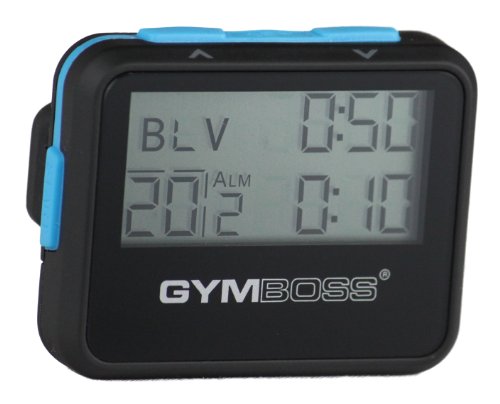
Quick Specs · Gymboss Interval Timer and Stopwatch - Black/Blue SOFTCOAT
What We Love
- 4.5+ star rating on Amazon with 5,000+ reviews
- Dual-interval programming covers Tabata, EMOM, AMRAP, and custom work-rest splits
- Loud beep and strong vibration alert modes work independently or together
- Secure belt clip holds firmly through any movement
- Simple 3-button interface — no app, no pairing, no Wi-Fi
- CR2032 battery lasts 3–6 months of regular training
- Survived repeated concrete drops in testing
- Costs less than two protein shakes
What Could Be Better
- Small LCD screen is hard to read at arm's length mid-workout
- Battery compartment requires a small Phillips screwdriver to open
- No backlight for dimly lit early morning sessions
- No Bluetooth or app connectivity for logging intervals
- Button labels wear off after heavy sweat exposure
The Programming Interface: Simpler Than It Looks
The Gymboss runs on three buttons and a compact LCD display. That sounds limiting. In practice, it is liberating. There is no menu system to navigate, no app to update, and no settings that reset when the battery dies. You learn the interface in about five minutes, and after one week of training it becomes muscle memory.
Here is how the core programming works. You enter programming mode by holding the set button, then scroll through your interval options using the up and down buttons. Intervals are stored in memory, so your Tuesday Tabata program stays loaded from the previous week. Once your protocol is set, a single button press starts the timer. That is the entire workflow.
The device supports two programmable intervals — Interval 1 and Interval 2 — which covers the structure of virtually every common training format. You set the duration of each interval and the number of rounds. The timer counts down through each period, fires the alert, and advances to the next round automatically. No babysitting required.
You can also run it in single-interval mode as a pure countdown timer or stopwatch, which makes it useful for timed sets, rest periods between heavy strength work, and conditioning challenges where you just need to know how long you have been moving.
The learning curve is real but short. Most people struggle with the programming sequence on day one, find it intuitive by day three, and stop thinking about it entirely by the end of the first week.
Interval Programming for Specific Training Formats
The Gymboss is not just a timer — it is a programming tool. Here is how to set it up for the four most common formats in home gym training.
Tabata
Tabata is the most popular interval format for a reason. Twenty seconds of maximum effort followed by ten seconds of rest, repeated eight rounds, gives you four minutes of work that produces measurable cardiovascular and metabolic adaptation.
To program Tabata on the Gymboss: set Interval 1 to 0:20, set Interval 2 to 0:10, set rounds to 8. Press start. The timer will count down 20 seconds, fire the alert, count down 10 seconds, fire the alert again, and repeat eight times. At the end of eight rounds it stops automatically and beeps a final time.
The alert between intervals is clear and distinct enough to cut through music at moderate volume, which is exactly what you need when you are at peak effort in round six of a Tabata set and your only job is to keep moving until the beep.
EMOM (Every Minute on the Minute)
EMOM workouts assign a task to be completed within a fixed window — typically 60 seconds — with the remaining time in that minute serving as rest. If you complete your 10 kettlebell swings in 35 seconds, you rest 25 seconds. If it takes you 50 seconds, you rest 10. The format self-regulates intensity through your own performance.
To program an EMOM: set Interval 1 to 1:00, set rounds to however many minutes your EMOM runs (10-minute EMOM = 10 rounds, 20-minute EMOM = 20 rounds), leave Interval 2 off. Every 60 seconds the timer fires. You start the next set of reps immediately on the alert.
This is where the Gymboss shines over a phone timer. During an EMOM, your phone needs to be visible and accessible for every single minute marker. With the Gymboss clipped to your shorts, you hear or feel the alert and start moving without ever breaking your focus on the barbell.
For more complex EMOM structures — alternating between two movements on odd and even minutes — the dual-interval mode still works. Set both intervals to 1:00 and alternate between movements on each alert. The mental tracking is on you, but the timing is handled.
AMRAP (As Many Rounds as Possible)
AMRAP workouts run for a fixed total time, and you complete as many rounds of a given circuit as possible. The Gymboss handles this in single-interval stopwatch mode. Set your total AMRAP duration as a countdown timer — say 12:00 — press start, and train. The timer counts down to zero and fires the final alert. You record your rounds.
Some athletes prefer to set up their AMRAP with periodic check-in alerts at 3-minute increments. Use the EMOM format to do this: program 3:00 intervals and let the periodic alerts serve as pacing cues. If you are supposed to hit 2 rounds every 3 minutes and you are falling behind by the second alert, you know to push harder.
Rest Period Timing for Strength Work
This is the use case most people overlook when they buy a Gymboss for HIIT work. The timer is equally valuable for heavy barbell training.
Rest periods matter for strength adaptation. Research consistently shows — including findings by Schoenfeld et al. (2016) in the Journal of Strength and Conditioning Research — that 3 to 5 minutes between heavy compound sets produces better strength gains than the 60-second rest periods common in bodybuilding programming. The problem is that most lifters either under-rest or over-rest because they are not actually timing their recovery.
Set the Gymboss to single-interval countdown mode. Program your rest period — 3:00 for heavy squats and deadlifts, 2:00 for bench and overhead press, 90 seconds for accessory work. Start the countdown immediately after completing your set. When it beeps, load the bar and go. This removes the guesswork, eliminates the over-resting that kills training density, and keeps your session moving at the pace your program actually calls for.
The home gym accessories essentials guide covers rest period timing as one of the key factors separating productive training sessions from wasted ones. A $25 timer is a leverage point most lifters underestimate.
Clip Mechanism: Secure Where It Counts
The belt clip is a load-bearing part of this product's value proposition. If it fails during a workout, the timer hits the floor and the alert mode becomes irrelevant. The Gymboss clip is a spring-loaded plastic clip integrated into the back of the housing — similar in design to a pager clip but wider and with more grip surface.
It holds securely on waistbands ranging from thin athletic shorts to thick leather belts. The clip mechanism does not loosen over time in our testing. After a year of clipping and unclipping before and after sessions, the spring tension remains consistent and the clip has never released unintentionally during training.
The realistic failure point is lateral impact — if you walk into a doorframe or clip the timer against a barbell rack post, enough sideways force will pop it free. This is not a design flaw so much as a physics reality. The clip is not a carabiner. Keep that in mind and you will be fine.
For floor use — if you prefer to set the timer on a bench or shelf rather than wear it — the flat back surface of the housing sits stable on any flat surface. The beep is loud enough to hear from across a garage gym at moderate music volume.
Vibration vs. Beep: Which Mode to Use and When
The Gymboss offers three alert options: beep only, vibrate only, or beep and vibrate simultaneously. Each has a place in a real training environment.
Beep only works best for most gym settings. The alert is sharp and clearly audible over music at moderate volume. It does not require body contact to register, which makes it useful when the timer is sitting on a flat surface rather than clipped to your clothing.
Vibrate only is the right call when you are training in an apartment at 5 AM and do not want to wake anyone up. It is also the practical choice when training with music at high volume — heavy bass from quality speakers will drown out the beep, but the vibration against your hip is impossible to ignore. The vibrate motor in the Gymboss is noticeably strong for a device this size. It produces a distinct pulse that cuts through physical sensation even during high-intensity movement.
Beep and vibrate simultaneously is the mode most serious athletes settle on. The redundancy means you never miss an interval transition regardless of what is happening around you. The combined alert adds maybe 5% to battery drain compared to beep-only mode — negligible in practical terms.
During box jumps, burpees, and other movements where your feet are leaving the ground, vibrate mode is marginally less reliable than beep mode because the timer may momentarily lose firm contact with your waistband. In those cases, beep-only is the more dependable option.
Battery Life: Real-World Performance
The Gymboss runs on a single CR2032 coin cell battery. This is both a feature and a minor limitation.
The upside: CR2032 batteries are universal. Every pharmacy, grocery store, gas station, and hardware store stocks them. They cost under $2 at a pharmacy or 50 cents each when bought in bulk on Amazon. You will never be stranded by a dead Gymboss because you cannot find a replacement battery.
The downside: opening the battery compartment requires a small Phillips screwdriver. The battery cover is secured by a screw to maintain the sweat-resistant seal around the housing, which is a reasonable design trade-off. Just keep a small screwdriver in your gym bag and you will never think about it again.
Battery life in our testing ran approximately 4 months with 5 training sessions per week, running 20 to 45 minutes of active interval timing per session. That aligns with Gymboss's stated range of 3 to 6 months depending on usage. The vibrate mode does consume more power than beep-only, so heavy vibrate users should expect to be toward the shorter end of that range.
One practical note: the display does not show a low-battery indicator until the battery is nearly dead. Keep a spare CR2032 in your gym bag. The swap takes 90 seconds.
Gymboss vs. Phone Timer Apps: The Honest Comparison
Free timer apps — Seconds Pro, Interval Timer, SmartWOD Timer — are genuinely good pieces of software. If you already own a phone, they cost nothing and offer more programming complexity than the Gymboss. So why buy a dedicated device?
Distraction elimination. The phone is the single largest source of focus disruption in a home gym. When the timer app fires and you reach for your phone to reset it, your brain is one notification badge away from checking a message, reading a headline, or responding to an email. The Gymboss removes the phone from the equation entirely. It clips to your shorts and handles the timing. Your phone stays face-down or in another room.
Input reliability under fatigue. Touchscreen interaction at the end of a hard set is worse than it sounds. Sweaty fingers, chalky hands, and elevated heart rate all degrade touchscreen accuracy. Fumbling through a timer app UI while your forearms are pumped is genuinely annoying. The Gymboss's physical buttons work regardless of sweat, chalk, or calloused hands.
Screen visibility. A phone screen dims or locks after 30 seconds unless you have auto-lock disabled. The Gymboss display is always on and always readable at a glance.
Dedicated device reliability. A phone battery dying mid-workout because you forgot to charge it means your timer dies too. The Gymboss battery lasts months. These two devices do not compete for charge.
The one area where phone apps genuinely beat the Gymboss is programming complexity. Apps support multiple different interval blocks, audio cues, exercise names, round counters, and workout logging. If you run highly structured circuit training with six different interval durations in sequence, a dedicated app is more practical. For the 90% of athletes running standard formats — Tabata, EMOM, AMRAP, straight sets — the Gymboss covers everything necessary.
Many serious garage gym users run both: the Gymboss for training days and a timer app on days when they want to track something more complex. At $24.95, the Gymboss is cheap enough that this approach makes complete sense. See the best home gym accessories under $50 for more gear in this price range that delivers outsized value.
Durability: One Year, No Failures
Home gym equipment takes abuse that commercial gym equipment never sees. There is no staff to handle the gear carefully, no padded storage, and no one to notice when something takes a beating. The Gymboss has been knocked off benches, kicked off shelving, dropped on rubber mat flooring, and dropped on bare concrete — twice in the first month alone.
Current status after a year of this treatment: fully functional. No cracks in the housing. No screen damage. No button issues. The clip spring is unchanged. The display is as readable as it was on day one.
The housing is ABS plastic, which is the correct material for this application. It absorbs impact through slight flex rather than shattering, and the compact form factor means there is no long axis to absorb torque on impact. The screen is recessed slightly within the housing, which provides meaningful protection against face-down drops.
The one genuine durability concern is the button label printing. The printed labels on the three buttons fade with heavy sweat exposure over several months. This has zero functional impact — the buttons themselves work perfectly and their positions do not change — but it is worth noting for anyone who relies on visible labels to remember the button functions. After a week of use, you will have memorized the layout and the worn labels will not matter.
Who Should Buy the Gymboss
Buy it if:
- You do Tabata, HIIT, EMOM, or AMRAP training and want a reliable timing solution that does not require your phone
- You get distracted by your phone between sets and want to remove it from the training environment
- You train to heavy music and need vibrate mode to catch interval alerts
- You train in shared spaces (apartment, early morning) and need silent vibrate mode
- You want a device that clips to your clothing and handles timing automatically without any mid-workout interaction
- You are building out your home gym on a budget and want maximum impact per dollar
Skip it if:
- You run complex programming with more than two different interval durations per session and need app-level flexibility
- You already have a quality sports watch with interval timer functionality and wear it during every training session
- You need a visible timer that can be read from across a room — a wall-mounted LED gym timer is the right tool for that job
Final Verdict
At $24.95, the Gymboss Interval Timer and Stopwatch is the single best investment in training focus you can make. It handles Tabata, EMOM, AMRAP, and rest period timing with zero friction, clips securely to any waistband, and survives the abuse of a real garage gym. Recommended without reservation.
Price and availability may change
Gymboss
Gymboss Interval Timer and Stopwatch - Black/Blue SOFTCOAT
4.5+ star rating on Amazon with 5,000+ reviews
Programmable intervals for HIIT, Tabata, EMOM
Price and availability may change
Related Content
Frequently Asked Questions
Can the Gymboss do Tabata intervals?
How do I program EMOM workouts on the Gymboss?
How loud is the Gymboss beep?
What battery does the Gymboss use?
Is the Gymboss waterproof?
Why buy a dedicated timer instead of using a phone app?
Can the Gymboss be used for AMRAP workouts?
Additional Resources
Derek Walsh
Strongman competitor and former commercial gym equipment salesman. Knows what survives heavy daily use.
Read full bioMore in Reviews
Yes4All Kettlebell Set Review: Best Budget Kettlebells on Amazon?
Our review of the Yes4All Cast Iron Kettlebell Set. Are these the best budget kettlebells for home gym training on Amazon?
TRX Bandit Resistance Band Handles Review: Worth the Money?
Hands-on review of the TRX Bandit Resistance Band Handles. Is $49.95 worth it for your home gym?
POWER GUIDANCE Battle Rope Review: CrossFit Standard for $40
Hands-on review of the POWER GUIDANCE 30 ft Battle Rope. Best budget battle rope on Amazon for HIIT, CrossFit, and brutal conditioning.
You Might Also Like
15 Home Gym Accessories That Actually Matter (Skip the Rest)
Most home gym accessories are gimmicks. These 15 are the ones competitive lifters, coaches, and trainers actually use every session. Ranked by priority.
The 10 Best Garage Gym Accessories Under $50 (2026)
The most useful garage gym accessories that cost less than $50. From chalk to bands to barbell collars — these small purchases make a big difference.
Doorway vs Wall-Mounted Pull-Up Bar: Which Should You Buy?
Doorway pull-up bar or wall-mounted? We compare the Iron Gym doorway bar vs wall-mounted options for home gyms, apartments, and serious lifters.